
Key Findings
- Most roles are mid-level: 57% of process automation positions target professionals with 5+ years of experience
- Median salary is $150,000: The middle 80% of roles pay between $88K and $215K annually
- Certifications appear in 32% of posts: PMP, UiPath Certified Developer and Blue Prism certifications lead requests
- Manufacturing and tech firms dominate hiring: Manufacturing (20%), Technology (15%) and IT Services (13%) lead postings
- California leads the market: 13% of U.S. roles are posted in California, followed by Texas (10%) and Ohio (6%)
- Degrees increasingly required: Only 32% of junior roles skip degree requirements, dropping to 17% at senior levels
The Role of a Process Automation Professional
The market dynamics here reflect broader patterns we see across process optimization recruitment, where organizations invest in professionals who can deliver measurable operational improvements through technology.
We categorized each role by seniority and found the market heavily favors mid-level professionals – they account for more than half of all postings.
We then extracted experience requirements (84% of roles mentioned a specific number) and calculated the average minimum at each level of seniority. Finally, we analyzed job titles to identify the most common naming conventions at each level.
- Junior (17% of roles)
- Minimum experience: 3 years
- Common titles: RPA Developer, Business Analyst with RPA, Process Automation Engineer
- Mid-Level (57% of roles)
- Minimum experience: 5 years
- Common titles: RPA Architect, Process Automation Consultant, Technical Operations Manager Workflow Automation
- Senior (26% of roles)
- Minimum experience: 10 years
- Common titles: Director Manufacturing and Automation Engineering, VP Workflow Automation, Director Marketing Automation
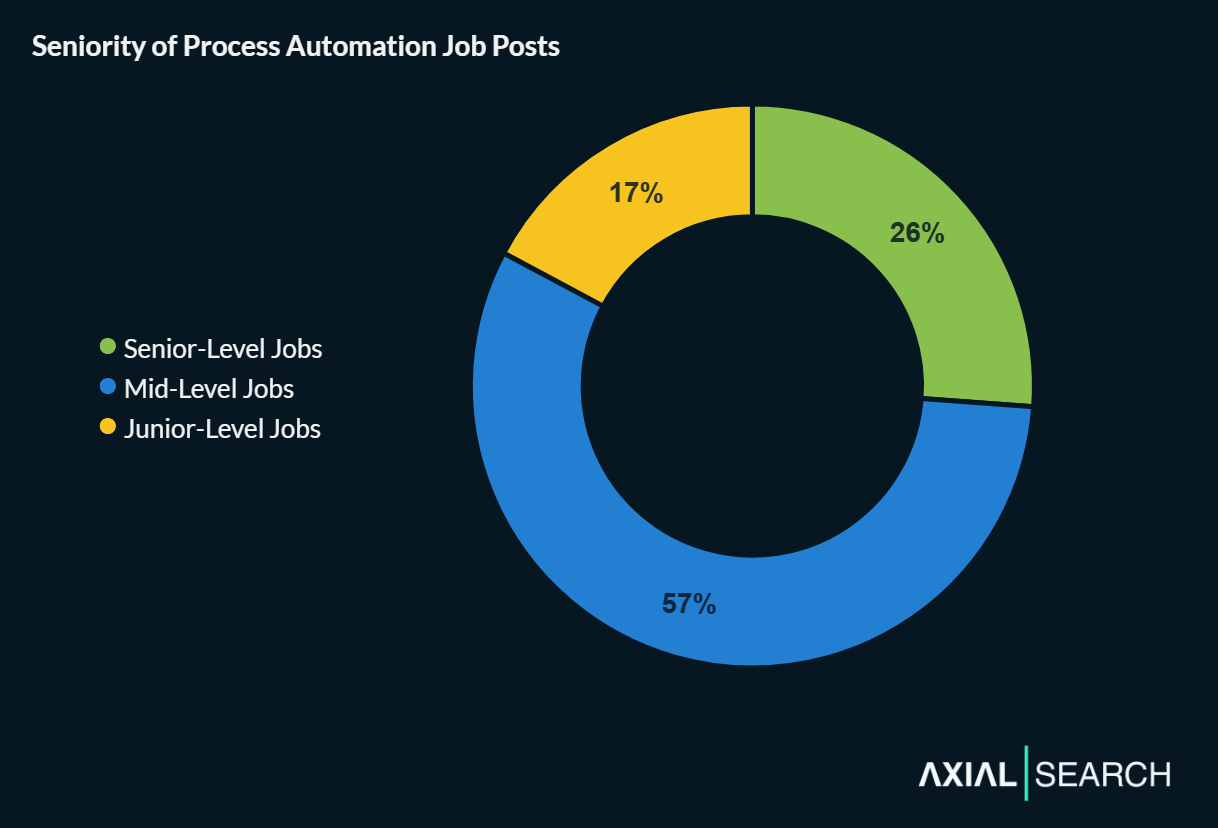
Most process automation jobs are mid-level
What Do Process Automation Jobs Involve?
So what is a process automation professional actually responsible for day-to-day? We analyzed the language across all job posts to extract the core responsibilities at each level. What emerged is a clear progression of expectations from implementation to strategic vision:
Junior-Level Roles:
- Deploy RPA solutions using UiPath, Blue Prism or Automation Anywhere
- Design computer-based automation systems for process control and quality
- Analyze workflows and collaborate with stakeholders to identify automation opportunities
Mid-Level Roles:
- Lead cross-functional automation initiatives bridging business requirements with technical execution
- Architect enterprise automation solutions integrating RPA, AI and APIs
- Manage automation programs using Lean Six Sigma to drive efficiency
Senior-Level Roles:
- Define enterprise automation strategy spanning manufacturing and digital operations
- Lead engineering functions with P&L accountability for automation investments
- Drive transformation through automation centers integrating AI and intelligent systems
Key takeaway: Junior professionals deploy automation tools, mid-level leaders architect enterprise solutions, senior executives define organizational strategy. Each step up means more influence over how automation transforms operations.
Who’s Hiring for Process Automation?
Manufacturing leads with 20% of process automation postings – this tracks with the discipline’s roots in industrial operations. Technology follows at 15%, with IT Services rounding out the top three at 13%. Professional Services captures 11%, with Financial Services at 10% completing the top five.
The manufacturing concentration makes sense given automation’s historical focus on production efficiency, though the strong showing from technology and IT services reflects how RPA has evolved beyond factory floors into knowledge work.
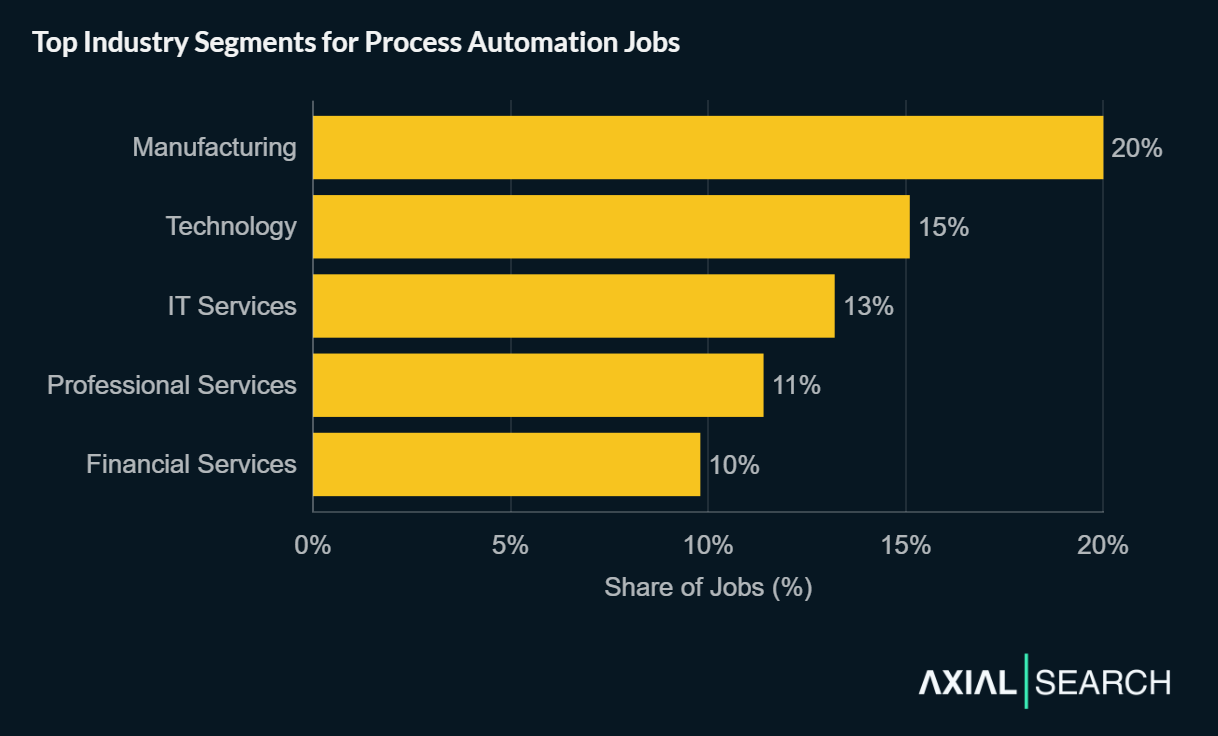
Manufacturing leads process automation hiring
Large companies with 10,001+ employees account for 32% of postings – which closely tracks the broader workforce distribution across the U.S. economy. What’s striking is the startup presence – 17% of roles come from companies with fewer than 51 employees, likely representing RPA consultancies and automation service providers.
Organizations with 501-1,000 employees add another 13%, while mid-sized companies (201-500 employees) capture 11% of the market. This distribution suggests process automation serves both mature enterprises optimizing scale operations and smaller firms building specialized automation capabilities.
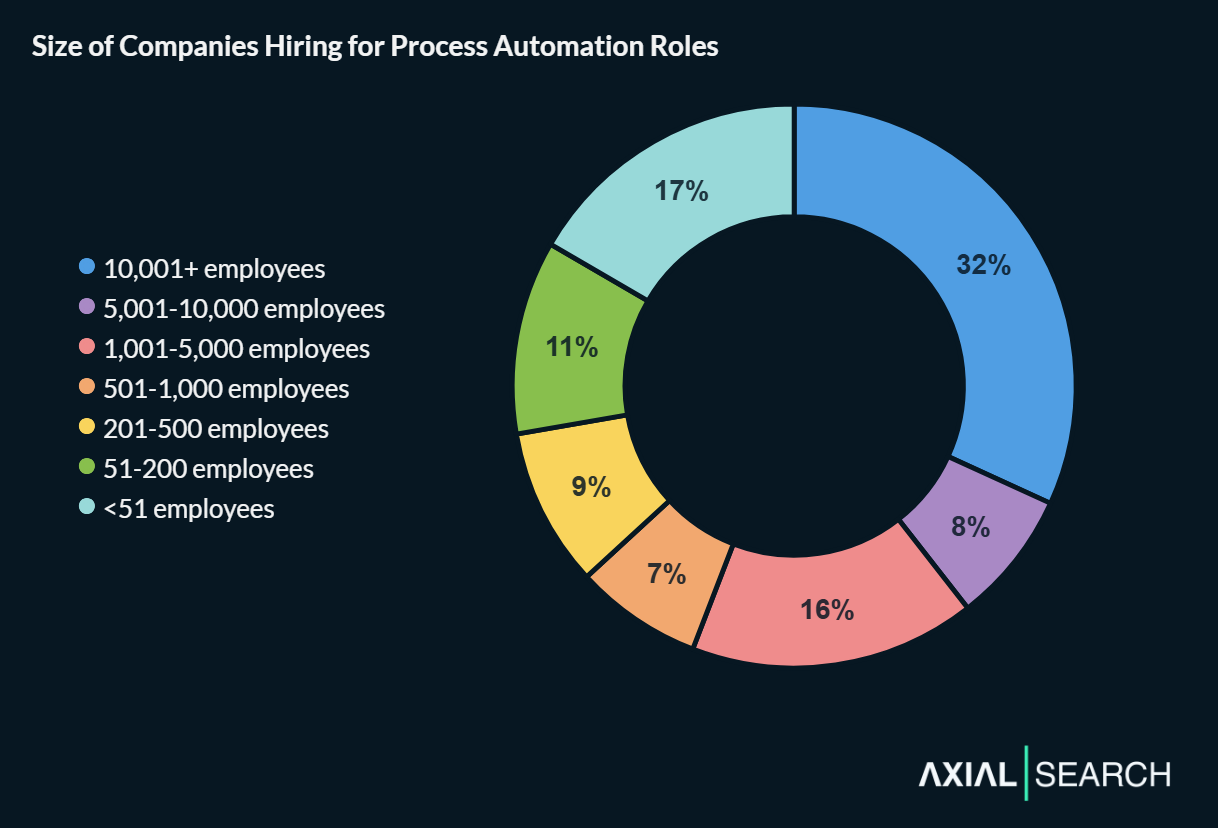
Large enterprises and startups drive demand
Where Are Process Automation Jobs Located?
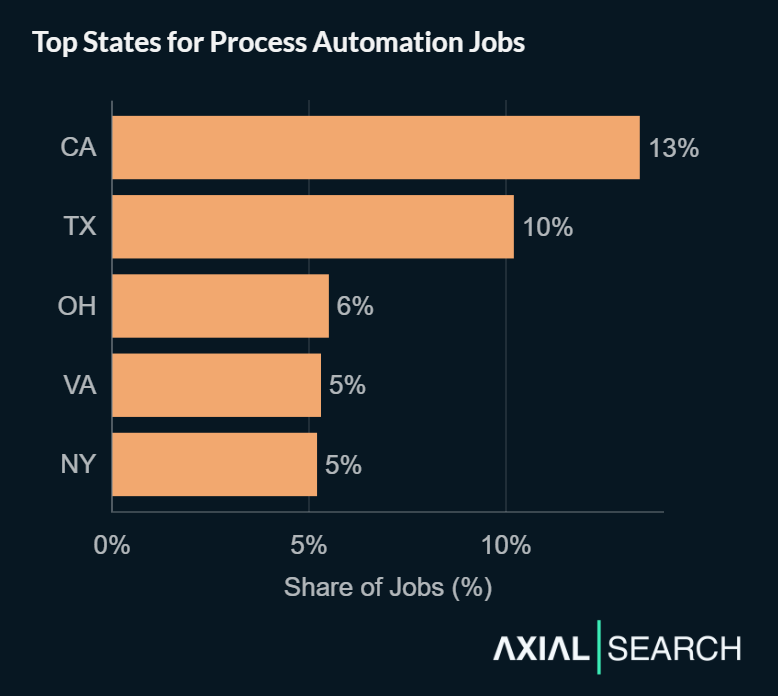
California and Texas lead the market
California captures 13% of all process automation postings. Texas follows at 10%, Ohio at 6%, Virginia at 5%, and New York rounds out the top five at 5%.
The concentration in major tech and manufacturing hubs reflects where both industrial operations and RPA service providers cluster. Remote roles account for just 11.5% of postings despite the technical nature of the work, suggesting most organizations prefer automation professionals on-site where they can access physical systems and collaborate directly with operations teams.
States worth watching include Illinois, Pennsylvania, North Carolina, Florida and Georgia – each capturing roughly 3-4% of the market and representing growing manufacturing regions with maturing automation capabilities.
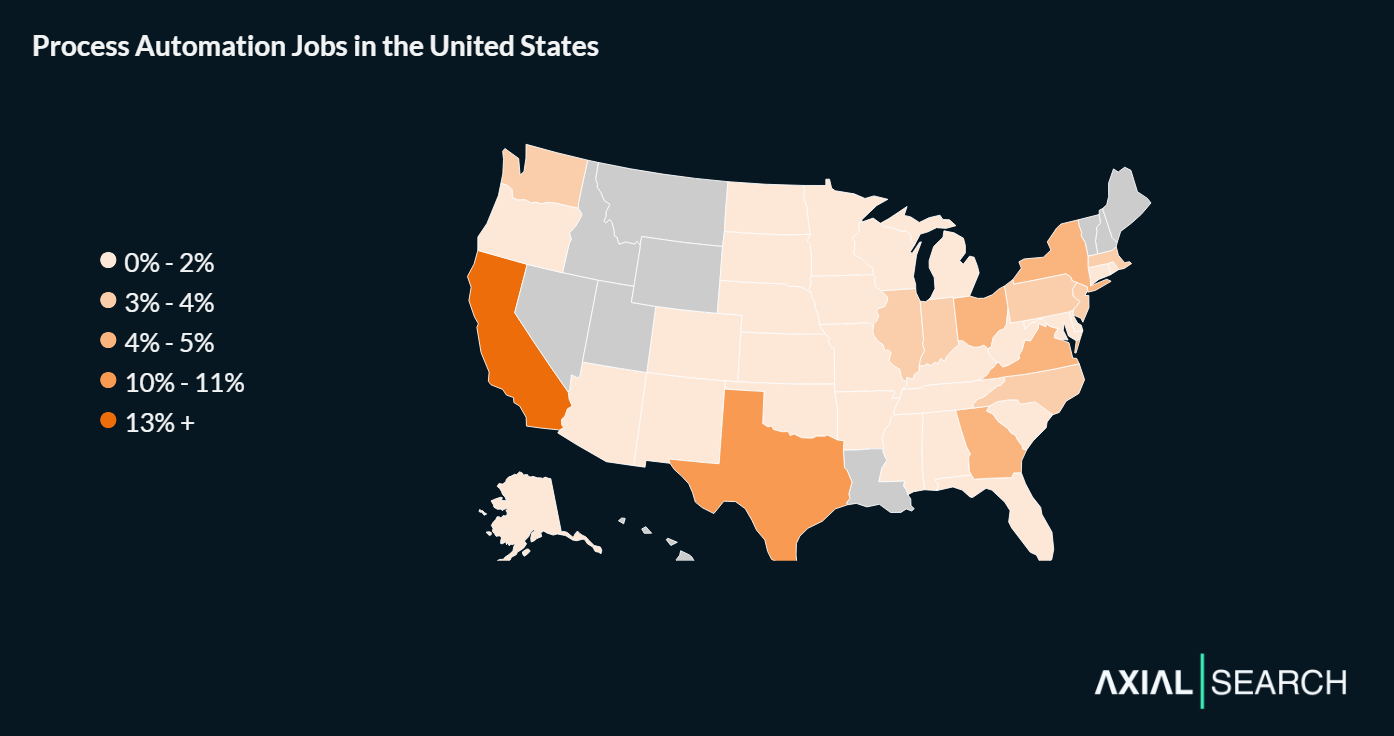
Process automation jobs cluster in industrial hubs
Key takeaway: California, Texas and Ohio together account for roughly one-third of all process automation opportunities. The limited remote work (11.5%) reflects how automation roles remain tied to physical operations and on-site system access despite increasing digitalization.
Requirements for Process Automation Jobs
We analyzed the minimum requirements of each job post and found that most process automation jobs (69%) require some form of degree. The pattern tightens considerably as you move up the career ladder.
For junior roles, 68% require a degree (all bachelor’s level). The remaining 32% don’t specify formal education requirements.
Mid-level positions tighten up: 61% require a bachelor’s degree, 3% specify a master’s, and 1% ask for a PhD.
Senior roles have the strictest requirements: 79% require a bachelor’s degree, 3% require a master’s, and 1% require a PhD.
Degree fields of study shift significantly by seniority level:
Junior roles:
- Computer Science (41%)
- Electrical Engineering (18%)
- Information Technology (10%)
- Engineering (9%)
- Information Systems (9%)
Mid-level roles:
- Computer Science (25%)
- Engineering (17%)
- Electrical Engineering (11%)
- Information Systems (10%)
- Business (6%)
Senior roles:
- Engineering (36%)
- Mechanical Engineering (14%)
- Computer Science (13%)
- Business (12%)
- Information Technology (9%)
The shift from pure technical degrees at junior levels toward engineering and business credentials at senior tiers reflects how automation leadership increasingly demands operational expertise alongside technical skills.
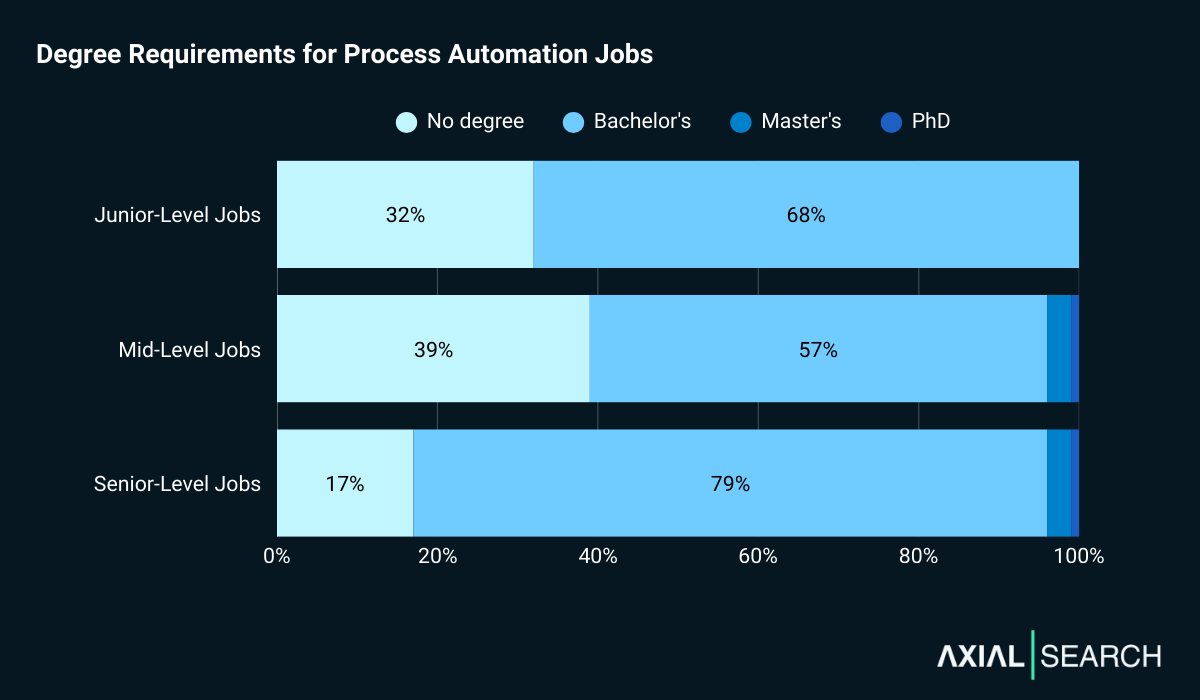
Degree requirements increase with seniority
Requested Qualifications in Process Automation Job Posts
Process automation professionals must excel at communication, problem-solving and team leadership. Communication and problem-solving each appeared in 26% of listings, with team leadership following at 23% – reflecting the role’s dual nature as both technical implementer and organizational change agent.
Project management (20%), troubleshooting (17%) and cross-functional collaboration (16%) round out the core capabilities, emphasizing the need to coordinate multiple stakeholders while maintaining operational systems.
Deep technical expertise matters equally. RPA development, API integration and workflow automation are table stakes, supported by hands-on experience with platforms like UiPath, Blue Prism and Automation Anywhere. Knowledge of frameworks including Agile, Lean Six Sigma and REFramework enables effective project delivery.
Nearly one-third of postings (32%) request specific certifications, with these credentials leading:
- Project Management Professional (PMP)
- UiPath Certified Automation Developer Professional
- Blue Prism Certified Developer (AD01)
- Microsoft Certified Power Automate RPA Developer
- Lean Six Sigma Black Belt
- Automation Anywhere Certification
- Professional Engineer (PE)
- Certified Public Accountant (CPA)
Key takeaway: Technical depth in RPA platforms is table stakes, but change management skills like communication and cross-functional collaboration separate strong candidates from purely technical ones. Platform certifications validate execution capabilities while PMP and Lean Six Sigma address the process improvement and organizational change dimensions.
What do Process Automation Jobs Pay?
Just under half (48%) of the process automation roles we analyzed included an advertised salary.
There was significant breadth in the ranges employers posted, so we normalized the data by selecting the midpoint for our analysis. From our experience, this is generally a much more indicative number for an employer’s target offer – especially in the current market where initial ranges often run wide.
Across the entire dataset of salaries, we found the median salary for process automation positions to be $150,000. The middle 80% of salaries (10th to 90th percentile) ranged from $88,400 to $214,890.
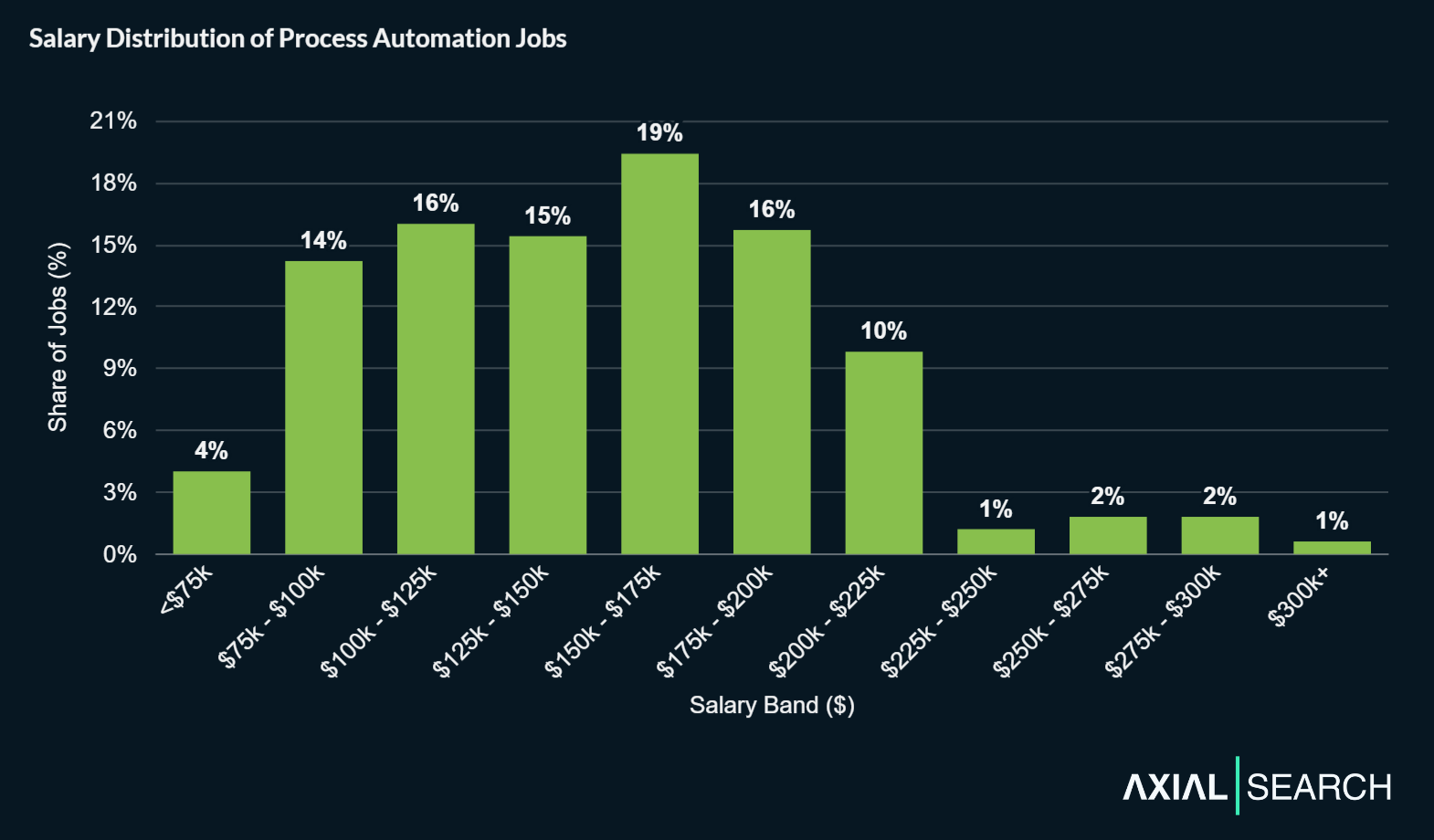
Most salaries fall between $88K and $215K
Breaking process automation salaries down by seniority reveals clear progression. Junior roles start at a median $106,750, with mid-level positions climbing 24% to $132,500. The leap to senior adds another 47% – reaching $195,000 median.
What’s notable is the overlap between junior and mid-level ranges. Junior roles at the 90th percentile ($172,500) exceed mid-level roles at the median ($132,500) by $40,000, suggesting specialized RPA expertise can command premium compensation even at early career stages.
Senior roles show the widest spread – $146,150 to $255,440 – indicating significant variation based on industry sector, P&L responsibility and organizational scope. Manufacturing automation directors likely earn differently than marketing automation VPs despite similar seniority levels.
The ranges tighten considerably between 25th and 75th percentiles across all levels, suggesting market consensus around core compensation bands while outliers at both ends reflect specialized expertise or geographic premiums.
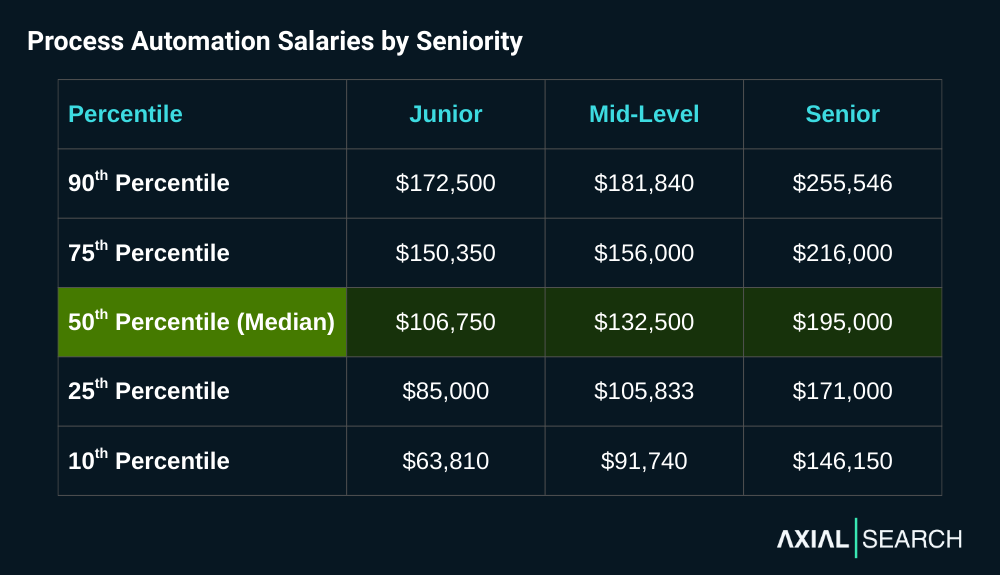
Senior automation professionals earn median salaries of $195K
Key takeaway: Process automation positions pay exceptionally well. The median senior-level salary of $195,000 puts these roles in the top 7% of all earners in the United States. Even mid-level professionals earning the median $132,500 land in the top 14%.
Final Thoughts
For Candidates: Build hands-on experience with UiPath, Blue Prism or Automation Anywhere early – platform certifications appear in one-third of postings and accelerate credibility. For mid-level roles, demonstrating you’ve architected enterprise automation solutions integrating multiple systems separates candidates. At senior levels, experience defining automation strategy and managing P&L matters more than technical execution alone. PMP and Lean Six Sigma credentials bridge the gap between technical and business leadership.
For Employers: The tight salary clustering around $132,500 for mid-level roles reflects market maturity – fall significantly below that and expect longer time-to-fill. The strongest signal for senior candidates is experience with enterprise transformation and operational leadership, not just RPA implementation. Remote flexibility remains limited at 11.5%, reflecting how automation work still requires substantial on-site presence despite digital tools – though this may shift as cloud-based orchestration platforms mature.
Methodology
We analyzed 695 process automation job postings collected from LinkedIn, Indeed and Glassdoor between November 2024 and January 2025. The dataset was limited to full-time roles posted in the United States that explicitly mentioned “process automation,” “RPA,” “workflow automation” or close variations in the job title.
Duplicate postings were removed using job title, company name and location matching. Seniority levels were determined by analyzing job titles alongside minimum experience requirements stated in each posting. When experience ranges were provided, the lower bound was used for consistency.
Salary data was extracted from the 48% of postings that included compensation ranges. We used the midpoint of each range for analysis, as this most closely reflects employer target offers in practice.
Industry classifications were assigned based on company descriptions and verified against LinkedIn company data where available. Geographic analysis was conducted at the state level using the primary job location listed in each posting.
Tags:
Related Insights
Continuous Improvement Jobs in 2026: Analyzing 1,000+ Posts
Continuous improvement professionals redesign operational workflows to eliminate waste, reduce costs and boost efficiency. We analyzed 1,086 continuous improvement jobs...
Market Analysis: Insights from 928 Process Design Jobs
Process design professionals analyze and redesign workflows, eliminating waste and building systems that improve how organizations operate. We analyzed 928...
Process Engineering Jobs: Insights from 6,000+ Posts
Process engineers design and optimize workflows to improve efficiency, reduce waste and ensure product quality. We analyzed 6,210 process engineering...

What You Need to Know About Operational Excellence Jobs
Organizations face relentless pressure to do more with less while preserving quality and customer satisfaction. Yet, many struggle to turn...

A Comprehensive Breakdown of Process Improvement Jobs
Companies lose revenue through inefficient processes. Targets process improvement initiatives can tackle this waste head-on. Process mining exposes bottlenecks and...

Lean Six Sigma Jobs and How They Benefit Your Business
Poor quality drains revenue through rework, defects, delays and customer dissatisfaction. Lean Six Sigma professionals systematically eliminate variation, streamline processes...