
Continuous Improvement Jobs in 2026: Analyzing 1,000+ Posts
Continuous improvement professionals redesign operational workflows to eliminate waste, reduce costs and boost efficiency. We analyzed 1,086 continuous improvement jobs posted across the United States between November 2024 and January 2025. The findings reveal what skills organizations value, how roles progress by seniority, and what companies pay to attract this talent.
 January 27, 2026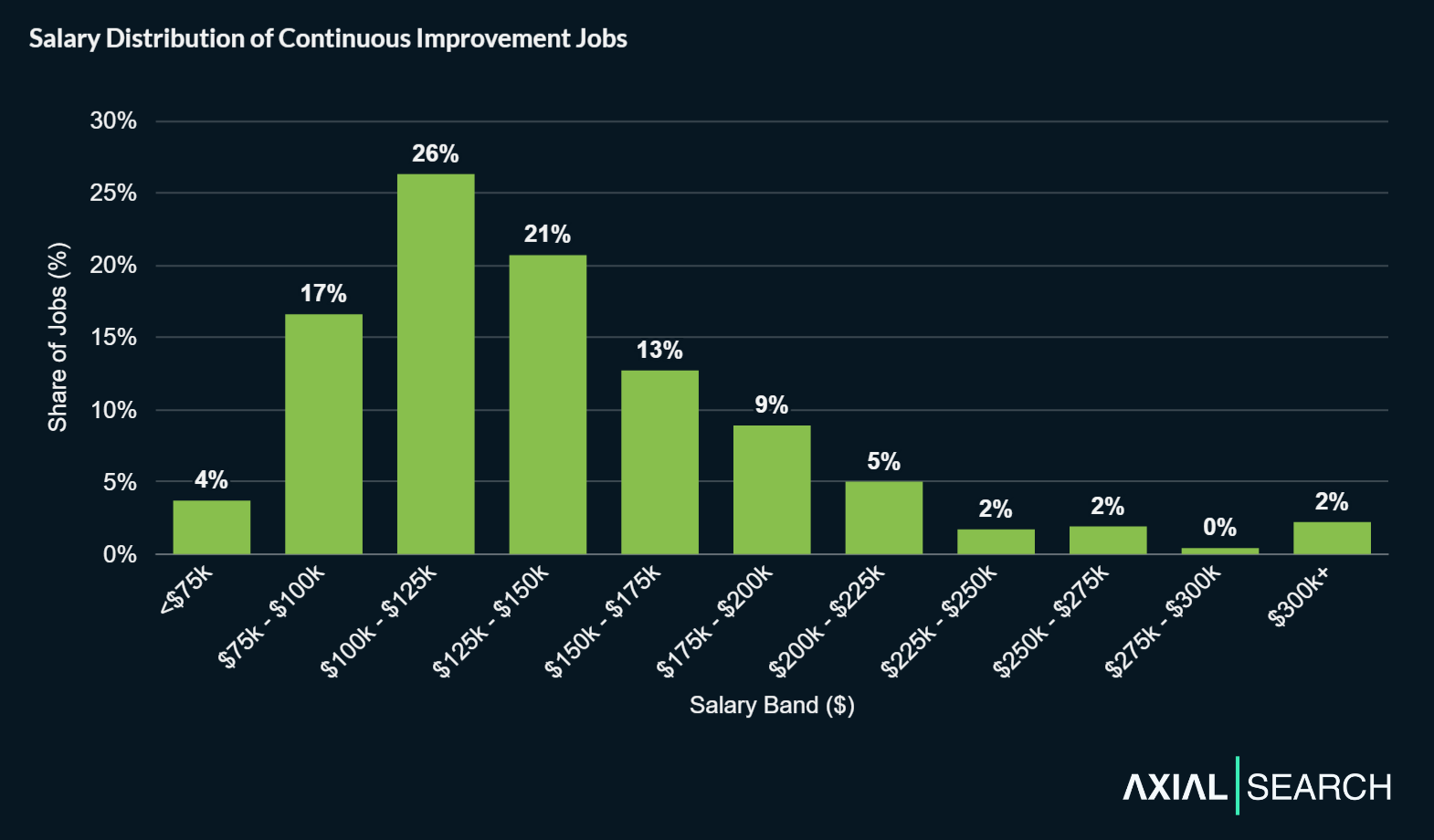
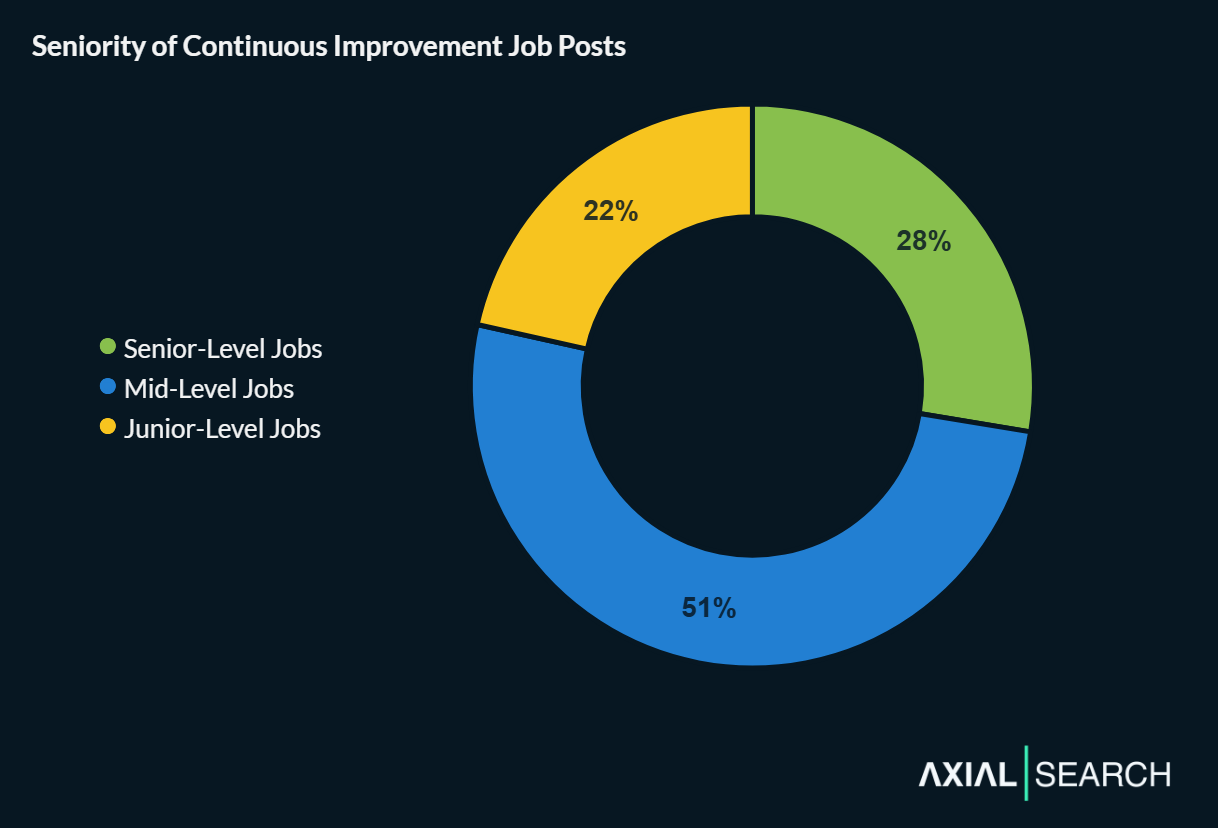
- Most roles are mid-level: 51% of continuous improvement positions target professionals with 5+ years of experience
- Median salary is $125,000: The middle 80% of roles pay between $83K and $208K annually
- Certifications appear in 51% of posts: Lean Six Sigma Black Belt, Green Belt and PMP lead requests
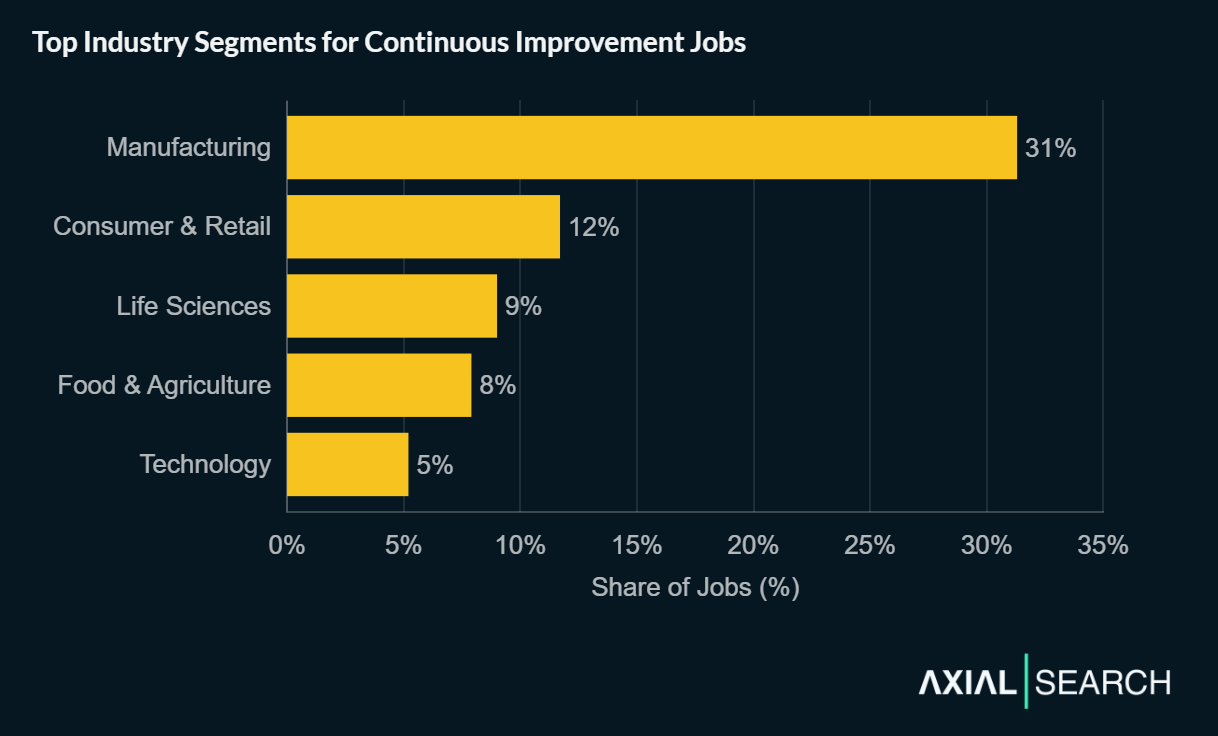
- Manufacturing firms dominate hiring: Manufacturing (31%), Professional Services (18%) and Consumer & Retail (12%) lead postings
- Texas leads the market: 15% of U.S. roles are posted in Texas, followed by California (13%) and North Carolina (10%)
- Technical degrees strongly preferred: Only 27% of junior roles skip degree requirements, dropping to 13% at senior levels
The Role of a Continuous Improvement Professional
The market dynamics here reflect broader patterns we see across process optimization recruitment, where organizations invest in professionals who can drive measurable operational improvements.
We categorized each role by seniority and found the market leans toward mid-level professionals – they account for just over half of all postings.
We then extracted experience requirements (88% of roles mentioned a specific number) and calculated the average minimum at each level of seniority. Finally, we analyzed job titles to identify the most common naming conventions at each level.
- Junior (22% of roles)
- Minimum experience: 3 years
- Common titles: Continuous Improvement Specialist, Continuous Improvement Engineer, Operational Excellence Coordinator
- Mid-Level (51% of roles)
- Minimum experience: 5 years
- Common titles: Continuous Improvement Manager, Operational Excellence Manager, Continuous Improvement Leader
- Senior (28% of roles)
- Minimum experience: 9 years
- Common titles: Director of Operational Excellence, Director of Continuous Improvement, Sr. Manager Continuous Improvement
What Do Continuous Improvement Jobs Involve?
So what is a continuous improvement professional actually responsible for day-to-day? We analyzed the language across all job posts to extract the core responsibilities at each level. What emerged is a clear progression of expectations from execution to strategic vision:
Junior-Level Roles:
- Execute improvement projects using Lean and Six Sigma tools
- Analyze operational data to identify inefficiencies and support implementation
- Coach frontline employees on improvement methodologies and standards
Mid-Level Roles:
- Build organizational capability through structured training across facilities
- Lead cross-functional transformation initiatives with rigorous ROI analysis
- Standardize processes and establish governance frameworks
Senior-Level Roles:
- Architect enterprise operating systems and multi-year transformation strategies
- Provide executive coaching while driving organizational change globally
- Design scalable infrastructure for automation and digital transformation
Key takeaway: Junior professionals execute projects, mid-level leaders build organizational capability, senior executives architect enterprise transformation. Each step up means more strategic influence over how operations evolve.
Who’s Hiring for Continuous Improvement?
As with our analysis of process engineering jobs, manufacturing takes the lead with 31% of continuous improvement postings – no surprise given the discipline’s roots in production optimization. Consumer & Retail follows at 12%, with Life Sciences rounding out the top three at 9%. Food & Agriculture captures 8%, and Technology at 5% completes the top five.
The manufacturing concentration makes sense – physical operations create the greatest demand for process optimization, where gemba walks, kaizen events and shop floor improvements generate immediate value.
Large companies with 10,001+ employees account for 29% of postings – which closely tracks the broader workforce distribution1 across the U.S. economy. Organizations with 51-200 employees add another 22%, meaning small and mid-sized manufacturers create substantial demand.
This distribution suggests continuous improvement serves two distinct use cases: mature enterprises sustaining formal operating systems versus growth-stage companies building process capability from scratch.
[continuous-improvement-hiring-company-size.png]
Where Are Continuous Improvement Jobs Located?
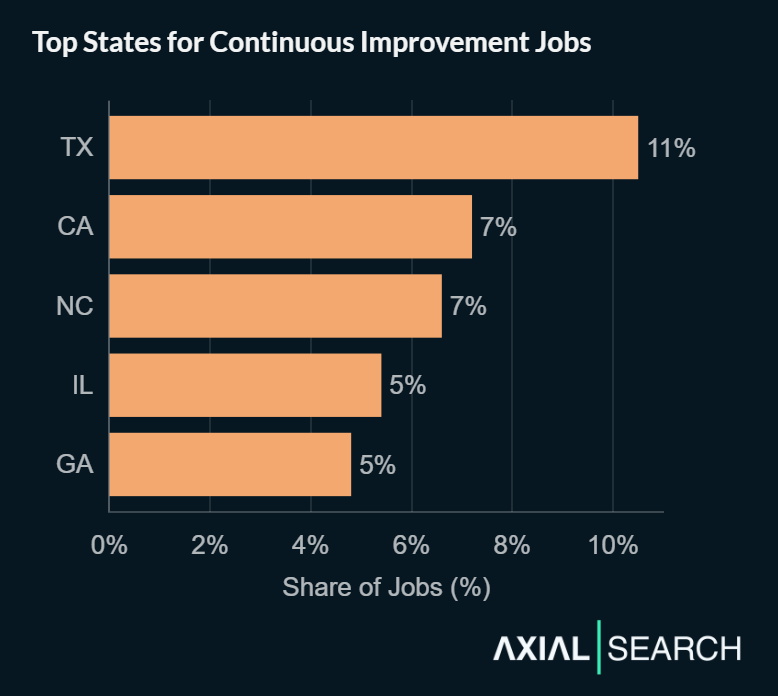
Texas leads the market with 15% of all continuous improvement postings. California follows at 13%, North Carolina at 10%, Illinois at 8%, and Georgia rounds out the top five at 6%.
The concentration in manufacturing hubs reflects where physical operations cluster. Remote roles account for just 11% of postings despite increasingly digital tools – the hands-on nature of shop floor improvements requires physical presence for effective implementation.
States worth watching include Ohio, Indiana, Pennsylvania and Michigan – each capturing roughly 3-5% of the market and representing established manufacturing regions with ongoing transformation needs.
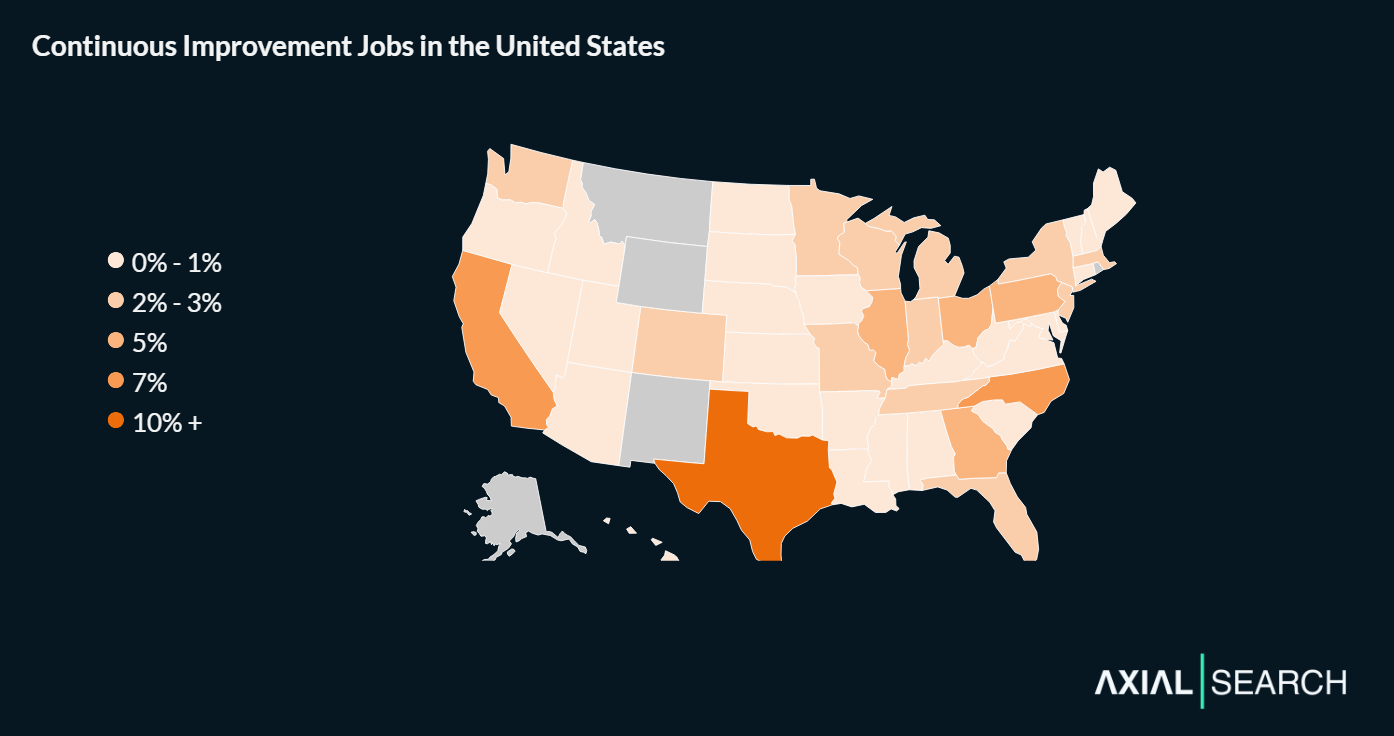
Key takeaway: Texas offers the most continuous improvement opportunities by volume, but California and North Carolina provide strong alternatives. Expect on-site requirements for most roles given the shop floor focus of this work.
Requirements for Continuous Improvement Jobs
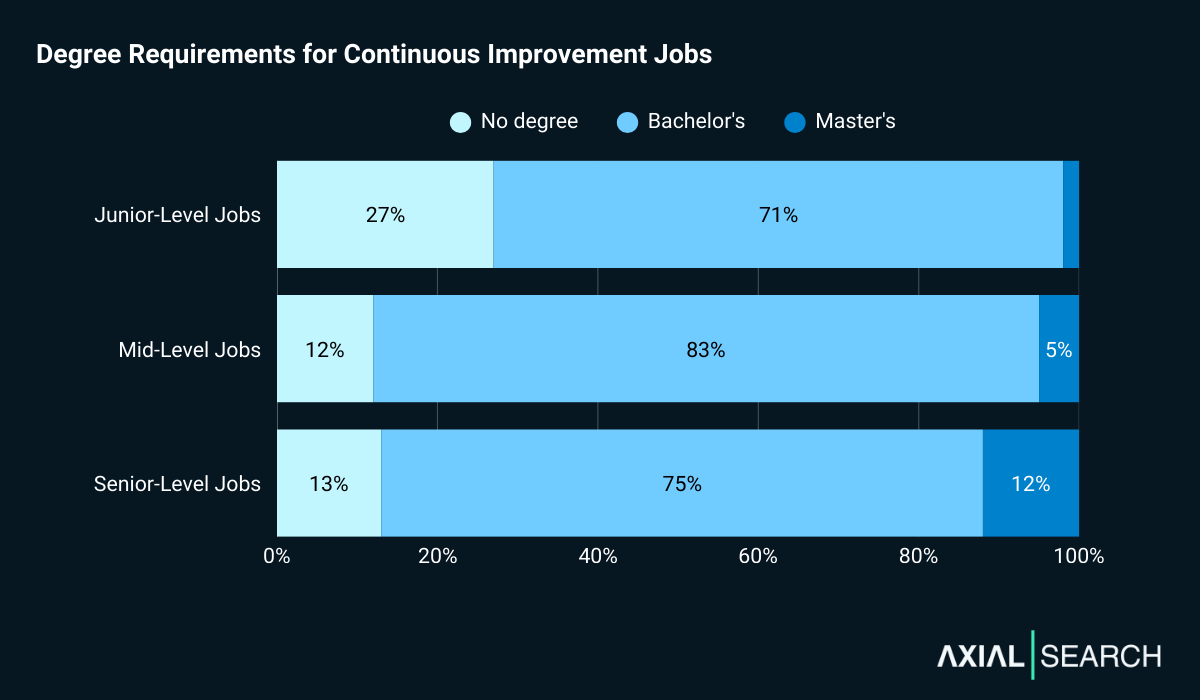
We analyzed the minimum requirements of each job post and found that most continuous improvement jobs (82%) require some form of degree. The pattern tightens considerably as you move up the career ladder.
For junior roles, 73% require a degree (71% bachelor’s, 2% master’s). The remaining 27% don’t specify formal education requirements.
Mid-level positions show stricter requirements: 88% require a degree (83% bachelor’s, 5% master’s).
Senior roles have the tightest requirements: 87% require a degree (75% bachelor’s, 12% master’s).
Degree fields of study that are typically requested of continuous improvement professionals include:
- Engineering (42%)
- Business (27%)
- Industrial Engineering (16%)
- Operations Management (9%)
- Supply Chain (9%)
- Business Administration (8%)
- Mechanical Engineering (7%)
- Manufacturing Engineering (4%)
- Operations (4%)
- Science (3%)
Requested Qualifications in Continuous Improvement Job Posts
Continuous improvement professionals must excel at communication, data analysis and process improvement. Communication appeared in 57% of listings, data analysis in 43%, and process improvement in 42% – reflecting the role’s dual nature as both technical problem-solver and organizational change agent.
Change management (40%), problem-solving (34%) and project management (33%) round out the core capabilities, emphasizing the need to drive adoption across resistant cultures while managing structured initiatives.
Deep methodological expertise matters equally. Lean, Six Sigma and Kaizen are table stakes, supported by hands-on experience with frameworks like DMAIC, Value Stream Mapping and 5S.
Just over half of postings (51%) request specific certifications, with these credentials leading:
- Lean Six Sigma Black Belt
- Lean Six Sigma Green Belt
- Six Sigma Black Belt
- Lean Six Sigma Master Black Belt
- Project Management Professional (PMP)
- PROSCI Change Management
- Certified Associate Project Manager (CAPM)
- Lean Six Sigma Yellow Belt
Key takeaway: Methodological credentials matter – Lean Six Sigma certifications validate technical expertise while PROSCI and PMP address the AI recruitment and governance skills needed to drive adoption. Communication capabilities separate strong candidates from purely technical ones.
What do Continuous Improvement Jobs Pay?
Just over half (51%) of the continuous improvement roles we analyzed included an advertised salary.
There was significant breadth in the ranges employers posted, so we normalized the data by selecting the midpoint for our analysis. From our experience, this is generally a much more indicative number for an employer’s target offer – especially in the current market where initial ranges often run wide.
Across the entire dataset of salaries, we found the median salary for continuous improvement positions to be $125,000. The middle 80% of salaries (10th to 90th percentile) ranged from $82,500 to $208,000.
Breaking continuous improvement salaries down by seniority reveals substantial progression. Junior roles start at a median $104,000, with mid-level positions climbing 16% to $120,250. The real premium appears at senior levels – a 50% jump to $180,450 median.
What’s notable is the range widening: junior salaries vary by $61,000 from bottom to top, mid-level by $70,000, but senior roles spread across a $130,000 band despite commanding higher absolute numbers. This wide senior range reflects significant variation based on industry, company size and transformation scope.
The overlap between mid-level and senior tiers is considerable – mid-level roles at the 90th percentile ($153,541) closely track with senior roles at the 25th percentile ($158,838). This suggests high-performing mid-level practitioners in large organizations can out-earn junior directors at smaller firms.
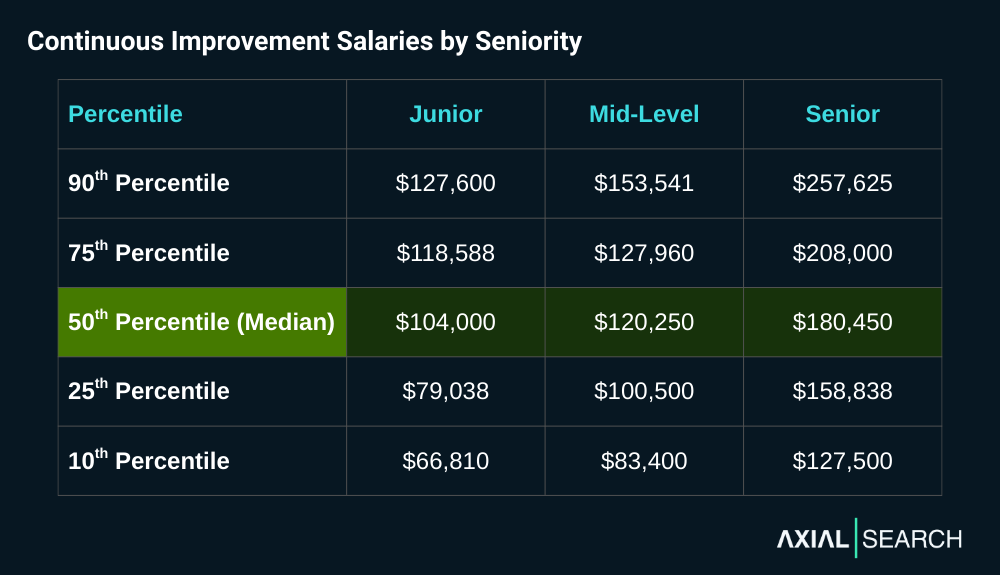
Key takeaway: Continuous improvement positions pay exceptionally well. The median senior-level salary of $180,000 puts these roles in the top 8% of all earners2 in the United States. Even mid-level professionals earning the median $120,250 land in the top 17%.
Final Thoughts
For Candidates: Pursue Lean Six Sigma certifications early – Black Belt or Green Belt credentials appear in half of postings. Build hands-on experience with shop floor improvements and gemba walks, as most roles require physical presence. For mid-level roles, demonstrating you’ve built organizational capability across facilities separates candidates. At senior levels, experience architecting enterprise operating systems and driving multi-year transformations matters more than technical methodology expertise alone.
For Employers: The salary clustering around $120,250 for mid-level roles reflects market maturity – fall significantly below that and expect longer time-to-fill. The strongest signal for senior candidates is experience with enterprise transformation and executive coaching, not just project execution. Remote flexibility remains limited given the shop floor nature of this work, though digital tools increasingly enable hybrid arrangements for planning and training activities.
Methodology
We analyzed 1,086 continuous improvement job postings collected from LinkedIn, Indeed and Glassdoor between November 2024 and January 2025. The dataset was limited to full-time roles posted in the United States that explicitly mentioned “continuous improvement,” “operational excellence” or close variations in the job title.
Duplicate postings were removed using job title, company name and location matching. Seniority levels were determined by analyzing job titles alongside minimum experience requirements stated in each posting. When experience ranges were provided, the lower bound was used for consistency.
Salary data was extracted from the 51% of postings that included compensation ranges. We used the midpoint of each range for analysis, as this most closely reflects employer target offers in practice.
Industry classifications were assigned based on company descriptions and verified against LinkedIn company data where available. Geographic analysis was conducted at the state level using the primary job location listed in each posting.

Inside the AI Engineering Job Market: 43,500 Postings Analyzed
The complete picture of the AI engineering job market in 2026: hiring demand, what these roles pay, where the jobs are, who's hiring and what it takes to get in.

AI Architecture Salaries: 16,900 Postings, Benchmarked
What AI architecture roles pay in 2026: median salary, pay by seniority, top-paying sectors and locations, and how often bonus and equity are mentioned in US job postings.

How Hot Is the AI Operations Job Market in 2026?
The complete picture of the AI operations job market in 2026: hiring demand, what these roles pay, where the jobs are, who's hiring and what it takes to get in.
Turn AI ambition into lasting business value
Whether you're hiring your first AI leader or scaling enterprise transformation capability, we help you define, assess and recruit the people who make it stick.