
The 95% AI Transformation Problem
We’ve all encountered leaders who ask “what are we doing about AI?” expecting people to get busy making it happen.
So, pilots launch in every department. AI training is rolled out to teams. People do get busy.
And the outcome? MIT research found that 95% of enterprise AI implementations fail to deliver meaningful results.
The problem isn’t the technology. It’s not regulation, model quality, or lack of AI talent.
According to MIT’s analysis, companies fail because they’re optimizing everything except the actual constraint: their organization’s capacity to integrate AI into existing workflows.
Executives pour budgets into sales and marketing tools while the highest ROI sits in back-office automation—unglamorous work that actually removes bottlenecks instead of adding more pilots to the traffic jam.
Theory of Constraints cuts through this noise with brutal clarity: your AI transformation has one limiting factor at any given time. Everything else is distraction.
Understanding Theory of Constraints

Goldratt created TOC after observing bottlenecks in his software implementations for manufacturers
Theory of Constraints, developed by Eliyahu Goldratt, is built on one principle: every system has exactly one constraint limiting performance at any given time.
That’s not to say the rest of the system is optimal—it rarely is. It’s that right here, right now, those other issues are irrelevant.
Think about it: you could have outdated data infrastructure, insufficient AI training, weak executive buy-in, and siloed departments all at once. All real problems. But only one of them is the actual bottleneck preventing progress today.
The genius of TOC is that it forces you to stop trying to fix everything and start focusing on the one thing that matters.
Goldratt illustrated this with a simple thought experiment: imagine a chain. You can strengthen nine links to industrial-grade steel, but if the tenth link is made of paper, the chain still breaks at exactly the same load. The paper link is your constraint. Everything else is theater.
In AI transformation, this plays out constantly. Companies invest millions in cutting-edge models while their constraint is managers who don’t have two hours a week to redesign workflows. They hire AI specialists while their constraint is an executive who won’t kill competing priorities. They run training programs while their constraint is teams who lack authority to implement AI recommendations.
The framework doesn’t tell you how to fix the constraint. It tells you to stop wasting energy on everything else until you do.
Finding Your AI Transformation Constraint
Here’s the reality: AI transformations will always have multiple problems. But if you dig into them honestly, most fall into three categories.
Constraint #1: Change Capacity
This is the most common one, and it’s the one executives hate to admit.
Your people are generating AI insights. The technology works. The pilots succeed. But nothing scales because nobody has the organizational bandwidth to act on it. This is fundamentally a change management challenge, not a technology problem:
- Managers too buried to redesign processes around AI outputs
- Employees who complete AI training and then revert to old workflows within a week
- Successful pilots that sit in PowerPoint decks instead of being implemented across teams.
If you’ve got working AI somewhere in your organization but it’s not spreading—this is you.
Constraint #2: Authority
People know what needs to happen. They just can’t get approval to do it.
This one’s insidious because it looks like alignment problems or communication issues, but the real constraint is someone with authority who won’t make a call:
- Decision-making bottlenecks at the executive level
- Competing priorities that prevent real focus
- Political resistance from departments that see AI as a threat to headcount or influence
If your teams are frustrated because they keep waiting for green lights that never come—this is you.
Constraint #3: Technical
The actual technology is broken or missing. If nothing works anywhere despite genuine effort—maybe this is you:
- Data quality so poor that AI genuinely can’t function
- Legacy systems that physically can’t integrate with modern tools
- Missing technical capabilities that no amount of organizational willpower can solve
But if you have any successful AI pilots anywhere in your organization, your constraint isn’t technical. The technology works somewhere, which means your limit is replicating that success. That’s organizational, not technical.

You are only as strong as your weakest link
The Five-Step Process for Breaking Constraints
Once you’ve identified the constraint on your AI transformation, Theory of Constraints gives you a precise sequence to break through it. Most organizations skip straight to throwing money at the problem. TOC demands more discipline than that.
Step 1: Identify the constraint
You’ve just done this. Don’t move forward until you’re confident. If you’re wrong about the constraint, everything that follows is wasted effort.
Step 2: Exploit the constraint
Get maximum output from the constraint using only existing resources.
This is the step everyone skips – but you need to squeeze every bit of performance from what you already have:
- If your constraint is manager bandwidth for workflow redesign, don’t hire more managers yet. Give existing managers protected time, clear frameworks, and concrete examples of what good looks like.
- If your constraint is executive decision-making, don’t add more stakeholders to meetings. Remove agenda items, kill competing priorities, and create forcing functions for faster decisions.
Step 3: Subordinate everything else
Align all other activities to support the constraint.
This is where it gets uncomfortable. You pause AI pilots in non-constraint areas. You tell stakeholders “no” even when they have budget. You focus resources exclusively on fixing the bottleneck.
High-performing teams hate this. They want to keep moving at full speed. But running non-constraint activities at 100% just creates work piling up at the bottleneck.
Step 4: Elevate the constraint
Only now do you invest in expanding capacity.
After you’ve optimized with existing resources and subordinated everything else, add headcount, budget, or tools specifically at the constraint.
Do it strategically, not reactively.
Step 5: Repeat
The constraint will shift. When it does, start over.
Where Leaders Go Wrong
- Skipping exploitation and jumping to elevation – Constraint identified? Hire consultants. Buy tools. Launch initiatives. But if you haven’t exploited the constraint with existing resources first, you’re just scaling inefficiency.
- Refusing to subordinate non-constraint activities – Running everything at full speed creates chaos. Subordination creates focus. Even high-performing teams need to pause when they’re not addressing the constraint.
- Treating symptoms instead of constraints – “People aren’t using AI tools” looks like a training problem. But if managers don’t have time to redesign workflows, more training just creates frustrated employees who know how to use tools they can’t actually implement.
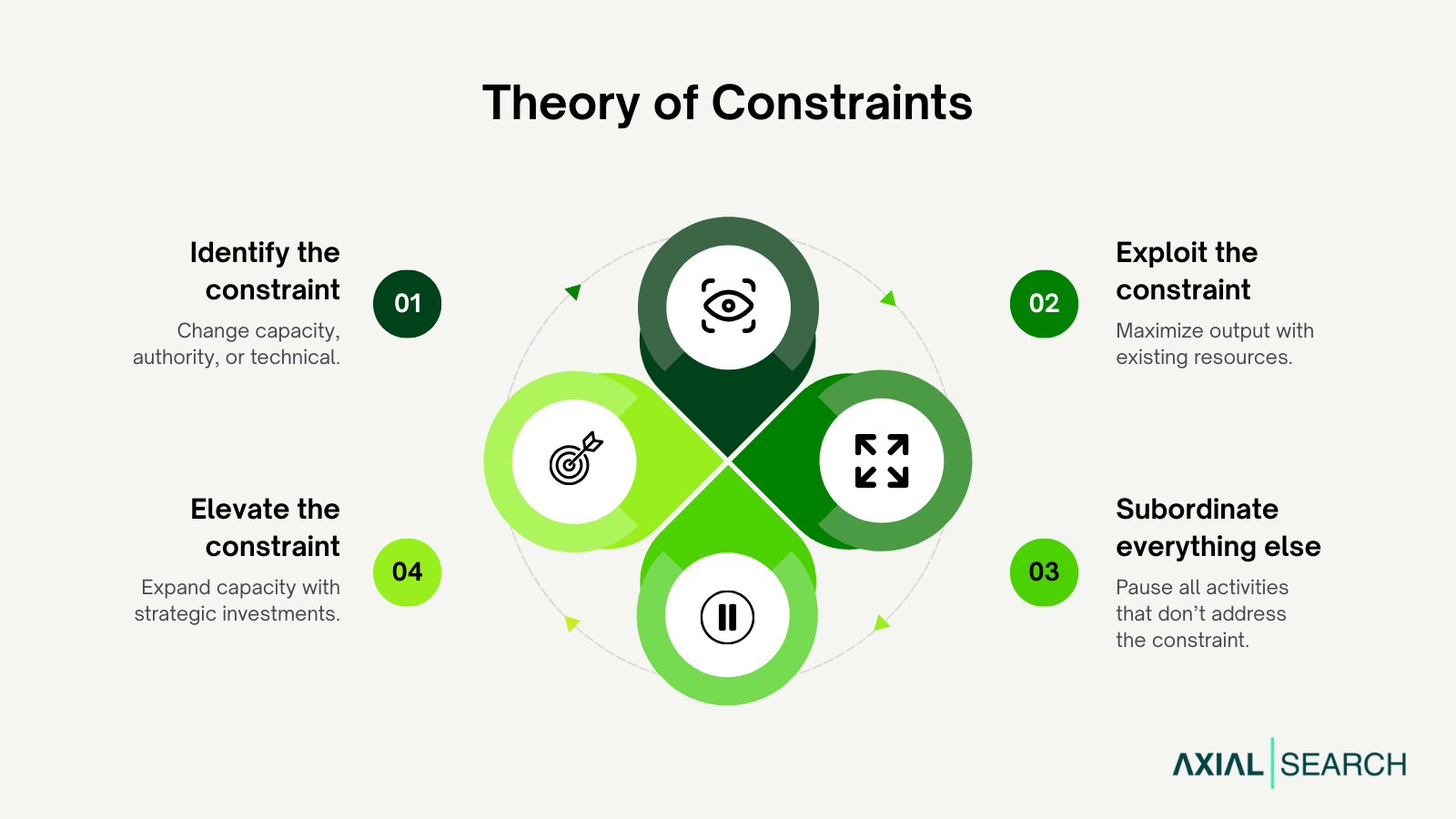
Identify, Exploit, Subordinate, Elevate, Repeat
Fix Your AI Transformation Bottleneck
You don’t need a six-month diagnostic or expensive consultants to get started. Here’s some tactical advice you can action today:
- Find your constraint:
- List every AI initiative currently running
- For each one, write what would need to happen for 10x impact
- The same obstacle will appear repeatedly—that’s your constraint
- Focus everything on it:
- Ask: are we actually addressing this, or working around it?
- Pause initiatives that don’t directly address the constraint
- Reallocate those resources to the bottleneck
- Measure progress:
- Track whether the constraint is actually moving
- When it’s fixed, find the next one
- Repeat
The fastest path to comprehensive AI adoption isn’t launching more pilots. It’s fixing one constraint at a time, deliberately and completely.
Theory of Constraints separates AI transformation leaders who deliver from those who manage perpetual pilots. Need help fixing your bottleneck? Contact Axial Search
Tags:
Related Insights
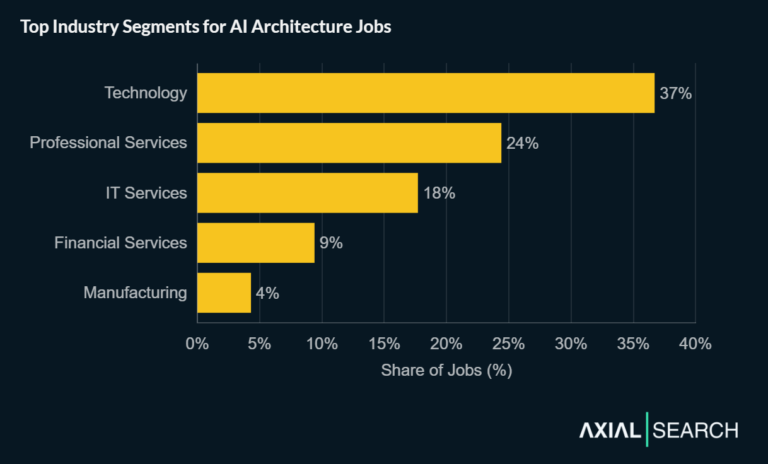
AI Architecture Jobs: 3,487 Postings Analyzed
AI architects design the technical foundation for enterprise AI systems - from cloud platforms to agentic workflows. We analyzed 3,487...
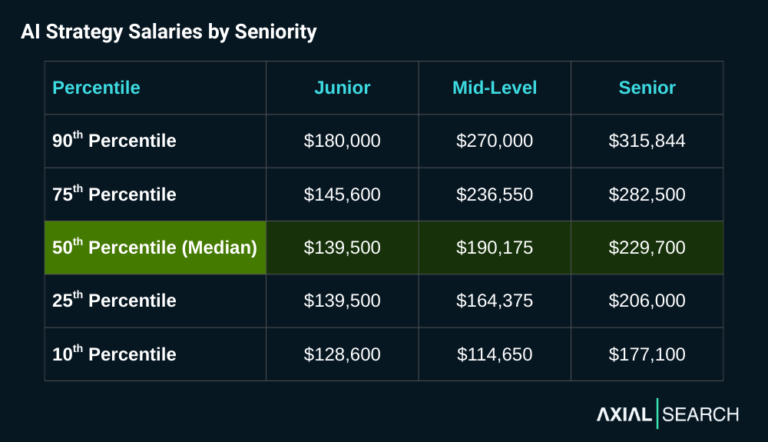
The AI Strategy Job Market in 2026: Analysis of 1,859 Postings
AI strategists build roadmaps for deploying AI across organizations, identifying high-value use cases and managing the teams that turn those...
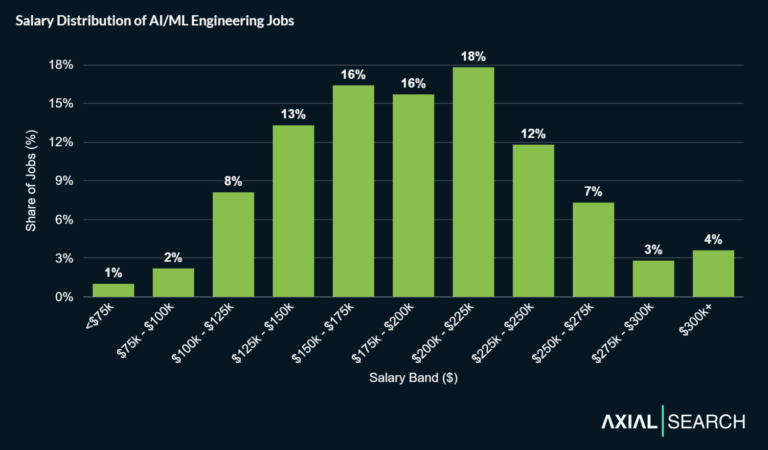
AI/ML Engineering Jobs in 2026: Analyzing 10,000+ Posts
AI/ML engineers build and deploy machine learning systems that power everything from recommendation engines to autonomous vehicles. We analyzed 10,133...
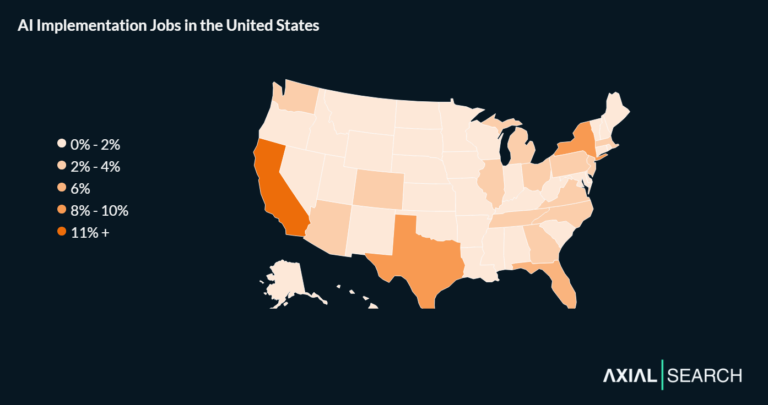
The AI Implementation Job Market: 3,159 Roles Analyzed
AI implementation professionals lead the technical deployment of AI systems across organizations, managing both platform integration and stakeholder adoption. We...
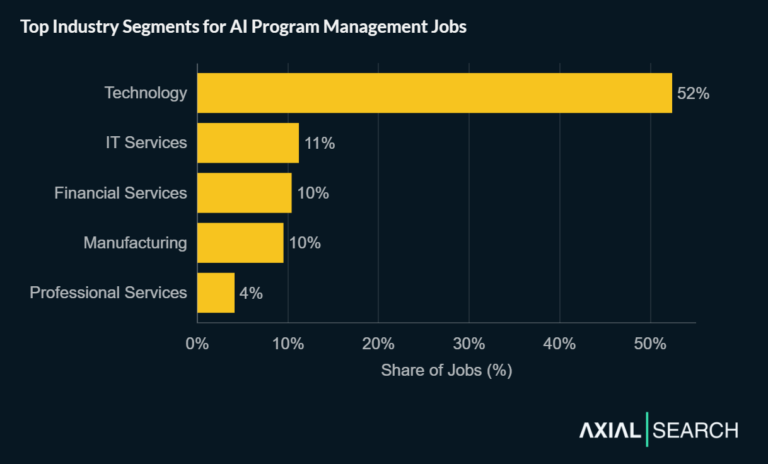
What 468 AI Program Management Jobs Tell Us
AI program managers lead cross-functional teams to deliver AI initiatives on time, on budget and at scale. We analyzed 468...
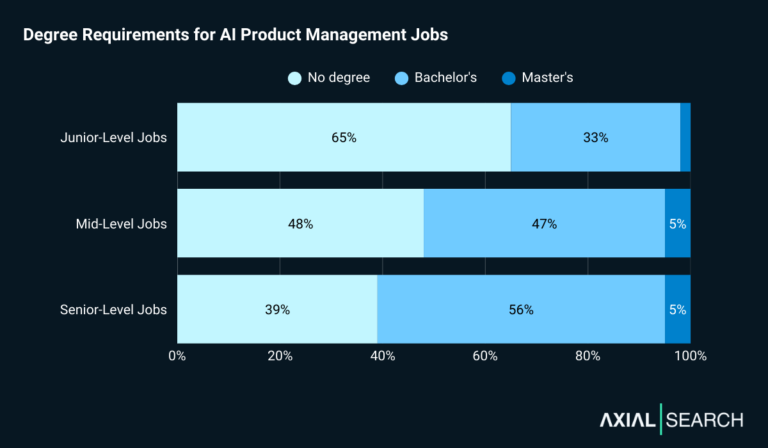
Market Insights from 592 AI Product Management Jobs
AI product managers own the roadmap, strategy, and execution for AI-powered products. We analyzed 592 AI product management jobs posted...