Key Findings
- Most roles are mid-level: 79% of AI program management positions target professionals with 7+ years of experience
- Median salary is $182,650: The middle 80% of roles pay between $133K and $271K annually
- Certifications appear in 20% of posts: PMP, SAFe and PgMP lead requests
- Technology firms dominate hiring: Technology (52%), IT Services (11%) and Financial Services (10%) lead postings
- California leads the market: 40% of U.S. roles are posted in California, followed by Washington (10%) and Texas (9%)
- Technical degrees increasingly required: Only 45% of junior roles skip degree requirements, dropping to 21% at senior levels
The Role of an AI Program Management Professional
These patterns align with what we see across AI recruitment, where organizations balance technical delivery with strategic transformation.
We categorized each role by seniority and found the market heavily favors mid-level professionals – they account for nearly four-fifths of all postings.
We then extracted experience requirements (90% of roles mentioned a specific number) and calculated the average minimum at each level of seniority. Finally, we analyzed job titles to identify the most common naming conventions at each level.
- Junior (3% of roles)
- Minimum experience: 3 years
- Common titles: AI Program Manager, Technical Program Manager AI, AI Security Strategy & Operations Program Manager
- Mid-Level (79% of roles)
- Minimum experience: 7 years
- Common titles: AI Infrastructure Technical Program Manager Operations Coordination, AI Regulatory Program Manager, Technical Program Manager Ranking AI
- Senior (18% of roles)
- Minimum experience: 10 years
- Common titles: Sr. Director Technical Program Management AI/ML, Director AI Program Manager, Sr. Staff Program Manager AI Strategy & Governance Lead
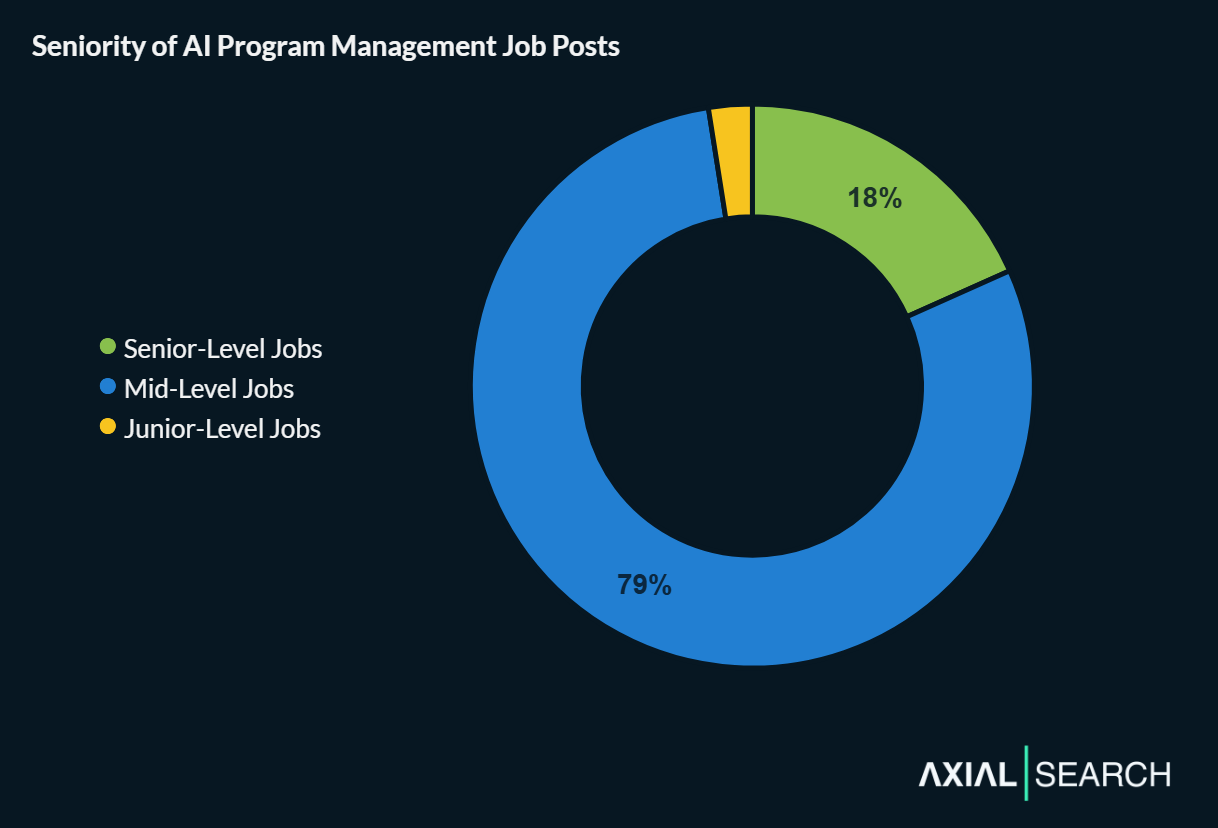
Most AI program management jobs are mid-level
What Do AI Program Management Jobs Involve?
So what is an AI program manager actually responsible for day-to-day? We analyzed the language across all 468 job posts to extract the core responsibilities at each level. What emerged is a clear progression of expectations from execution to vision:
Junior-Level Roles:
- Coordinate AI tool adoption within practice groups
- Manage release workflows for autonomy features
- Support cross-functional collaboration through OKR tracking and community engagement
Mid-Level Roles:
- Own end-to-end delivery from discovery through deployment
- Drive enterprise AI adoption through automation systems and governance frameworks
- Lead complex multi-disciplinary initiatives with full accountability for scope and timeline
Senior-Level Roles:
- Build and scale Technical Program Management organizations for enterprise AI platforms
- Define long-term AI strategy aligned with business transformation goals
- Advance responsible AI practices through governance frameworks and safety boards
Key takeaway: Junior program managers coordinate execution, mid-level leaders own delivery end-to-end, senior executives build organizational capabilities. Each step up means more strategic influence over how AI operates at scale.
Who’s Hiring for AI Program Management?
Technology companies lead with 52% of AI program management postings – more than half the market. This concentration makes sense given the discipline’s technical roots and the rapid AI adoption within tech firms building internal platforms and customer-facing systems.
IT Services follows at 11%, with Financial Services rounding out the top three at 10%. Manufacturing captures another 10%, with Professional Services at 4% completing the top five.
The technology sector’s dominance reflects the fact that AI program managers need both strategic program thinking and deep technical fluency – capabilities that tech companies value and can effectively deploy at scale.
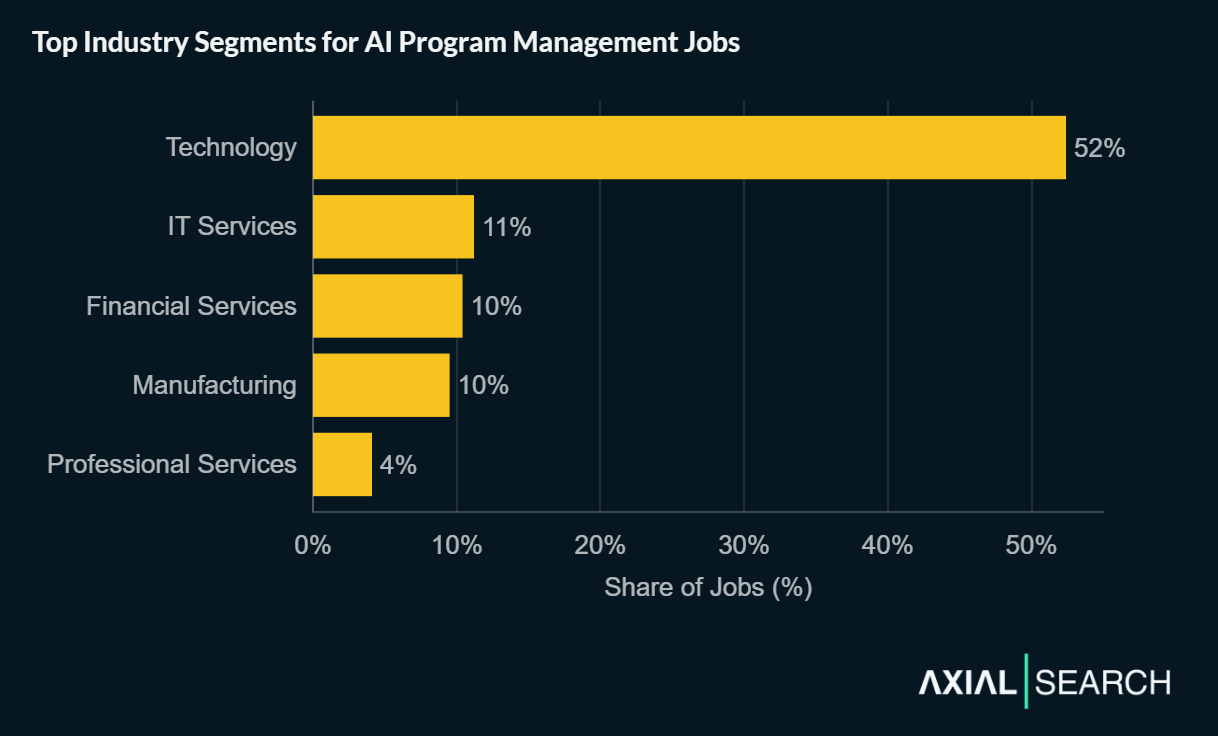
AI program management jobs are mostly posted by technology companies
Large companies with 10,001+ employees account for 64% of postings – well above the economy’s wider workforce distribution of ~30%. Organizations with 1,001-10,000 employees add another 17%, meaning roughly eight out of ten AI program management roles are at companies with over 1,000 employees.
This concentration suggests AI program management is primarily an enterprise-scale function. The complexity of coordinating AI initiatives across large organizations, combined with budget requirements for transformation programs, creates demand that smaller companies rarely match.
That said, small businesses still capture a meaningful share – 9% of roles are posted by companies with fewer than 51 employees, suggesting boutique consulting firms and high-growth startups create specialized demand.
[ai-program-management-hiring-company-size.png]
Where Are AI Program Management Jobs Located?
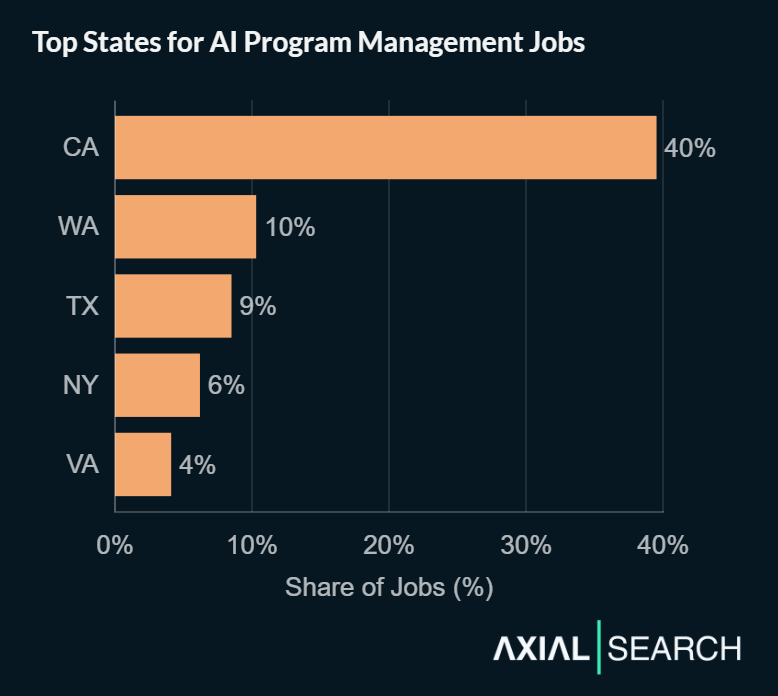
California leads AI program management hiring with 40% of all roles
California dominates the market with 40% of all AI program management postings – two in five roles. Washington follows at 10%, Texas at 9%, New York at 6% and Virginia rounds out the top five at 4%.
Together, these five states account for nearly two-thirds of all opportunities, reflecting the concentration of tech companies and financial services firms in these markets. The geographic spread thins quickly beyond the top tier.
Remote roles account for just 12% of postings despite the technical nature of the work, suggesting most organizations prefer AI program managers to work on-site where they can coordinate directly with engineering teams and business stakeholders.
Other states worth noting include Illinois, Georgia, Virginia and Florida – each capturing roughly 2-3% of the market and representing growing regional tech ecosystems with maturing AI capabilities.
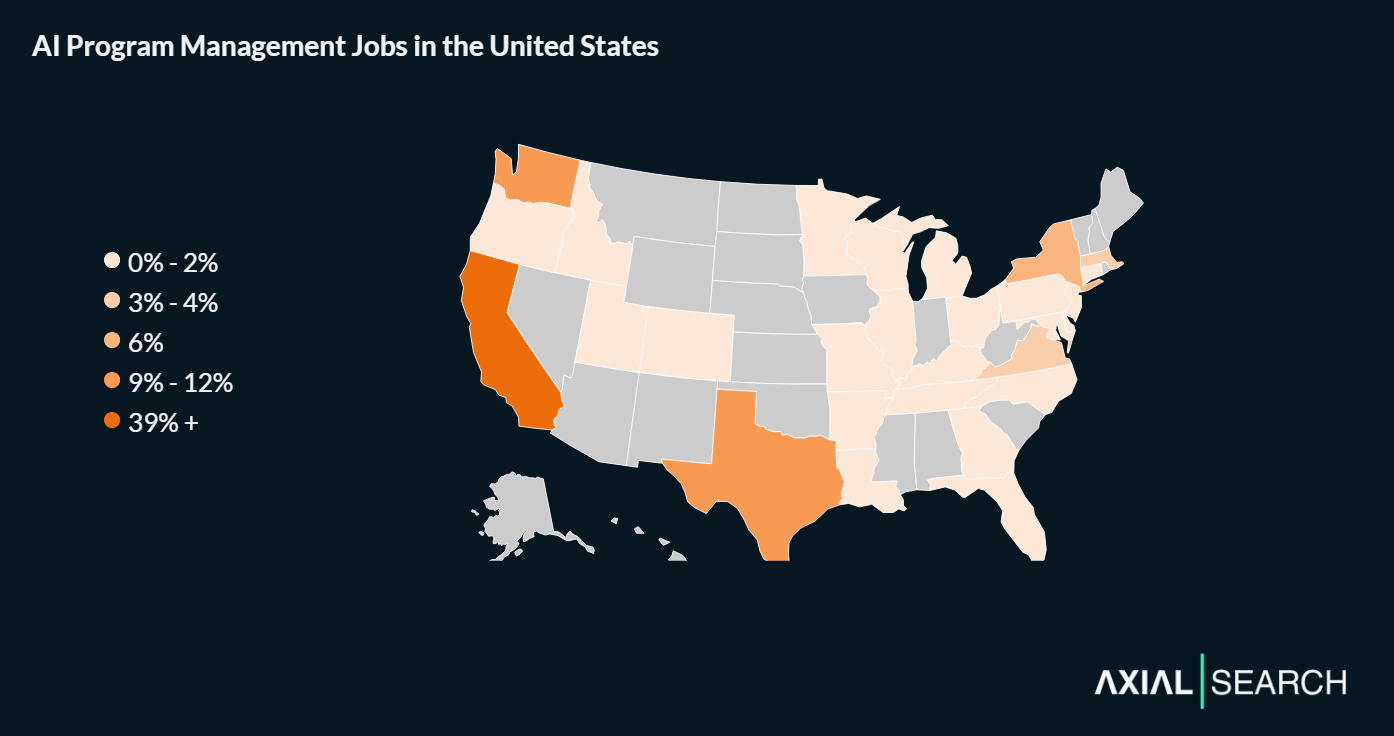
Two thirds of AI program management jobs are in 5 states
Key takeaway: If you’re looking for an AI program management role, California offers four times as many opportunities as any other state. Washington and Texas provide the next tier, but expect significantly fewer options – and limited remote work – outside these major tech hubs.
Requirements for AI Program Management Jobs
We analyzed the minimum requirements of each job post and found that most AI program management jobs (62%) require some form of degree. The pattern tightens considerably as you move up the career ladder.
For junior roles, 55% require a degree (all bachelor’s level). The remaining 45% don’t specify formal education requirements.
Mid-level positions show similar patterns: 59% require a degree (58% bachelor’s, 1% master’s).
Senior roles have the strictest requirements: 65% require a bachelor’s degree and 14% require a master’s degree.
Degree fields of study that are typically requested of AI program managers include:
- Computer Science (42%)
- Engineering (22%)
- Business (10%)
- Software Engineering (11%)
- Data Science (4%)
- Information Systems (4%)
- Information Technology (4%)
- Technology Management (3%)
- Business Management (3%)
- Finance (2%)
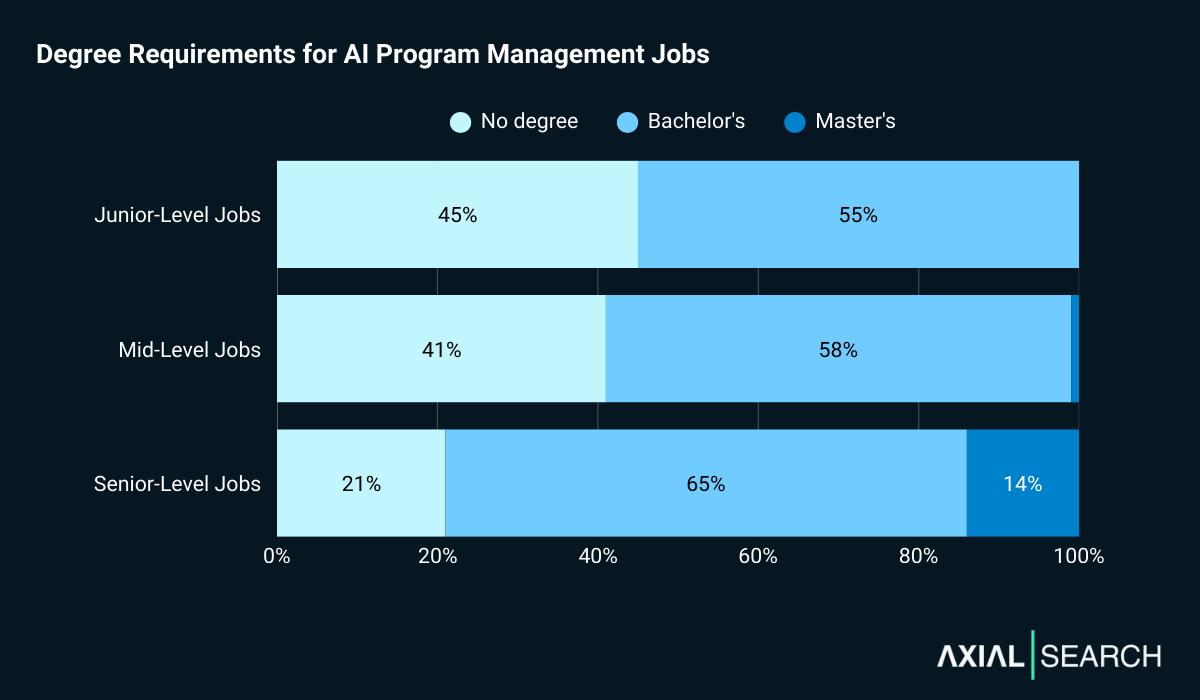
Degree requirements increase as your AI program management career progresses
Requested Qualifications in AI Program Management Job Posts
AI program managers must excel at risk management, stakeholder engagement and cross-functional collaboration. Risk management appeared in 39% of listings, stakeholder management in 37%, and communication in 36%.
These skills reflect the role’s dual nature – coordinating technical teams while managing organizational change and executive expectations simultaneously.
Technical program management capabilities (32%) and program management expertise (28%) round out the top five, emphasizing the need to balance strategic oversight with hands-on delivery.
Just 20% of postings request specific certifications, but when they do, these credentials lead:
- Project Management Professional (PMP)
- Scaled Agile Framework (SAFe)
- Program Management Professional (PgMP)
- Certified Scrum Master (CSM)
- PRINCE2
- ITIL
- PROSCI Change Management
- Certified Information Privacy Professional (CIPP)
Key takeaway: Strategic program capabilities matter most, but change management skills like risk assessment and stakeholder alignment separate successful AI program managers from those who only understand technical delivery.
What do AI Program Management Jobs Pay?
More than two-thirds (69%) of the AI program management roles we analyzed included an advertised salary.
There was significant breadth in the ranges employers posted, so we normalized the data by selecting the midpoint for our analysis. From our experience, this is generally a much more indicative number for an employer’s target offer – especially in the current market where initial ranges often run wide.
Across the entire dataset of salaries, we found the median salary for AI program management positions to be $182,650. The middle 80% of salaries (10th to 90th percentile) ranged from $132,550 to $270,500.
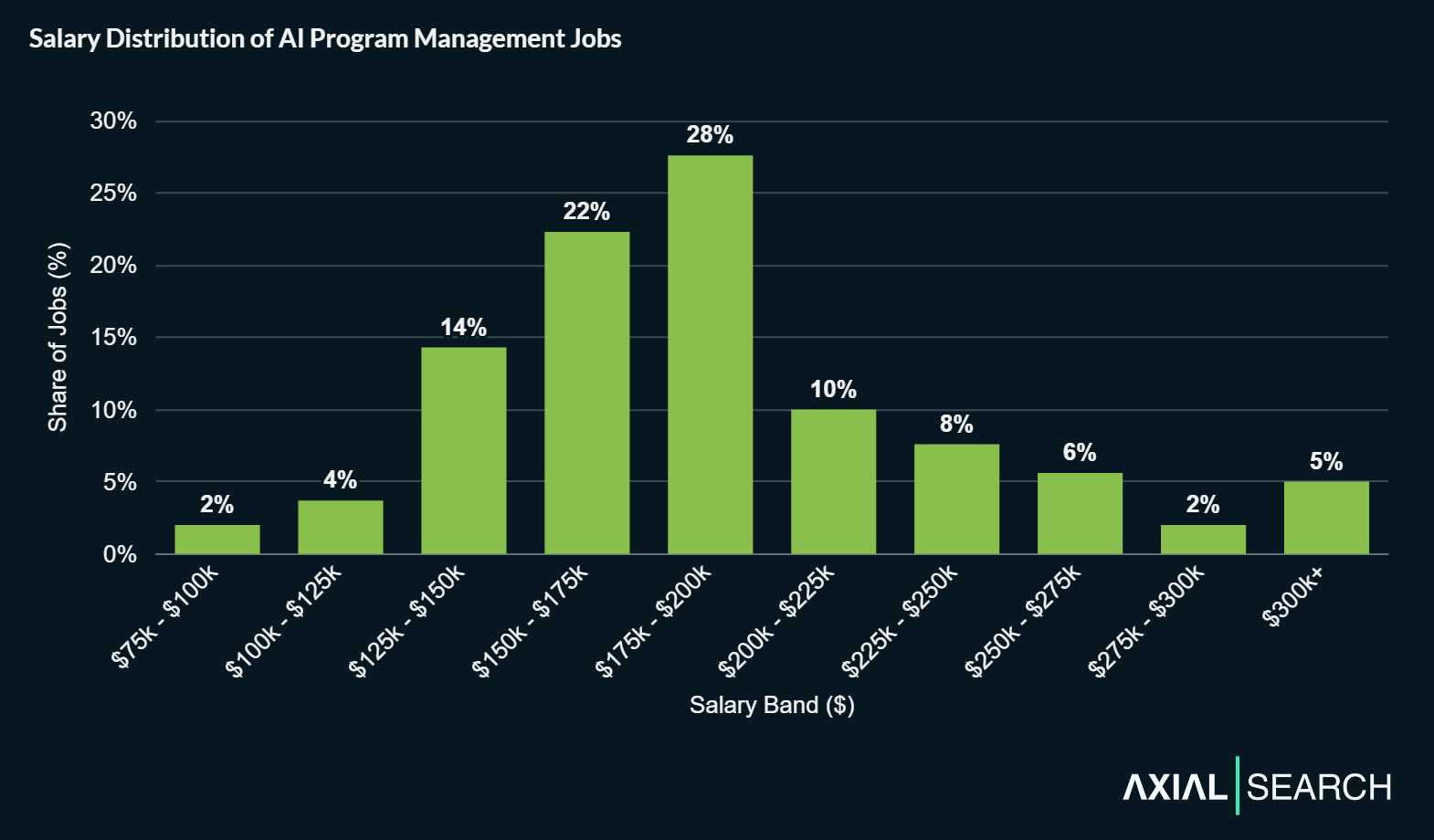
Most AI program management salaries fall within $133k to $271k
Breaking AI program management salaries down by seniority reveals strong progression. Junior roles start at a median $125,845, with mid-level positions jumping 45% to $182,650. The leap to senior adds another 23% – reaching $223,750 median.
What’s notable is the overlap between tiers: mid-level roles at the 90th percentile ($248,375) exceed senior roles at the 10th percentile ($175,750) by $72,625. This compression reflects the premium placed on specialized expertise and complex program scope rather than title alone.
Senior roles show the tightest clustering – despite commanding the highest absolute numbers, the range from 10th to 90th percentile spans just $151,750 compared to $115,825 for mid-level roles. This suggests more standardized compensation at leadership levels where strategic program ownership and organizational influence are table stakes.
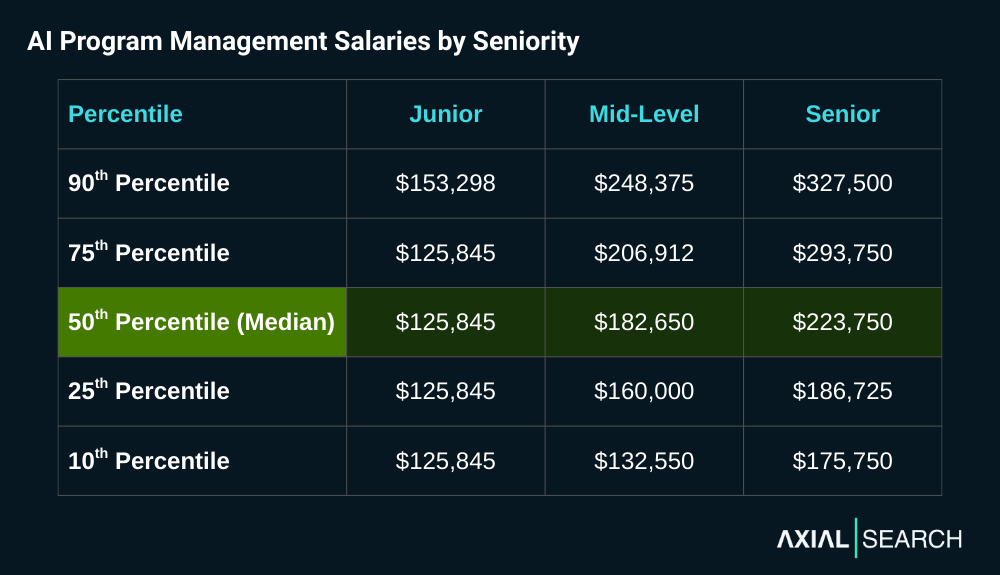
Senior AI program managers are in the top 5% of U.S. earners
Key takeaway: AI program management positions pay exceptionally well. The median senior-level salary of $223,750 puts these roles in the top 5% of all earners in the United States. Even mid-level professionals earning the median $182,650 land in the top 8%.
Final Thoughts
For Candidates: Build hands-on experience with Agile delivery and stakeholder management early – these capabilities appear across all levels. For mid-level roles, demonstrating you’ve owned end-to-end program delivery with accountability for scope and timeline separates candidates. At senior levels, experience building organizational AI capabilities and defining transformation strategy matters more than technical depth alone. PMP and SAFe certifications accelerate credibility.
For Employers: The tight salary clustering around $182,650 for mid-level roles reflects market maturity – fall significantly below that and expect longer time-to-fill. The strongest signal for senior candidates is experience scaling Technical Program Management organizations and advancing responsible AI governance, not just managing individual programs. Remote flexibility remains limited despite technical work – expect candidates to push for hybrid arrangements.
Methodology
We analyzed 468 AI program management job postings collected from LinkedIn, Indeed and Glassdoor between November 2024 and January 2025. The dataset was limited to full-time roles posted in the United States that explicitly mentioned “AI program management,” “AI program manager” or close variations in the job title.
Duplicate postings were removed using job title, company name and location matching. Seniority levels were determined by analyzing job titles alongside minimum experience requirements stated in each posting. When experience ranges were provided, the lower bound was used for consistency.
Salary data was extracted from the 69% of postings that included compensation ranges. We used the midpoint of each range for analysis, as this most closely reflects employer target offers in practice.
Industry classifications were assigned based on company descriptions and verified against LinkedIn company data where available. Geographic analysis was conducted at the state level using the primary job location listed in each posting.
Tags:
Related Insights
AI Architecture Jobs: 3,487 Postings Analyzed
AI architects design the technical foundation for enterprise AI systems - from cloud platforms to agentic workflows. We analyzed 3,487...
The AI Strategy Job Market in 2026: Analysis of 1,859 Postings
AI strategists build roadmaps for deploying AI across organizations, identifying high-value use cases and managing the teams that turn those...
AI/ML Engineering Jobs in 2026: Analyzing 10,000+ Posts
AI/ML engineers build and deploy machine learning systems that power everything from recommendation engines to autonomous vehicles. We analyzed 10,133...
Theory of Constraints: Fix Your AI Transformation Bottleneck
Your AI transformation is stuck because you're trying to do everything at once. Theory of Constraints provides a systematic solution:...
The AI Implementation Job Market: 3,159 Roles Analyzed
AI implementation professionals lead the technical deployment of AI systems across organizations, managing both platform integration and stakeholder adoption. We...
Market Insights from 592 AI Product Management Jobs
AI product managers own the roadmap, strategy, and execution for AI-powered products. We analyzed 592 AI product management jobs posted...