
Key Findings
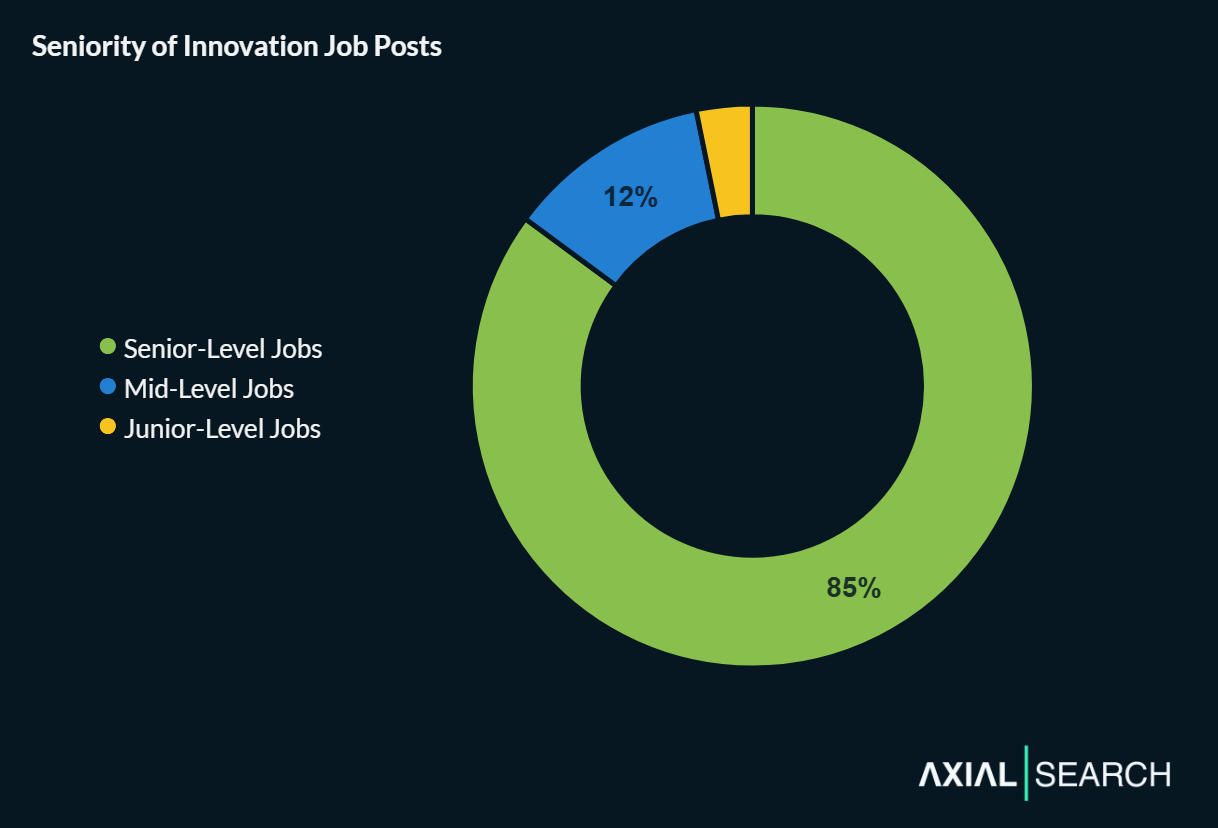
- Most roles are senior-level: 85% of innovation positions target professionals with 9+ years of experience
- Median salary is $186,000: The middle 80% of roles pay between $155K and $283K annually
- Certifications appear in 14% of posts: OneStream, NetSuite ERP and PMP lead requests
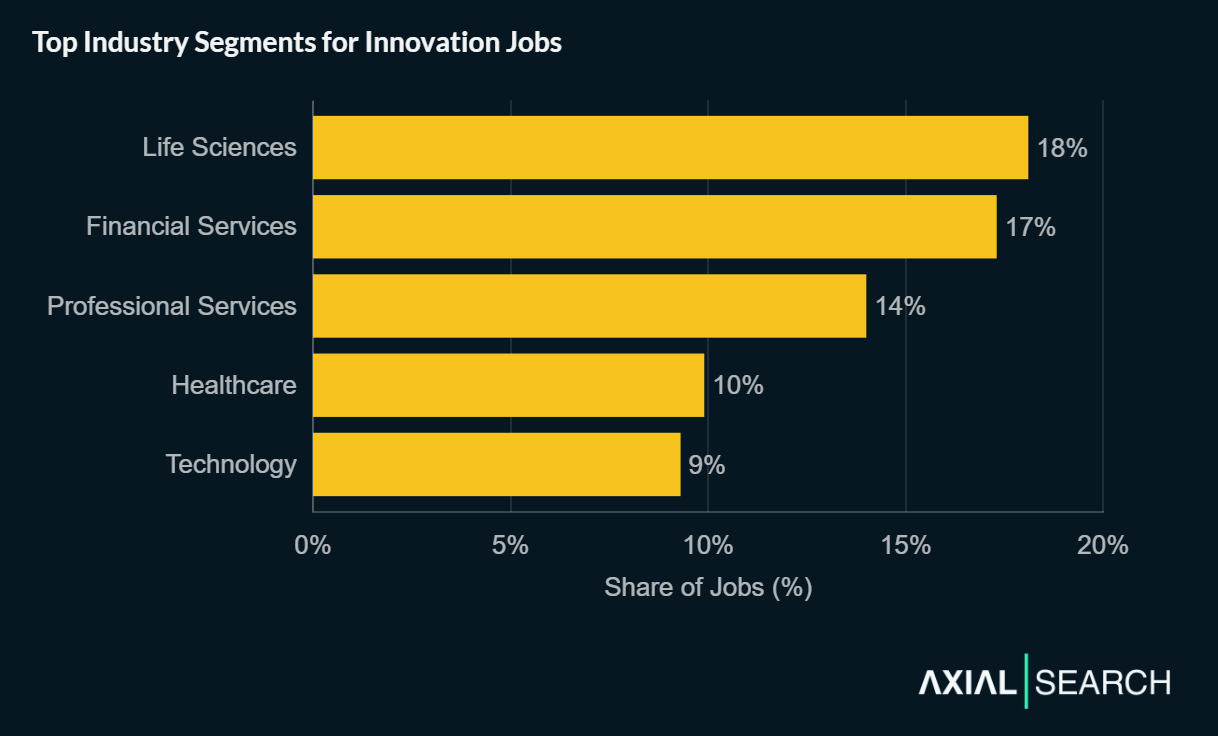
- Life sciences and financial firms dominate hiring: Life Sciences (18%), Financial Services (17%) and Professional Services (15%) lead postings
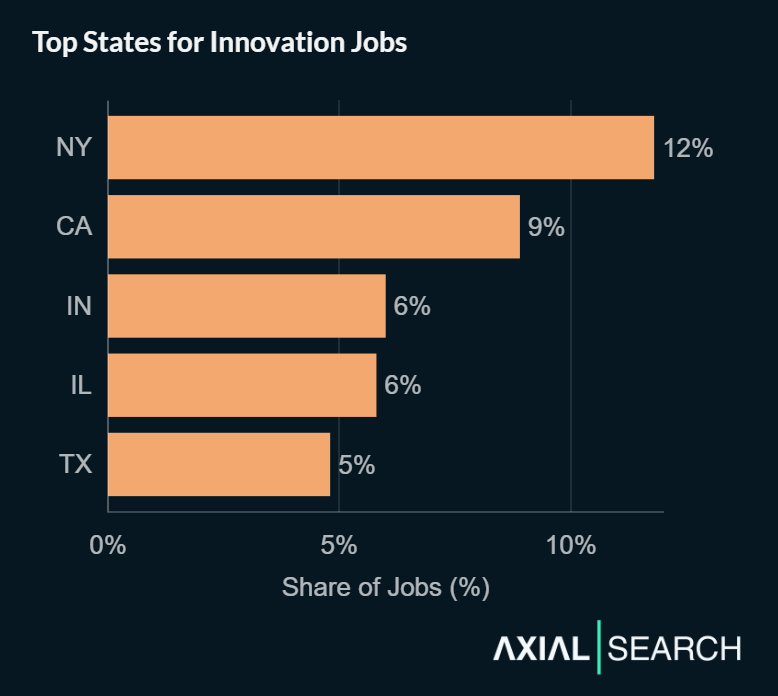
- New York and California lead the market: NY captures 11% of U.S. roles, CA captures 9%
- Advanced degrees increasingly common: 30% of senior roles don’t require degrees, but 25% require master’s or doctoral degrees for those that do
The Role of an Innovation Professional
These patterns align with what we see across transformation and change management recruitment, where organizations balance strategic vision with hands-on execution capabilities.
We categorized each role by seniority and found the market heavily skews toward senior professionals – they account for 85% of all postings.
We then extracted experience requirements (91% of roles mentioned a specific number) and calculated the average minimum at each level of seniority. Finally, we analyzed job titles to identify the most common naming conventions at each level.
- Junior (3% of roles)
- Minimum experience: 9 years
- Common titles: Chief Information and Innovation Officer, Assistant to Chief Innovation Officer, Associate Office of Chief Product and Innovation Officer
- Mid-Level (12% of roles)
- Minimum experience: 8 years
- Common titles: Associate Director Technology and Innovation, Managing Director & Executive Coach, Director Product & Innovation Marketing
- Senior (85% of roles)
- Minimum experience: 9 years
- Common titles: Associate Director Patient Engagement, VP of Technology & Innovation, Vice President Advanced Tax Strategy & Innovation
What Do Innovation Jobs Involve?
So what is an innovation professional actually responsible for day-to-day? We analyzed the language across all job posts to extract the core responsibilities at each level. What emerged is a clear progression of expectations from coordination to enterprise transformation:
Junior-Level Roles:
- Coordinate innovation executives managing schedules and cross-functional projects
- Establish AI governance frameworks across internal and client operations
- Align innovation strategy with mission through multi-year planning
Mid-Level Roles:
- Lead ERP implementations from discovery through optimization
- Translate market signals into product strategies managing prototype to production
- Drive cross-functional delivery coordinating IT and external vendors
Senior-Level Roles:
- Architect enterprise innovation spanning AI adoption and digital transformation
- Integrate stakeholder perspectives across full development lifecycles
- Lead technical organizations translating research into scalable solutions
Key takeaway: Junior professionals coordinate executive operations, mid-level leaders translate digital strategy into product delivery, senior executives architect enterprise transformation. Each step up means more organizational influence over how innovation shapes competitive positioning.
Who’s Hiring for Innovation?
Life Sciences leads with 18% of innovation postings, followed closely by Financial Services at 17%. Professional Services rounds out the top three at 14%, with Healthcare (10%) and Technology (9%) completing the top five.
The concentration in life sciences reflects patient-centered innovation methodologies and regulatory compliance demands that require dedicated leadership. Financial services’ strong showing indicates how fintech disruption and digital transformation drive investment in innovation capabilities.
Life sciences leads innovation hiring
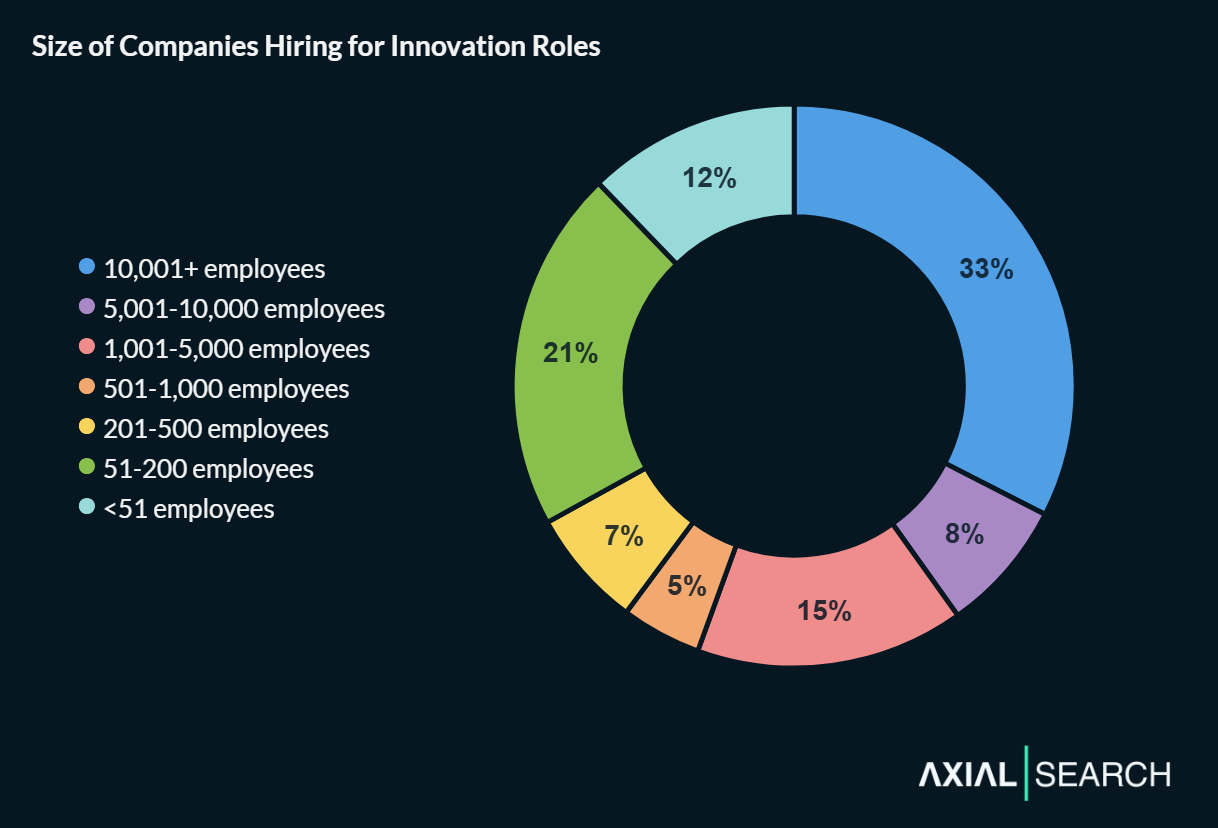
Large companies with 10,001+ employees account for 33% of postings – closely matching the broader workforce distribution across the U.S. economy. Organizations with 1,001-10,000 employees add another 16%, meaning roughly half of innovation roles are at companies with over 1,000 employees.
What’s striking is the startup and small business presence – 33% of roles come from companies with fewer than 201 employees. This bimodal distribution suggests innovation serves two contexts: mature enterprises building formal innovation functions versus startups and small businesses where innovation leadership combines strategic vision with hands-on execution.
One third of innovation jobs appear at firms with <201 employees
Where Are Innovation Jobs Located?
One third of innovation jobs are found in 5 states
New York leads the market with 11% of all innovation postings. California follows at 9%, Indiana at 6%, Illinois at 6%, and Texas rounds out the top five at 5%.
The concentration in major business and life sciences hubs reflects where pharmaceutical companies, financial institutions and consulting firms cluster. Remote roles account for 25% of postings – the highest rate among transformation disciplines we’ve analyzed – suggesting innovation strategy work allows more geographic flexibility than hands-on implementation roles.
Beyond the top five, states worth watching include Pennsylvania, Massachusetts, New Jersey and North Carolina – each capturing roughly 3-4% of the market and representing growing regional ecosystems with maturing innovation capabilities.
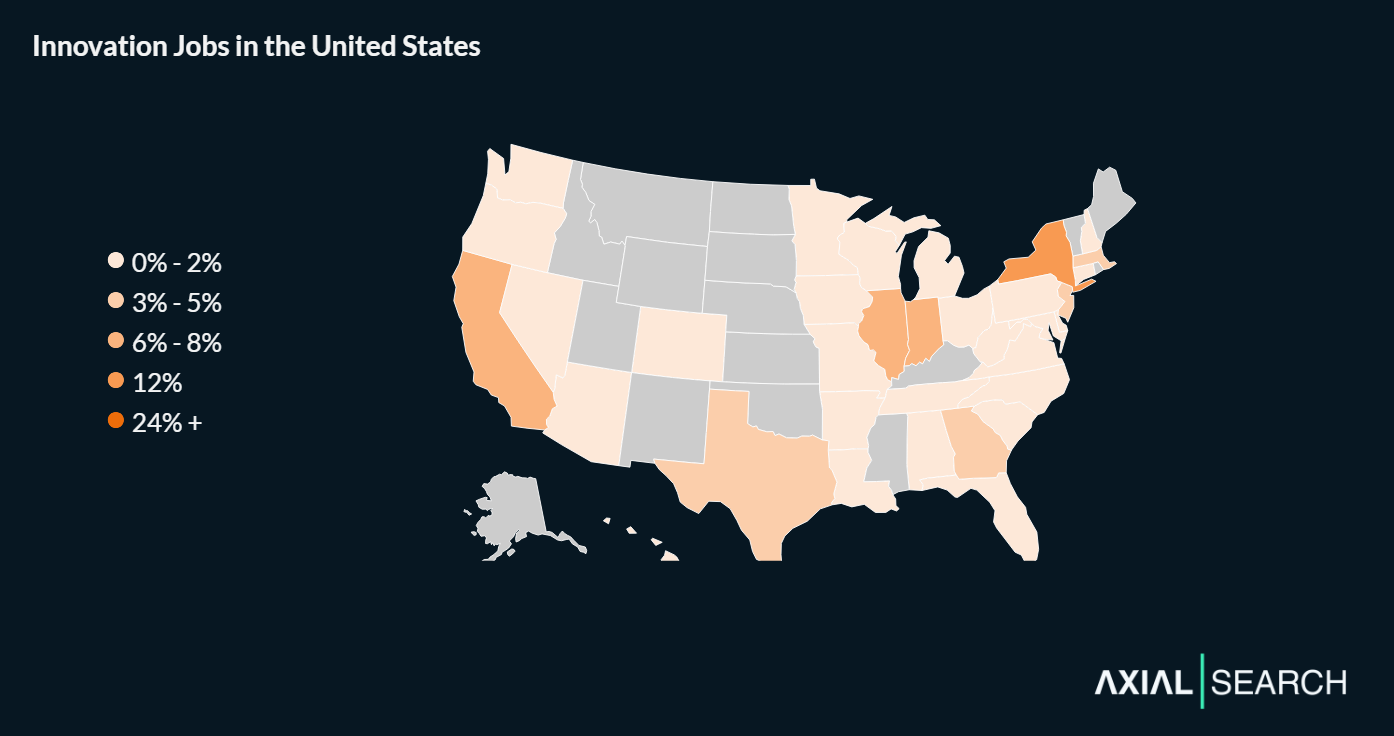
One quarter of innovation jobs offer remote work
Key takeaway: New York and California capture one in five innovation opportunities nationwide. The relatively high remote rate (25%) suggests organizations view innovation leadership as strategic rather than operational, requiring less physical presence than other transformation functions.
Requirements for Innovation Jobs
We analyzed the minimum requirements of each job post and found that degree requirements vary significantly by seniority level. What’s unusual is the pattern at senior levels – advanced degree requirements actually increase rather than staying flat.
For junior roles, 85% require a bachelor’s degree. The remaining 15% don’t specify formal education requirements.
Mid-level positions ease slightly: 65% require a bachelor’s, 2% require a master’s, and 4% require a PhD.
Senior roles show the most variance: 45% require a bachelor’s, 22% require a master’s, and 3% require a PhD. The remaining 30% don’t specify requirements.
The rise in advanced degrees at senior levels reflects how innovation leadership increasingly demands specialized expertise – whether clinical knowledge in life sciences, technical depth in emerging technologies, or research credentials that establish thought leadership.
Degree fields of study differ dramatically by seniority level:
Junior roles (limited sample):
- Technical fields dominate but sample size prevents meaningful percentages
Mid-level roles:
- Finance (44%)
- Accounting (42%)
- Management Information Systems (42%)
- Business (6%)
- Computer Science (6%)
- Engineering (6%)
Senior roles:
- Engineering (14%)
- Computer Science (14%)
- Information Technology (14%)
- Life Sciences (12%)
- Data Science (12%)
- Pharmacy (11%)
- Business (9%)
- Business Administration (8%)
The shift from finance-heavy mid-level backgrounds to technical and scientific senior credentials reflects how innovation roles bifurcate – mid-level positions often optimize existing systems (ERP, performance management) while senior leaders drive new capability development requiring deeper domain expertise.
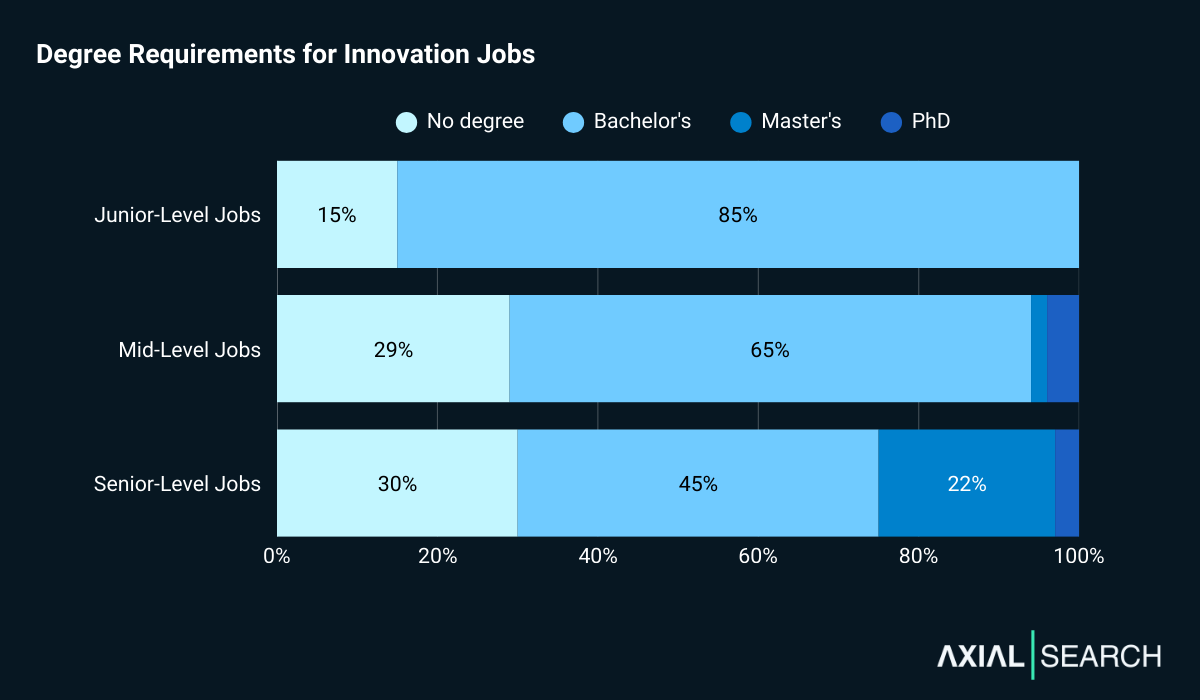
Advanced degrees increase at senior levels
Requested Qualifications in Innovation Job Posts
Innovation professionals must excel at communication, cross-functional collaboration and team leadership. Communication appeared in 39% of listings, cross-functional collaboration in 32%, and team leadership in 31% – reflecting the role’s nature as organizational orchestrator bridging technical execution with strategic vision.
Change management (27%), strategic planning (25%) and stakeholder engagement (25%) round out the core capabilities, emphasizing the need to drive adoption across resistant cultures while managing structured initiatives.
Technical expertise matters differently here than in other functions. Project management, data analysis and vendor management are table stakes, supported by hands-on experience with frameworks like Agile, Design Thinking and Patient-Focused Drug Development (particularly in life sciences contexts).
Just 14% of postings request specific certifications, but when they do, these credentials lead:
- OneStream Certification
- Certified NetSuite ERP Consultant
- Project Management Professional (PMP)
- Certified Treasury Professional (CTP)
- Information Technology Infrastructure Library (ITIL)
- Agile Certified Practitioner (PMI-ACP)
- Program Management Professional (PgMP)
- PROSCI Change Management
Key takeaway: Leadership capabilities separate innovation professionals from technical specialists. AI recruitment increasingly overlaps with innovation as organizations embed intelligence into products and processes – strategic thinking paired with change management determines whether transformations succeed.
What do Innovation Jobs Pay?
Seven out of ten (70%) innovation roles we analyzed included an advertised salary.
There was significant breadth in the ranges employers posted, so we normalized the data by selecting the midpoint for our analysis. From our experience, this is generally a much more indicative number for an employer’s target offer – especially in the current market where initial ranges often run wide.
Across the entire dataset of salaries, we found the median salary for innovation positions to be $186,000. The middle 80% of salaries (10th to 90th percentile) ranged from $154,900 to $282,500.
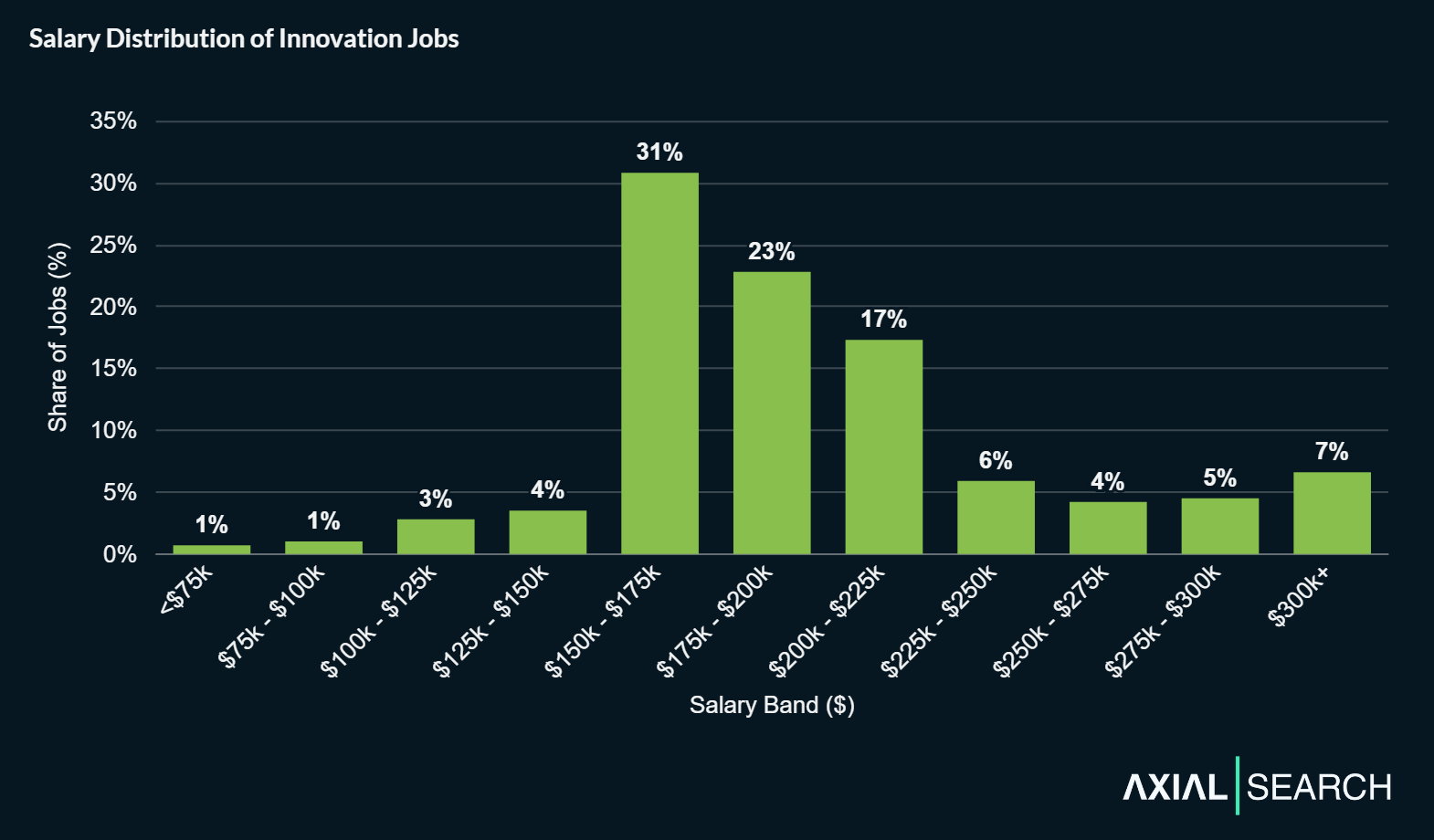
Most innovation salaries fall within $155K to $283K
Breaking innovation salaries down by seniority reveals an unusual pattern that defies traditional hierarchical progression. The small sample size at junior levels (n=11) creates clustering, but the broader pattern still shows compression. Junior roles command the highest median at $213,225 – reflecting how “junior” titles like Chief Innovation Officer carry executive accountability despite lower experience thresholds. Mid-level positions sit at $178,675 median, while senior roles reach $185,000.
Mid-level shows more variance ($161,625 to $300,000), with top performers reaching exceptional compensation through specialized platform expertise. Senior roles spread from $152,500 to $276,000, indicating significant variation based on industry, company size and strategic scope.
What’s notable is how compensation disconnects from seniority labels. The highest-paid mid-level positions ($300,000 at 90th percentile) significantly exceed median senior compensation, reflecting how domain expertise in high-demand areas – particularly ERP implementations and performance management platforms – commands premium pay regardless of title.
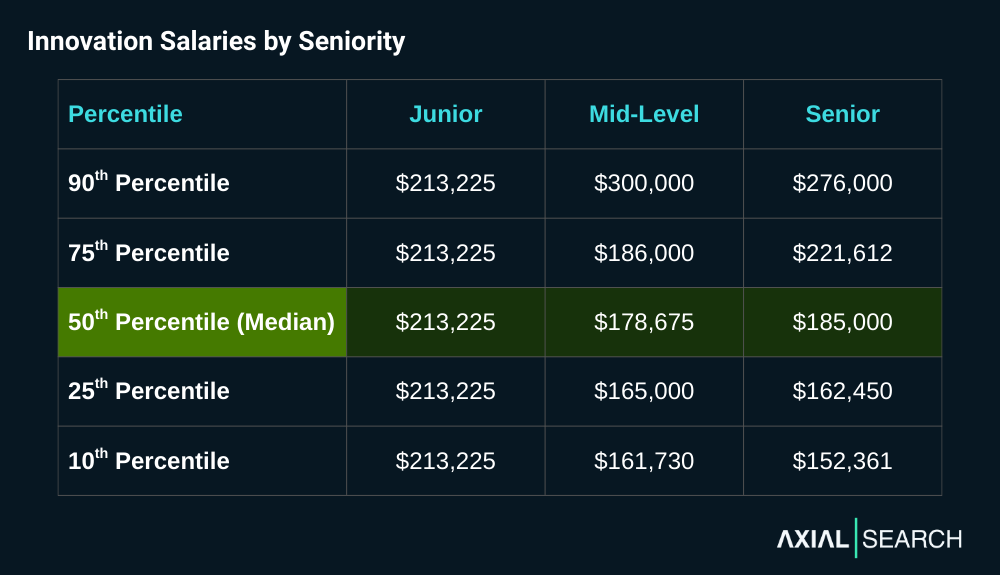
The small dataset skews junior-level salaries
Key takeaway: Innovation positions pay exceptionally well across all levels. The median senior-level salary of $185,000 puts these roles in the top 7% of all earners in the United States. Even mid-level professionals earning the median $179,450 land in the top 8%.
Final Thoughts
For Candidates: Build cross-functional collaboration and change management capabilities early – these skills appear in one-third of postings. Domain expertise matters: ERP certifications (NetSuite, OneStream) create mid-level opportunities while advanced technical degrees open senior paths. The flat salary structure means focusing on strategic scope and organizational impact matters more than title progression. Consider life sciences and financial services sectors where innovation investment runs deepest.
For Employers: The unusual salary compression around $185,000 median across mid and senior levels reflects both market confusion and small sample sizes at junior tiers. Junior executive titles command $213,000+ despite lower experience, while specialized mid-level practitioners reach $300,000. Define whether you need strategic vision (senior premium) or platform expertise (mid-level specialization). Remote flexibility at 25% exceeds other transformation disciplines – leverage this for national talent access.
Methodology
We analyzed 420 innovation job postings collected from LinkedIn, Indeed and Glassdoor between November 2024 and January 2025. The dataset was limited to full-time roles posted in the United States that explicitly mentioned “innovation” or close variations in the job title.
Duplicate postings were removed using job title, company name and location matching. Seniority levels were determined by analyzing job titles alongside minimum experience requirements stated in each posting. When experience ranges were provided, the lower bound was used for consistency.
Salary data was extracted from the 70% of postings that included compensation ranges. We used the midpoint of each range for analysis, as this most closely reflects employer target offers in practice.
Industry classifications were assigned based on company descriptions and verified against LinkedIn company data where available. Geographic analysis was conducted at the state level using the primary job location listed in each posting.
Tags:
Related Insights
Analysis of 301 Org Design and Organizational Development Jobs
Organizational development professionals build frameworks for workforce planning, leadership pipelines and cultural transformation, while organizational design specialists restructure how companies...

Systems Thinking: Why Your AI Pilot Won’t Scale
Congratulations, your AI pilot worked! Now watch it die. The proof of concept impressed leadership, the metrics looked good, everyone...
Digital Transformation Jobs in 2026: Analyzing 698 Roles
Digital transformation professionals lead organizations through technology modernization, implementing automation platforms, enterprise systems and digital workflows that reshape how companies...
Digital Strategy Jobs: In-Depth Analysis of 1,000+ Live Roles
Digital strategy professionals own the planning and execution of digital initiatives, from paid media campaigns and content strategies to enterprise...
Change Management Jobs in 2026: What 736 Postings Reveal
Change management sits at the intersection of strategy and execution—it's the discipline that turns ambitious transformation plans into actual results....
Insights from 2,202 Business Transformation Job Posts
Business transformation professionals redesign how organizations operate, leading initiatives that modernize systems, optimize processes and drive measurable change. We analyzed...