
Digital Transformation Jobs: The 2026 Market Map
The complete picture of the digital transformation job market in 2026: hiring demand, what these roles pay, where the jobs are, who's hiring and what it takes to get in.
Updated: July 14, 2026

Digital transformation is one of the most competed-for mandates in enterprise hiring, and the roles skew senior enough that most large companies route them through AI executive search rather than handle the search in-house. Drawing on 1,781 digital transformation jobs posted in the US since January 2026, this is the full picture: how hiring is trending, what the roles pay, where the jobs are, who's hiring and what it takes to get hired.
- Steady hiring pace: Digital transformation demand holds at ~64 new US postings weekly — no seasonal dips, no quiet seasons to wait for.
- Manager-heavy market: 34% of digital transformation roles are Manager-level, another 17% Director — this is a leadership function, not a support one.
- Professional Services dominates: 36% of digital transformation postings come from consulting firms, with Financial Services adding another 18%.
- ERP fluency matters most: Employers mention ERP platforms in 36% of digital transformation postings, Agile in 33%, cloud platforms in 21% — breadth across systems beats narrow specialization.
- Judgment trumps execution: Use-case selection and securing sponsorship rank highest in the digital transformation leadership profile — you're hired to pick the right battles and get them funded, not to run the implementations yourself.
- Enterprise-scale hiring: 65% of digital transformation roles come from companies with 10,000+ employees — if you're competing for talent, you're bidding against firms with deep pockets.
How hot is the digital transformation job market?
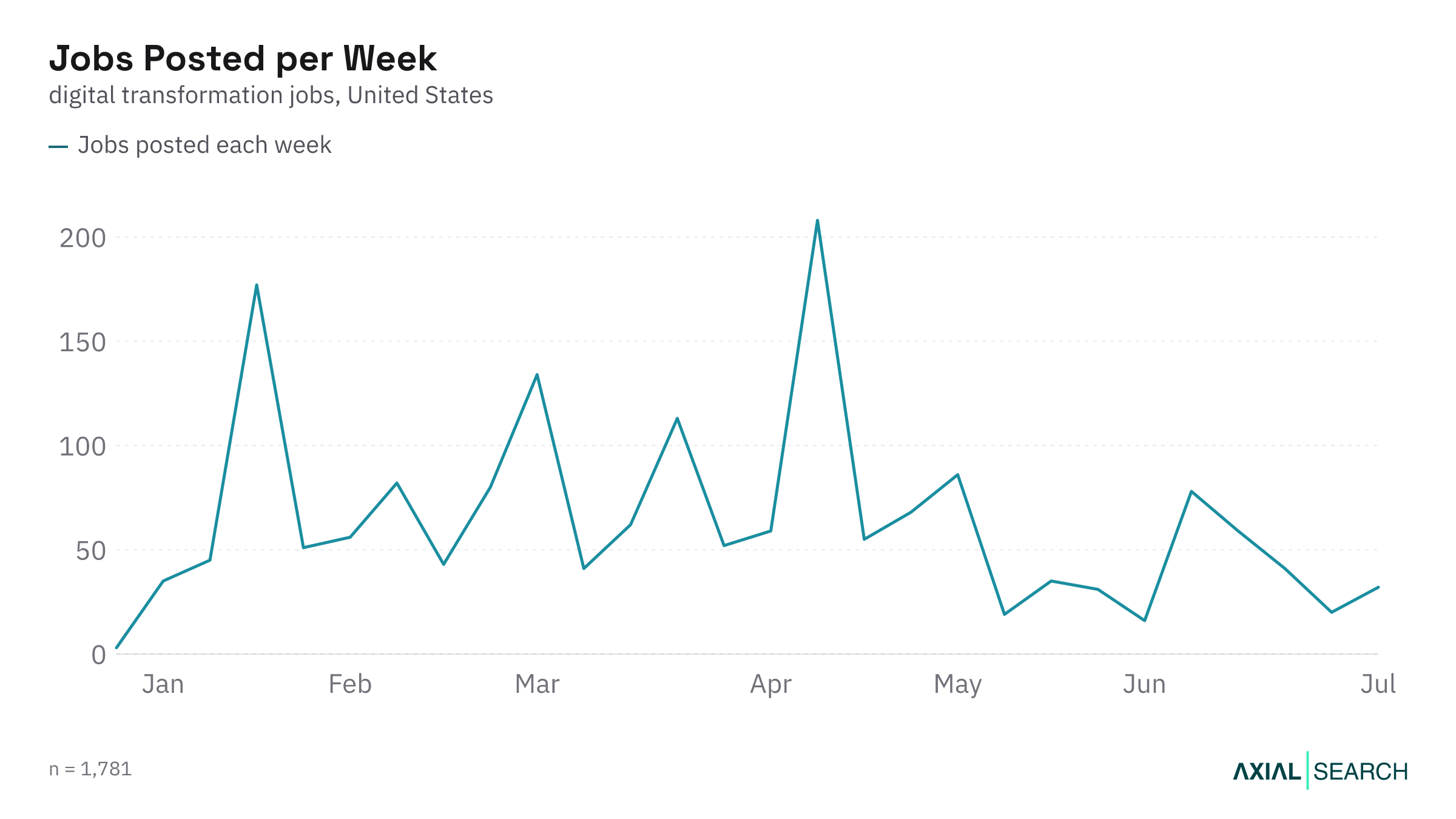
Digital transformation hiring has held steady through 2026 at around 64 new US roles a week. Week-to-week volume ranges from 3 to 208, reflecting the project-driven rhythm of enterprise change mandates, but the trend through the year stays level — no seasonal swings, no quiet stretches where the bar drops.
For candidates, that means roles keep arriving but competition stays high. You don't get a buyer's market. For hirers, it means your rivals are in the market at the same pace you are, and speed matters more than waiting for a lull. We break down digital transformation jobs by location and the companies hiring in full.
What digital transformation roles pay
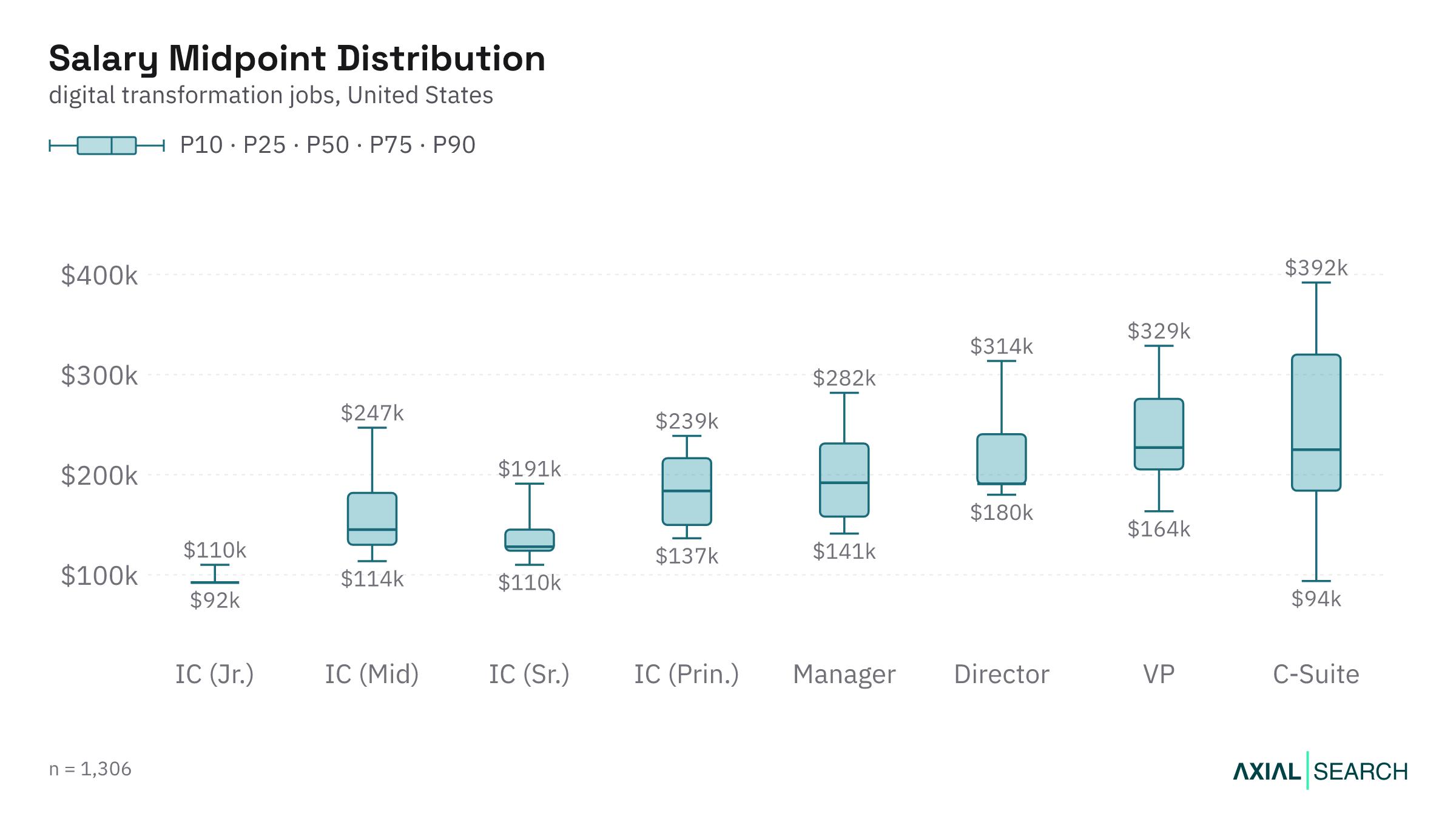
| Seniority | Median | 25th–75th percentile | 90th percentile |
|---|---|---|---|
| IC (Junior) | $92,000 | $92,000–$92,000 | $110,000 |
| IC (Mid) | $145,000 | $130,000–$182,000 | $247,000 |
| IC (Senior) | $128,000 | $124,000–$145,000 | $191,000 |
| IC (Principal) | $184,000 | $150,000–$216,000 | $239,000 |
| Manager | $192,000 | $158,000–$231,000 | $282,000 |
| Director | $191,000 | $191,000–$240,000 | $314,000 |
| VP | $227,000 | $205,000–$276,000 | $329,000 |
| C-Suite | $225,000 | $184,000–$320,000 | $392,000 |
The median digital transformation salary sits at $164,000. Pay climbs with seniority, and the spread inside each band is wide enough that negotiation moves the number as much as title does. Location and sector shift it considerably too.
One pattern worth noting: the Manager tier, which makes up 34% of postings, already centers well into six figures. This isn't a market where "manager" means middle management — digital transformation Managers are being hired to own enterprise change, not support it. At the Director and VP levels the medians converge closer than you'd expect; once you're past Manager, negotiation leverage and sector pay bands matter more than the next title bump. We've broken down digital transformation salaries in full — how pay shifts by sector, location, bonus and equity — and the table below holds every per-seniority figure. Salary data is drawn from employer-posted salary bands, annualized where necessary, and reported as percentiles. Figures reflect base salary; bonus and equity add to total comp but aren't broken out per-seniority in the data.
Where digital transformation jobs are located
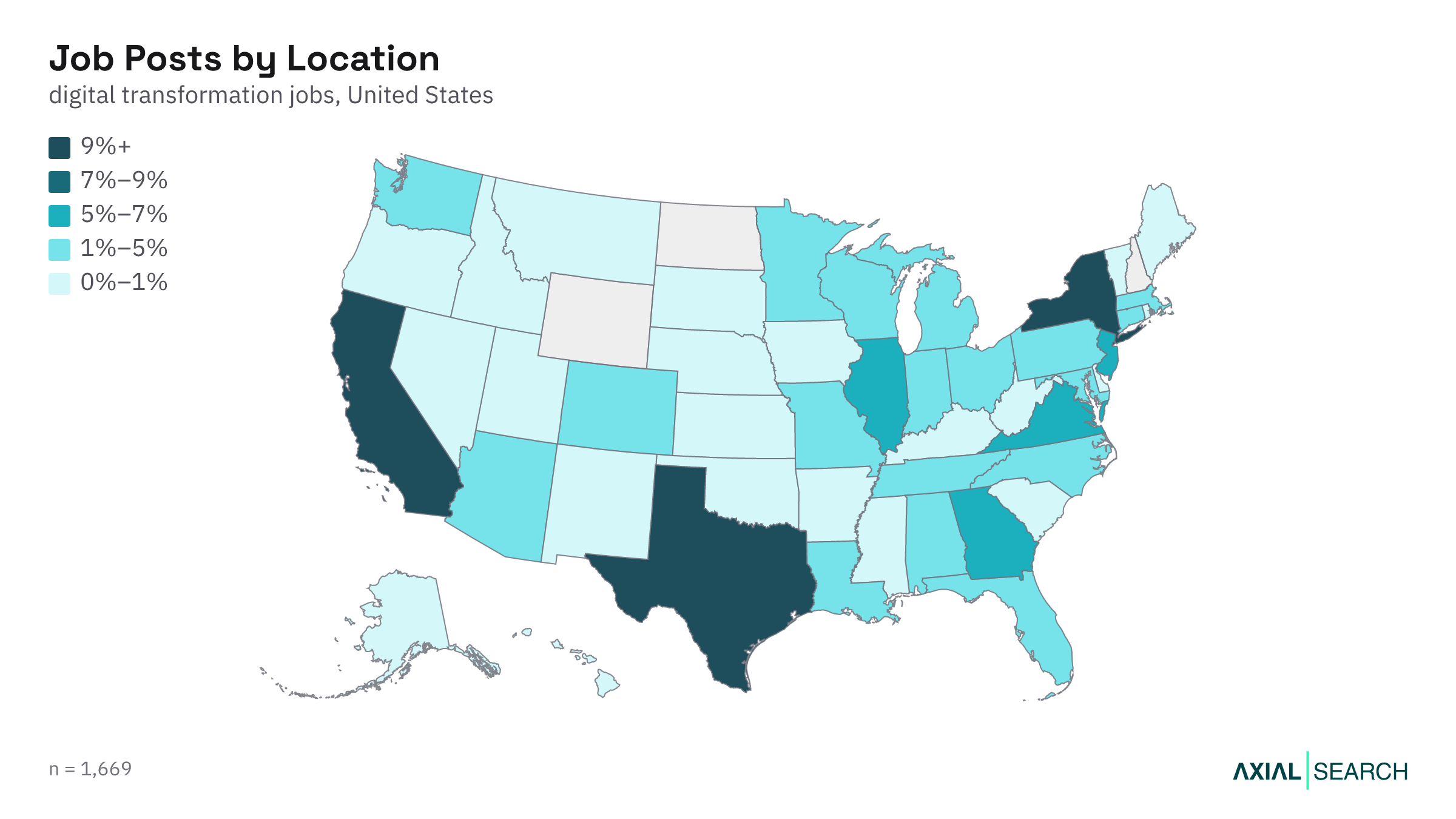
Digital transformation hiring spreads more evenly across the country than most AI leadership categories. Texas leads with 11% of postings, California follows at 10%, and New York, Illinois, New Jersey and Georgia each carry real volume. At the city level, Chicago (5.2%), Atlanta (4.1%) and Houston (3.2%) lead — reflecting the professional services and financial services concentration in those markets.
The even spread matters for both sides of the market. Candidates aren't forced to move to the coasts to find digital transformation roles. Hirers face local competition in more markets than just the Bay Area and New York — if you're slow, someone in Dallas or Charlotte will close the candidate first.
Who's hiring digital transformation talent
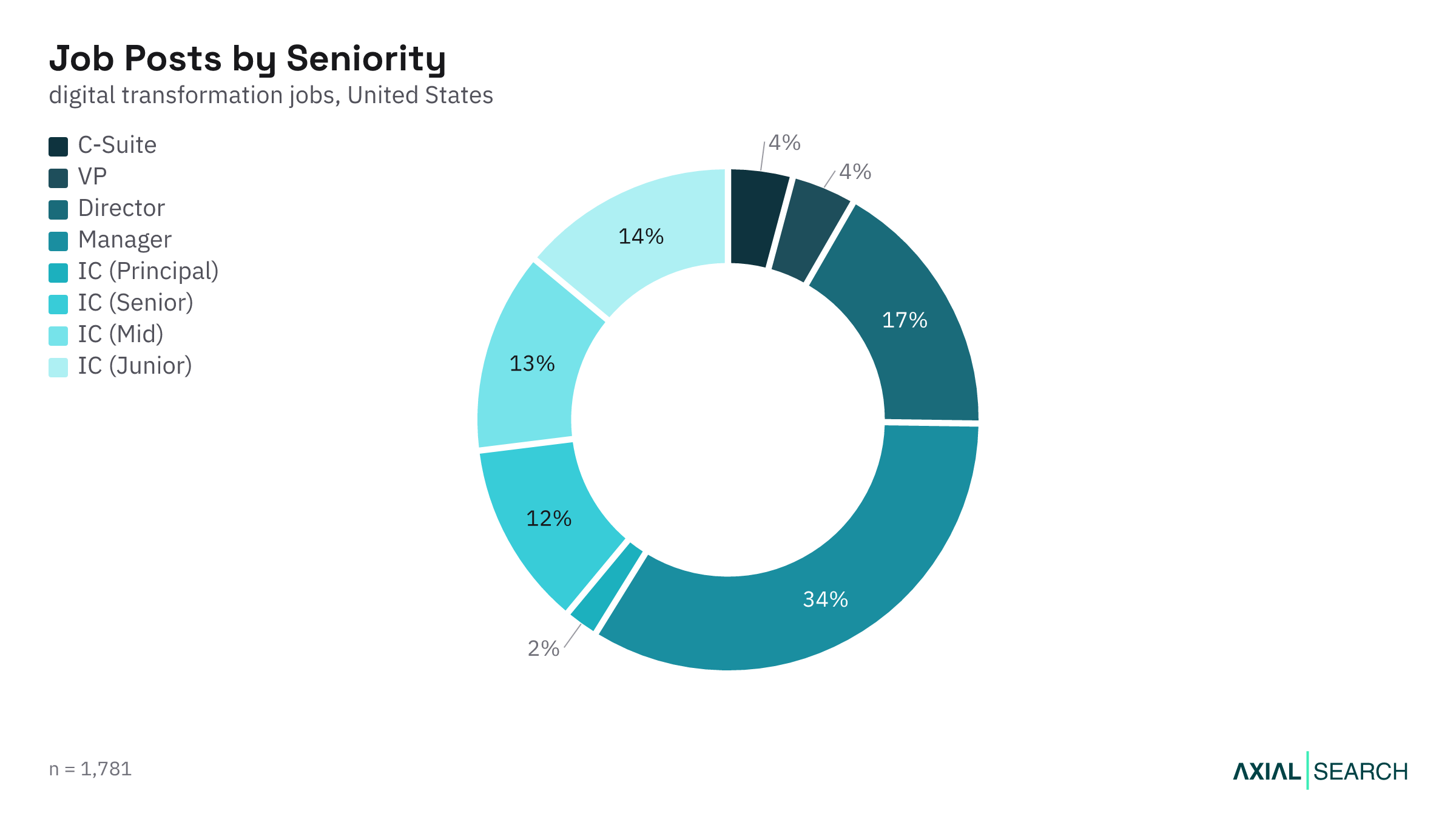
This is a leadership market. 34% of all digital transformation postings are Manager-level, another 17% Director — together they're half the market. Only 14% are junior individual contributors. Companies are hiring people to own enterprise change, not support it.
Who's posting those roles skews large and services-heavy:
| Sector | Share of postings |
|---|---|
| Professional Services | 36.2% |
| Financial Services | 17.9% |
| IT Services | 9.2% |
| Manufacturing | 7.3% |
| Technology | 3.4% |
Professional Services firms post more than a third of all digital transformation roles, Financial Services another 18%, and 65% of all postings come from enterprise-scale companies with more than 10,000 employees. If you're job-hunting, that tells you this is a big-company, consulting-adjacent market. If you're hiring against them, it tells you the competitors you're up against have deep pockets and established recruiting pipelines — you won't win on comp alone.
What it takes to land a digital transformation role
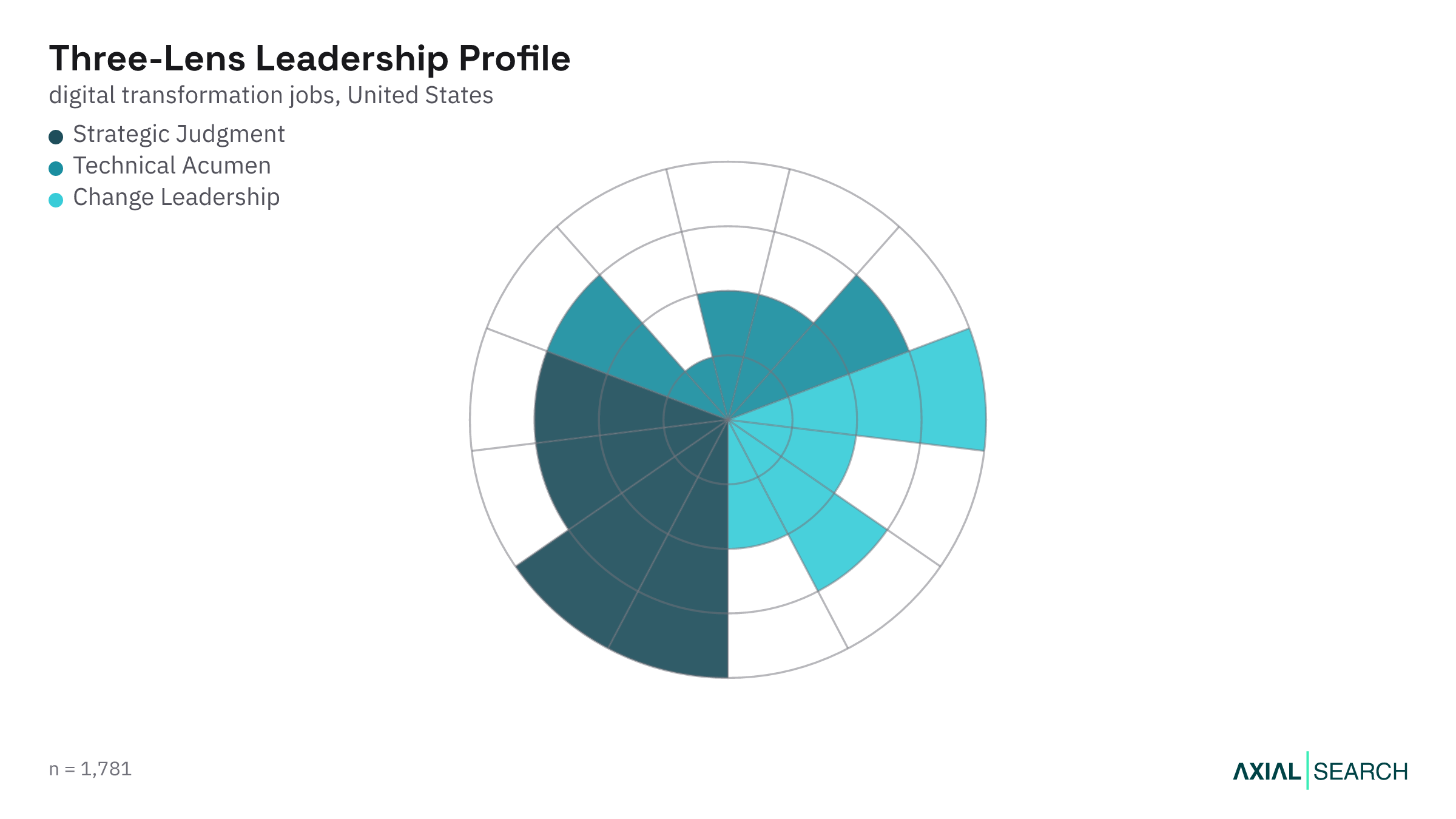
Digital transformation roles reward the ability to pick the right battles and get them funded. The capabilities employers emphasize most, mapped through our Three-Lens Leader framework, are use-case selection and securing sponsorship — the judgment to point an organization at the right transformation and the political skill to get buy-in. Operating-model design and value framing come next, while hands-on execution and driving adoption rank lower. These are digital transformation roles for people who design the plan and clear the path, not for people who run the implementations themselves.
On skills, breadth across enterprise systems matters more than depth in any one:
| Capability | Share of postings |
|---|---|
| ERP Platforms | 35.8% |
| Agile | 32.5% |
| Cloud Platforms | 20.8% |
| SQL | 18.9% |
| Observability & Monitoring | 18.2% |
ERP platforms show up in 36% of digital transformation postings, Agile in 33%, cloud platforms in 21%, SQL in 19% and observability tools in 18%. These figures reflect what postings mention, not a ranked checklist — treat them as signals of what to be conversant in. The pattern is clear: employers want people who can move across systems and methodologies, not specialists who only know one platform. We cover what it takes in the full guide to digital transformation skills and requirements.
The credential mix tilts practical. 84% of digital transformation postings require a degree — mostly bachelor's in Business (45%), Computer Science (43%) or Engineering (38%) — and the median experience requirement sits at 5 years, rising to 10 at Director and above. PMP certification appears in 42% of postings that mention certs, CPA in 19%, and CISSP in 6%. The message: employers want proof you've led change before, not proof you've studied it.
| Certification | Share of postings |
|---|---|
| Project Management Professional (PMP) | 42.1% |
| Certified Public Accountant (CPA) | 19.1% |
| Certified Information Systems Security Professional (CISSP) | 6.2% |
| Certified Information Systems Auditor (CISA) | 5.2% |
| Certified Information Security Manager (CISM) | 4.1% |
Bonus shows up in 28% of digital transformation postings and equity in 4%. These figures undercount reality — many employers wait until offer stage to discuss variable comp — but they still tell you which firms lead with total-comp packages versus which lead with base only.
Final Thoughts
For candidates. Digital transformation is a leadership function dressed up as a tech mandate. Employers are hiring you to choose the right fights, frame the value and get buy-in — not to build the systems yourself. If your pitch centers on hands-on execution or technical depth in one tool, you're answering the wrong question. Show you can read a room, secure sponsorship and translate business priorities into transformation roadmaps. ERP fluency, Agile and cloud platforms are table stakes; judgment and political skill are what separate the offer from the rejection. The market is steady, the roles are senior and the competition has the same resume you do — speed and clarity win. If you focus more on aligning AI capabilities with business objectives than enterprise-wide change, the AI strategy job market is the closer fit.
For employers. You're hiring against Professional Services firms with deeper pockets and faster close cycles, and 65% of the market is going after the same enterprise-scale talent pool you are. If your process runs longer than six weeks or your comp lags the $164,000 median, you'll lose candidates before you finish the debrief. Focus on people who've already picked the right use cases and secured executive sponsorship in prior roles — those capabilities predict success better than platform certifications do. And if you're stuck between a candidate who knows your ERP and one who's led three transformations across different stacks, hire the second one.
Methodology & sources
- Data sources. Job data is collected from publicly available postings on online job boards and updated weekly, covering US roles posted since January 2026. Explore and filter it on our live AI job market dashboard.
- Salaries are derived from the minimum and maximum bands employers post, annualized and reported as percentiles, not averages.
- Hiring volume counts matching postings per week; location, seniority and sector figures are each group's share of postings.
- The leadership profile reflects the relative emphasis across leadership capabilities inferred from job-description language; skills are drawn from AI analysis plus programmatic scanning of posting text.
- Skill and capability figures reflect what postings mention — an item not appearing means it wasn't stated in the posting, not that it isn't wanted.

Who's Hiring for Digital Transformation in 2026
Where digital transformation jobs are in 2026: hiring demand and trend, top states and cities, who's hiring by sector and company size, and the mix of seniority, contract type and remote work across US postings.

Digital Transformation Salary Benchmarks for 2026
What digital transformation roles pay in 2026: median salary, pay by seniority, top-paying sectors and locations, and how often bonus and equity are mentioned in US job postings.

Digital Transformation Roles: How to Position Yourself in 2026
How to become a digital transformation professional in 2026: the leadership capabilities employers screen for, the experience and degrees required, the certifications that matter, and the skills most in demand across…
Turn AI ambition into lasting business value
Whether you're hiring your first AI leader or scaling enterprise transformation capability, we help you define, assess and recruit the people who make it stick.