
Digital Transformation Salaries: 1,800 Postings, Benchmarked
What digital transformation leaders earn in the US in 2026: the median salary, how pay scales across eight seniority levels, the highest-paying sectors and states, and how often bonus and equity show up, benchmarked from 1,781 US job postings analyzed this quarter.
 Updated: September 17, 2026
- Steady compression at the top: Digital transformation salaries converge sharply above Manager — Director, VP and C-suite leaders all cluster within about $35,000 of each other, narrower than most senior leadership tracks.
- Professional Services dominates: It accounts for 36% of postings and pays the most — firms are hiring for client-facing transformation delivery, not just internal change programs.
- Equity is almost invisible: Only 4% of digital transformation postings mention it, peaking at 9% for Directors and 0% for junior ICs — this is base-and-bonus competition, not upside.
- Enterprise scale carries the equity, not the startup: Companies with 5,000+ employees mention equity in 16% of postings, four times the rate at mid-market or smaller firms — the opposite of the usual startup-equity assumption.
- The Principal IC path pays: It reaches close to Director territory, so staying technical doesn't cap your ceiling the way it does in most functions.
How much do digital transformation leaders make?
The median digital transformation salary is competitive. Pay compresses sharply above Manager — Director, VP and C-suite roles all cluster closer together than you'd expect for a senior leadership track.
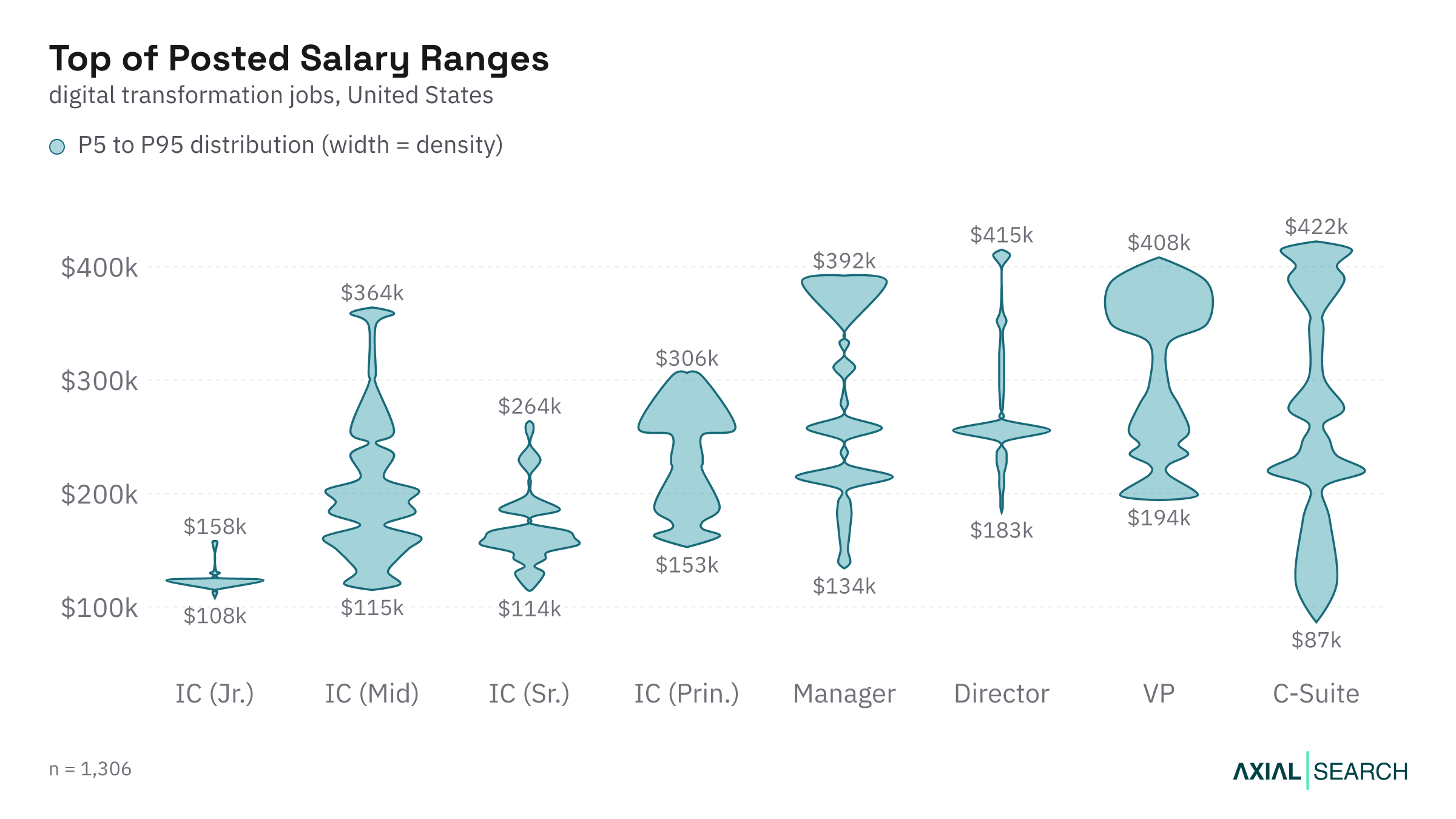
Top of the posted range by seniority — the median and typical maximum of what's posted, 5th to 95th percentile. This is the ceiling candidates can credibly negotiate toward, not the typical offer.
| Seniority | 5th percentile | 25th percentile | Median | 75th percentile | 95th percentile |
|---|---|---|---|---|---|
| IC (Junior) | $102,000 | $123,000 | $123,000 | $123,000 | $158,000 |
| IC (Mid) | $115,000 | $158,000 | $171,000 | $207,000 | $364,000 |
| IC (Senior) | $117,000 | $154,000 | $170,000 | $191,000 | $264,000 |
| IC (Principal) | $160,000 | $185,000 | $224,000 | $260,000 | $299,000 |
| Manager | $135,000 | $211,000 | $250,000 | $307,000 | $392,000 |
| Director | $180,000 | $250,000 | $251,000 | $306,000 | $415,000 |
| VP | $194,000 | $230,000 | $250,000 | $344,000 | $390,000 |
| C-Suite | $99,000 | $216,000 | $266,000 | $384,000 | $422,000 |
Where two percentiles show the same figure, employers are clustering on a round number at that end of the band.
The ceiling has held steady over the past year, consistent with digital transformation becoming table-stakes rather than a premium bet. The distribution is tight: many Director postings cluster at exactly the same posted maximum, and many Manager postings cluster at another shared benchmark, signaling that firms are pegging the range to external comp surveys rather than setting it role by role.
What makes digital transformation pay unusual is the compression above Manager: most functions show a steady climb through the executive tiers, but here the gap is modest — Director, VP and C-suite trade places at the median rather than stacking cleanly on top of each other. Digital transformation is treated as foundational infrastructure, not a premium bet, and the salary structure reflects that — steady, senior and compressed.
Because digital transformation cuts across so many industries and company types, the job itself varies wildly. A Director at a Professional Services firm is running a different playbook than one at a manufacturer, and the pay reflects that. Benchmarking correctly against that variation is exactly the judgment AI executive search brings to a leadership search.
Where most digital transformation salaries cluster
The market is densest at Manager level, which alone makes up a significant portion of postings, with Director adding another band — together these two levels represent a substantial share of the market.
That concentration matters more than the headline median: the band you're quoted at Manager or Director moves your pay far more than the next title bump does once you're past it.
Does staying an individual contributor cap digital transformation pay?
Not as much as you'd expect — the Principal IC track pays close to Director money, so staying technical doesn't cap your ceiling the way it does in most functions.
At the executive tiers the medians converge further still: title moves your pay less than negotiation once you're past Director.
How much room is there to negotiate at the top of the digital transformation range?
More than the median suggests — the 75th-to-95th percentile spread widens sharply at senior levels, from $158,000 for a top-quartile Junior IC to $306,000 for a Principal IC.
That spread is the real story: the higher you sit in the band, the more the posted maximum is a starting point rather than a hard ceiling.
What is the full salary range for digital transformation leaders?
The full posted digital transformation salary range runs from the 5th percentile for junior ICs up to $422,000 at the 95th percentile for C-suite roles — see the table above for the full ladder in between.
Does company size affect digital transformation pay?
Bigger pays more: enterprise-scale firms (5,000+ employees) post a median salary around $215,000 and mention equity in 16% of postings, more than any other size band.
Mid-market firms (500–5,000 employees) mention equity in just 4% of postings. Startup and small companies (under 500 employees) post the lowest median salary, around $170,000, with equity mentioned in only 3% of postings — among the lowest rates we track for any size band at any function.
Does company size affect digital transformation equity offers?
Yes, sharply — equity appears in 16% of postings at enterprise scale (5,000+ employees) versus just 3–4% at mid-market and startup firms, a wider gap than the pay difference alone would suggest.
That's the opposite of the usual startup-equity assumption from other tech-adjacent fields. For candidates weighing equity as part of comp, the data says look toward the largest employers, not the smallest.
Where do digital transformation leaders earn the most?
Pay is geographically compressed for digital transformation, but New Jersey and California lead with notably higher median salaries.
| State | Median salary | Share of postings |
|---|---|---|
| Ohio | $251,000 | 3.6% |
| Georgia | $229,000 | 5.1% |
| California | $224,000 | 10.7% |
| New Jersey | $221,000 | 4.5% |
| District of Columbia | $215,000 | 2.4% |
California captures 10.4% of the market and posts one of the highest median salaries in the country — for a function this distributed across industries, that concentration signals where the biggest transformation mandates sit, particularly in tech-adjacent Professional Services.
How tightly does digital transformation pay cluster across states?
Very tightly — the top five states sit close together, so where you work moves your salary far less than how senior you are.
That's a different pattern than most senior leadership tracks, where the top-paying states can separate by six figures.
The top-paying cities for digital transformation
San Francisco leads and pays the highest median salary, though the gap from top to bottom is modest — the city you're in moves your pay less than the sector and company size you're in.
San Francisco's premium reflects the Bay Area's Professional Services and tech concentration, while other leading markets track their positions as corporate headquarters hubs for Fortune 500 firms running large-scale transformation programs.
Which industries pay digital transformation leaders the most?
Digital transformation pays the most in Professional Services, where transformation is the product — a median salary around $251,000, roughly $43,000 ahead of the lowest-paying sector on this list.
| Sector | Median salary | Postings |
|---|---|---|
| Professional Services | $251,000 | 805 |
| Life Sciences | $241,000 | 33 |
| Manufacturing | $223,000 | 97 |
| Healthcare | $208,000 | 53 |
| Technology | $202,000 | 44 |
Professional Services is a significant portion of postings in this dataset, and it's where the transformation mandate is client-facing and billable, so the role skews toward strategy and executive engagement. Manufacturing sits second, driven by Industry 4.0 and operational-efficiency mandates that often involve plant-floor automation and ERP overhauls.
That Technology sits at the bottom is the surprise: tech firms are hiring digital transformation leaders to manage internal change, not client delivery, so the role is closer to program management than strategy.
How much does sector really matter for digital transformation pay?
Less than seniority does — roughly $43,000 separates the top sector (Professional Services) from the bottom of this list (Technology), a real gap but a smaller one than moving from Manager to Director.
Sector shapes the kind of transformation work you do more than it shapes the paycheck.
How often are digital transformation bonus and equity offered?
Bonus is mentioned in digital transformation postings and equity in just 4% — both are floors, not ceilings, since many roles that don't advertise either still offer one.
Dollar figures are almost never posted, so a mention rate is the best signal available.
How often a bonus is offered
A bonus is mentioned in digital transformation postings — common enough to ask about, but far from universal in the text.
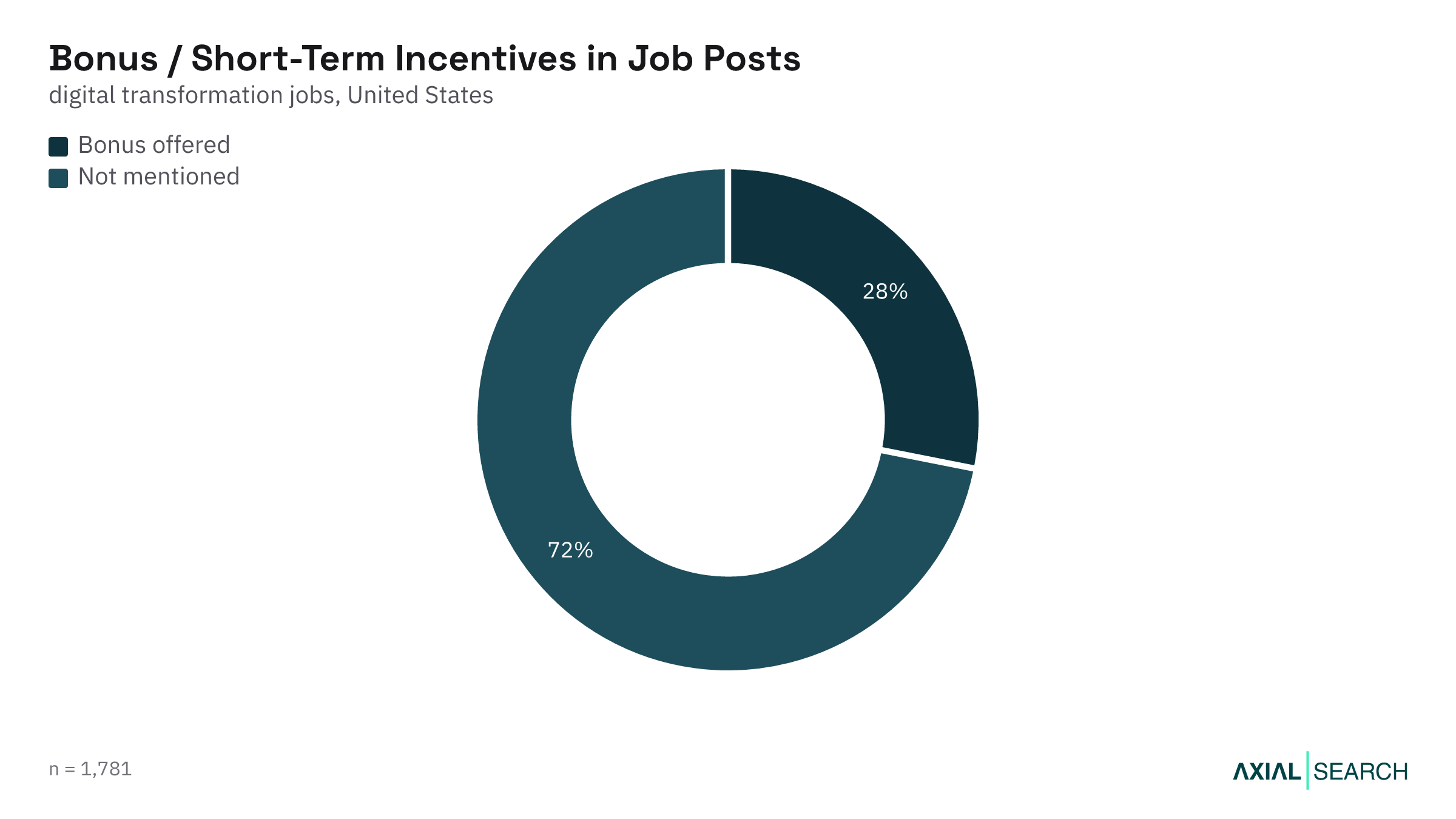
That share rises sharply at Manager level, where postings mention a bonus, and stays above 20% at most senior levels, including the C-suite. The lowest mention rates land at Junior IC (5%) and Mid IC, where the roles skew toward execution rather than client engagement or revenue accountability.
How often equity is offered
Equity is mentioned in just 4% of digital transformation postings, and it barely appears at any level — the highest mention rate is 9% at Director.
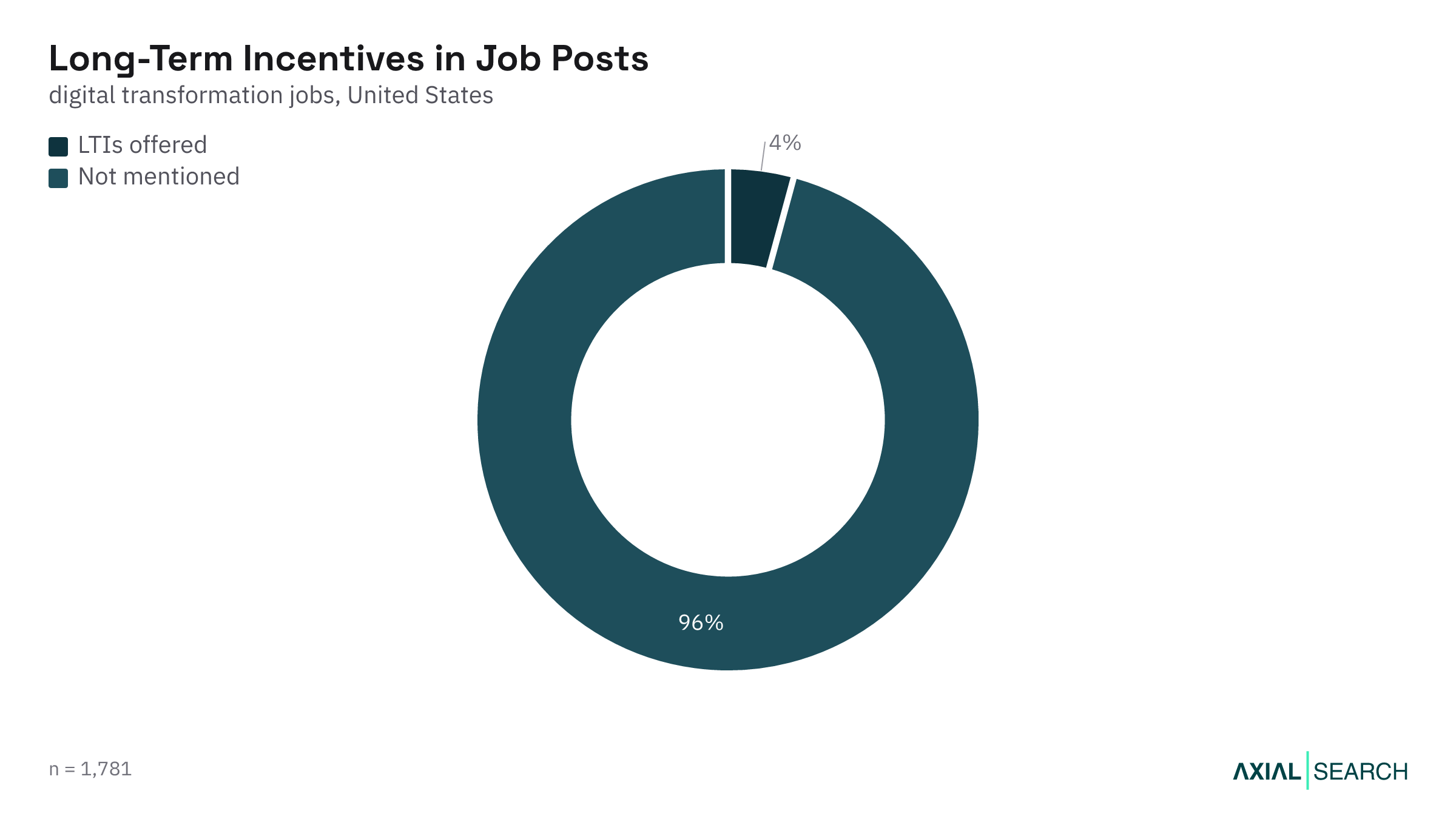
It drops to 0% at Junior IC, and Managers sit at just a minimal level, VPs at 7% and C-suite at 3%. This is one of the lowest equity-mention rates across any function we track, which reflects how digital transformation is positioned: a critical enabler of the business, not a high-risk bet.
| Level | Bonus mentioned | Equity mentioned |
|---|---|---|
| IC (Junior) | 6% | 0% |
| IC (Mid) | 26% | 4% |
| IC (Senior) | 38% | 5% |
| IC (Principal) | 26% | 3% |
| Manager | 50% | 2% |
| Director | 30% | 10% |
| VP | 38% | 7% |
| C-Suite | 26% | 9% |
What the bonus-versus-equity split says about digital transformation retention
The split tracks accountability, not seniority alone: bonus concentrates where roles carry client or revenue exposure — Manager and VP — while equity concentrates at Director, where retention of the people who can walk a transformation across the finish line matters most.
For candidates, that means the biggest lever to negotiate depends on your track: client-facing Managers should push on bonus structure, while Directors have more room to ask about equity specifically.
Final Thoughts
For candidates. Digital transformation pays steady and senior, but the money concentrates at Director and above and equity almost never shows up in the posting. Lead with the outcomes you drove — ERP migrations, process redesigns, measurable cost savings — and frame your work around executive sponsorship and cross-functional delivery, the two capabilities employers emphasize most. A PMP or Agile certification helps at the margin, but no credential opens this door on its own; it's the decisions you made and the scale of the change you led. If you're negotiating above Manager, the posted band is tight but the spread within each level is wide, so bring market data and be ready to justify where you sit in it. If you focus more on applying AI to reshape operations than on broader system overhauls, AI strategy salaries reflect that more specialized technical depth.
For employers. This is a deep but highly competitive pool: 1,781 US postings in a quarter, most of it management level, and the capabilities that matter most — use case selection, securing sponsorship and operating model design — are the hardest to read off a resume. Interview around real decisions, not years in seat, and be ready to move quickly when a strong candidate surfaces. Equity barely appears in digital transformation offers below enterprise scale, so you're mostly competing on base and bonus; if you want to stand out, lead with clarity on scope, executive access and the transformation mandate itself. Our digital transformation hiring guide covers interview questions and how to assess candidates against this exact profile.
Methodology & sources
- Data sources. Job data is collected from publicly available postings on online job boards and updated weekly, covering US roles posted since January 2026. Explore and filter it on our live AI job market dashboard.
- All salary figures are derived from the minimum and maximum salary bands employers post, annualized and reported as percentiles, not averages.
- Every salary figure on this page is the top of the posted range — the ceiling employers advertise, not the typical offer. The seniority table reports it at the 5th, 25th, 50th (median), 75th and 95th percentiles. Median salary in the sector, company-size and location tables is the median of that ceiling within each group.
- Company size is banded into three groups: Enterprise (5,000+ employees), Mid-market (500–5,000 employees) and Startup-Small (under 500 employees) — figures are reported only for postings that disclose a salary.
- Bonus and equity figures are mention rates — the share of postings that state a bonus or equity. A posting silent on either is counted as "not mentioned"; it does not mean none is offered.

How to Think About Digital Transformation Hiring in 2026
What it takes to hire digital transformation leaders in 2026: pay benchmarks, how competitive the market is, where talent concentrates, and how to assess candidates, all drawn from 1,781 US job postings analyzed this…

The Skills That Land Digital Transformation Roles in 2026
How to become a digital transformation leader in 2026: the qualifications, degrees, certifications and skills that 1,781 US job postings actually screen for, the leadership profile employers hire against, and how to…

Digital Transformation Jobs in 2026: What 1,800 Postings Reveal
Digital transformation's 2026 job market, mapped from 1,781 US postings: what these leadership roles pay, how hot hiring demand runs, whether the work is remote, and what digital transformation leaders actually do —…
Turn AI ambition into lasting business value
Whether you're hiring your first AI leader or scaling enterprise transformation capability, we help you define, assess and recruit the people who make it stick.