AI Transformation Leadership

The Three-Lens Leader Framework

Defining and assessing the leader for your AI transformation

Every business is under pressure to do more with AI. The technology has moved from a distant agenda to a line item with expectations for performance. Research shows that AI adoption is now mainstream, with more than 75% of companies using it in their business. Whether AI can deliver value is mostly a settled question.

The harder question is — how much? Only about a third of companies report a meaningful impact on the bottom line. Plenty are using AI. Far fewer have unlocked the potential that was promised.

The companies seeing real returns are the ones rethinking how work gets done — redesigning their operating models and challenging what it means to compete in their industry. Most companies never get there. They bolt AI onto individual tasks and pick up marginal gains, when the substantial ones come from changing the way the business runs. The tools are not the constraint. The capacity to lead that change is.

Strong AI leadership comes down to three things: clarity on where AI can create value, the technical acumen to build solutions that work, and the leadership to make new ways of working stick. Every business needs all three — but rarely in the same proportions.

The Three-Lens Leader Framework was built to get this decision right. By measuring talent against the realities your situation demands — your constraints, your capabilities, the agenda you're trying to deliver — it identifies the leader your business needs rather than one the job title implies.


The Three-Lens Leader Framework

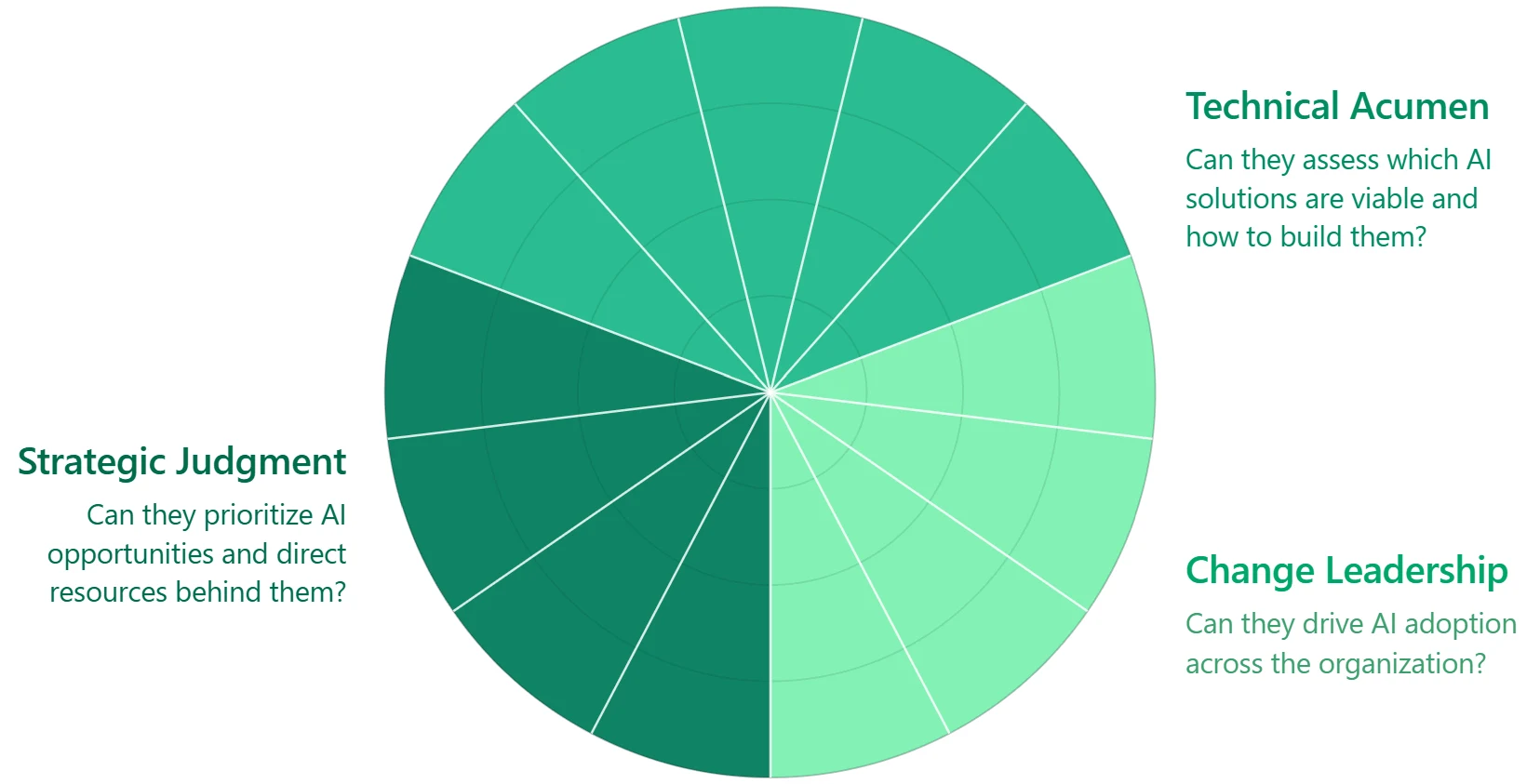
The Three-Lens Leader Framework — balancing strategic judgment, technical acumen and change leadership when hiring AI transformation leaders.

Source: Axial Search proprietary research, 2026

The Three-Lens Leader Framework defines the capabilities required to deliver AI transformation. It turns a broad hiring need into a clear, weighted profile of the leader an organization’s transformation agenda demands.


Where AI leadership searches go wrong

Recruitment campaigns for AI leadership often fail before anyone makes it to interview. The problem is rarely a shortage of candidates. It is a lack of precision about what the leader is actually being hired to do.

The assessment goes wrong in familiar ways:

  • Strategic judgment gets taken for granted: plenty of candidates talk fluently about models and market direction, far fewer can say where AI creates value for this business — which bets to make, which to leave alone.
  • Technical depth gets overweighted: the strongest engineer in the room is taken for the strongest leader, when that same person may never have aligned an executive team or moved a solution beyond a working pilot.
  • Change leadership gets underestimated: treated as a phase that follows the build, when it's what determines whether the build ever changes how the business runs.

Each one is the same error — weighting the role by what's easy to spot rather than what the business needs. Get it right and you're looking for the opposite:

FromTo
Fluent on AI
Clear on where it pays
An expert builder
A complete leader
Adoption as an afterthought
Adoption as the work

But the right assessment only pays off if the search was pointed at the right target to begin with. Every one of these failures runs back to the same upstream choice: hiring to fill a job rather than to deliver a mandate.

Moving from job titles to leadership mandates

No title misleads more than Chief AI Officer. Every one is expected to own enterprise AI strategy — but one can be hired to fix data foundations, the next to ship products, the next to win over an organization that doesn't trust the technology. Same title, three different jobs. The title describes the seat. It does not define the work.

The Three-Lens Leader Framework clarifies the mandate behind the title — which capabilities it demands, how heavily each lens should weigh and what kind of leader it calls for. The answer changes with the company's ambition, technical maturity, data environment and readiness for change.

The examples below show how the same title splits into very different mandates. They are not templates. They are illustrations of what happens when a search starts with the work to be done rather than the title to be filled.

Example mandates

A private equity firm seeking rapid value creation across its portfolio. Technical depth exists in the team and is supplemented with consultants. Strategy and organizational adoption matter more than hands-on build.

A provider with a settled automation agenda and strict data and compliance demands. The strategy is already set, the real gap is the technical maturity to ship and land it on the front line.

An industrial manufacturer sitting on a large but fragmented data estate, with goals anchored in operational efficiency. The balanced profile tilts toward connecting that data to decisions and framing value across operations.

A financial-services business with legacy systems, governance concerns and a low appetite for disruption. Success rests on data readiness and the technical standards to scale AI safely within tight risk and budget guardrails.

Chief AI Officer

Private equity firm
Strategic JudgmentTechnical AcumenChange Leadership

Hover a segment for detail.

Scope your transformation needs

Use the AI Leadership Talent Strategy Builder to translate your AI transformation goals into a profile of the leader who can help you achieve them.

Build your AI talent strategy

What the three lenses measure

The Three-Lens Leader Framework breaks the work of AI transformation into thirteen observable capabilities. Senior candidates can all sound credible if you don't know where to look. The question is whether they've shown the specific judgment, fluency and leadership this mandate demands — and these are the capabilities where it shows.

Lens 01

Strategic Judgment

Choosing the right problems to solve and aligning AI efforts with business priorities.

Capability 01

Use Case Selection

When anything is possible, knowing where to focus is priceless. Strong leaders separate attractive ideas from valuable ones — where AI improves cost, speed, quality, risk, compliance, customer experience or revenue — and defer the opportunities where the data, process or operating model is not ready.

Capability 02

Operating Model Design

Technology rarely fails in isolation; it fails because the work around it never changed. Strong leaders redesign roles, processes and decision rights so AI becomes part of how the business runs — clear on where ownership sits and how business and technical teams work together.

Capability 03

Value Framing

Success usually gets defined after the build, when it should be defined ahead of time. Strong leaders set the bar first — translating technical possibility into a business case with expected value, tradeoffs and a credible way to measure whether AI is improving performance.

Capability 04

Resource Management

Every AI initiative is a series of build, buy and partner decisions. Strong leaders direct budgets, talent and timelines across them — what to build internally, what to buy, where a partner accelerates progress and how to sequence it all without piling up complexity.

Lens 02

Technical Acumen

Understanding the conditions for success and how to build a working solution.

Capability 01

AI Literacy

The hype moves faster than the capability. Strong leaders separate substance from spin, explain AI plainly and catch when expectations are running ahead of what the organization can deploy.

Capability 02

Architectural Fluency

Most deployments break where systems come together. Strong leaders see how models, data and tools have to interact — spotting the connection that buckles under load before it's built.

Capability 03

Data Readiness Judgment

Every use case rests on data, and getting it ready is real work most companies underestimate. Strong leaders assess whether data is available, accessible, trusted and structured well enough to carry a solution — separating what's ready to ship from what has to wait.

Capability 04

Governance Discipline

The risk you don't see is the one that scales with you. Strong leaders spot where a deployment is exposed — model risk, security, data privacy, compliance, operational reliability — before it surfaces. They set guardrails that let the business scale responsibly without grinding progress to a halt.

Capability 05

Hands-On Execution

How much a leader needs to build themselves varies by role. Some mandates call for a leader who can build directly, from orchestrating existing tools to engineering original systems; others need only enough fluency to credibly lead and judge a technical team.

Lens 03

Change Leadership

Bringing the organization along and making new ways of working stick.

Capability 01

Securing Sponsorship

Adoption stalls the moment executive commitment wavers. Strong leaders win visible, sustained backing from the executives accountable for the outcome — aligned on the mandate, the investment, the tradeoffs and the behavior change required.

Capability 02

Shaping the Narrative

The organization can only act on what it understands. Strong leaders explain why the transformation matters, what will change and how people should respond — meeting resistance head-on rather than waiting it out.

Capability 03

Engaging the Organization

People support what they help build. Strong leaders bring in those closest to the work while solutions can still be shaped — building ownership instead of passive compliance, delivering tools people use rather than ones they put up with.

Capability 04

Driving Adoption

Strong leaders embed new ways of working through training, incentives and steady reinforcement. They set clear expectations and measure whether behavior has changed — not just whether a tool was shipped.

How the framework guides a search

The framework does not run the search — that's our job, and our process covers it end to end. What the framework does is sharpen the handful of decisions the whole search hinges on. Get these right and everything downstream gets easier. Get them wrong and no amount of sourcing or interviewing saves the hire.

Clarifying the mandate

Most searches begin with a title to fill. The framework forces you to start with the problem to solve and the constraints to overcome.

Weighting the capabilities

When constructing a role, the temptation is to describe your ideal candidate. Weighting the three lenses forces the hard choices a wish list avoids.

Mapping the market

Most searches discover too late that the spec was unrealistic. A defined profile is tested against the market before the search begins.

Assessing the evidence

Interviews reward the candidate who presents well. Evidence rewards the one who has done the work — decisions owned and outcomes delivered.

Comparing the tradeoffs

The perfect candidate does not exist. The framework lets you compare candidates head to head — strengths, weaknesses and the gaps a role can bear.


Hire leaders to deliver your AI agenda

AI transformation leadership is defined by the work, not the title. Where AI should create value, what can be built, and how the business will adopt new ways of working — that is what the role has to be built around.

The Three-Lens Leader Framework gives CEOs and leadership teams a clearer way to make that judgment — turning a decision usually made on instinct into one made on evidence.

The organizations that turn AI ambition into lasting value won't simply hire people who understand the technology. They'll hire leaders who connect all three lenses — turning investment into adoption, adoption into performance and performance into advantage.

Methodology

The Three-Lens Leader Framework draws on four sources of market and leadership insight.

  1. Hundreds of conversations with AI transformation leaders across sectors, functions and seniority levels — covering how organizations define AI leadership, where mandates are growing more complex and which capabilities prove most critical as AI moves from experimentation to deployment.
  2. An analysis of more than 100,000 AI transformation job postings between October 2025 and May 2026, identifying how organizations describe their needs, which capabilities they emphasize by role type and where job titles obscure real differences in mandate.
  3. A review of current research and executive thought leadership on AI adoption, data leadership, organizational change and the emerging role of senior AI executives.
  4. Pressure-testing with Axial Search's advisory network of AI executives and transformation leaders, whose feedback refined the structure and tested it against the realities of recruiting for these roles.

Together these inputs pointed to the same conclusion the framework is built on: AI transformation leadership depends not on any one of these capabilities, but on the balance across all three.

START A SEARCH

Turn AI ambition into lasting business value

Whether you're hiring your first AI leader or scaling enterprise transformation capability, we help you define, assess and recruit the people who make it stick.