
Who's Hiring for Digital Transformation in 2026
Where digital transformation jobs are in 2026: hiring demand and trend, top states and cities, who's hiring by sector and company size, and the mix of seniority, contract type and remote work across US postings.
Updated: July 13, 2026

Drawing on 1,781 US job postings analyzed this quarter, this is where digital transformation hiring stands: the demand trend, who's posting the most by sector and company size, what level and contract type those roles take, how remote work factors in and which states and cities hold the largest share of openings.
- Steady volume, punctuated by spikes: Digital transformation hiring averages 64 new US roles weekly, with occasional surges past 200 postings — the work is less seasonal than other AI functions.
- Enterprise-dominated hiring: 65% of digital transformation postings come from organizations with 10,000+ employees, and Professional Services alone accounts for 36% of all roles.
- Manager-heavy, not Director-gated: Digital transformation roles are modal at Manager (34% of postings), with a full ladder from junior IC (14%) through C-suite (4%) — a wider seniority spread than most AI functions.
- Hybrid is the default: Among digital transformation postings that specify work setting, 69% are hybrid and only 17% are fully remote — this work expects you in the office part-time.
- Nationally distributed, not coastal-only: Texas (11%) and California (10%) lead digital transformation hiring by state, but the top ten cities together hold just 27% of postings — the work happens everywhere.
How digital transformation hiring demand is trending
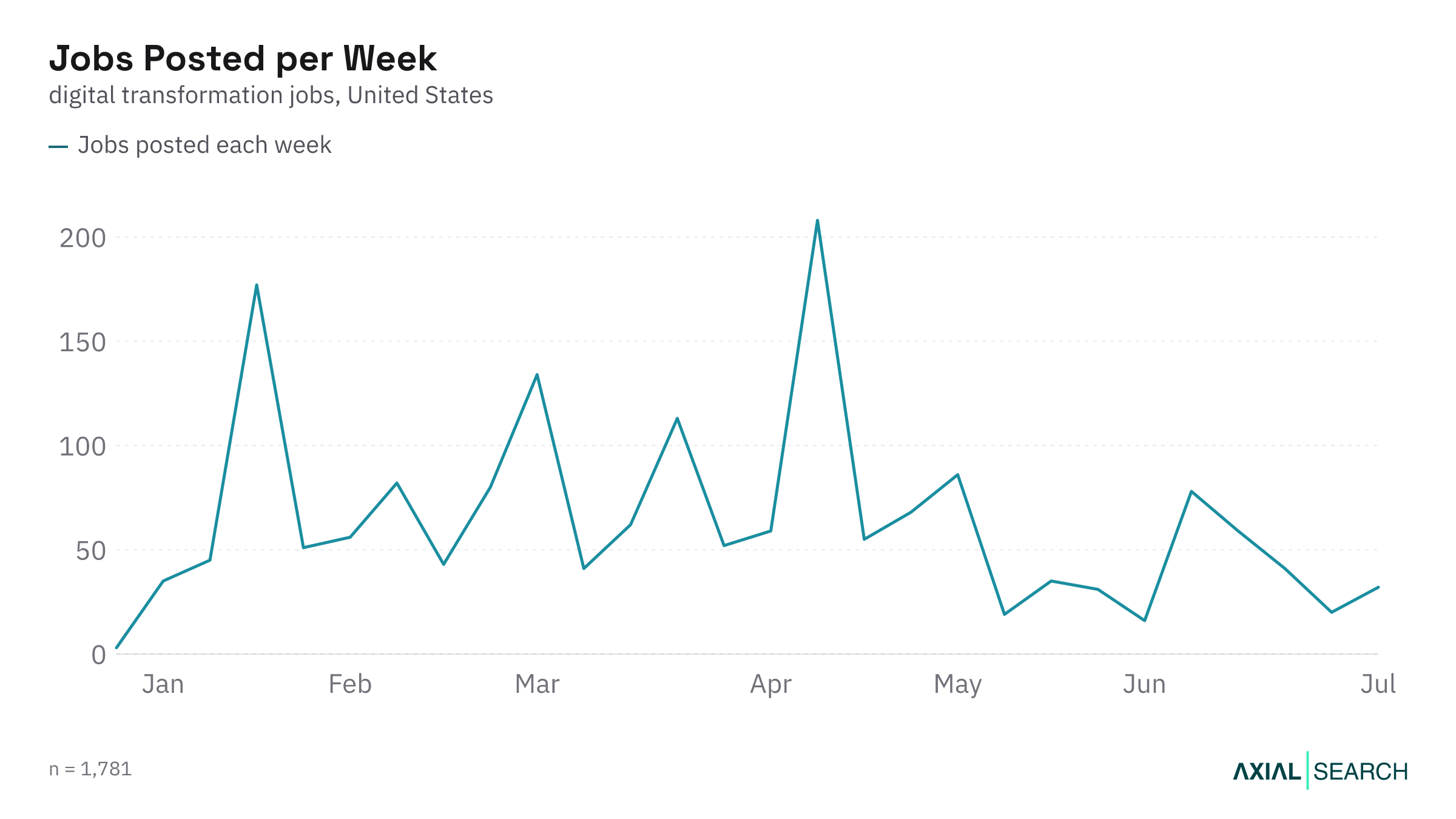
Digital transformation hiring has been steady through the first half of 2026, averaging around 64 new US roles a week.
Two weeks stand out: the week of January 19 posted 177 roles and the week of April 13 posted 208, likely reflecting synchronized hiring cycles at large consulting firms and enterprise clients. Outside those spikes, weekly volume has held between 30 and 135 postings, settling near 60 as the summer quarter opened.
That sustained baseline, absent the seasonal drop you often see in specialist hiring, means candidates face predictable competition week to week. For employers, it means you're fishing the same pool every Monday — not racing to hire before a surge ends, but competing steadily for a finite number of qualified leaders.
Who's hiring digital transformation talent
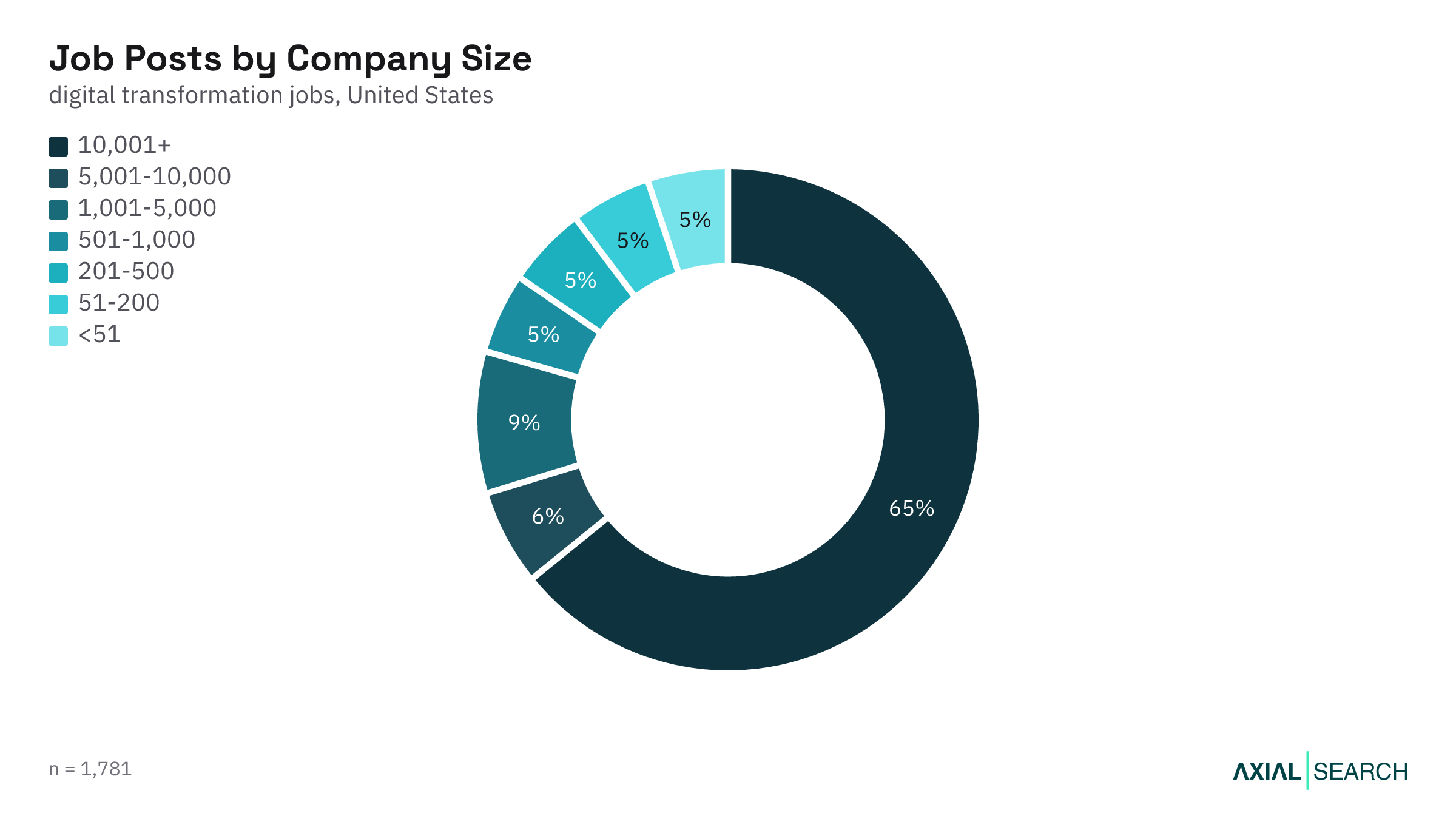
Two-thirds of digital transformation postings (65%) come from companies with more than 10,000 employees. These are organizations large enough to be running multi-year transformation programs and staffing them with dedicated roles rather than part-time project teams.
The next tier down, 1,001 to 5,000 employees, accounts for 9%, and the 5,001 to 10,000 band another 6%. Startups under 51 employees post just 5% of roles — this is not a function small teams are building out yet.
The sector mix reflects that enterprise weight:
| Sector | Share of digital transformation postings |
|---|---|
| Professional Services | 36.2% |
| Financial Services | 17.9% |
| IT Services | 9.2% |
| Manufacturing | 7.3% |
| Technology | 3.4% |
| Healthcare | 2.9% |
Professional Services dominates — consulting firms and service providers hire transformation talent to deploy at client sites, which explains why more than a third of all postings trace back to that sector.
Financial Services and Manufacturing both rank high, showing this work has spread well beyond tech-native companies and into industries with legacy infrastructure to overhaul. The tail of Technology firms posting at this level is smaller than in functions like AI strategy, where pure-play software companies drive a larger share.
What kind of digital transformation roles are being posted
These roles span a wider seniority range than most AI functions, they're overwhelmingly permanent and they lean heavily hybrid rather than fully remote. The three cuts below describe what a typical opening looks like.
Seniority levels in digital transformation hiring
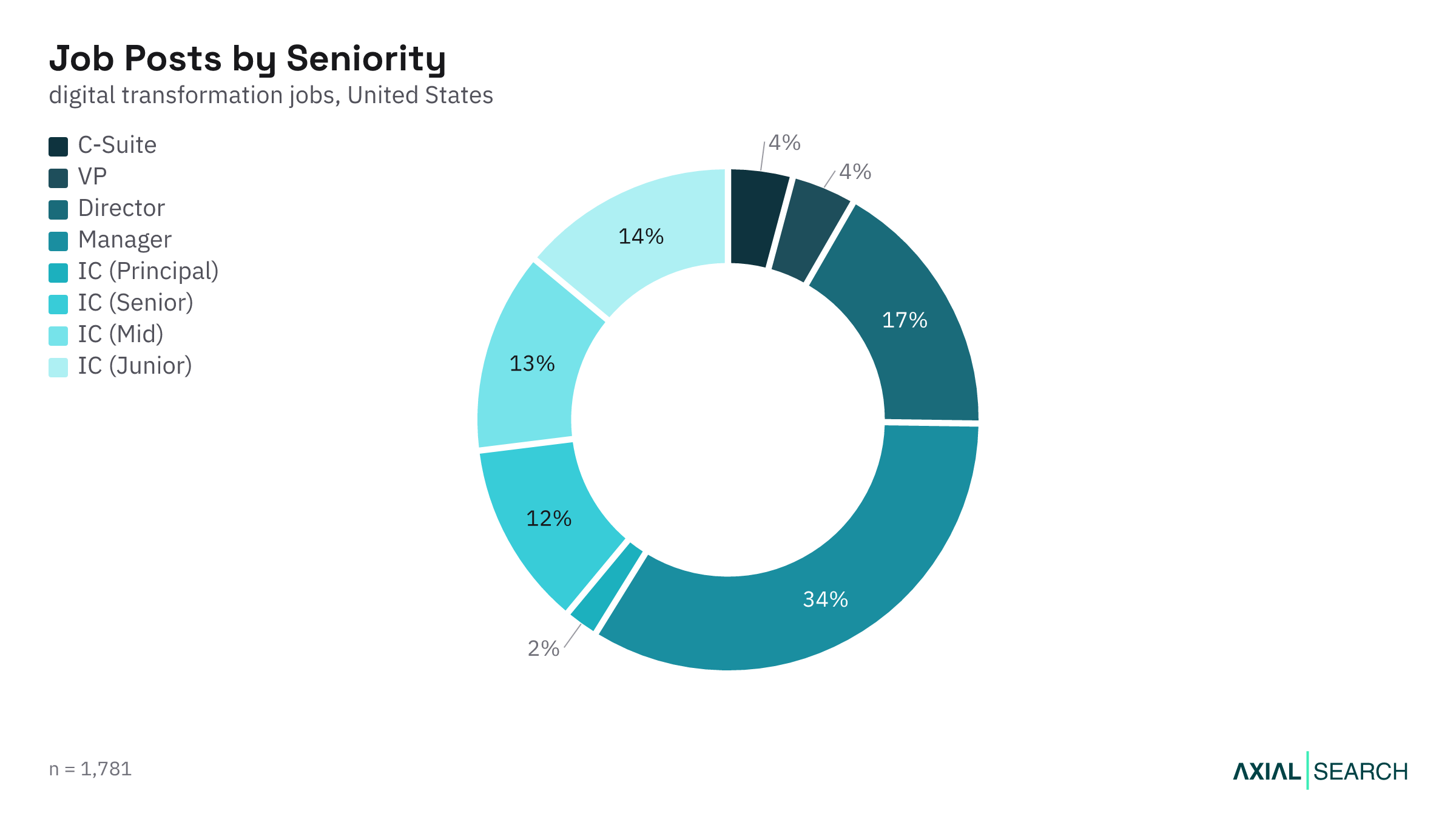
Digital transformation postings skew Manager-level — 34% of all roles sit at that band. Directors account for 17%, and then the distribution spreads across the IC ladder: 14% are junior ICs, 13% mid-level and 12% senior.
VP roles make up 4% and C-suite another 4%. Principal IC, the technical expert track that stays out of management, is just 1%.
That's a wider spread than functions like AI strategy, where Director-level dominates. For candidates, it means entry is less bottlenecked at the top — you can start as a mid-level IC and build a transformation skillset before stepping into management.
For employers, it means you're hiring teams rather than single senior leaders, and the market supplies enough volume at each band to staff a full program without cherry-picking only Directors.
Full-time versus contract digital transformation roles
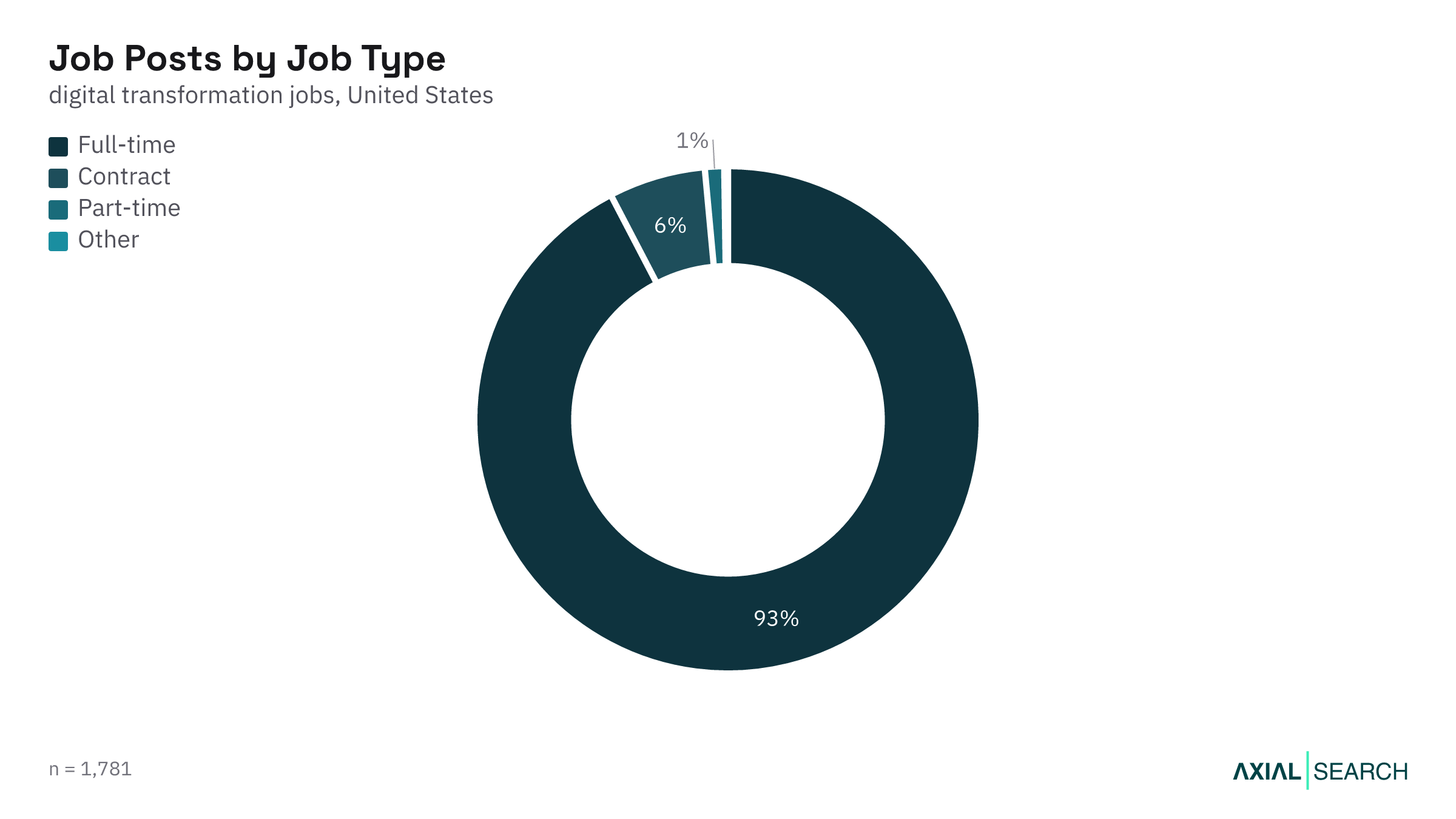
This is a permanent-hire market: 93% of postings are full-time, 6% contract, and the remaining 1% split between part-time and other arrangements.
Companies are building digital transformation as a standing capability, not staffing it with contractors on short engagements. If you're a candidate expecting flexibility through contract work, the openings exist but they're a slim minority.
Remote, hybrid and onsite digital transformation roles
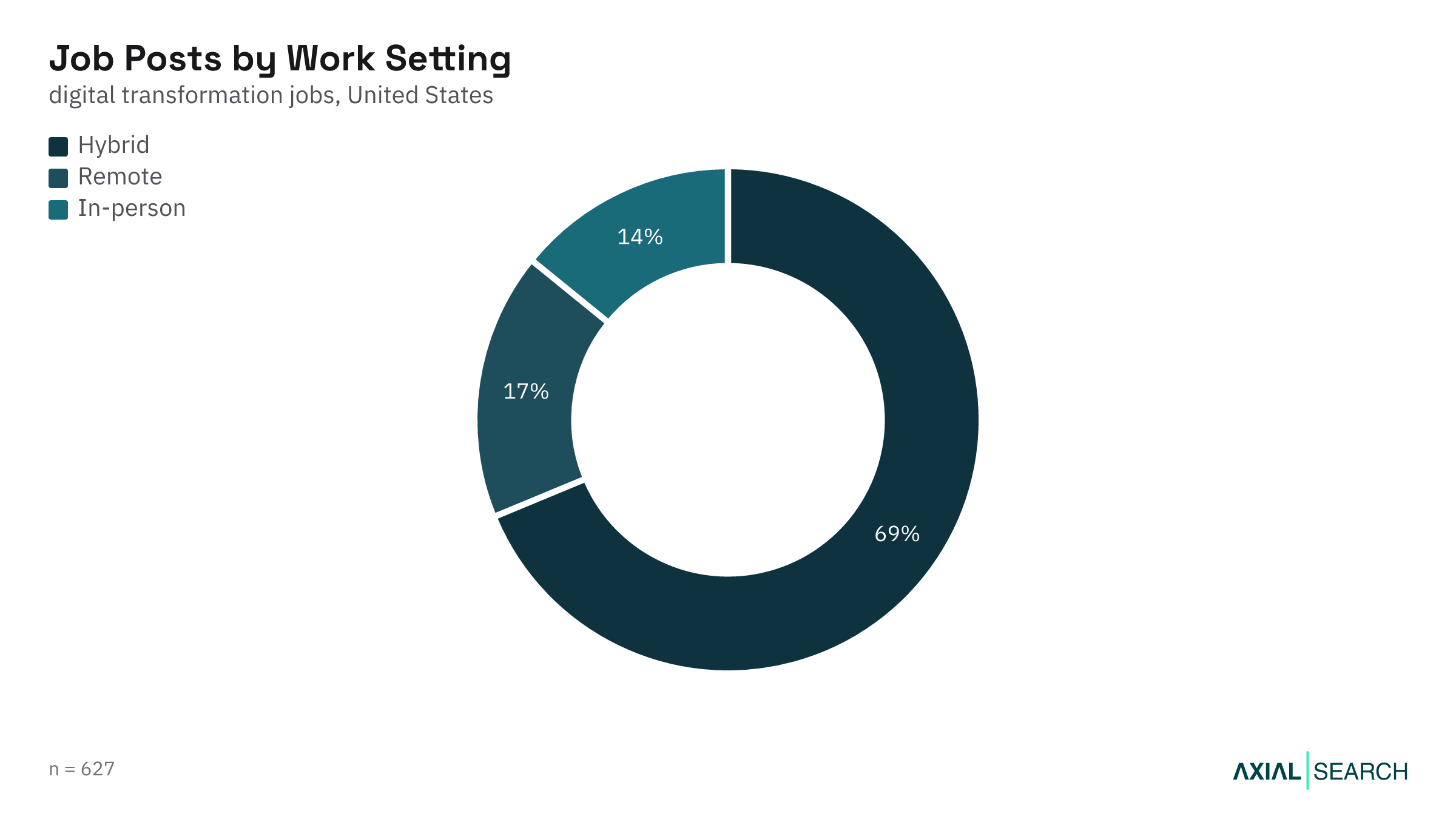
Most postings don't state a work model at all, but among the 35% that do, hybrid is the default — 69% of specified roles. Only 17% are fully remote and 14% are strictly on-site.
So while the work clusters in a few cities, a meaningful share can be done from elsewhere, just not to the same degree as fully remote AI functions. If you're unwilling to commute at least part-time, your addressable market shrinks to about 6% of all postings.
Where digital transformation jobs are located
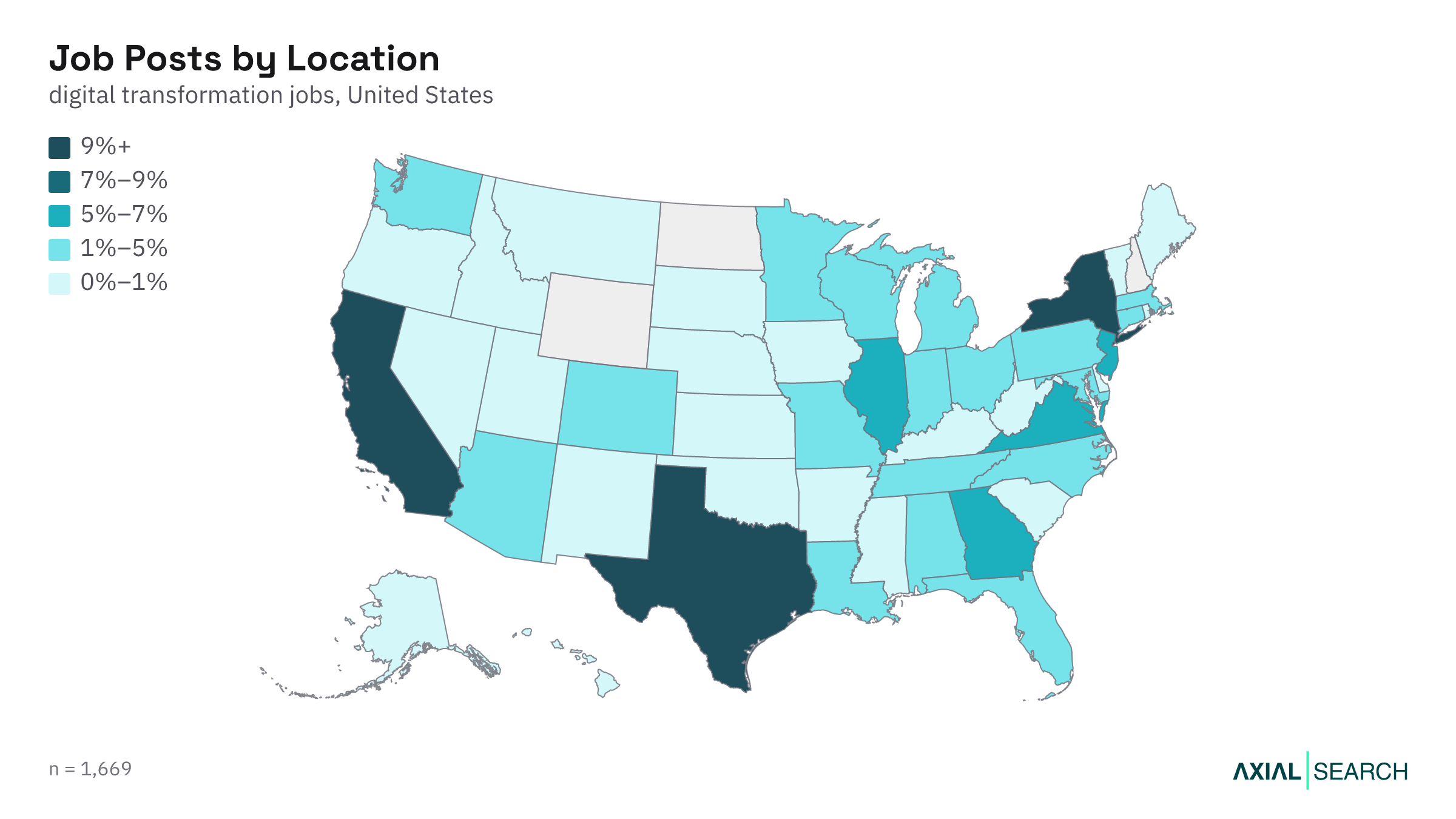
Digital transformation jobs are more nationally distributed than most AI hiring. Texas leads with 11% of postings, California sits at 10% and New York at 9%. Illinois holds 5%, New Jersey and Georgia each 5%, and no single state commands more than that 11% share.
| State | Share of postings |
|---|---|
| Texas | 10.5% |
| California | 10.4% |
| New York | 8.9% |
| Illinois | 5.2% |
| New Jersey | 4.6% |
| Georgia | 4.6% |
| Virginia | 4.5% |
| Florida | 4.4% |
| North Carolina | 4.2% |
| Pennsylvania | 3.7% |
The top ten states together account for just 62% of postings, leaving the other 38% spread across the remaining forty. That means hiring happens everywhere, not just in the handful of metros that dominate other AI functions.
The top cities for digital transformation jobs
At the city level, Chicago leads with 5% of postings, a reflection of its concentration of enterprise headquarters and the consulting firms that serve them. Atlanta follows at 4%, Houston at 3%, Dallas at 3%, Charlotte at 2% and San Francisco at 2%.
| City | Share of postings |
|---|---|
| Chicago, IL | 5.2% |
| Atlanta, GA | 4.1% |
| Houston, TX | 3.2% |
| Dallas, TX | 2.9% |
| Charlotte, NC | 2.2% |
| San Francisco, CA | 2.1% |
| McLean, VA | 1.6% |
| Boston, MA | 1.6% |
| Austin, TX | 1.6% |
| Los Angeles, CA | 1.6% |
No single city dominates the way New York does for AI strategy or San Francisco does for machine learning. The top ten cities together hold just 27% of postings, so the other 73% are scattered across dozens of metros.
If you're a candidate, that means you're not forced to relocate to two coastal hubs. If you're an employer hiring through AI executive search, it means your competition for talent is more regionally fragmented — local presence matters, and candidates who know your market carry an edge.
For where these jobs pay the most, see digital transformation salaries.
Final Thoughts
For candidates. Digital transformation is a management-heavy market, but it's less bottlenecked at Director than other AI functions — a third of postings sit at Manager, and another quarter are IC roles. That wider ladder means you can enter earlier and build the skillset before you run the program. The work is also more nationally distributed than most AI hiring, so if you're outside the Bay Area or New York, you're competing on more equal footing. Lead with breadth: the most-mentioned capabilities are ERP platforms, Agile, cloud platforms and SQL, not deep expertise in any single stack. Full breakdowns of what gets shortlisted are in digital transformation skills. If you lean more toward architecting machine learning roadmaps than enterprise-wide change, AI strategy hiring demand shows where that specialization leads.
For employers. This is a stable, high-volume market — you're posting against 64 other roles a week, most of them from enterprise-scale competitors in Professional Services and Financial Services. Two-thirds of your candidates expect hybrid work, and nearly all of them expect permanent roles, so contract-to-hire won't attract the best shortlist. Because the talent is regionally spread, local presence and regional expertise matter more than in coastal-concentrated functions.
Methodology & sources
- Data sources. Job data is collected from publicly available postings on online job boards and updated weekly, covering US roles posted since January 2026. Explore and filter it on our live AI job market dashboard.
- Hiring demand is the count of matching postings per week.
- Company size, seniority, job type and work setting are each group's share of postings. Work-setting shares are computed over the 35% of postings that state a work model — the rest are silent, not counted as a category.
- Top states and cities are ranked by share of postings; remote-only postings are excluded from the cities list.
- Sector distribution reflects the primary industry classification of the hiring organization as stated in job postings.

Digital Transformation Salary Benchmarks for 2026
What digital transformation roles pay in 2026: median salary, pay by seniority, top-paying sectors and locations, and how often bonus and equity are mentioned in US job postings.

Digital Transformation Roles: How to Position Yourself in 2026
How to become a digital transformation professional in 2026: the leadership capabilities employers screen for, the experience and degrees required, the certifications that matter, and the skills most in demand across…

Digital Transformation Jobs: The 2026 Market Map
The complete picture of the digital transformation job market in 2026: hiring demand, what these roles pay, where the jobs are, who's hiring and what it takes to get in.
Turn AI ambition into lasting business value
Whether you're hiring your first AI leader or scaling enterprise transformation capability, we help you define, assess and recruit the people who make it stick.