
Who's Hiring AI Strategy Talent in 2026
Where AI strategy jobs are in 2026: hiring demand and trend, top states and cities, who's hiring by sector and company size, and the mix of seniority, contract type and remote work across US postings.
Updated: July 13, 2026

If you're looking for an AI strategy role, or hiring for one through AI executive search, this is where the market is. Drawing on 9,672 US job postings analyzed this quarter: how demand is trending, who's hiring and where the jobs are concentrated.
- AI strategy hiring runs at roughly 350 postings a week — steady through 2026 and trending gently upward, not cooling off.
- Half the market is Director-level, and just 2% of AI strategy postings are for junior ICs; this is a leadership-heavy market that rewards prior initiative-running experience.
- Nearly half the jobs come from companies with 10,001+ employees, and Technology firms alone post a quarter of all AI strategy roles.
- Of postings that specify a work setting, half are hybrid and a third fully remote — only 16% require on-site presence five days a week.
- California and New York together hold 35% of postings, but the city mix is surprisingly national: Chicago, Atlanta and Austin all rank in the top five.
How AI strategy hiring demand is trending
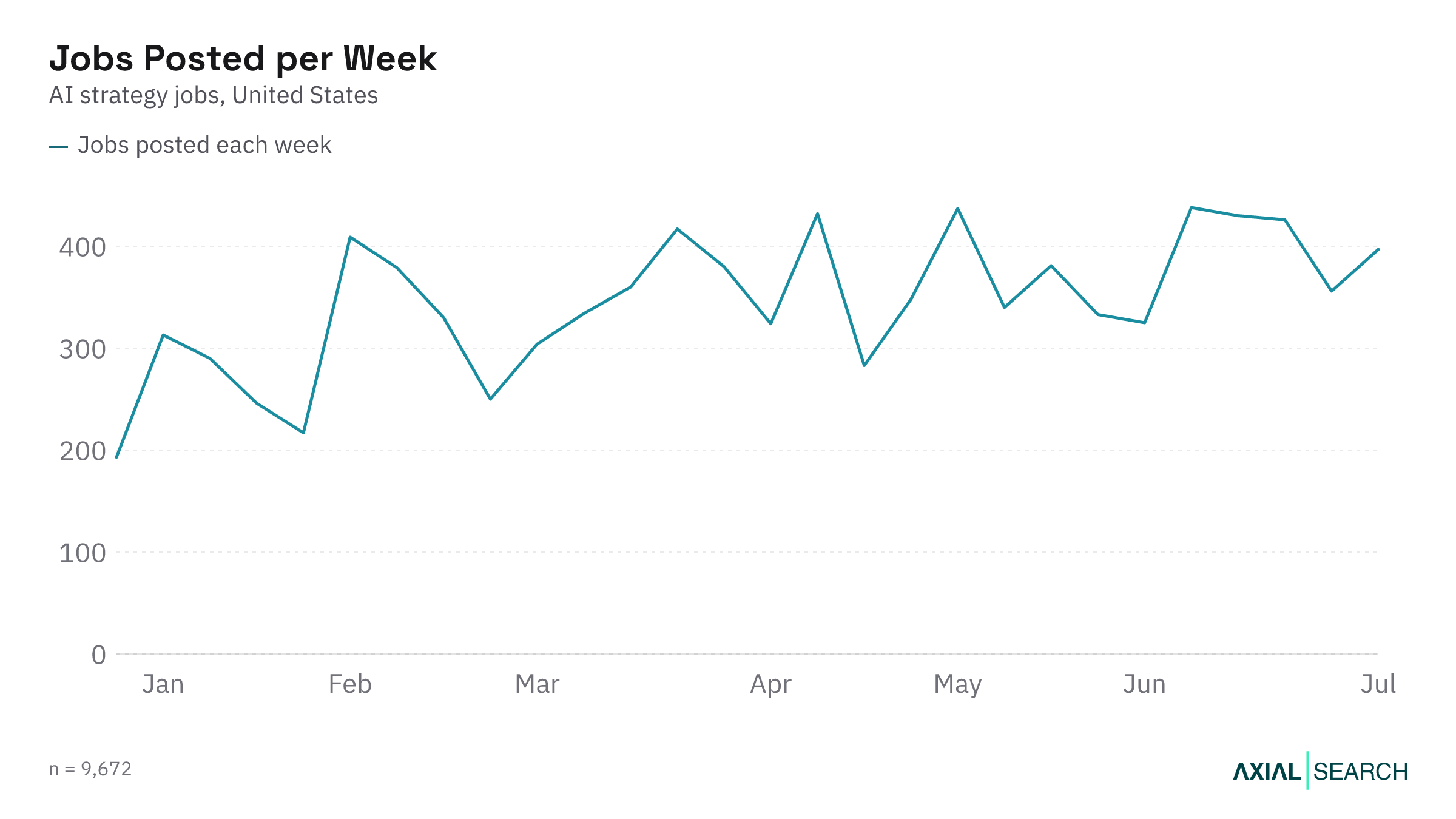
AI strategy hiring has been remarkably steady. Employers post around 350 new US roles a week on average, fluctuating between a low of 193 postings in late December 2025 and highs past 430 in spring and early summer 2026. The trend has edged upward through the first half of 2026 rather than cooling off, with weekly postings in late June and early July holding near 400 to 430 new roles.
For candidates, that means a consistent flow of openings rather than a feast-or-famine cycle; for employers, it means the competition for senior AI strategy talent isn't letting up. The upward momentum suggests that volume isn't about to shrink.
Who's hiring AI strategy talent
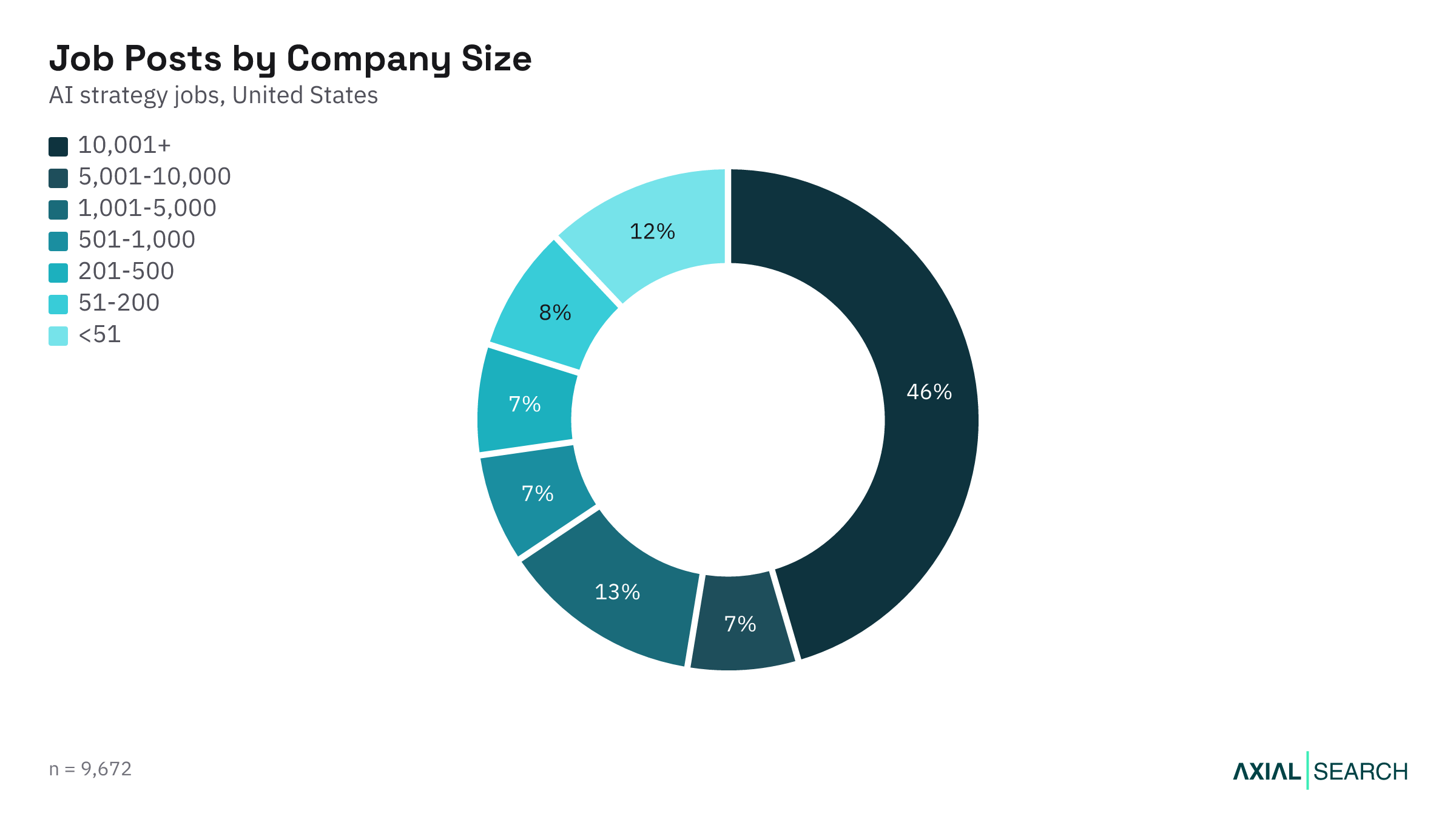
Enterprise-scale companies dominate. Nearly half of all AI strategy postings come from companies with more than 10,000 employees — organizations large enough to need a dedicated AI agenda and the budget to hire someone senior to run it. The next tier, companies with 1,001 to 5,000 employees, accounts for another 13%, and mid-sized firms with 5,001 to 10,000 employees add 7%.
Smaller companies also hire at this level but in lower volumes: 51–200-employee firms post 8% of roles, and sub-51-employee startups another 12%. So while enterprise hiring dominates, there's a meaningful long tail of smaller organizations building AI capability in-house.
That enterprise weight shows up in the sector mix too:
| Sector | Share of AI strategy postings |
|---|---|
| Technology | 25% |
| Professional Services | 21% |
| IT Services | 11% |
| Financial Services | 9% |
| Manufacturing | 4% |
| Life Sciences | 4% |
| Healthcare | 4% |
Technology firms post a quarter of the market, followed closely by Professional Services at 21%. IT Services contributes another 11%, and Financial Services 9%. The presence of Manufacturing, Life Sciences and Healthcare shows AI strategy hiring has spread well beyond tech-native companies into sectors that are operationalizing AI at scale.
What kind of AI strategy roles are being posted
These are senior, permanent and increasingly location-flexible roles. The three cuts below — seniority, contract type and work setting — describe what a typical opening looks like.
Seniority levels in AI strategy hiring
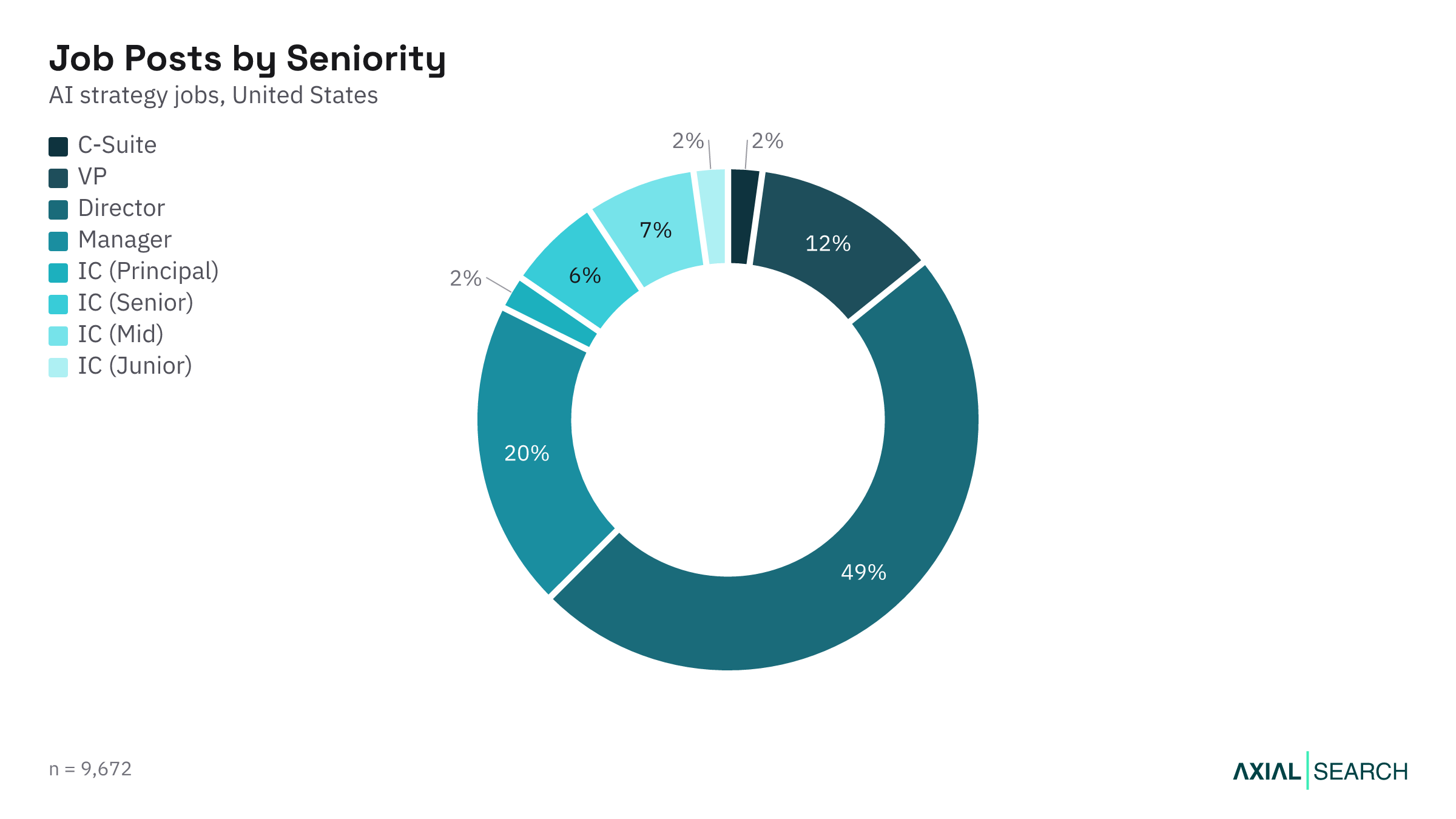
Nearly half of all AI strategy postings are Director-level, and another 20% are Manager-level. VP roles make up 12%, and C-suite positions just 1%, so roughly eight in ten AI strategy roles sit in management.
On the individual-contributor side, mid-level ICs account for 7%, senior ICs another 6%, junior ICs only 2%, and the Principal IC track a slim 2%. If you're early in your career, the direct route into AI strategy is narrow — most people arrive having led something adjacent first. This is a market that rewards experience running initiatives, not just contributing to them.
Full-time versus contract AI strategy roles
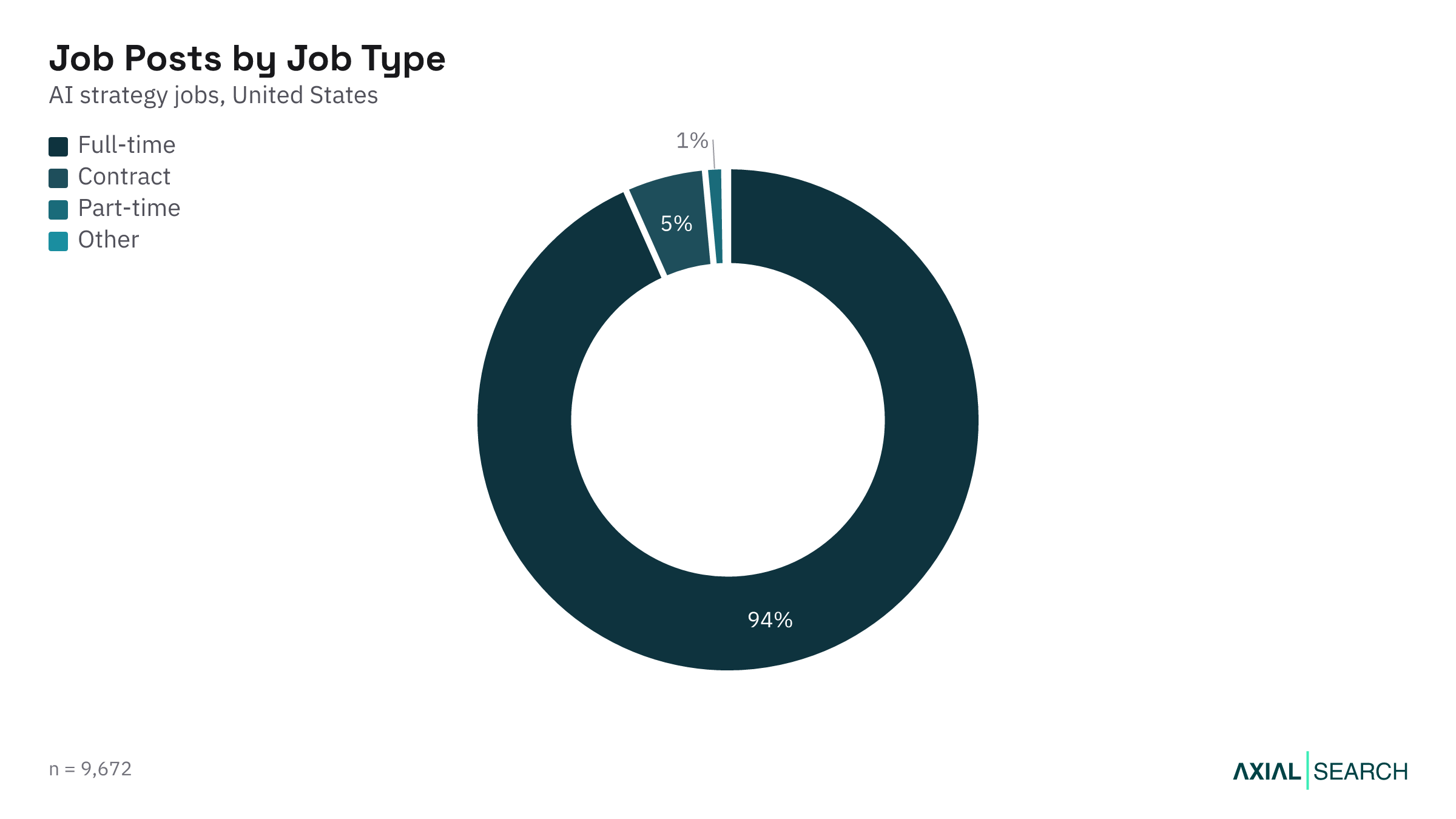
This is a permanent-hire market: 94% of AI strategy postings are full-time. Only 5% are contract roles, and part-time and other arrangements together make up less than 2%. Companies are building AI strategy as a standing capability, not staffing it with contractors or interim leaders.
Remote, hybrid and onsite AI strategy roles
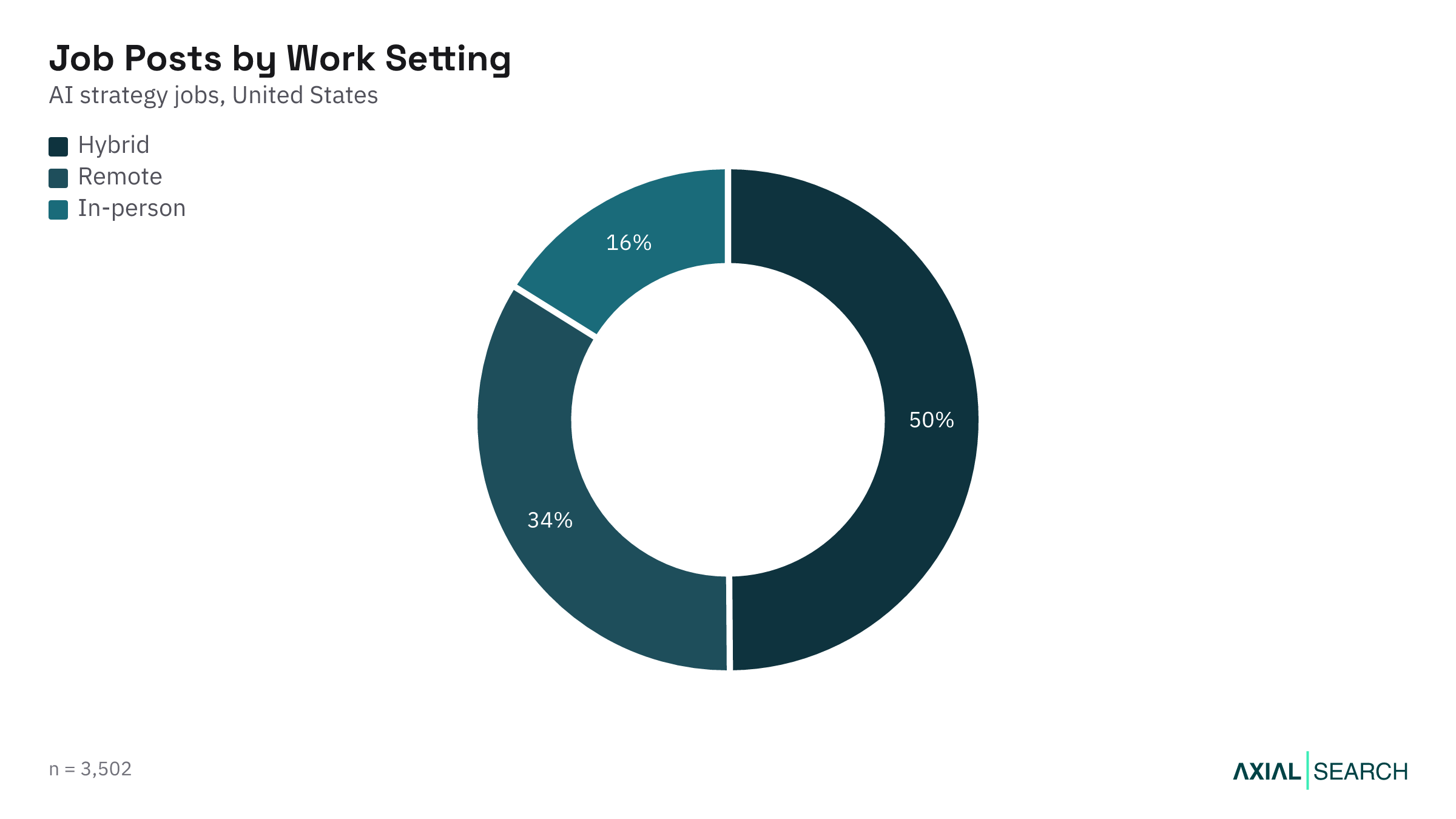
Most postings don't state a work model at all, but among those that do (roughly a third of the total), half are hybrid, a third are fully remote, and only 16% are strictly on-site. So while the work clusters in a few cities, a lot of it can be done from anywhere, and the hybrid share suggests employers want people in the room some of the time but not five days a week.
Where AI strategy jobs are located
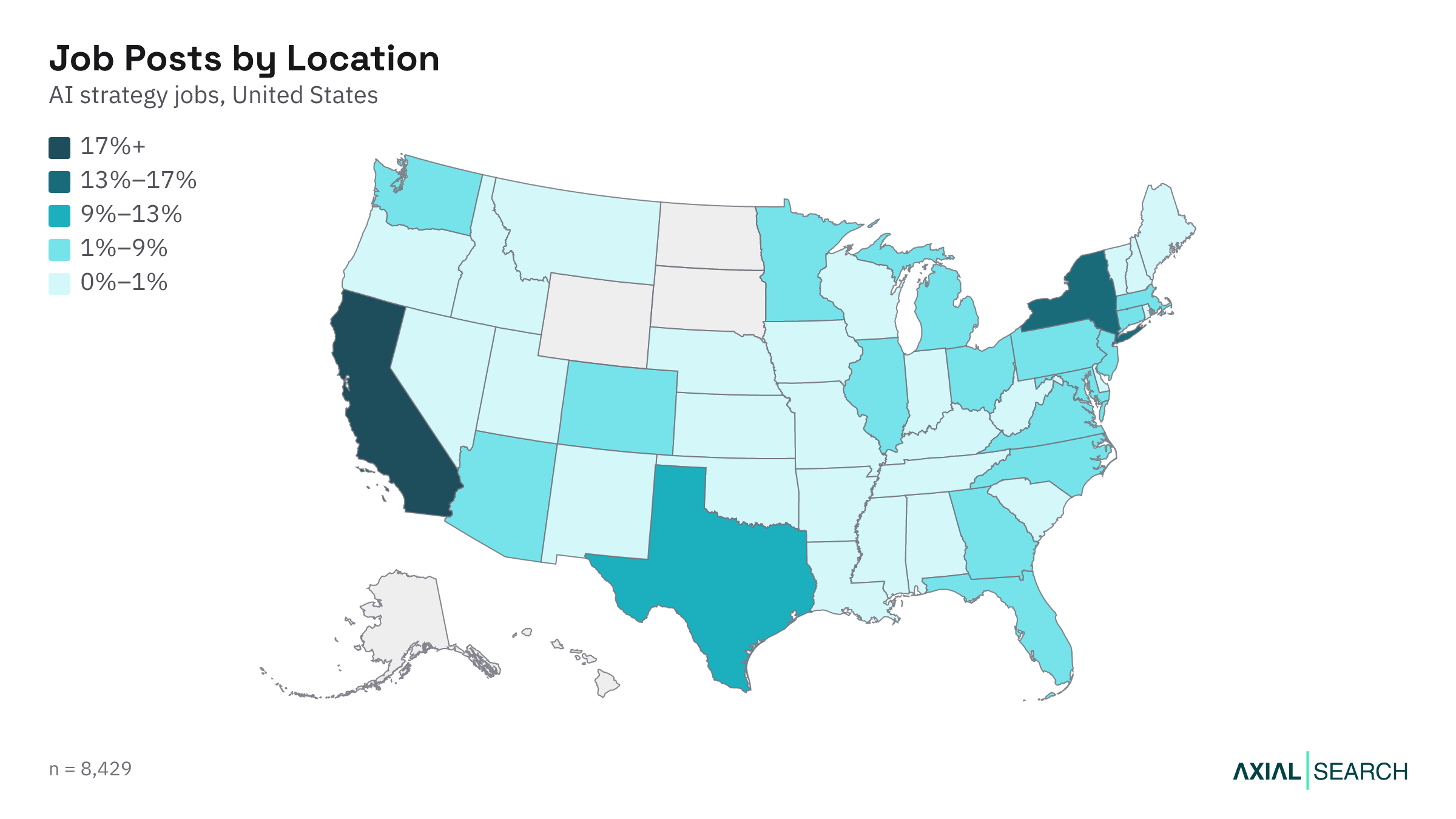
AI strategy jobs cluster in a handful of states. California leads with 20% of all postings, New York holds another 15%, and together they account for 35% of the market. Texas sits at 9%, followed by Massachusetts and Illinois each at 5%. Georgia, Washington and New Jersey each contribute 4%, forming a clear second tier of hiring.
| State | Share of postings |
|---|---|
| California | 20% |
| New York | 15% |
| Texas | 9% |
| Massachusetts | 5% |
| Illinois | 5% |
| Georgia | 4% |
| Washington | 4% |
| New Jersey | 4% |
The rest of the country is more diffuse, but while California and New York dominate, the volume isn't as concentrated as you might expect from the tech-industry headlines — roughly 65% of AI strategy postings sit outside those two states.
The top cities for AI strategy jobs
At the city level the concentration is sharper, but the list is more national than the state view suggests. San Francisco leads with 7% of all AI strategy postings, Chicago follows at 5%, and Atlanta and Boston each hold 4%. Austin and Seattle sit at 3%, and Dallas and San Jose each contribute around 2%.
| City | Share of postings |
|---|---|
| San Francisco, CA | 7.2% |
| Chicago, IL | 5.1% |
| Atlanta, GA | 4.2% |
| Boston, MA | 4.1% |
| Austin, TX | 3.3% |
| Seattle, WA | 3.1% |
| Dallas, TX | 2.4% |
| San Jose, CA | 2.3% |
San Francisco is the single biggest metro by a wide margin, but Chicago, Atlanta and Austin all rank highly — so the work is more nationally distributed than the coastal headline implies. For where these jobs pay the most, see AI strategy salaries.
Final Thoughts
For candidates. This is a senior market: nearly 70% of AI strategy roles are Director or Manager level, and the entry path through junior IC roles is thin. What gets you shortlisted is leading initiatives that shipped, not supporting ones that stalled. If you're targeting an AI strategy role and your resume reads like a list of tools you've used, rewrite it around decisions you made and outcomes you drove. The market is steady and trending up, so the volume of openings is reliable — the hard part is standing out in a pool where everyone claims AI expertise. If you prefer setting organizational guardrails over shaping product roadmaps, AI governance hiring demand reflects that need.
For employers. You're competing with 350 new AI strategy postings a week, most of them from enterprise-scale companies with deeper pockets and more brand pull than you have. If your internal shortlist runs dry after three referrals, you're not alone: this is a thin, competitive pool, and the best candidates are fielding multiple offers. Move quickly, and be ready to interview around real decisions, not years in seat.
Methodology & sources
- Data sources. Job data is collected from publicly available postings on online job boards and updated weekly, covering US roles posted since January 2026. Explore and filter it on our live AI job market dashboard.
- Hiring demand is the count of matching postings per week.
- Company size, seniority, job type and work setting are each group's share of postings. Work-setting shares are computed over the ~36% of postings that state a work model — the rest are silent, not counted as a category.
- Top states and cities are ranked by share of postings; remote-only postings are excluded from the cities list.

AI Strategy Salaries in 2026: Benchmarks from 8,900 Job Posts
What AI strategy roles pay in 2026: median salary, pay by seniority, top-paying sectors and locations, and how often bonus and equity are mentioned in US job postings.

How to Land an AI Strategy Role in 2026
How to become an AI strategist in 2026: the leadership capabilities employers screen for, the experience and degrees required, the certifications that matter, and the skills most in demand across US postings.

The AI Strategy Job Market in 2026: What 8,900 Postings Reveal
The complete picture of the AI strategy job market in 2026: hiring demand, what these roles pay, where the jobs are, who's hiring, and what it takes to get in. Figures reflect what US job postings state.
Turn AI ambition into lasting business value
Whether you're hiring your first AI leader or scaling enterprise transformation capability, we help you define, assess and recruit the people who make it stick.