
The State of the AI Governance Job Market in 2026
The complete picture of the AI governance job market in 2026: hiring demand, what these roles pay, where the jobs are, who's hiring and what it takes to get in.
 Updated: August 4, 2026
- A specialized market: governance hiring wants policy judgment paired with real technical grounding, and that pool is thin.
- Median pay of $169,000: The Principal IC track pays near Director money, so staying technical doesn't cap your ceiling in AI governance.
- California and New York lead: 14% of AI governance roles are in CA, 13% in NY, with San Francisco the top hiring city at 5%.
- Manager-heavy but IC-rich: Manager roles dominate at 28%, but combined IC postings (Senior, Mid, Principal) account for 46% of the AI governance market.
- Professional Services first: 35% of AI governance hiring comes from consulting and advisory firms, ahead of Technology (13%) and Financial Services (13%).
- Observability tops the list: 41% of AI governance postings mention observability platforms, followed by Python (28%) and NIST frameworks (27%).
What do AI governance leaders do?
AI governance leaders set the rules, review gates and risk boundaries that keep enterprise AI deployments compliant and auditable — the 1,997 US postings analyzed here consistently ask for people who can turn risk judgment into enforceable policy, not just write reports about it.
That covers model risk, security, data privacy, compliance and operational reliability — anticipating where a deployment is exposed before it ships, not after, exactly the hybrid profile AI executive search is built to find. It's a judgment role that sits between engineering and compliance, not a purely technical or purely policy one.
The leadership profile employers screen for in AI governance roles
Governance discipline tops what employers screen for in AI governance candidates, followed closely by AI literacy — mapped through our Three-Lens Leader framework.
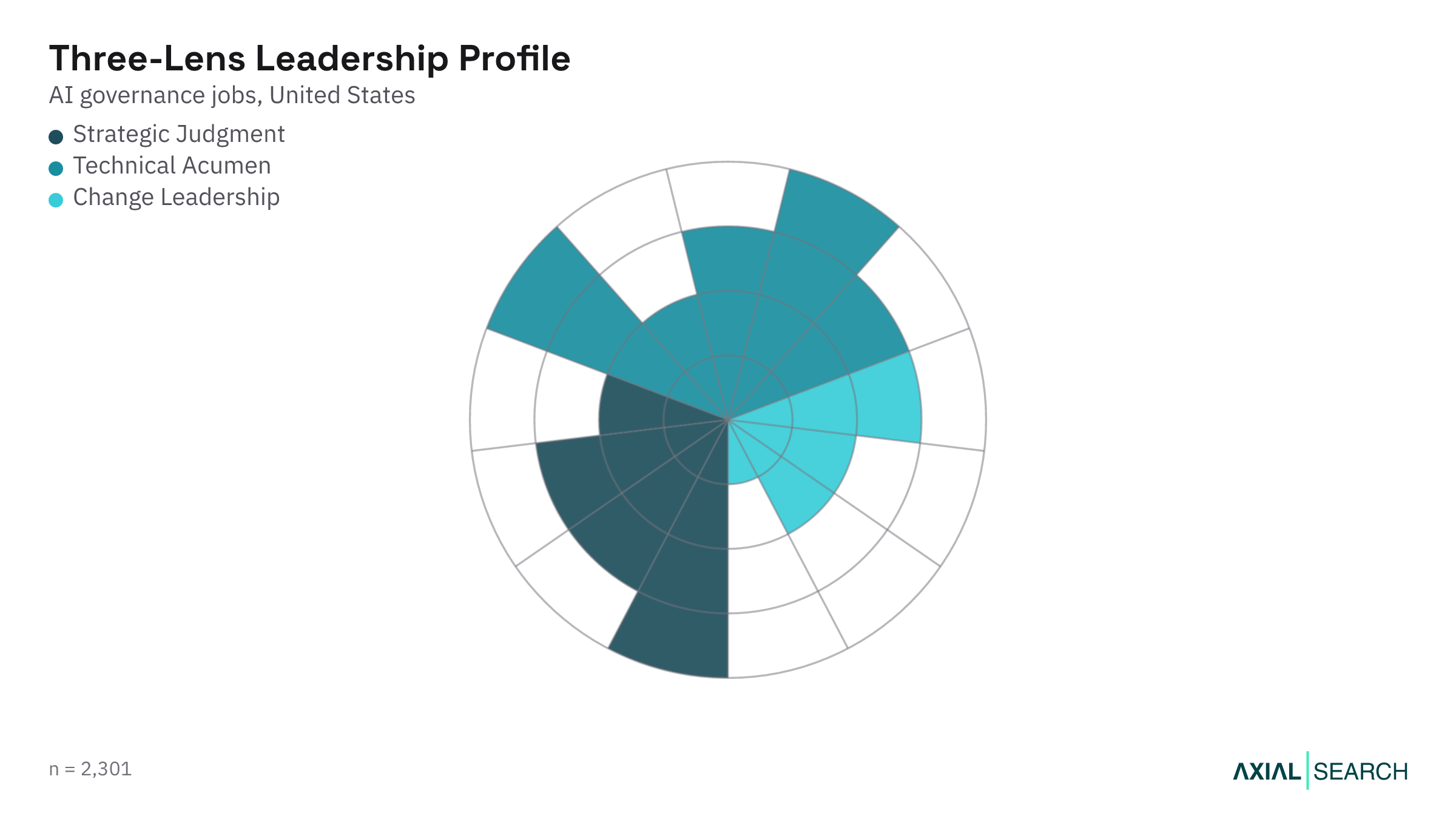
Use case selection and value framing follow, because governance increasingly means deciding which AI uses are worth the risk and making that case to the business. Hands-on execution ranks in the middle of the profile, higher than in most AI leadership functions, and driving adoption ranks last — these are roles that set the rails, not roles that sell change.
The skills AI governance leaders need on the job
Observability tops the skills list for AI governance, mentioned in 41% of postings, with Python at 28% and NIST frameworks at 27%.
Foundation models and cloud platforms round out the picture — employers want governance leaders who can read the systems they're overseeing, not just write policy about them. The full skills, certification and degree breakdown lives on our AI governance careers guide.
The credentials and experience AI governance roles expect
Most AI governance postings ask for a technical or quantitative degree and around five years of experience, with Computer Science the single largest field at 45%.
The bar rises with seniority — Directors are typically asked for a decade — and certifications like CISSP, CISM and the newer AI Governance Professional credential carry real weight here, unlike in most AI functions.
Is AI governance a good career?
AI governance is a specialized, well-paid corner of the AI job market, with a median salary of $169,000 and pay that keeps climbing for candidates who stay technical.
The pool is thinner than AI engineering or data science, which cuts both ways: fewer openings, but less competition once you clear the credential and experience bar. Professional services firms and enterprise-scale companies are hiring steadily, and the work rewards judgment over volume of output.
What AI governance roles pay
The median AI governance salary is $169,000, and the Principal IC track pays close to Director money, so staying technical doesn't cap your ceiling — the executive tier is a different story, where VP and C-suite pay actually trail Director and Manager.
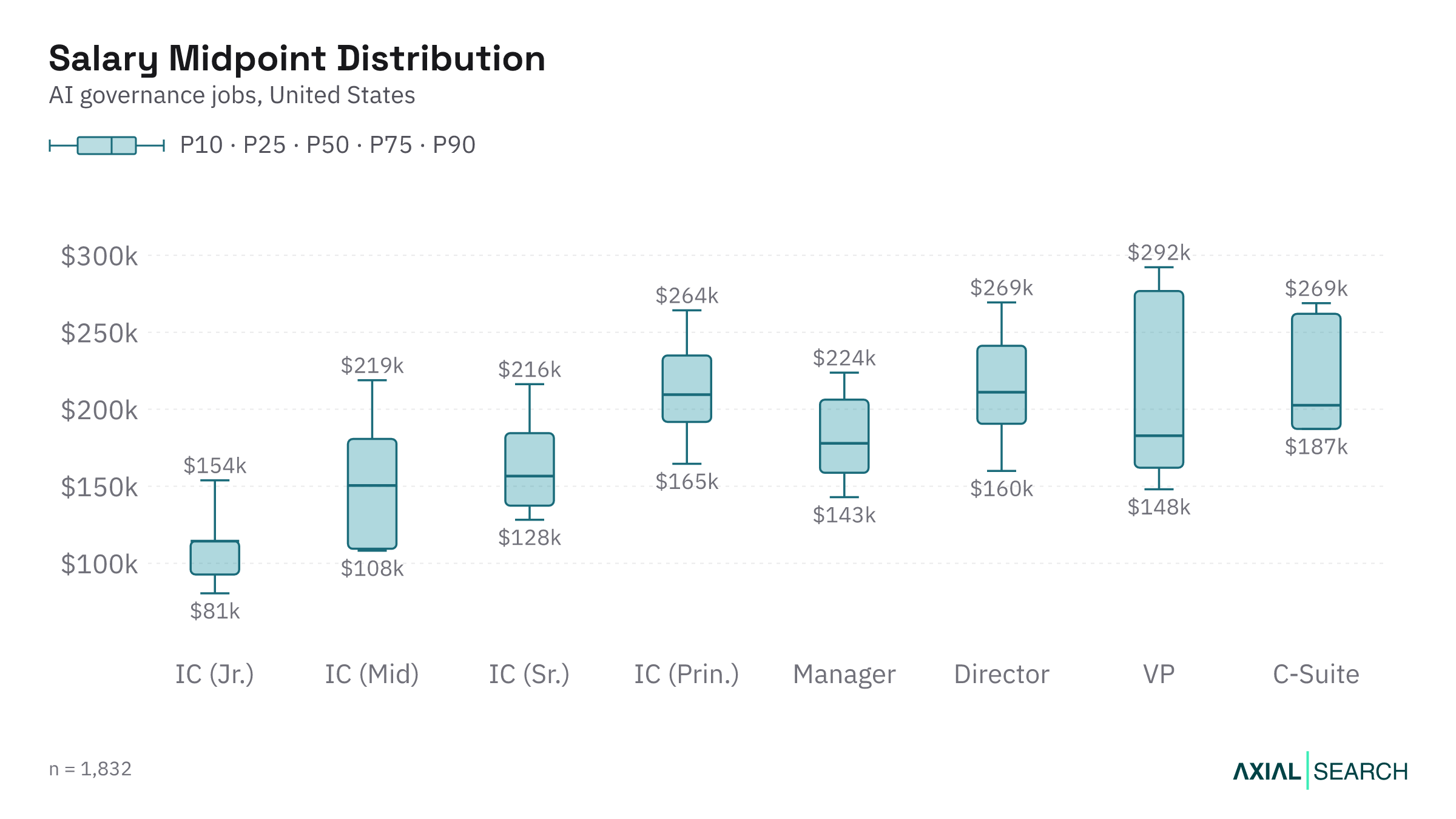
Bonus shows up in a significant share of postings; equity is rarer, at 11%, and concentrates at the top of the ladder. The full breakdown by seniority, sector and location lives on our AI governance salaries page.
How hot is the AI governance job market?
73% of US AI governance postings sit at senior level or above. This is a market hiring judgment and authority, not entry-level capacity.
Enterprises staff governance frameworks as regulatory timelines land, not in response to a hype cycle. That consistency tells you the market has stabilized at scale rather than chasing a hype cycle.
Competition for the best candidates is real and it isn't letting up.
Who's hiring AI governance talent
Manager-level roles account for 28% of AI governance postings, but combined IC roles — Senior, Mid and Principal — add up to 46% of the market, so this is a market with room to enter, not just to lead.
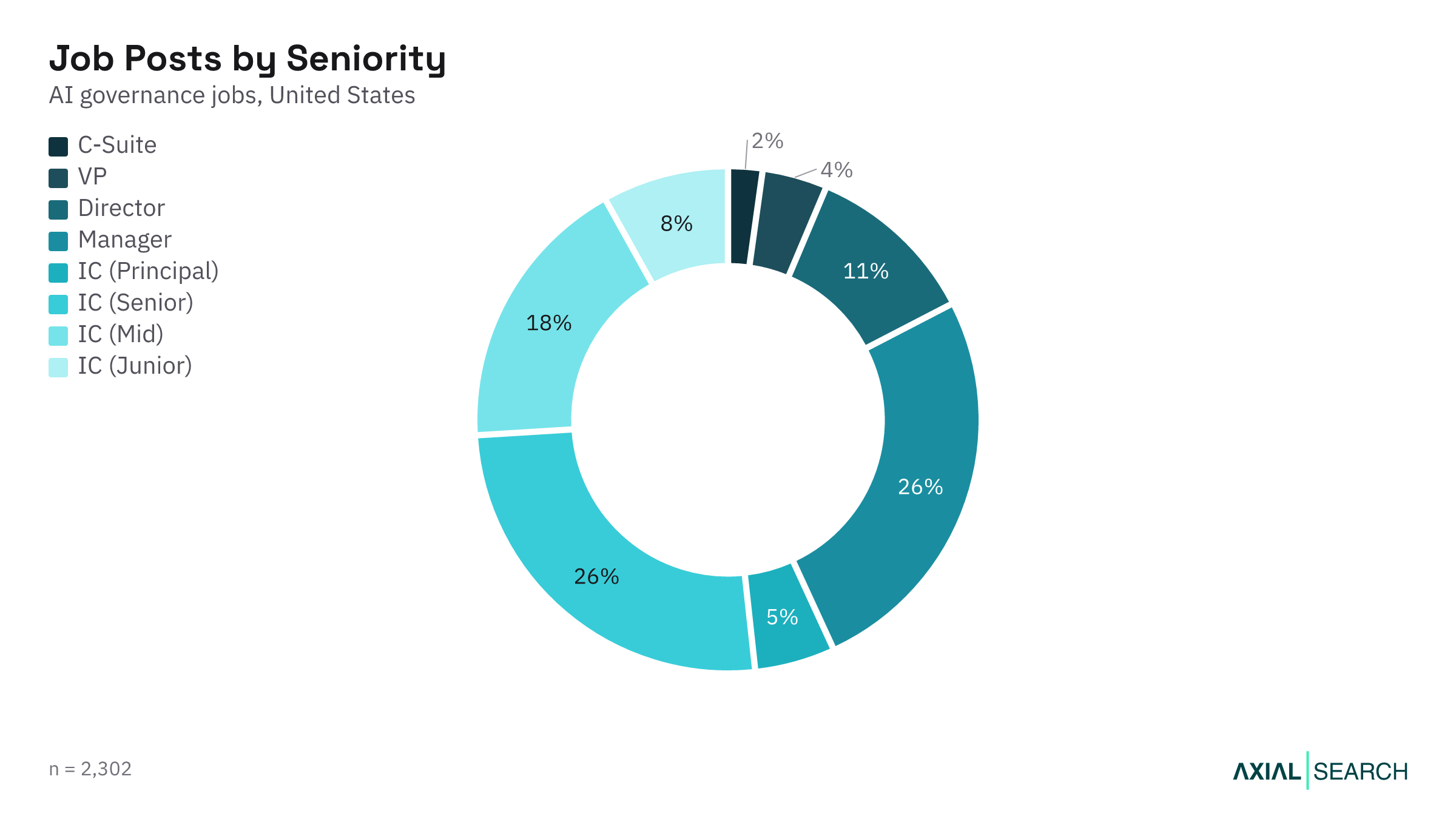
Professional Services firms post more roles than any other sector — 35% of the market — followed by Technology and Financial Services at 13% each. Our AI governance hiring guide breaks down the full sector and company-size picture, plus who you're bidding against for talent.
Are AI governance jobs remote?
Mostly hybrid — of AI governance postings that specify a work model, 52% are hybrid and 31% are fully remote, with the rest strictly on-site.
So while the work clusters in a handful of metro areas, a meaningful share of it can be done from anywhere, which widens the options on both sides of the hire.
Where AI governance jobs are located
California and New York together hold about a quarter of AI governance postings — 14% and 13% respectively — but the market spreads wider than most AI functions.
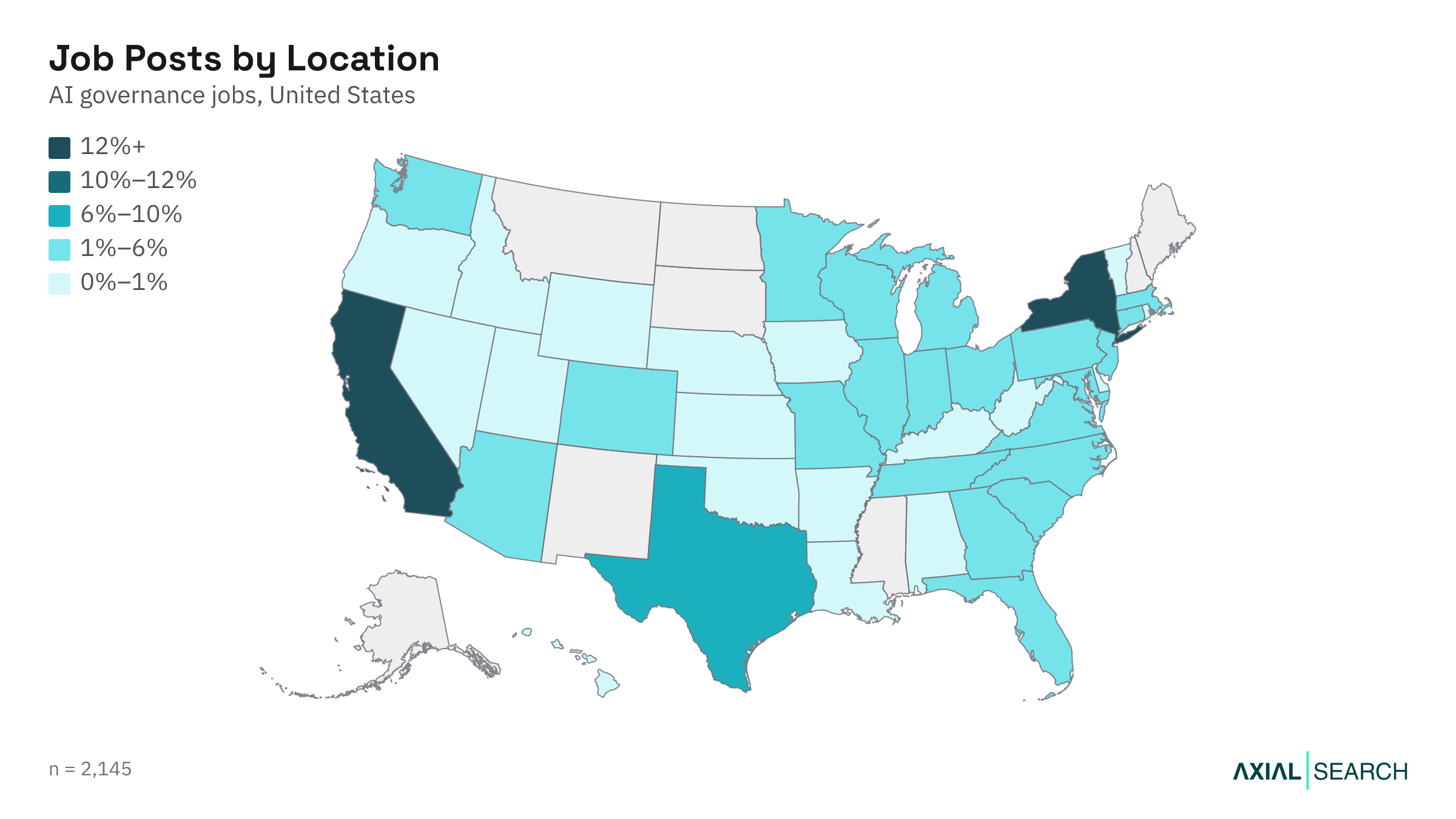
Texas carries 8%, and regulated hubs like Charlotte and Chicago show real volume at the city level.
Final Thoughts
For candidates. If you're looking at AI governance roles, know that the market rewards technical fluency as much as policy chops. Observability platforms, NIST frameworks and Python all show up more often than vendor-specific tools, so build breadth before depth. The Principal IC track pays like Director money, so staying technical is a viable path to top-tier comp. And most postings require a degree, so if you're early in your career and deciding whether to go back to school, the answer in this function is yes.
For employers. If you're hiring AI governance talent, you're competing with Professional Services firms that post more roles than any other sector and enterprise-scale companies that dominate the market. That means your offer needs to clear a high bar on comp, scope and visibility. The best candidates have options, and they're choosing roles where governance sits at the center of AI strategy, not bolted on afterward. If your governance hire reports three layers down or lacks budget authority, you'll lose to the firm that gives them a seat at the table.
Methodology & sources
- Data sources. Job data is collected from publicly available postings on online job boards and updated weekly, covering US roles posted since January 2026. Explore and filter it on our live AI job market dashboard.
- Salaries are derived from the minimum and maximum bands employers post, annualized and reported as percentiles, not averages.
- Hiring volume counts matching postings per week; location, seniority and sector figures are each group's share of postings.
- The leadership profile reflects the relative emphasis across leadership capabilities inferred from job-description language; skills are drawn from AI analysis plus programmatic scanning of posting text.
- Skill and capability figures reflect what postings mention: an item not appearing means it wasn't stated in the posting, not that it isn't wanted.

AI Governance Pay in 2026: Salaries, Bonuses and Equity
What AI governance roles pay in 2026: median salary, pay by seniority, top-paying sectors and locations, and how often bonus and equity are mentioned in US job postings.

Breaking Into AI Governance: Skills, Degrees and Certifications
How to become an AI governance professional in 2026: the leadership capabilities employers screen for, the experience and degrees required, the certifications that matter, and the skills most in demand across US…

How to Hire AI Governance Leaders in 2026
Where AI governance jobs are in 2026: hiring demand and trend, top states and cities, who's hiring by sector and company size, and the mix of seniority, contract type and remote work across US postings.
Turn AI ambition into lasting business value
Whether you're hiring your first AI leader or scaling enterprise transformation capability, we help you define, assess and recruit the people who make it stick.