
AI Architecture Salaries: 16,900 Postings, Benchmarked
What AI architecture roles pay in 2026: median salary, pay by seniority, top-paying sectors and locations, and how often bonus and equity are mentioned in US job postings.
 Updated: October 8, 2026
- AI architecture's overall median is $189,000, with the market concentrating at Mid and Senior IC (together 66% of postings), so that figure reflects early-to-mid-career pay more than leadership tiers.
- The Principal IC track is the surprise in AI architecture: it pays close to Director money, so staying technical doesn't cap your ceiling the way it does in most functions.
- IT Services, Technology and Professional Services together post 67% of all AI architecture roles, with Professional Services reaching the highest Director-level ceilings when competing for scarce technical leadership.
- California leads on volume in AI architecture (19% of postings) and San Francisco, Dallas and Austin are the top metros, each posting 3–5% of all US AI architecture roles.
- Equity appears in just 12% of AI architecture postings, peaking at C-suite (25%) and Principal IC (21%) but nearly absent at Manager (7%) and VP (5%), suggesting it's negotiated quietly or reserved for retention.
How much do AI architects make?
The median AI architecture salary is competitive. Pay climbs steadily up the IC ladder, and the Principal IC track closes in on Director money — but Director is effectively the ceiling: C-suite pay ties it rather than topping it, and VP sits below both.
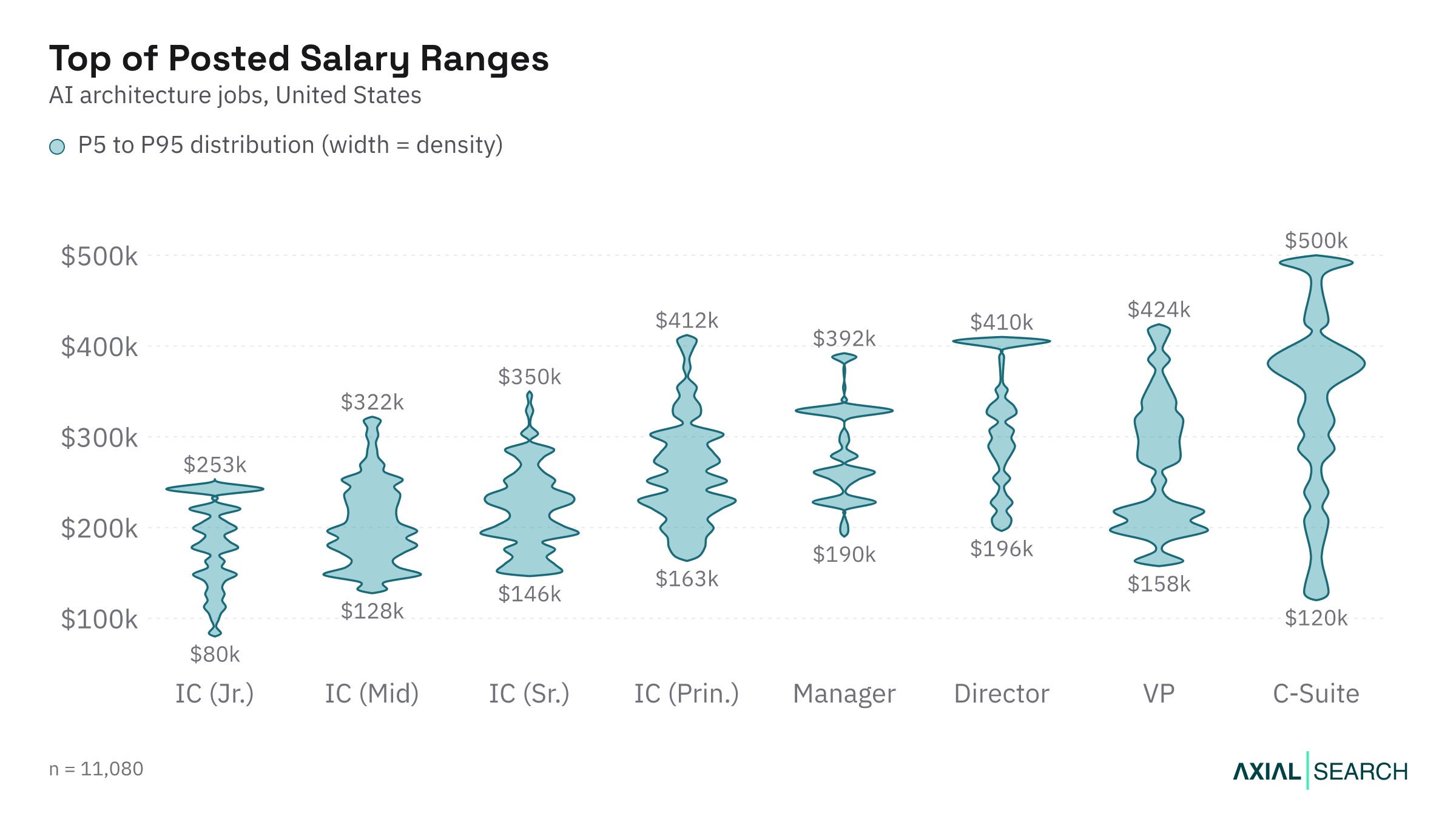
Top of the posted range by seniority — the median and typical maximum of what's posted, 5th to 95th percentile. This is the ceiling candidates can credibly negotiate toward, not the typical offer.
| Seniority | 5th percentile | 25th percentile | Median | 75th percentile | 95th percentile |
|---|---|---|---|---|---|
| IC (Junior) | $90,000 | $150,000 | $195,000 | $239,000 | $252,000 |
| IC (Mid) | $130,000 | $166,000 | $200,000 | $241,000 | $322,000 |
| IC (Senior) | $148,000 | $180,000 | $218,000 | $248,000 | $342,000 |
| IC (Principal) | $170,000 | $215,000 | $253,000 | $300,000 | $392,000 |
| Manager | $191,000 | $230,000 | $262,000 | $329,000 | $392,000 |
| Director | $195,000 | $254,000 | $314,000 | $410,000 | $421,000 |
| VP | $158,000 | $200,000 | $216,000 | $300,000 | $424,000 |
| C-Suite | $123,000 | $227,000 | $279,000 | $362,000 | $425,000 |
Where two percentiles show the same figure, employers are clustering on a round number at that end of the band.
The top of the posted band is where strong candidates land in a negotiation, so it's the more useful benchmark for senior roles.
Where most AI architecture salaries cluster
Mid-level and Senior ICs together account for a substantial portion of AI architecture postings, so the median reflects the early-to-mid-career tier more than the leadership cohort.
Your seniority matters far more than your geography or your sector for where you land in this band — exactly the signal AI recruitment screens candidates on first.
What is the full salary range for AI architects?
The full posted AI architecture salary range runs from the 5th percentile for IC (Junior) up to the 95th percentile for C-Suite — see the table above for the full ladder.
How much room is there to negotiate at the top of the AI architecture range?
The gap between the 75th and 95th percentile widens sharply by seniority — narrow at Junior IC, far wider by Principal IC.
That widening spread is the real story: the higher you sit in the band, the more the posted maximum is a starting point rather than a hard ceiling.
What to make of the AI architecture VP figures
The VP figure is worth treating carefully: the sample is small, at just 1% of postings, and the top end is inflated by a handful of exceptionally high bands.
That pattern likely reflects companies competing hard for scarce leadership talent rather than a stable market rate.
Which industries pay AI architects the most?
AI architecture pay concentrates where technical complexity and scale intersect: IT Services, Technology and Professional Services dominate hiring volume, together accounting for 67% of all roles.
| Sector | Median salary | Postings |
|---|---|---|
| Professional Services | $255,000 | 5,034 |
| Financial Services | $246,000 | 1,047 |
| Technology | $240,000 | 3,902 |
| Manufacturing | $235,000 | 958 |
| Life Sciences | $210,000 | 272 |
At Director level, where the sample is largest and the figures most reliable, Professional Services posts the highest median salary, ahead of Technology and Manufacturing.
How much does sector really matter for AI architecture pay?
About a significant gap separates the highest-paying sectors from mid-tier ones like Telecom & Media — real, but nowhere near as large as the seniority effect.
Moving from Mid IC to Director moves your pay by far more than switching sectors, so seniority is the dominant variable here.
Which sectors post the most AI architecture roles?
The sectors posting the most roles aren't the sectors paying the most: IT Services leads on volume at 23% of postings but sits near the market median on pay.
Professional Services posts a similar share of roles and pays more at the top, so it's the better target if you're optimizing for ceiling rather than sheer opportunity count.
Does company size affect AI architecture pay?
Company size moves pay, but the pattern is cleaner on equity than on base: enterprise-scale firms (5,000+ employees) post a $239,000 median salary and mention equity more often than mid-market firms do.
| Company size | Median salary | Equity mention rate |
|---|---|---|
| Enterprise (5,000+) | $239,000 | 28% |
| Mid-market (500-5,000) | $199,000 | 16% |
| Startup-Small (<500) | $195,000 | 17% |
Startups and small companies sit near the market median on base pay but are the second most likely to mention equity, behind only the enterprise tier.
How company size affects AI architecture equity offers
The mid-market is where equity nearly disappears — companies in the 500–5,000 employee range rarely mention equity in their pay disclosures.
Big employers use equity as a retention lever at scale; mid-market firms tend to rely on base and bonus instead.
Where do AI architects earn the most?
Pay is geographically compressed for AI architecture, but California is the standout at real scale, with a disproportionate share of US postings.
Median salary by state — states with meaningful posting volume, ranked by pay.
| State | Median salary | Share of postings |
|---|---|---|
| Oklahoma | $262,000 | 0.4% |
| Louisiana | $255,000 | 0.5% |
| California | $248,000 | 19.0% |
| Arkansas | $246,000 | 0.3% |
| Connecticut | $240,000 | 1.2% |
California posts nearly three times as many roles as second-place Texas, pairing the highest volume with a top-tier ceiling.
Which states are outliers in AI architecture pay?
Louisiana, Oklahoma and Alabama each post fewer than 1% of roles but report the highest median figures — a sign of thin samples, not a deeper market.
Treat them as noise driven by a handful of specialized contracts rather than a signal to chase; California is the reliable benchmark at real volume.
The top-paying cities for AI architecture
San Francisco leads decisively on volume, but it doesn't crack the top ten cities by pay — the highest per-role ceilings concentrate in smaller, concentrated markets instead.
| City | Median salary | Postings |
|---|---|---|
| Santa Clara, CA | $288,000 | 383 |
| Hillsboro, OR | $288,000 | 26 |
| Cambridge, MA | $281,000 | 77 |
| Tulsa, OK | $280,000 | 37 |
| San Jose, CA | $278,000 | 342 |
| Morristown, NJ | $278,000 | 22 |
| Milpitas, CA | $275,000 | 31 |
| Palo Alto, CA | $274,000 | 142 |
| Toledo, OH | $271,000 | 38 |
| San Antonio, TX | $270,000 | 51 |
The highest-paying cities by median are smaller markets with concentrated hiring, led by the Silicon Valley core; the Bay Area pays the most on both volume and comp, but the gap to second-tier hubs like Austin or Seattle is modest.
How often are AI architecture bonus and equity offered?
Dollar figures are almost never posted, so a mention rate is the best signal available: bonus shows up in AI architecture postings, equity in just 12%.
A mention rate is a floor, not a ceiling — many roles that don't advertise a bonus or equity still offer one; the posting was silent, not the offer.
How often a bonus is offered
A bonus is mentioned in some AI architecture postings, common enough to ask about but far from universal.
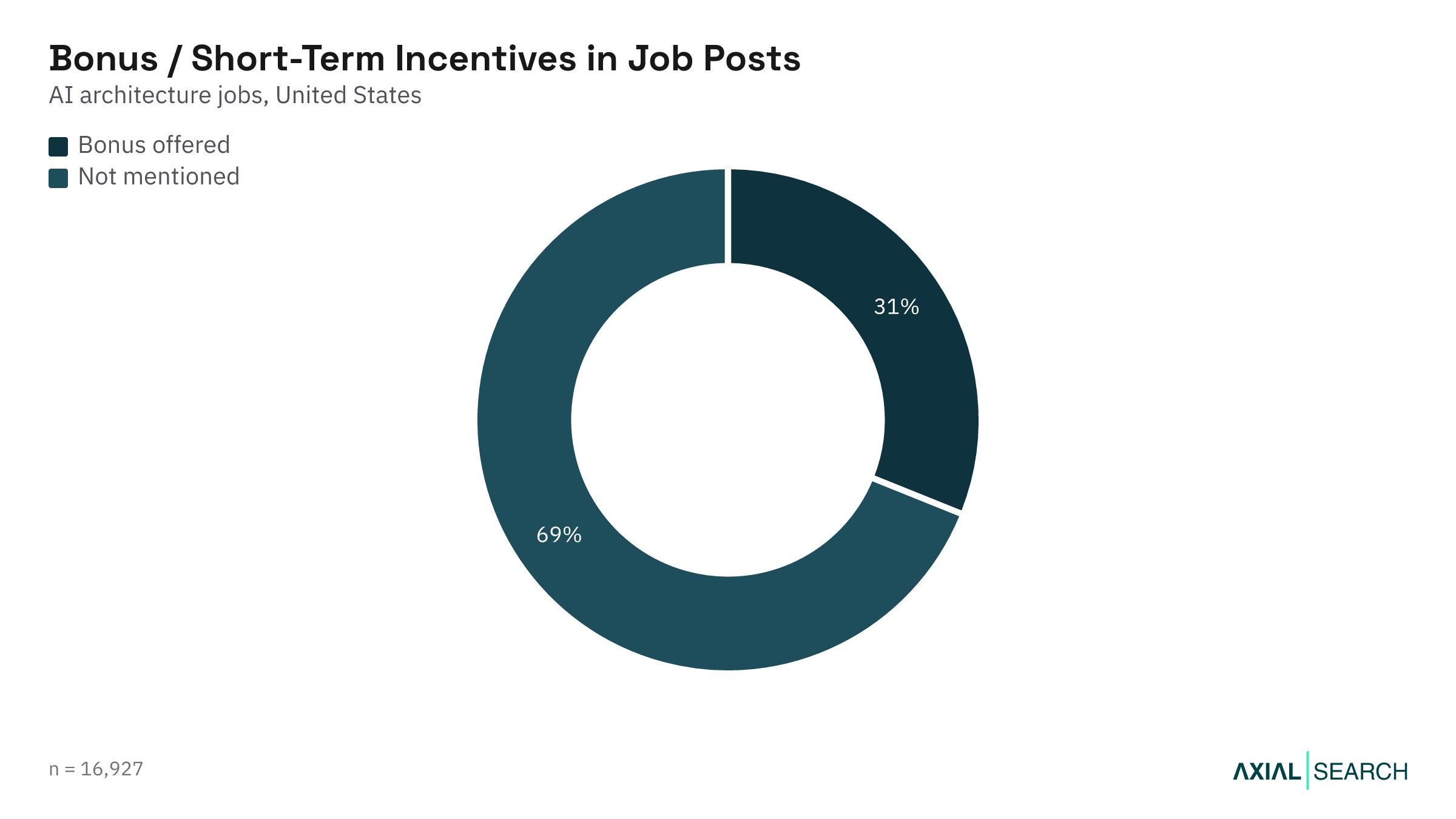
The pattern by seniority is predictable: it climbs from Junior and Mid IC levels to Manager and VP, then drops sharply at C-suite, where equity and carried-interest structures likely take over. The Manager and VP figures are the highest in the dataset, suggesting a bonus is used as a short-term incentive for people running teams but not yet at the strategic leadership tier.
| Level | Bonus mentioned | Equity mentioned |
|---|---|---|
| IC (Junior) | 24% | 20% |
| IC (Mid) | 23% | 10% |
| IC (Senior) | 34% | 23% |
| IC (Principal) | 45% | 26% |
| Manager | 56% | 9% |
| Director | 54% | 15% |
| VP | 68% | 12% |
| C-Suite | 14% | 26% |
How often equity is offered
Equity is mentioned in just 12% of AI architecture postings, and it peaks in places comp theory wouldn't predict: the C-suite and Principal IC roles, not Manager or VP.
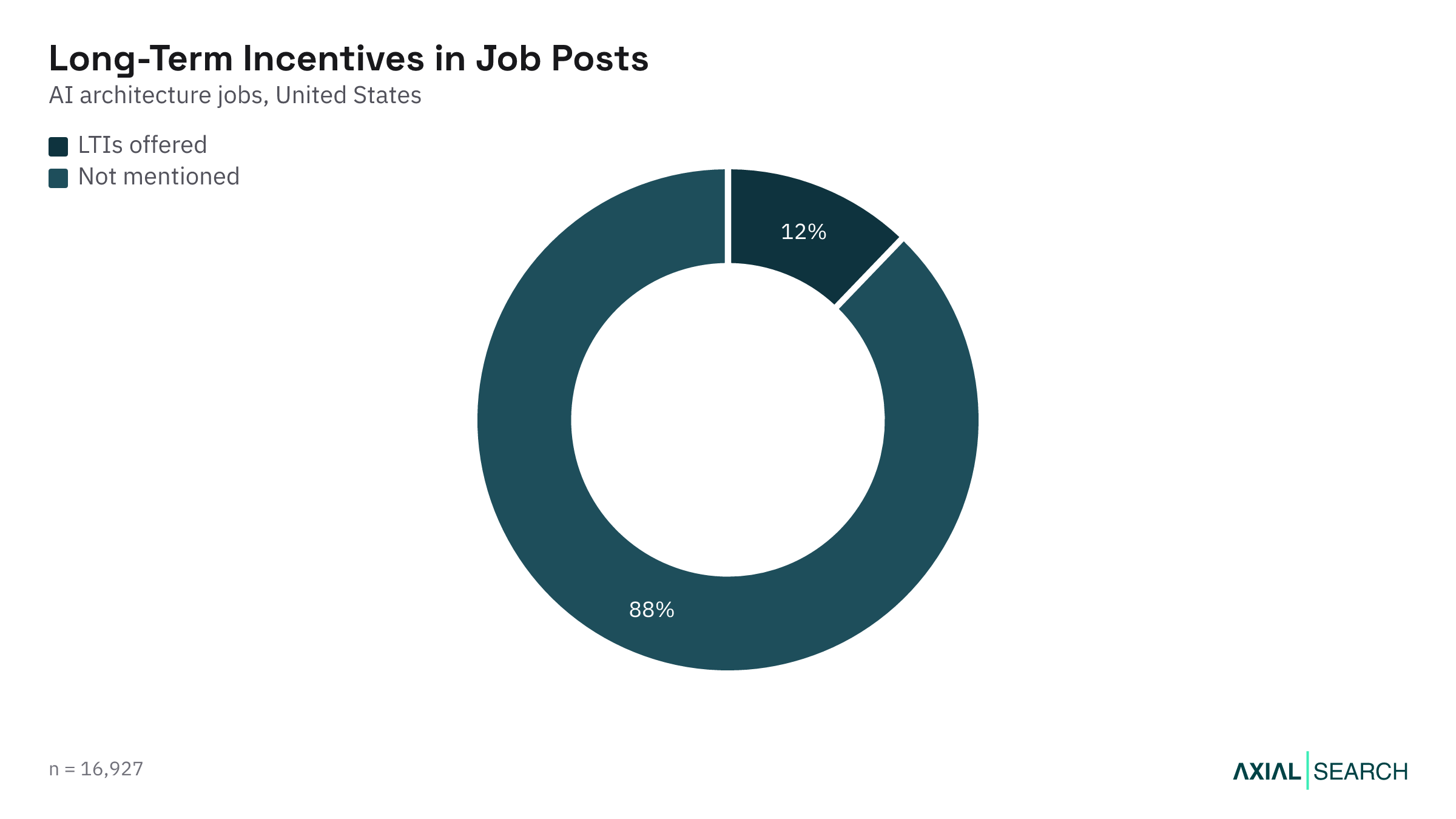
It's lowest at Manager (7%) and VP — the two levels where you'd expect equity to be standard. That suggests equity is either not on the table at those levels, assumed and left out of the posting, or negotiated case by case rather than advertised up front.
What the bonus-versus-equity split says about AI architecture retention
Enterprise-scale employers (5,000+ employees) mention equity in postings that disclose pay at roughly twice the mid-market rate, pointing to equity as a retention lever used at scale rather than a default part of every offer.
Don't assume equity is on the table just because you're at Manager or VP — ask early, and get the strike price and vesting schedule in writing before you sign.
Final Thoughts
For candidates. AI architecture is a volume market, but pay scales sharply with seniority, not geography. Moving from Senior IC to Director shifts the median by far more than relocating from Austin to San Francisco. Equity is mentioned in just 12% of postings, so if it matters to you, ask early — the data shows it's most common at C-suite and Principal IC, not Manager or VP, which means it's either negotiated quietly or not on the table. The Principal IC track is the real surprise: it pays close to Director money, so staying technical doesn't cap your ceiling. When evaluating offers, look at the full package, not just base — bonus is common at Manager and VP, equity is not. If you focus more on deployment and production systems than model design, AI engineering salaries reflect that infrastructure-focused path.
For employers. The market is deep at Mid and Senior IC and thin at leadership — Director and above roles are scarce. If you're hiring a Director or VP, expect to compete on total comp, not just base, and expect the search to take longer; the candidates you want are already employed, likely paid well, and not scanning job boards. Equity mention rates are low overall and just 7% at Manager, which suggests most postings are silent on the full package — fine for attracting volume at junior levels, but it costs you qualified senior candidates who filter by total comp, not base.
Methodology & sources
- Data sources. Job data is collected from publicly available postings on online job boards and updated weekly, covering US roles posted since January 2026. Explore and filter it on our live AI job market dashboard.
- All salary figures are derived from the minimum and maximum salary bands employers post, annualized and reported as percentiles, not averages.
- Every salary figure on this page is the top of the posted range — the ceiling employers advertise, not the typical offer. The seniority table reports it at the 5th, 25th, 50th (median), 75th and 95th percentiles. Median salary in the sector, company-size and location tables is the median of that ceiling within each group.
- Bonus and equity figures are mention rates — the share of postings that state a bonus or equity is offered. A posting silent on either is counted as "not mentioned"; it does not mean none is offered.
- Seniority distribution, sector and location breakdowns count the share of postings in each category; figures reflect what was posted, not the full opportunity set.

The Skills That Land AI Architecture Roles in 2026
How to become an AI architecture professional in 2026: the leadership capabilities employers screen for, the experience and degrees required, the certifications that matter, and the skills most in demand across US…

AI Architecture Jobs in 2026: What 16,900 Postings Reveal
The complete picture of the AI architecture job market in 2026: hiring demand, what these roles pay, where the jobs are, who's hiring and what it takes to get in.

How to Hire for AI Architecture in 2026
Where AI architecture jobs are in 2026: hiring demand and trend, top states and cities, who's hiring by sector and company size, and the mix of seniority, contract type and remote work across US postings.
Turn AI ambition into lasting business value
Whether you're hiring your first AI leader or scaling enterprise transformation capability, we help you define, assess and recruit the people who make it stick.