
How to Land an AI Engineering Role: Skills 43,000 Postings Ask For
How to become a ai engineering professional in 2026: the leadership capabilities employers screen for, the experience and degrees required, the certifications that matter, and the skills most in demand across US postings.
Updated: July 13, 2026

How to get hired as an AI engineering leader
AI engineering sits at the center of the AI job market — the builders who turn strategy into working systems. This is what employers screen for: the leadership capabilities, qualifications, credentials and skills that appear in 43,480 US job postings analyzed this quarter and how to position yourself against them.
- AI engineering prizes hands-on execution over strategy — 62% of AI engineering postings mention Python, employers want builders who can ship production systems and work across the full stack from model training to deployment.
- Computer Science dominates degree requirements — 62% of AI engineering roles call for CS degrees, higher than any other AI function, and 72% require a degree at all.
- The IC track pays close to management — AI engineering's Principal IC roles reach Director-level compensation, so staying technical doesn't cap your ceiling the way it does elsewhere.
- Cloud fluency is table stakes — 55% of AI engineering postings mention cloud platforms, and RAG already appears in 32%, which means the orchestration layer is moving from emerging to expected.
- Certifications barely register — the highest-mentioned cert in AI engineering (CISSP) appears in just 1.3% of postings; spend your time shipping code instead.
- AI engineering is accessible early-career — 66% of AI engineering roles target IC bands, the median asks for 5 years of experience, and Junior roles expect just 2.
The AI engineering leadership profile employers screen for
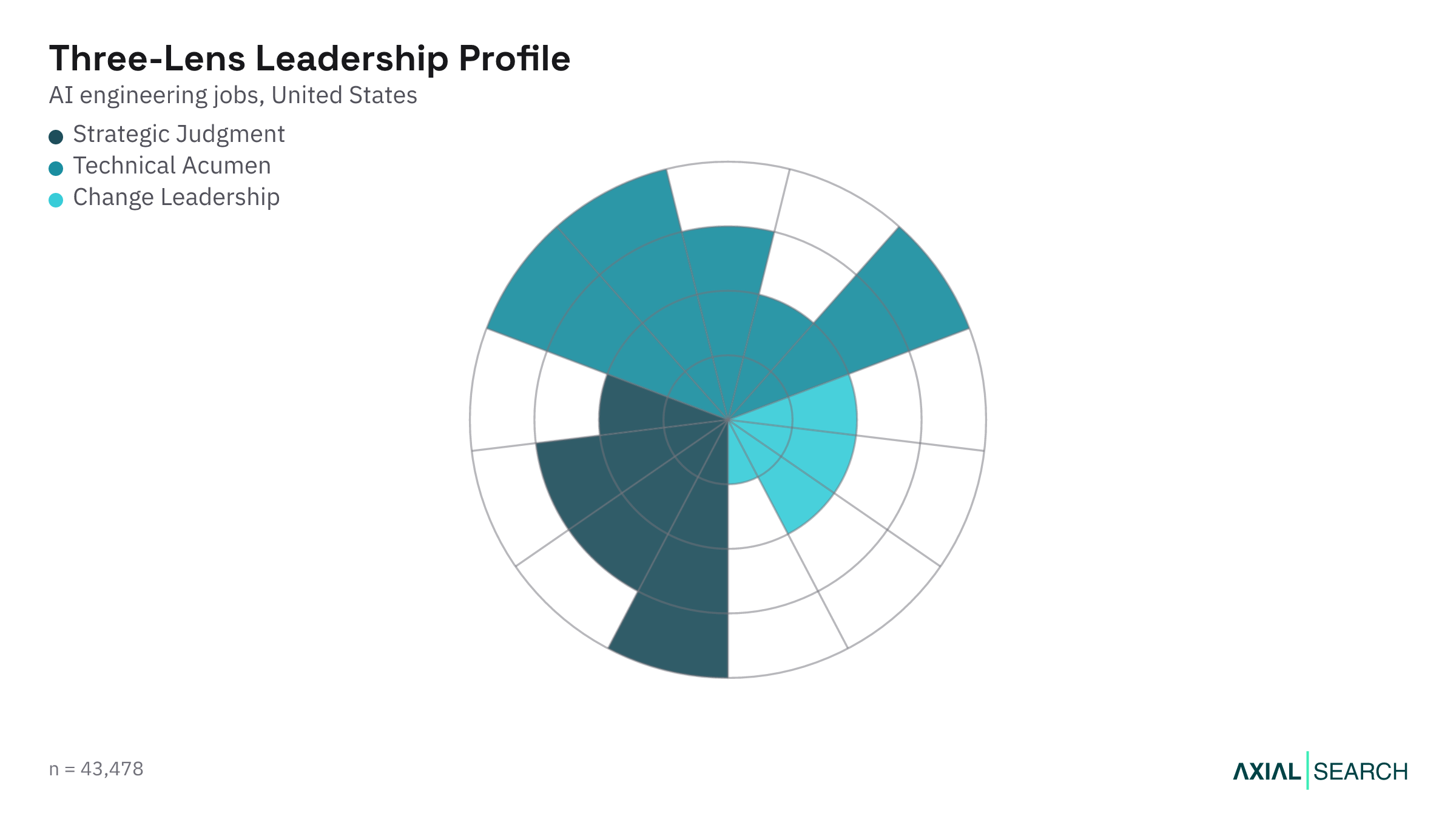
AI engineering is a build role, and the demand data leaves no room for doubt.
Our Three-Lens Leader framework scores every role across strategic judgment, technical acumen and change leadership. For AI engineering, four of the five most-screened capabilities are technical, and the business-facing skills that dominate AI strategy postings rank near the bottom here.
AI Literacy and Hands-On Execution top the profile together. Employers want a deep, current grasp of what the models do and the ability to design, prototype and ship working systems with them. Use Case Selection and Architectural Fluency follow — engineers here own whether they're building the right thing and how the pieces connect. Data Readiness Judgment rounds out the top five, because production AI systems live or die on whether the data can carry them.
Securing Sponsorship, Shaping the Narrative and Driving Adoption barely register. Employers want people who can build, not people who can sell what might be built.
When you position yourself, lead with what you have put into production and the technical decisions behind it. This is exactly the profile AI recruitment is built to identify.
What qualifications AI engineering roles require
The baseline is experience plus a technical degree. It's a conventional bar and a lower one than AI strategy — most roles are accessible to someone five years into their career.
How much experience AI engineering roles expect
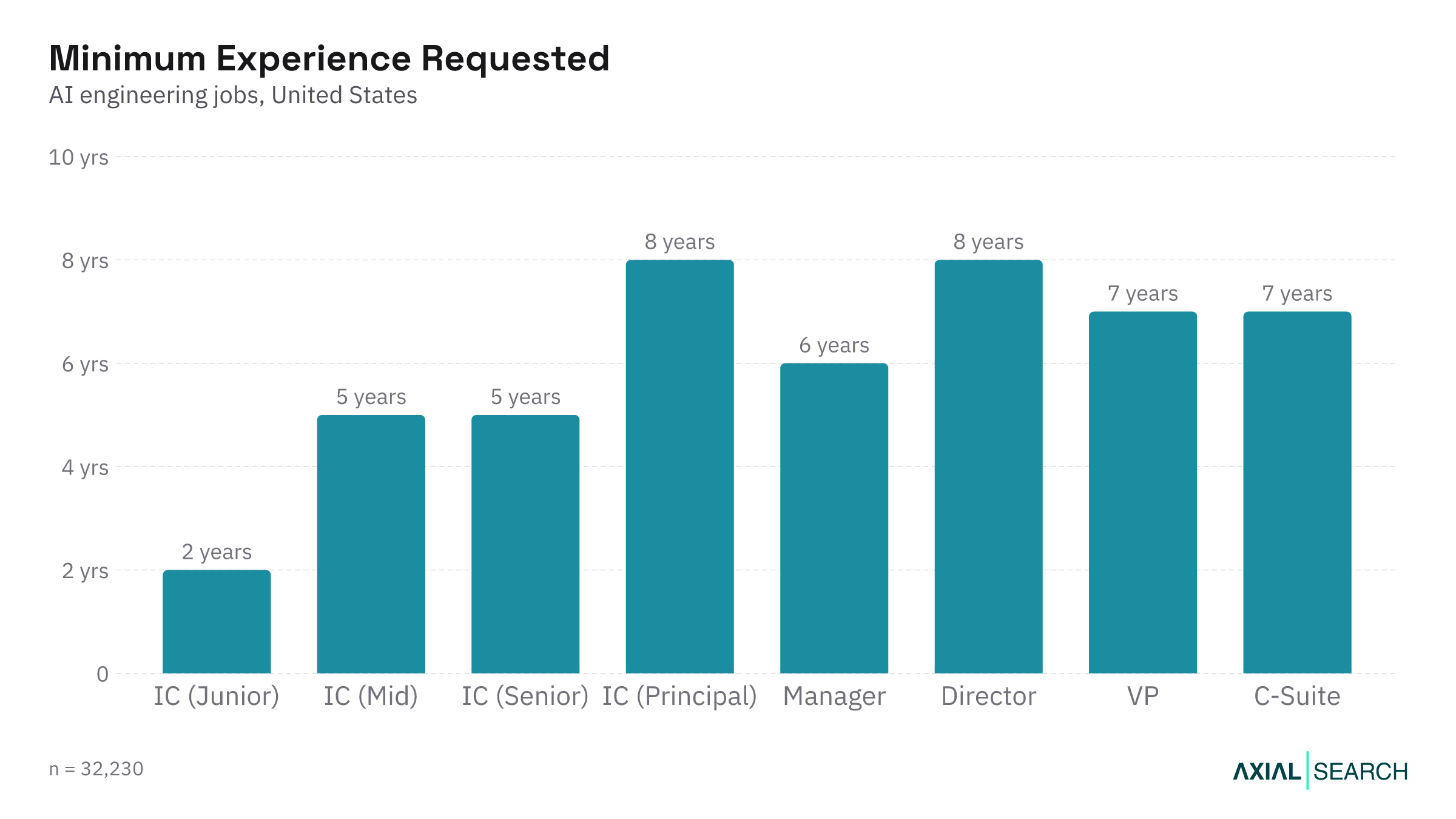
The median AI engineering role asks for 5 years of experience.
The market splits roughly two-to-one across individual contributor bands versus management. Mid-level IC roles account for 35% of AI engineering postings, Senior IC another 31%, Junior IC 12% and Principal IC 8%. Manager roles make up 10%, Directors 3%, VPs 1% and C-suite barely registers.
That means the realistic entry point for AI engineering is earlier than for strategy roles. You can arrive straight out of a technical degree program and work your way up the IC track without needing to pivot into management to advance. Junior AI engineering roles expect 2 years of experience, Mid and Senior both ask for 5, Managers 6, and Principal, Director and VP all land around 7–8 years.
For candidates this means you don't need to have led transformation programs or sat in executive meetings. You need to have built things that worked.
For hiring managers it means you can recruit earlier-career talent and grow them internally rather than competing for the small pool of ten-year veterans.
Degrees and fields AI engineering employers want
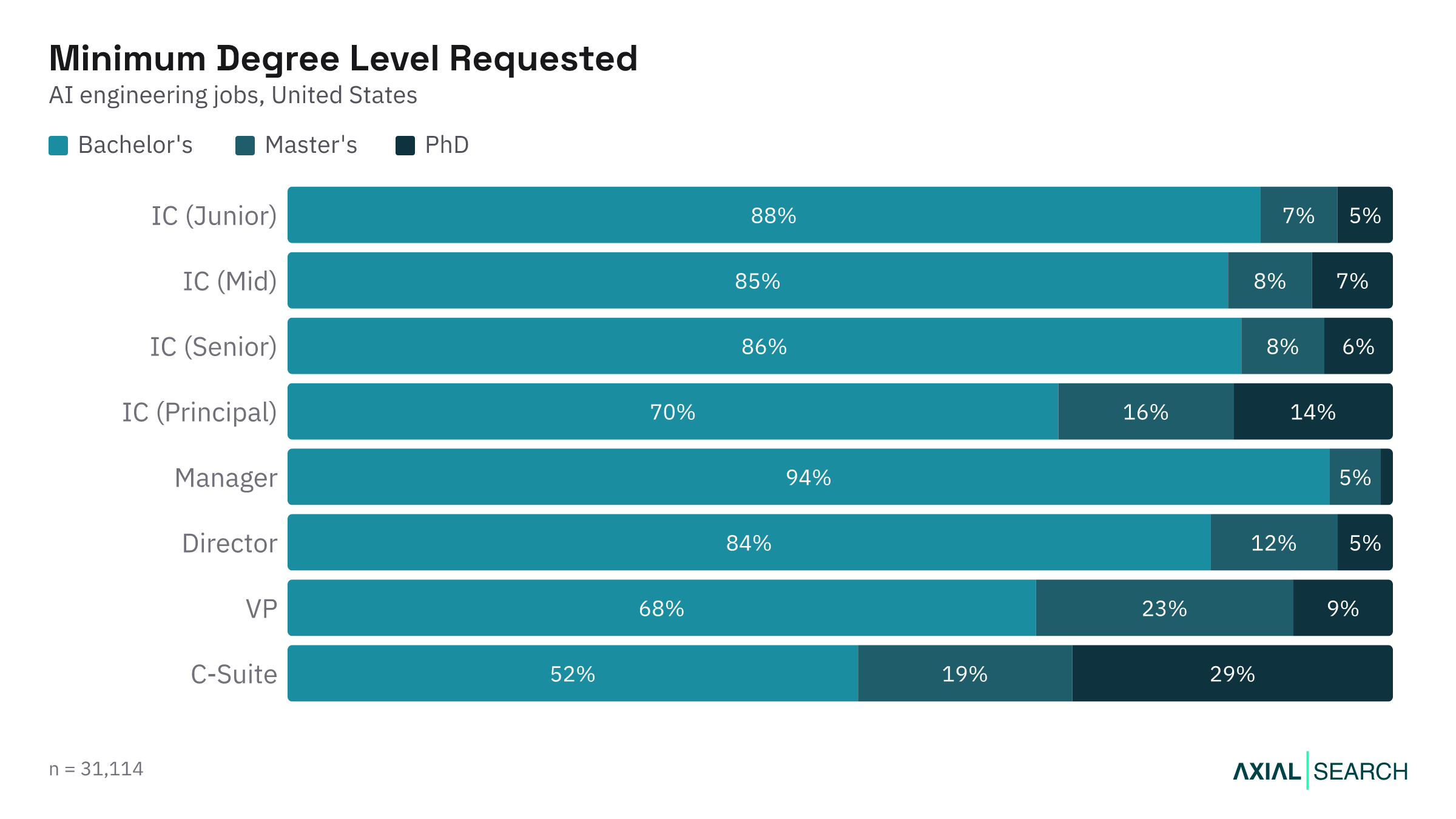
72% of AI engineering postings require a degree, and while a bachelor's clears the bar for most roles, advanced degrees become common at Principal level and above.
Across Junior, Mid, Senior and Manager bands, bachelor's degrees appear in 85–94% of AI engineering postings. Master's degrees start showing up at Principal level (16% of postings) and VP (23%), while PhDs appear in 14% of Principal roles, 9% of VP and 29% of C-suite.
The field you studied matters, and the list is overwhelmingly technical:
| Degree field | Share of postings |
|---|---|
| Computer Science | 62.2% |
| Engineering | 33.7% |
| Data Science | 21.1% |
| Machine Learning | 13.5% |
| Software Engineering | 10.4% |
| Statistics | 10.4% |
| Business | 9.6% |
| Mathematics | 9.5% |
| Information Systems | 8.7% |
| Artificial Intelligence | 8.0% |
Computer Science accounts for nearly two-thirds of AI engineering postings, Engineering another third. Data Science and Machine Learning together appear in roughly a third of roles. The business-adjacent fields that show up in AI strategy postings barely register here — Business degrees appear in just 10% of AI engineering postings. This is a technical role screened by technical people, and the degree field is a signal they lean on hard.
If you hold a non-technical degree and want to break into AI engineering, the path is to demonstrate hands-on building ability in a way that's visible and credible — open-source contributions, deployed projects, a portfolio that shows you can write production code and ship models. The degree won't disqualify you but you'll need stronger evidence elsewhere.
Certifications for AI engineering roles
Be honest with yourself about certifications: they barely move the needle here and the ones that do appear aren't AI-specific.
The highest is CISSP, a security credential, at just 1.3% of AI engineering postings.
| Certification | Share of postings |
|---|---|
| Certified Information Systems Security Professional (CISSP) | 1.3% |
| AWS Certified Data Engineer - Associate | 1.1% |
| Google Cloud Certified - Professional Data Engineer | 1.1% |
| Databricks Certified Data Engineer Associate | 1.0% |
| Certified Cloud Security Professional (CCSP) | 0.6% |
| AWS Certified Solutions Architect | 0.5% |
| Certified Information Security Manager (CISM) | 0.5% |
| Certified Public Accountant (CPA) | 0.4% |
| Project Management Professional (PMP) | 0.3% |
| Certified Secure Software Lifecycle Professional (CSSLP) | 0.1% |
The signal here is what's absent: there is no dominant AI engineering certification, so don't delay applying to go collect one.
The cloud and data-platform credentials that do appear (AWS, GCP, Databricks) reflect that a lot of AI engineering work is, in practice, building on managed infrastructure. If you already hold one, mention it; if you don't, spend the time shipping code instead.
The skills that matter for AI engineering roles
Fluency across the stack matters more than depth in any one framework. Employers want someone who can move from Python to cloud infrastructure to foundation models without needing a specialist for each layer.
The capabilities AI engineering leaders need
| Capability | Share of postings |
|---|---|
| Python | 61.5% |
| Cloud Platforms | 54.7% |
| Foundation Models | 51.0% |
| Observability & Monitoring | 42.0% |
| CI/CD | 33.9% |
| RAG | 31.6% |
| MLOps | 25.6% |
| Deep Learning | 24.1% |
| SQL | 21.5% |
| LLM Frameworks | 20.4% |
| Version Control | 20.3% |
| Containerization | 19.8% |
| Java | 17.4% |
| Big Data Processing | 16.4% |
| Agentic AI | 15.8% |
Three themes run through this list.
Python (62%) and cloud platforms (55%) are table stakes — more than half of AI engineering postings mention them explicitly. Foundation models (51%) and RAG (32%) now appear in more than half and nearly a third of AI engineering postings respectively, which means being able to work with LLMs and retrieval-augmented generation is quickly moving from emerging to expected. And observability (42%) and CI/CD (34%) both appear in more than a third of AI engineering postings, a reminder that AI engineering is still engineering — you're expected to ship production systems, not just train models.
MLOps (26%), deep learning (24%) and SQL (22%) follow, which tells you that model training, data pipeline work and production infrastructure are all in scope for these roles. Agentic AI (16%) already appears in more than one in seven AI engineering postings, a sign that the orchestration of multi-step AI systems is becoming a core engineering skill faster than most assume.
For candidates this means you need to be able to talk credibly about the full lifecycle of an AI system: how you built it, how you deployed it, how you monitored it in production and how you iterated on it.
For hiring managers it means the person who can only talk about model accuracy but can't explain how they'd serve it at scale isn't ready yet.
Software and tools AI engineering roles use
| Software / tool | Share of postings |
|---|---|
| AWS | 39.0% |
| Microsoft Azure | 38.7% |
| GCP | 20.8% |
| PyTorch | 19.8% |
| LangChain | 17.4% |
| Docker | 15.9% |
| TensorFlow | 14.6% |
| Claude | 12.7% |
| Apache Spark | 11.0% |
| React | 9.9% |
| Git | 9.9% |
| GitHub | 8.9% |
| LangGraph | 8.7% |
| Databricks | 8.1% |
| GitHub Copilot | 8.0% |
The cloud platforms lead by a wide margin — AWS (39%) and Azure (39%) together appear in more than three-quarters of AI engineering postings, while GCP (21%) rounds out the top three.
Knowing how these platforms price, secure and scale AI workloads matters more than any single modeling framework. PyTorch (20%) and LangChain (17%) both appear in roughly one in five AI engineering postings, which means employers increasingly expect engineering candidates to have hands-on familiarity with both deep-learning frameworks and the orchestration layers that sit on top of foundation models. Docker (16%) is a reminder that containerization is still the default way production AI systems get deployed.
Claude (13%) appearing in more than one in ten AI engineering postings signals that Anthropic's model is now production infrastructure, not just a research tool. LangGraph (9%) and GitHub Copilot (8%) showing up in nearly one in ten postings each tells you that agentic workflows and AI-assisted development are quickly becoming part of the standard engineering stack.
Remember that these are the tools postings mention — a platform not listed isn't disqualifying. Treat the list as the vocabulary to be fluent in, not a checklist to complete. The candidate who can credibly discuss tradeoffs between platforms is worth more than the one who has used all of them but can't explain why they chose each one.
How to position yourself for an AI engineering role
Pull the threads together and a clear playbook emerges.
Lead with what you built and how it performed. The single strongest thing you can show is a track record of shipping AI systems that worked in production — that's what the leadership profile rewards and it's what separates an engineer from a researcher. Frame it around the technical decisions you made, the tradeoffs you navigated and the business outcomes those decisions delivered.
Back it with the conventional credentials. Evidence the roughly five years and the technical degree and don't be shy about production-engineering experience — a lot of AI engineering is systems work in disguise. If you're earlier in your career, demonstrate that you can already work across the full stack: model training, deployment, observability, iteration.
Demonstrate current AI fluency across the stack. Be able to talk fluently about Python, cloud platforms, foundation models and RAG and about how to deploy and monitor them in production without pretending to be a platform specialist. Breadth, credibly held, is the goal. Show you understand the production lifecycle, not just the modeling part.
Skip the certification treadmill. There's no credential that unlocks this market, so invest that time in shipping code and building a portfolio that shows you can work across the full AI stack. If you already hold a cloud or data-platform cert, mention it; if you don't, the marginal value of going to get one is low compared to just shipping another project.
Final Thoughts
For candidates. AI engineering is the build role, and employers screen for people who ship systems that work. Lead with production outcomes, demonstrate fluency across the full stack from Python to cloud to foundation models, and don't wait to collect certifications that barely register in hiring decisions. The person who can talk about the technical decisions behind a deployed system is worth more than the one with a long list of courses completed. If you prefer training models over serving them in production, ML engineering skills focus on the science side of the stack.
For employers. This is the single largest and most in-demand role in the AI job market right now — more than 43,000 AI engineering postings, roughly 1,600 new ones a week — which means you're competing for talent with every other company trying to ship AI systems at scale. The profile that wins is someone who can work across the full stack, who understands production systems and who has already shipped something that worked. Interview around deployed systems, not years in seat, and be ready to move quickly when you find someone credible.
Methodology & sources
- Data sources. Job data is collected from publicly available postings on online job boards and updated weekly, covering US roles posted since January 2026. Explore and filter it on our live AI job market dashboard.
- Requirements are extracted from job descriptions using a combination of programmatic rules and AI analysis. Minimum experience is the median minimum years requested by seniority; minimum degree is the lowest degree a posting requires.
- Top degree fields, certifications and skills are the items mentioned most often across postings.
- The leadership profile reflects the relative emphasis across leadership capabilities inferred from job-description language using our framework; skills are drawn from AI analysis plus programmatic scanning of posting text.
- These are mention rates — the share of postings that state each item. A skill, degree or certification not appearing means it wasn't stated in the posting, not that it isn't valued.
Need help finding AI engineering talent that can ship at scale? Contact Axial Search.

AI Engineering Pay in 2026: Salaries, Bonuses and Equity
What ai engineering roles pay in 2026: median salary, pay by seniority, top-paying sectors and locations, and how often bonus and equity are mentioned in US job postings.

AI Engineering Jobs in 2026: A Data-Backed Market Map
The complete picture of the ai engineering job market in 2026: hiring demand, what these roles pay, where the jobs are, who's hiring and what it takes to get in.

AI Engineering Job Demand in 2026: 43,000 Postings Mapped
Where ai engineering jobs are in 2026: hiring demand and trend, top states and cities, who's hiring by sector and company size, and the mix of seniority, contract type and remote work across US postings.
Turn AI ambition into lasting business value
Whether you're hiring your first AI leader or scaling enterprise transformation capability, we help you define, assess and recruit the people who make it stick.