
ML Engineering Pay in 2026: Salaries, Bonuses and Equity
What ML engineering roles pay in 2026: median salary, pay by seniority, top-paying sectors and locations, and how often bonus and equity are mentioned in US job postings.
 Updated: October 1, 2026
- ML Engineering pays $197,000 at the median — strong, but the real story is how steeply the ceiling climbs: Principal ICs earn more than Managers and now outpace Directors too, so staying technical doesn't cap your comp the way it does in most functions.
- The IC track diverges early. Mid-level ML engineering postings account for 39% of the market, Senior for 32%, and the climb from there rewards depth over title — Principal ICs outearn Directors at the top of the posted range.
- Manufacturing and Capital Markets & PE lead on pay — both sectors cluster around $258,000–$280,000, ahead of Technology at $244,000, while Technology dominates on volume with 37% of all ML engineering postings.
- California accounts for 36% of all ML engineering postings and pays a $20,000 premium over the second tier; the highest metros — San Mateo, South San Francisco, Cupertino — all top $270,000.
- Equity shows up in 26% of ML engineering postings overall, but jumps to 68% at enterprise-scale companies (5,000+ employees) and 33% at Principal IC level, so where and how senior you are determines whether it's on the table.
- 78% of ML engineering roles require a degree, with Computer Science named in 69% of postings; PhD share climbs from 13% at Junior IC to 33% at Principal, so research credentials move you faster at the top end.
How much do machine learning engineers make?
The median ML engineering salary is $197,000. Pay tracks seniority closely, but the technical and management tracks invert near the top: Principal individual contributors now earn more than Director money, so staying technical doesn't cap your earnings the way it does in many functions.
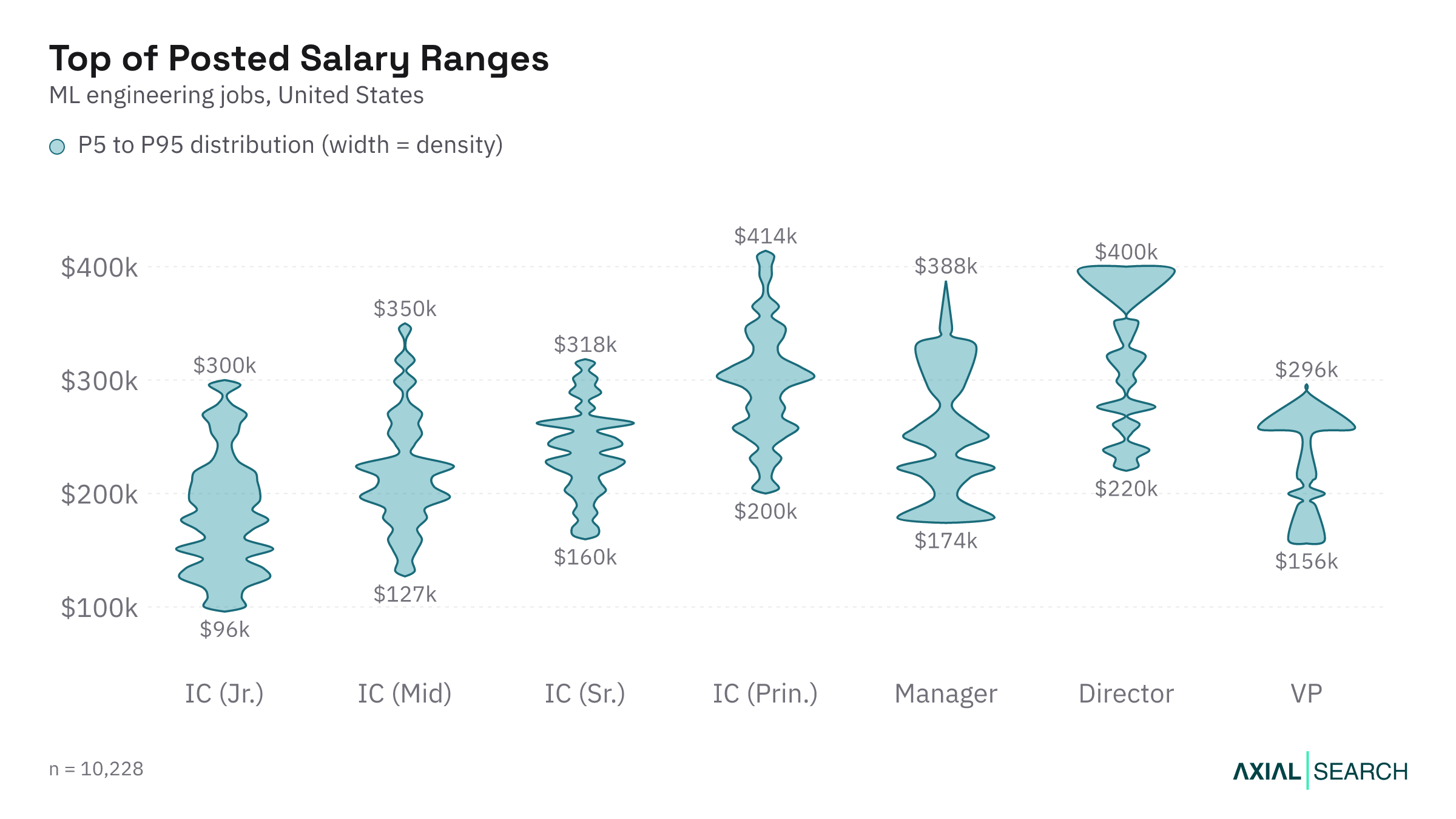
Top of the posted range by seniority — the median and typical maximum of what's posted, 5th to 95th percentile. This is the ceiling candidates can credibly negotiate toward, not the typical offer.
| Seniority | 5th percentile | 25th percentile | Median | 75th percentile | 95th percentile |
|---|---|---|---|---|---|
| IC (Junior) | $94,000 | $137,000 | $180,000 | $213,000 | $300,000 |
| IC (Mid) | $125,000 | $184,000 | $211,000 | $244,000 | $350,000 |
| IC (Senior) | $164,000 | $212,000 | $241,000 | $261,000 | $342,000 |
| IC (Principal) | $202,000 | $260,000 | $300,000 | $334,000 | $414,000 |
| Manager | $174,000 | $204,000 | $234,000 | $258,000 | $343,000 |
| Director | $220,000 | $250,000 | $279,000 | $346,000 | $400,000 |
| VP | $156,000 | $196,000 | $220,000 | $260,000 | $300,000 |
| C-Suite | $260,000 | $260,000 | $300,000 | $338,000 | $367,000 |
Where two percentiles show the same figure, employers are clustering on a round number at that end of the band.
That ceiling has moved up over the past year, consistent with increased hiring for ML engineering. For candidates who can credibly argue they sit in the top quartile, the posted maximum is the starting point, not the ceiling.
Where most ML engineering salaries cluster
The market is densest at Mid and Senior IC levels — together they account for roughly seven of every ten ML engineering postings, so the middle of this distribution is where most candidates land. That concentration is exactly why AI recruitment built for ML engineering focuses so heavily on Mid and Senior IC sourcing.
The band you're quoted matters far more than the headline median. Director is effectively the ceiling on title in this dataset — the sample thins out too fast past it for a stable read, so treat Director as the top of the visible ladder.
Does staying technical or moving into management pay more in ML engineering?
Staying technical now pays more than moving into management in ML engineering — the Principal IC median has pulled ahead of Director, and both sit well above Manager.
That's unusual: in most functions the management track eventually pulls ahead. In ML engineering it doesn't — Principal IC is the ceiling among these bands, so if you're optimizing for comp and prefer building to managing, the data doesn't just avoid punishing that choice, it rewards it.
What is the full salary range for machine learning engineers?
The full posted ML engineering salary range runs from the 5th percentile for Junior ICs up to $414,000 at the 95th percentile for Principal ICs — see the table above for the full breakdown by seniority.
How much room is there to negotiate at the top of the ML engineering range?
More than the median suggests — the gap between the 75th and 95th percentile is widest for Mid-level ICs and narrowest for VP roles, per the table above, so negotiating leverage doesn't scale neatly with seniority.
That spread is the real story: in the bands where it's wide, the posted maximum is a genuine starting point in negotiation, not a hard ceiling.
Which industries pay machine learning engineers the most?
ML engineering pays the most where the work is quantitative, high-stakes and mission-critical: Capital Markets & PE tops the table, with Manufacturing close behind.
| Sector | Median salary | Postings |
|---|---|---|
| Capital Markets & PE | $278,000 | 152 |
| Manufacturing | $258,000 | 1,487 |
| Real Estate | $257,000 | 42 |
| Retail and Hospitality | $246,000 | 687 |
| Technology | $246,000 | 6,636 |
Technology dominates on volume at 37% of all ML engineering postings, so you're more likely to find a role there than anywhere else, even though four sectors pay a higher ceiling.
How much does sector really matter for ML engineering pay?
Not as much as you'd think — about $31,000 separates the top-paying sector (Capital Markets & PE) from the bottom of this list (Retail and Hospitality).
Sector matters, but seniority moves your pay far more: the gap between a Junior IC and a Principal IC is substantial at the median.
Does company size affect ML engineering pay?
Bigger pays more in ML engineering, and the pattern is clean: enterprise-scale companies post higher median salaries than both mid-market firms and smaller companies.
The real difference isn't the median — it's the equity. Of the postings that disclose pay, equity is mentioned more frequently at enterprise-scale companies than at startups and small firms under 500 employees. Larger firms lean on equity as a retention lever far more than smaller ones do, even though the base-salary gap between bands is narrow.
Does company size affect ML engineering equity offers?
Yes, sharply — of ML engineering postings that disclose pay, those at enterprise-scale companies (5,000+ employees) mention equity more often than the 37% rate at startups and small firms under 500 employees.
Mid-market firms (500–5,000 employees) sit in between. If you're targeting total comp with equity as a real component, enterprise is the safer bet; at a startup, ask directly, since fewer postings state it even when it's on the table.
Where do machine learning engineers earn the most?
Pay is geographically concentrated in ML engineering, and California is the standout, while also accounting for a significant share of all postings.
| State | Median salary | Share of postings |
|---|---|---|
| California | $257,000 | 34.9% |
| New York | $245,000 | 10.7% |
| Oregon | $239,000 | 0.4% |
| Washington | $226,000 | 13.0% |
| Maryland | $226,000 | 1.7% |
The broader pattern holds: the coasts pay the most, California dominates both the volume and the ceiling, and the gap between the top-paying states is narrow. Where you work moves your salary far less than how senior you are.
How much does location really matter for ML engineering pay?
Less than seniority does — the top-paying state (California, $257,000) differs from other states in this table.
Washington and New York both pay competitively with California while carrying real volume of their own, so the coasts broadly compete on pay even where California doesn't win outright.
The top-paying cities for ML Engineering
Zoom into the metro level and the picture sharpens. San Francisco proper accounts for a substantial share of all US postings and sits inside California, the single largest state market in the dataset.
The highest-paying metros — San Mateo, South San Francisco and Cupertino — all top $270,000, well above the California state median. Outside the coasts, regional pay stays within a narrower band than seniority-driven differences. If you're optimizing for comp and job options, geography matters but remains secondary to level.
How often are ML engineering bonus and equity offered?
Bonus is mentioned in some ML engineering postings and equity in others — both are floors, not ceilings, since many roles that don't advertise either still offer one.
Dollar figures are almost never posted, so a mention rate is the best signal available.
How often a bonus is offered
A bonus is mentioned in some ML engineering postings overall — common enough to ask about, but far from universal in the job description text.
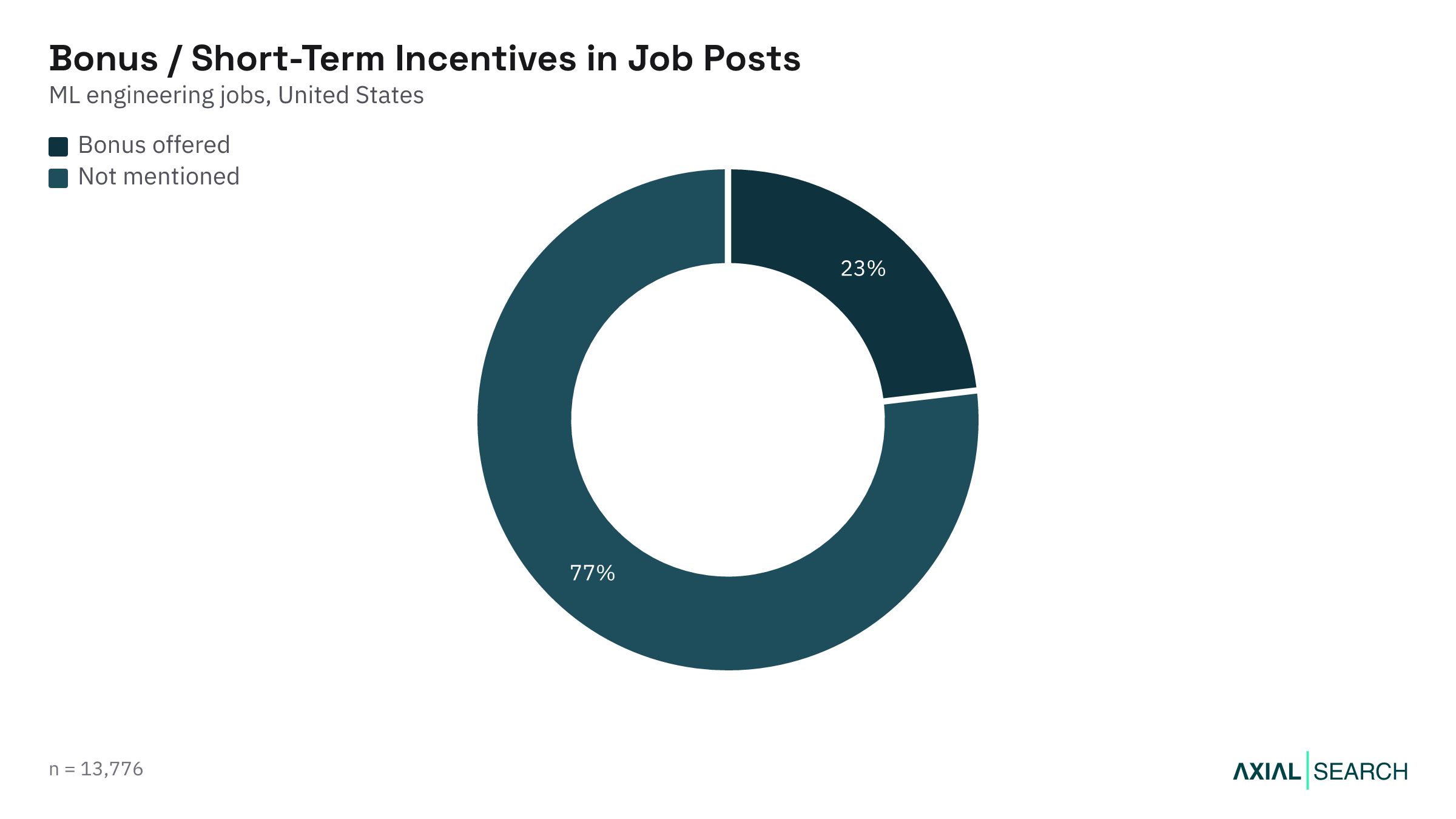
The mention rate climbs with seniority and leverage: VP roles lead, followed by Director roles. Mid IC sits at a lower percentage, Junior IC at 19% and Senior IC at a lower level — and C-suite is 17%, though that's a single-digit sample. If you're negotiating, ask whether a performance bonus is on the table even when the posting is silent; plenty of roles that don't mention one still pay it.
How often equity is offered
Equity is mentioned in ML engineering postings overall, and unlike bonus it doesn't concentrate in management — it rises steadily through the IC track, peaking at higher rates for Principal ICs.
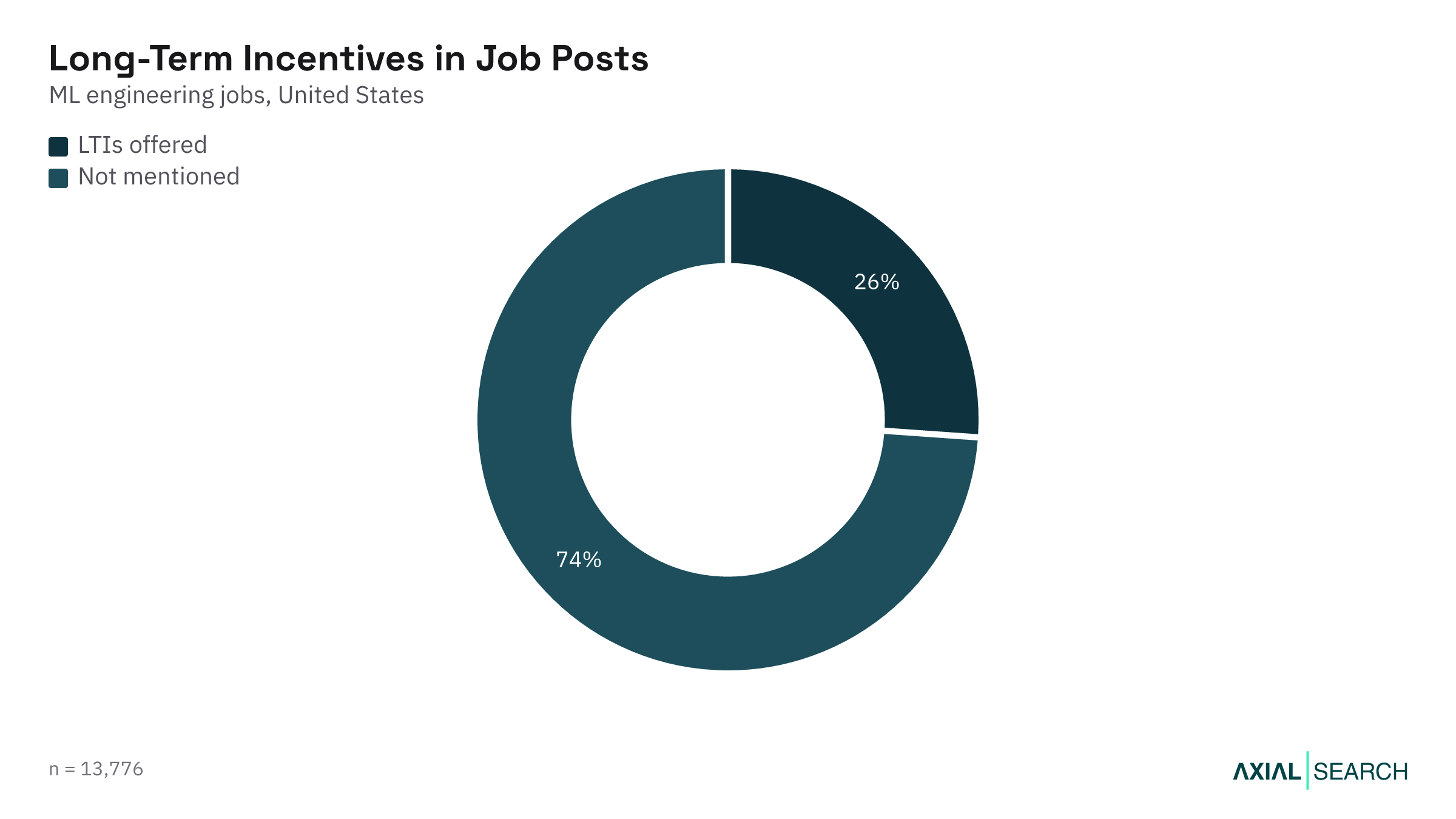
By level: Senior IC 27% and Principal IC 33%. It falls off in management — Director 27%, VP positions lag significantly — and C-suite sits at 17% on a tiny sample. If you're targeting a Principal IC or Director role at an enterprise firm, expect equity to be part of the package even if the posting doesn't say so; at a startup, ask early, since it's less predictable there.
| Level | Bonus mentioned | Equity mentioned |
|---|---|---|
| IC (Junior) | 20% | 21% |
| IC (Mid) | 20% | 35% |
| IC (Senior) | 31% | 37% |
| IC (Principal) | 42% | 45% |
| Manager | 56% | 19% |
| Director | 38% | 31% |
| VP | 64% | 17% |
| C-Suite | 33% | 22% |
What the bonus-versus-equity split says about ML engineering retention
Companies concentrate bonus dollars on management (VP 56%) and equity on deep technical talent (Principal IC 33%) — two different retention tools aimed at two different flight risks.
That's why equity clusters at the Principal IC level while bonus clusters in management: firms use equity to hold onto engineers who can walk across the street, and bonus to align the people managing them.
Final Thoughts
For candidates. ML Engineering is one of the few functions where staying technical pays as well as moving into management, and the data proves it: Principal ICs now out-earn Director at the median, and lead every other seniority level at the 95th percentile too. If you're optimizing for comp and you prefer building to managing, this is the right function. Lead with systems you've shipped, models you've optimized in production and the business outcomes they drove — not the depth of your academic background. Equity shows up in a third of Principal-IC postings, so ask about it even when it's not advertised. If you focus more on application integration than training loops, AI engineering salaries track a lighter infrastructure stack.
For employers. This is a competitive, high-volume market: nearly 14,000 US postings in six months, most of them at Mid, Senior and Principal IC level, and the talent pool is thinner than the posting count suggests. The candidates with strong ML engineering skills — not just training-loop familiarity — are the ones who move fast through the interview process and field multiple offers. If you're hiring at Principal IC or Director, expect a long search unless you're paying at the 75th percentile or higher and offering equity as standard.
Methodology & sources
- Data sources. Job data is collected from publicly available postings on online job boards and updated weekly, covering US roles posted since January 2026. Explore and filter it on our live AI job market dashboard.
- All salary figures are derived from the minimum and maximum salary bands employers post, annualized and reported as percentiles, not averages.
- Every salary figure on this page is the top of the posted range — the ceiling employers advertise, not the typical offer. The seniority table reports it at the 5th, 25th, 50th (median), 75th and 95th percentiles. Median salary in the sector, company-size and location tables is the median of that ceiling within each group.
- Bonus and equity figures are mention rates — the share of postings that state a bonus or equity. A posting silent on either is counted as "not mentioned"; it does not mean none is offered.

How to Advance Your ML Engineering Career
How to become an ML engineering professional in 2026: the leadership capabilities employers screen for, the experience and degrees required, the certifications that matter, and the skills most in demand across US…

The State of the ML Engineering Job Market in 2026
The complete picture of the ML engineering job market in 2026: hiring demand, what these roles pay, where the jobs are, who's hiring and what it takes to get in.

How to Hire Machine Learning Engineers in 2026
Where ML engineering jobs are in 2026: hiring demand and trend, top states and cities, who's hiring by sector and company size, and the mix of seniority, contract type and remote work across US postings.
Turn AI ambition into lasting business value
Whether you're hiring your first AI leader or scaling enterprise transformation capability, we help you define, assess and recruit the people who make it stick.