
What Is Your AI Transformation Bottleneck?
How to find the one constraint that caps your AI work, apply the theory of constraints to it, and decide which level of AI leader to hire to clear it.
 Updated: August 7, 2026
- Employers stress explaining AI plainly more for director and VP roles than for C-suite, while leaders' resumes show the opposite pattern.
- In our sample, 79% of C-suite and 74% of VP leaders have owned revenue or a P&L, compared with 61% of directors.
- Leaders make build, buy or partner decisions and sequencing a main emphasis on their resumes, but employers rate it only a moderate emphasis, so the skill that stops project sprawl is underweighted in hiring.
- VP job postings mention generative AI or LLMs in 23% of cases, against 8% of C-suite postings.
What is an AI transformation bottleneck?
An AI transformation bottleneck is the one constraint that caps how much value all of your AI work can deliver, and it is rarely model access or tools. In most companies it is ownership, data readiness or a process nobody has redesigned. Every project behind it waits in the same queue, however good the project is.
Tools stopped being the constraint some time ago. Stanford HAI reports that organizational AI adoption rose to 88%.1 When nearly every company has the same models and platforms, access cannot be what separates the companies getting value from the ones still running pilots. The difference sits further upstream, in the things a vendor cannot ship to you.
Data readiness is a good example, and our data shows a gap around it. In the AI job postings we analyzed for Digital Transformation roles, C-suite postings put noticeably more weight on getting data ready for AI than director or VP postings do. That fits the constraint view: unready data stalls everything downstream of it.
The candidates have not caught up. In a sample of Digital Transformation leaders in our network, getting data ready for AI is a minor theme on resumes at every level, C-suite included. So a common constraint in AI transformation is a skill the hiring market wants more than leaders advertise. If you are hiring to clear a data constraint, the resume will not tell you who can do it, so ask for specifics.
How do you apply theory of constraints to AI?
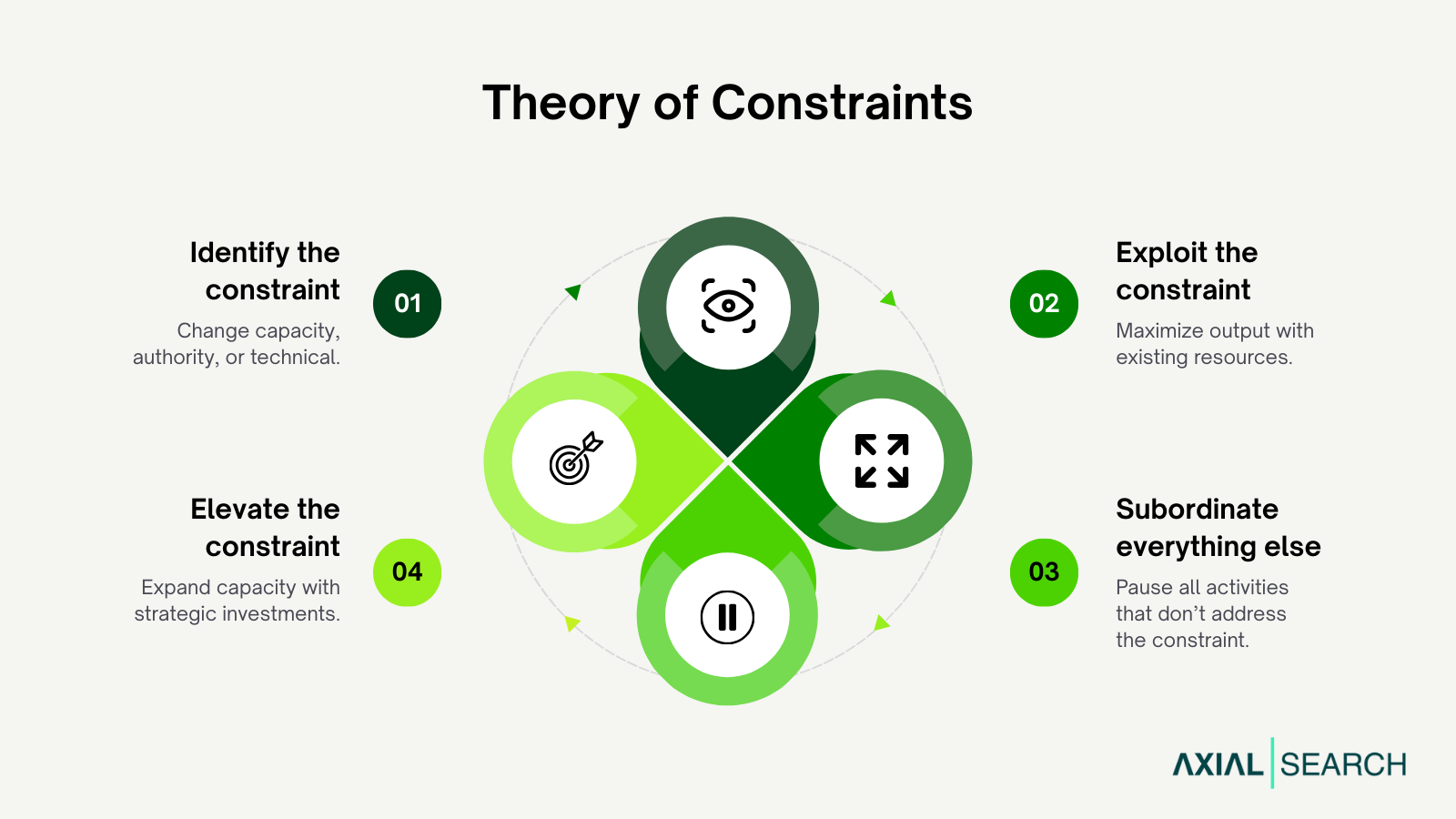
Run the five focusing steps on your AI portfolio: identify the single constraint, get the most out of it, make every other project wait on it, add capacity to it, then look for the next one. Funding more pilots before step one only lengthens the queue in front of the constraint.
Theory of constraints forces a question most AI roadmaps skip: what is the one thing everything else is waiting on? A list of thirty use cases does not answer it. A capacity map does. Find the scarce resource, whether that is a data engineering team, a legal review or one executive who signs off on every model, and treat its hours as the real budget.
The second step, exploiting the constraint, is mostly about choosing what goes through it. Employers already understand this. In the AI job postings we analyzed, choosing which AI use cases to pursue is a central requirement at director, VP and C-suite level alike. Prioritization is not a nice-to-have in these roles; it is the job.
One VP in a large company's solution engineering group put the team's limited capacity on the biggest, highest-value pursuits and routed AI workshop and briefing requests through a prioritization model tied to opportunity value. Revenue supported rose from about $230 million with 9 people to about $300 million with 12. That is the method in miniature: the constraint was expert time, and the gain came from deciding what it was spent on before adding headcount.
Only after you have squeezed the constraint should you elevate it with more people, more budget or better tooling. Elevate first and you pay to scale waste.
The method is simple; naming the constraint is the hard part. Two of the constraints that most often hide behind a stalled AI program are people problems: adoption and project sprawl.
Is the AI adoption bottleneck a leadership gap?
Often, yes. When adoption stalls, the missing piece is usually a senior owner who can explain AI plainly and make the case for change, not another engineer. Our data shows employers and leaders disagree about exactly these skills, and that disagreement is where hiring misses happen.
According to AWS, culture, not technology, drives AI innovation and meaningful adoption success.2 The pilots work; the organization does not move. Someone has to translate what the technology does into plain business terms and then carry people through the change.
The market splits on that first skill. In the AI job postings we analyzed, employers stress explaining AI plainly and cutting through hype more for director and VP roles than for C-suite roles. Leaders' resumes run the other way: in our sample, C-suite leaders feature plain explanation of AI more prominently than directors or VPs do. The level employers want this skill at is the level where candidates are least likely to show it.
Resumes are uneven on making the case for change too. VP resumes give it real weight, while director and C-suite resumes treat it as a minor theme. So if your adoption problem lives in the executive team, the C-suite resume in front of you may not tell you whether this person can handle resistance.
This is why so many AI transformations stall on people rather than technology. Interview for these skills directly. Ask candidates to explain a model's limits to a skeptical CFO, and to describe a change effort that met real resistance and how they got through it.
Why do more projects tighten AI transformation constraints?
Every new AI project competes for the same constrained owner, data team or approval path, so adding projects raises work in progress without raising output. The fix is to sequence and cut, not to add.
Leadership teams find this part of theory of constraints the hardest to accept. A new pilot feels like progress. But if it needs the same data engineers as the three pilots already waiting, it adds no capacity. It adds a queue, more context switching and longer cycle times for everything already in flight.
Strategy teams are often looking the wrong way. According to the World Economic Forum, 72% of chief strategy officers cite commercialization of AI as among the most impactful trends, but only 24% cite talent shortage and workforce transformation.3 Commercial ambition without attention to the people constraint is how portfolios sprawl.
The skill that prevents sprawl is portfolio discipline: build, buy or partner decisions, budgets and sequencing. Leaders already lead with it: in our sample, it is a main theme on resumes at every level. Employers, by contrast, give it only moderate weight in the AI job postings we analyzed. The discipline that keeps the queue short is undervalued at the hiring stage.
One VP at an IT services firm set up a test-and-deploy governance model for AI investments that shortened time-to-value by 30 to 60%, brought benefits forward by 6 to 12 months and improved portfolio ROI by avoiding or deferring low-value initiatives. The gain came from saying no. If your next AI hire cannot point to projects they killed or deferred, you are likely hiring someone who will add to the queue.
What level of AI leader removes the bottleneck?
Hire a VP when the constraint is getting pilots into production, and a C-suite leader when the constraint is ownership of AI outcomes and the P&L behind them. A Director rarely has the authority to move a company-wide constraint alone.
The ownership data is clear. In our sample of Digital Transformation leaders, 79% of C-suite leaders and 74% of VPs have owned revenue or a P&L, compared with 61% of directors. C-suite in this sample includes founders and chiefs of small companies, so the top level is broader than Fortune 500 executives. Still, if the constraint is that nobody owns the commercial outcome of AI, the C-suite and VP pools are where commercial ownership is most common.
VPs look like the delivery level. In our sample, 24% of VPs have also worked in Product, against 15% of directors. Employers write VP roles that way too: in the AI job postings we analyzed, VP postings mention generative AI or LLMs in 23% of cases, against 8% of C-suite postings, with director postings in between.
One VP at a technology company moved 8 of 11 AI pilots into production and cut the pilot-to-production cycle by 42%, using reusable architecture patterns and stakeholder alignment. That is what a VP hire should do to a production constraint.
For a fuller view of how these levels split the work, see our guide to the leadership roles behind AI transformation. If the constraint is ownership but you are not ready for a permanent executive, fractional AI leadership can put a senior owner on the constraint while you work out the permanent role.
Find the constraint before you hire
Your AI transformation moves at the speed of its one constraint. Name it before you fund another pilot. When the constraint is data readiness, test for it directly, because resumes underplay it.
When it is adoption, hire for plain explanation and change leadership, and interview for both. When it is portfolio sprawl, hire someone who can show what they cut. Then match the level to the job: a VP to push pilots into production, a C-suite leader to own the outcome and the P&L.
Hire the wrong level, or for the skills the resume happens to lead with, and the constraint stays exactly where it was.
Methodology and sources
Candidate figures come from a random sample of 1,000 US and Canadian Digital Transformation leaders at Director, VP and C-suite level in Axial Search's candidate network, using each person's current level in that function. Job-posting figures come from a random sample of 866 US and Canadian job postings for Digital Transformation roles at Director, VP and C-suite level from the past 12 months. Anecdotes are drawn from resumes in our network and generalized so no person or employer can be identified. External figures are cited below.

How to Build an AI Team From Scratch: Roles and Order
Which AI roles to hire first, whether to promote from inside or hire outside, what each senior seat costs, and how long the build takes, based on job posting and candidate data.

What Does an AI Steering Committee Decide?
What an AI steering committee should decide, what one accountable leader should own instead, and how to hire that leader when there is no committee.

How Should You Structure a Fractional AI Leadership Engagement?
How to scope, price and review a fractional AI leader: decision rights, retainer versus deliverable fees, weekly hours, and when to extend, narrow or hire full time.
Turn AI ambition into lasting business value
Whether you're hiring your first AI leader or scaling enterprise transformation capability, we help you define, assess and recruit the people who make it stick.