
What to Know When Hiring AI Engineers
What it takes to hire AI engineers in 2026: pay benchmarks, market competitiveness, where talent concentrates and a free job description template, from 43,480 US postings.
 Updated: July 29, 2026
- AI engineering hiring tilted upward into summer. Postings rose 14% over the last quarter against the quarter before, signaling no slowdown in demand for AI engineering talent.
- Enterprise teams post nearly half the AI engineering roles, but startups punch above their weight. 47% of postings come from organizations with 10,000+ employees, yet companies under 51 post 13% — more than any single mid-size band.
- Professional Services and Technology lead AI engineering demand, but hiring spreads across sectors. Those two post 29% and 24% respectively, while Financial Services, Manufacturing and Healthcare together account for another 14%.
- Two-thirds of AI engineering postings target mid and senior ICs. 35% are mid-level, 31% senior, and just 12% junior — the bar to enter is high but the middle of the market is wide open for AI engineering candidates.
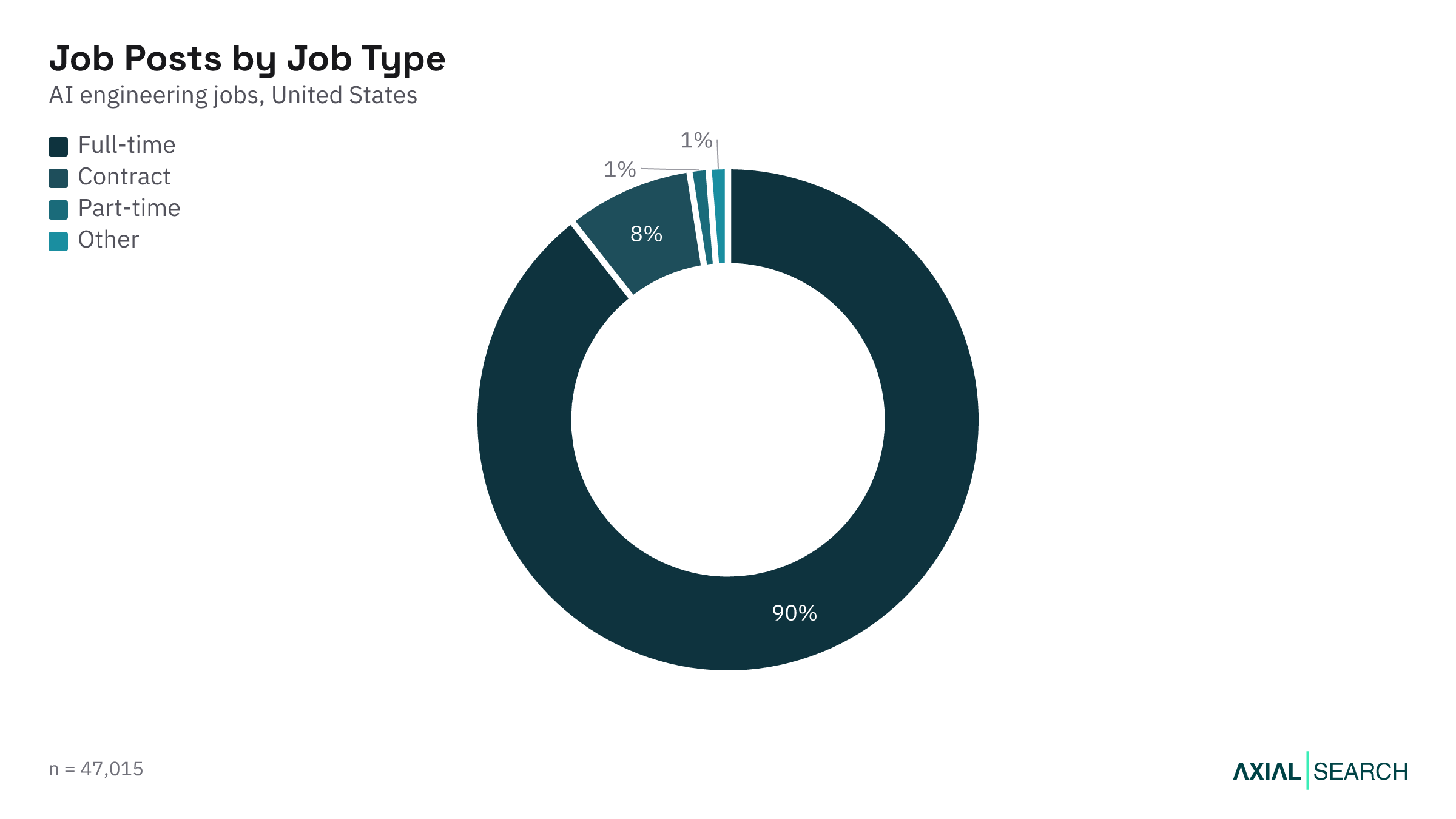
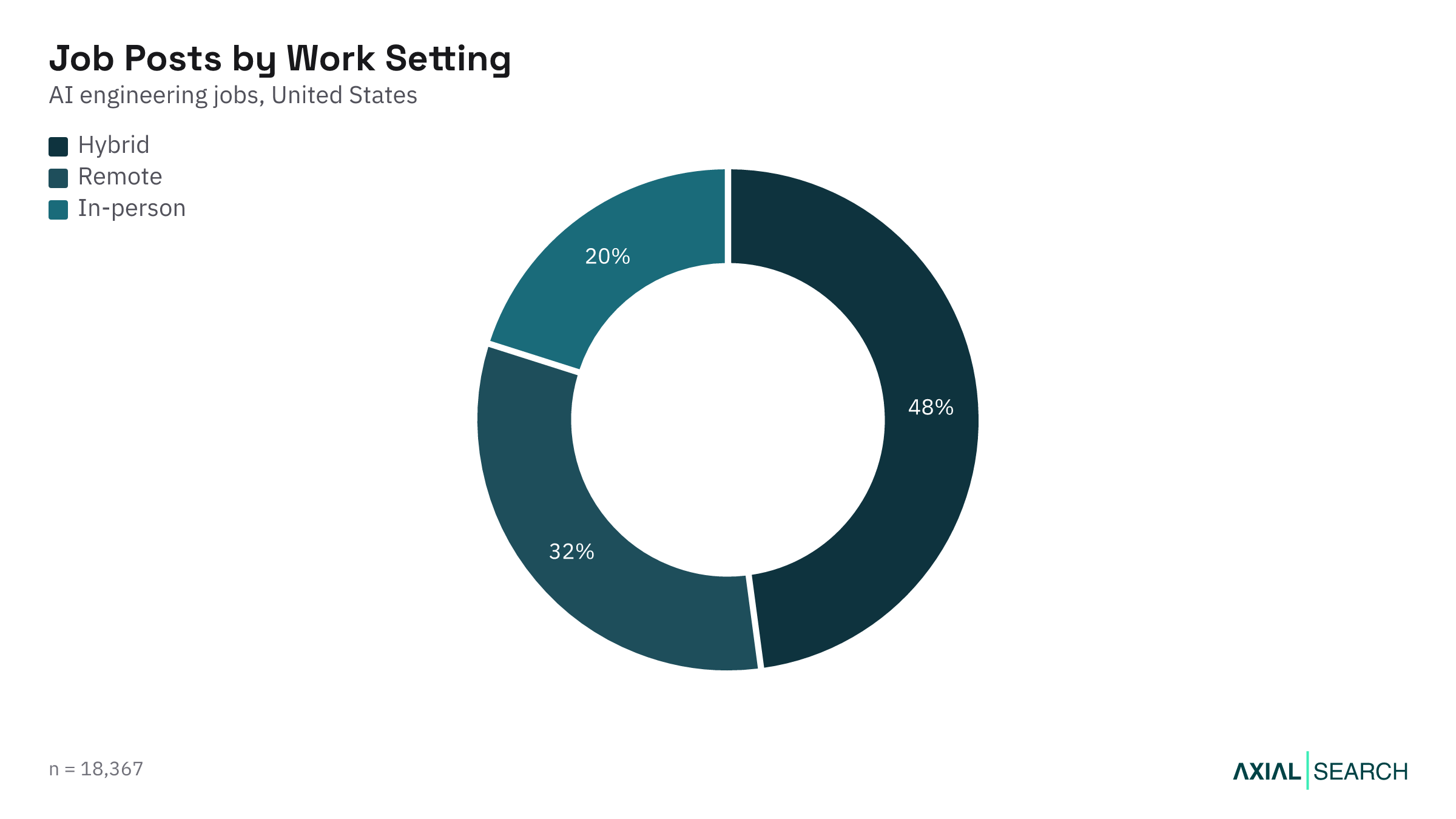
- Most AI engineering roles offer location flexibility. Of postings that specify a work model, 48% are hybrid and 32% fully remote, while 90% are full-time permanent AI engineering positions.
- California holds a fifth of AI engineering postings, but demand spreads nationally. San Francisco leads at 8.8%, yet Texas, New York and Washington each contribute 4–11%, and eight other states post over 1,200 AI engineering roles apiece.
What will you need to pay to hire AI engineers?
Budget a median of $176,000 for an AI engineering hire — pay climbs steadily up the ladder, and the Principal IC track commands close to Director-level money, so staying technical doesn't cap what a strong candidate can ask for; above Director, though, pay doesn't keep climbing — VP and C-suite bands actually trail it.
That's the posted band, not the final offer. Bonus (mentioned in 31% of AI engineering postings) and equity (14%) sit on top, and they're not evenly spread — equity peaks at the Principal IC level, bonus peaks at Manager and VP. For the full breakdown by seniority, sector and location, see AI engineering salaries.
How AI engineering pay changes with seniority
Pay rises steadily through Mid and Senior IC, then splits: the Manager track tops out lower than the Principal IC track, which is unusual and worth knowing before you set a leveling structure.
If you're building a req around a Manager title expecting to underpay a senior technical candidate, the data says otherwise — a Principal IC candidate can credibly ask for Director money, and often gets it, which is the kind of leveling mistake AI recruitment built for technical hiring catches before the offer goes out.
Where bonus and equity fit into an AI engineering offer
31% of AI engineering postings mention a bonus and 14% mention equity, and neither is spread evenly across levels — bonus climbs with management seniority, equity peaks at Principal IC.
If you're competing for a Principal IC candidate, an equity component is doing more work in that conversation than it will for a Manager hire.
How competitive is the market for AI engineers?
Competitive — 66% of AI engineering postings target IC roles at Mid or Senior level, and the entry-level pipeline is thin, so growing your own talent takes longer than hiring it.
Two-thirds of the market sits in the Mid and Senior IC bands, where candidates have the most options and the least reason to take a below-market offer. The challenge isn't finding openings to compete against — it's finding people who can do the work, and technical depth is hard to read off a resume.
Why the AI engineering pipeline is thin at the top
Only 8% of AI engineering postings target the Principal IC level and just 12% target junior roles, so the deep-technical bench most teams want to promote into is thin on both ends.
That means a realistic build-your-own-bench plan takes years, not quarters — for an immediate need, hiring is faster than developing.
Who are you competing with for AI engineering talent?
You're competing against enterprise-scale companies most often — 47% of AI engineering postings come from organizations with 10,000+ employees — but also against a meaningful startup segment: 13% of postings come from companies under 51 employees.
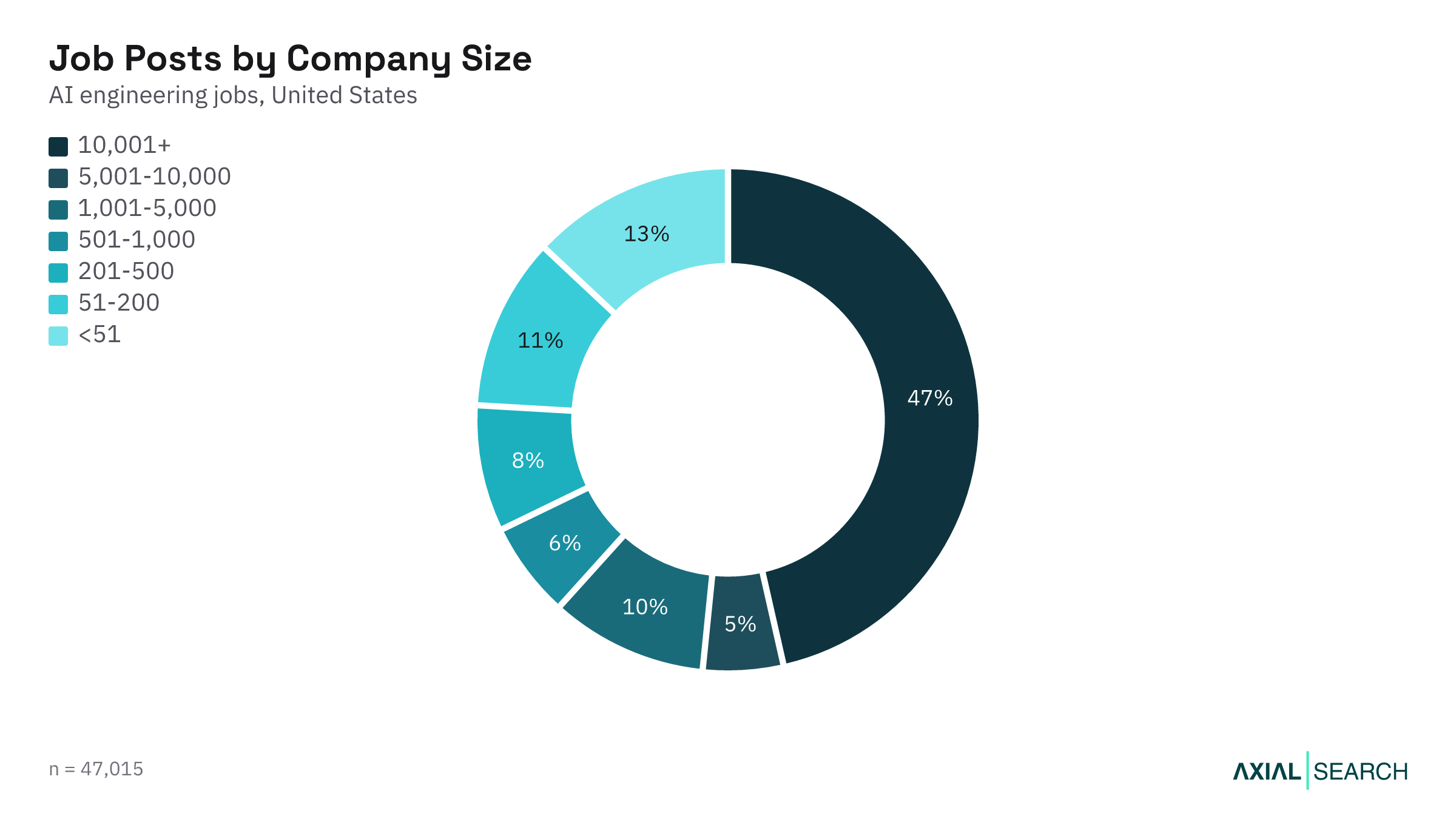
That split tells you AI engineering is both a big-company infrastructure play and a startup technical hire. Mid-size companies collectively post the remaining share, spread fairly evenly across the 51–200 band (11%), 201–500 (8%), 1,001–5,000 (10%) and 5,001–10,000 (5%).
The sector breakdown shows the same spread:
| Sector | Share of postings |
|---|---|
| Professional Services | 28% |
| Technology | 24% |
| IT Services | 15% |
| Financial Services | 6% |
| Manufacturing | 5% |
| Healthcare | 2% |
| Capital Markets & PE | 1% |
| Telecom & Media | 1% |
Professional Services edges out Technology for the top spot, and IT Services hiring is nearly as large as the two leaders combined. Financial Services, Manufacturing and Healthcare all show up with meaningful shares. AI engineering is no longer a tech-only discipline; it's infrastructure work that every industry with data and customers now needs.
What level of AI engineering hire do you actually need?
66% of AI engineering postings target a full-time, mid-to-senior IC — not a manager and not a junior generalist. The three cuts below describe the shape of the market so you can benchmark the req you're about to open.
Seniority levels in AI engineering hiring
Two-thirds of AI engineering postings are mid-level or senior IC roles. Mid-level engineers account for 35%, senior engineers another 31%, and the two bands together make up a significant portion of the market. Only 12% target junior engineers, and the Principal IC track — deep technical specialists who stay out of management — accounts for 8%.
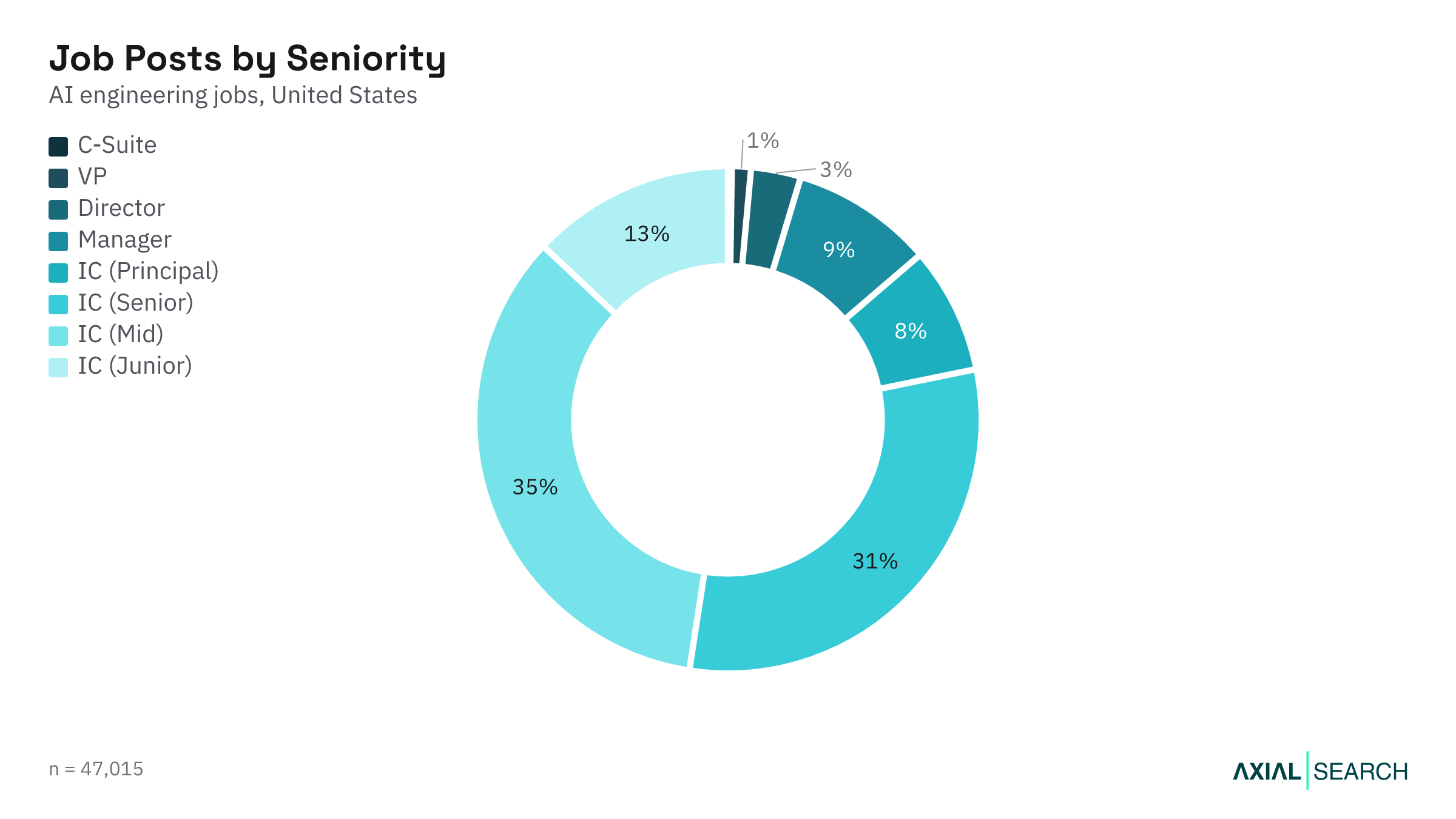
Leadership roles are thin on the ground. Managers make up 10%, Directors 3%, VPs 1% and C-suite roles barely register. This is a technical execution market, not a management one.
If you're structuring a req around a Manager title expecting to underpay a senior IC, the data says the reverse: a Principal IC candidate has options and a pay ceiling that rivals your Director band. We break down what each seniority band pays in AI engineering salaries.
Full-time versus contract AI engineering roles
This is a permanent-hire market. 90% of postings are full-time roles, with contract work making up 9%. Part-time and other arrangements together account for 1%. Companies are building AI engineering as a standing capability, not staffing projects with short-term contractors.
Remote, hybrid and onsite AI engineering roles
Nearly half of AI engineering postings specify hybrid work, 32% are fully remote and 20% are strictly on-site. So while the work clusters geographically — as we'll see next — a meaningful share of it can be done from anywhere, which widens your candidate pool if you're willing to hire remote.
Where is AI engineering talent concentrated?
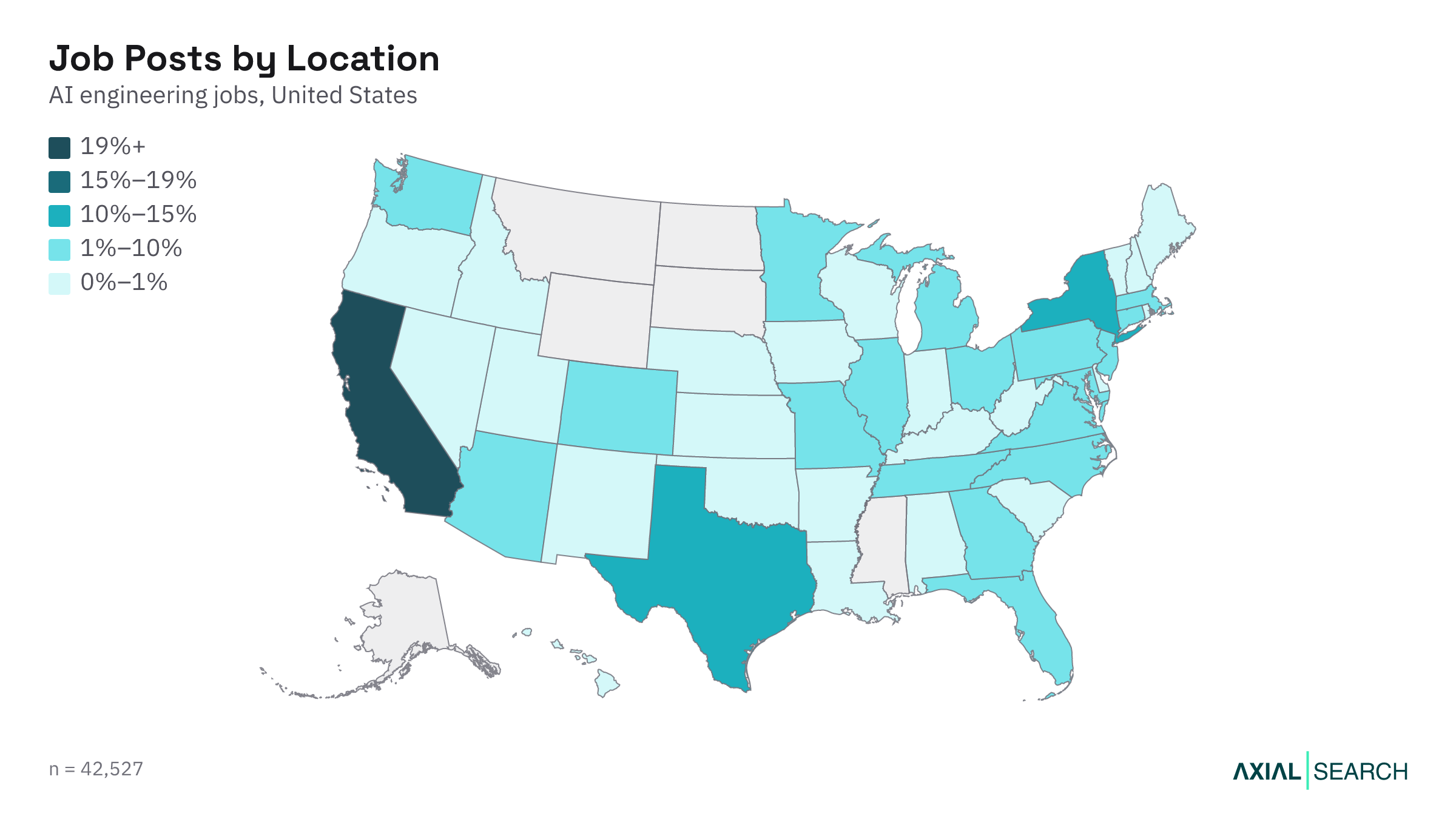
AI engineering talent concentrates in California (22% of postings), New York (11%) and Texas (10%) — the top six states hold 56% of the market.
| State | Share of postings |
|---|---|
| California | 22% |
| New York | 11% |
| Texas | 10% |
| Washington | 5% |
| Virginia | 4% |
| North Carolina | 4% |
| Florida | 4% |
| Illinois | 3% |
The concentration in California, New York and Texas makes sense — those are the largest tech and corporate markets in the country. Washington's presence reflects the Seattle tech corridor, and Virginia and North Carolina show that AI engineering demand extends well beyond the coasts. Florida and Illinois each post more than 1,200 roles, rounding out a national footprint.
The top cities for AI engineering jobs
At the city level the concentration is even sharper. San Francisco dominates, posting nearly three times as many roles as the next city, but the list below it is national.
| City | Share of postings |
|---|---|
| San Francisco, CA | 9.0% |
| Austin, TX | 3.5% |
| Seattle, WA | 3.3% |
| Chicago, IL | 3.0% |
| Atlanta, GA | 2.7% |
| Dallas, TX | 2.7% |
| Charlotte, NC | 2.5% |
| Boston, MA | 2.4% |
Austin, Seattle, Chicago, Atlanta and Dallas all show strong AI engineering demand. The work is more nationally distributed than the California dominance suggests, and Charlotte and Boston add another 2.5–2.6% each. If you're not tied to the Bay Area, these metros give you a real shot at competitive candidates without competing directly against San Francisco pay expectations.
How do you assess AI engineering candidates?
Assess AI engineering candidates on what they've shipped, not on trivia — Python (62%), cloud platforms (55%) and foundation models (51%) are the skills the market actually screens for, so start there.
Ask them to walk through one system they built end to end, including what broke and how they found out. That single question filters more effectively than a stack of algorithm puzzles, because AI engineering is a production-systems discipline, not a research one.
Technical questions to screen AI engineering candidates on
Ask the candidate to walk through a real system they built: what it did, how they deployed it, and how they knew it was working in production. Follow with specifics on their stack — which cloud platform, how they integrated a foundation model, whether they've built a RAG pipeline — since Python (62%), cloud platforms (55%) and foundation models (51%) are what the market actually screens for.
Push past the happy path. Ask what broke after launch, how they found out, and what they changed. A candidate who can only describe the build, not the operating of it, isn't ready for a production-heavy role.
System-design questions for senior AI engineering candidates
For Senior and Principal IC candidates, ask them to design an AI system end to end on a whiteboard: ingestion, model serving, monitoring and rollback. The Principal IC band pays close to Director money, so hold that bar to a genuinely architectural level, not just a coding one.
Ask how they'd monitor a model in production for silent failure — a model that's still returning answers but has drifted. That question separates candidates who've operated systems from candidates who've only trained them.
Red flags to watch for when interviewing AI engineering candidates
Watch for candidates who can describe model architecture fluently but go vague the moment you ask about deployment, monitoring or what happens when a system fails. That gap is common and it's the exact gap this market pays a premium to avoid.
Also watch for a portfolio that's all notebooks and no shipped systems — the leadership profile data across the AI engineering job market puts hands-on execution at the top of what employers screen for, and a candidate who's only trained models in isolation hasn't demonstrated it yet.
Final Thoughts
For employers. You're competing for a thin pool of engineers who can move between tools and ship production systems. Speed matters, and the seniority mix — two-thirds mid and senior IC — means most candidates have options. Interview around real build decisions, not years of experience, and be ready to move quickly on candidates who demonstrate hands-on execution and architectural fluency. The Principal IC track competes with Director-level pay, so if you're hiring senior technical talent expect them to negotiate as hard as your management candidates do.
Methodology & sources
- Data sources. Job data is collected from publicly available postings on online job boards and updated weekly, covering US roles posted since January 2026. Explore and filter it on our live AI job market dashboard.
- Hiring demand is the count of matching postings per week.
- Company size, seniority, job type and work setting are each group's share of postings. Work-setting shares are computed over the postings that state a work model — the rest are silent, not counted as a category.
- Top states and cities are ranked by share of postings; remote-only postings are excluded from the cities list.
- Salary figures cited in this article are drawn from the subset of postings that state a salary range; percentiles and medians are calculated within each seniority band and reported in full in AI engineering salaries. Bonus and equity figures reflect the share of postings that mention those forms of compensation.
- Interview questions are built from what postings in this dataset ask for, plus Axial Search's own placement experience — they are guidance, not a guarantee of what any single employer should require.

How to Become an AI Engineer in 2026
How to become an AI engineer in 2026: the qualifications, certifications, skills and career path that 43,480 US job postings actually ask for.

Inside the AI Engineering Job Market: 43,500 Postings Analyzed
The complete picture of the AI engineering job market in 2026: hiring demand, what these roles pay, where the jobs are, who's hiring and what it takes to get in.

What AI Engineering Roles Pay in 2026
What AI engineering roles pay in 2026: median salary, pay by seniority, top-paying sectors and locations, and how often bonus and equity are mentioned in US job postings.
Turn AI ambition into lasting business value
Whether you're hiring your first AI leader or scaling enterprise transformation capability, we help you define, assess and recruit the people who make it stick.