
The AI Operations Hiring Market: Demand and Top Employers
Where ai operations jobs are in 2026: hiring demand and trend, top states and cities, who's hiring by sector and company size, and the mix of seniority, contract type and remote work across US postings.
Updated: July 13, 2026

If you're looking for an AI operations role, or hiring for one, this is where the market is. Drawing on 1,575 US job postings analyzed this quarter: the current market size, who's hiring across sector and company size, what the seniority and contract mix looks like and where the work is concentrated geographically. AI operations sits at the intersection of infrastructure, deployment and day-to-day model performance — and the companies hiring for it span enterprise software platforms, cloud providers and the firms embedding AI into their core operations.
- AI operations hiring averages 93 postings a week: A consistent but contained AI operations market — small enough that candidates can track most openings, large enough that employers compete for experienced people.
- Technology holds 42% but the function has spread: AI operations postings now come from IT Services, Professional Services and Financial Services at meaningful scale, not just tech companies.
- Company size splits evenly: 27% of AI operations roles come from 10,000+ employee firms and 19% from sub-51 startups — both enterprises scaling deployed models and early-stage companies building AI-first products need this capability.
- Mid-level IC roles dominate at 32%: AI operations is a practitioner market with only 5% of postings at Director level — the entry path for technical early-career candidates is wider here than in AI strategy or product.
- Remote and hybrid together hold three-quarters of specified work settings: Among AI operations postings that state a model, only a quarter require full in-person — flexibility matters when the talent pool is narrow.
- California posts 30% of openings, San Francisco 18%: AI operations jobs cluster where AI-native companies and cloud infrastructure providers are concentrated, but Texas, Illinois and Colorado form a clear second tier.
The current size of the AI operations job market
AI operations hiring runs at around 93 new US postings a week, based on the last twelve weeks of stable data. That's a contained market compared to the broader AI hiring landscape — small enough that a candidate can track most of the openings, large enough that employers face real competition for experienced people.
For candidates, it means the market is active but not flooded. For employers looking to fill these roles through AI recruitment, it means you're competing for a limited pool of people who know how to operationalize models in production rather than just build them.
Who's hiring AI operations talent
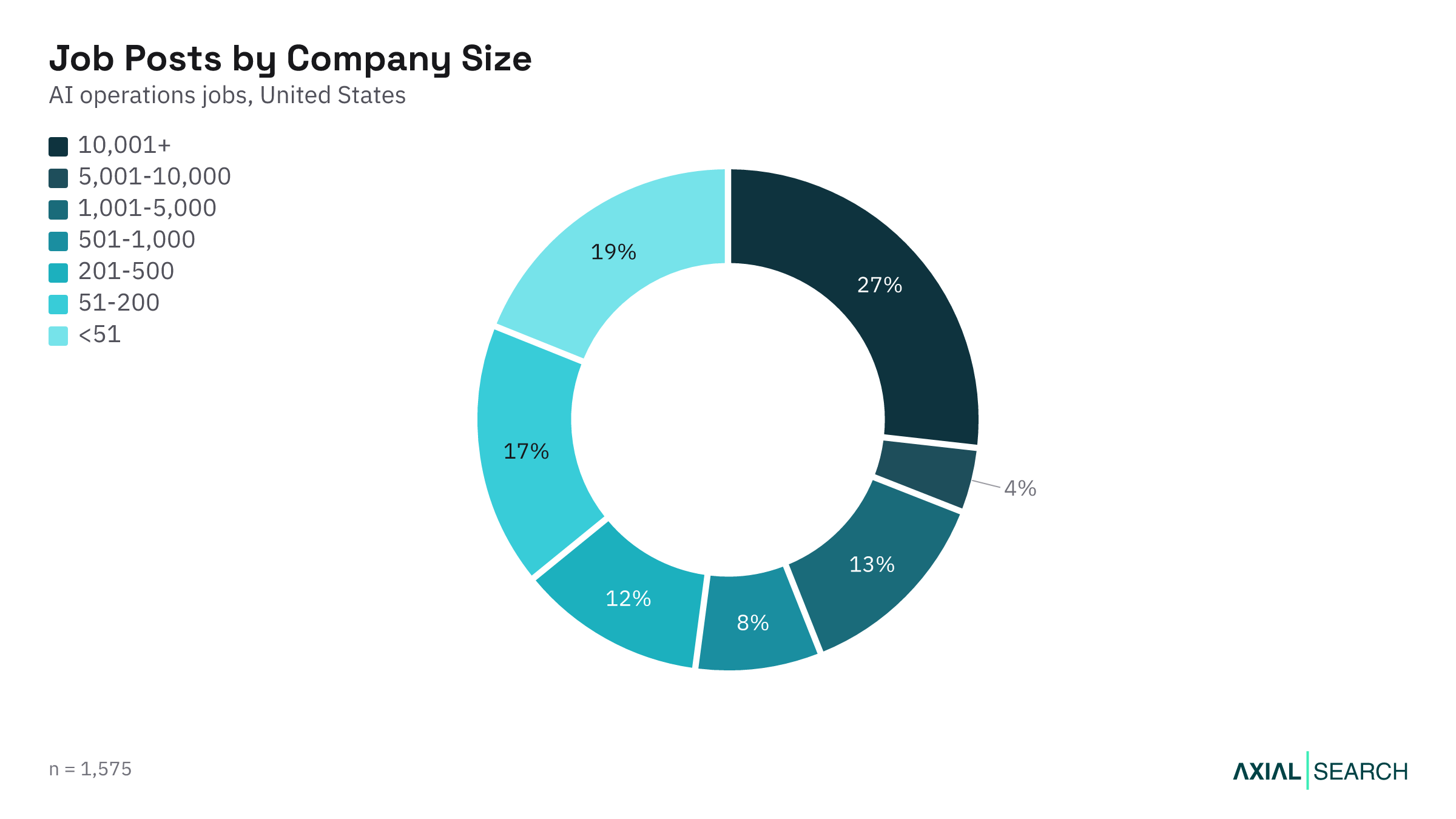
The company-size mix is almost evenly split. Just over a quarter of postings come from 10,000+ employee firms and nearly a fifth come from sub-51 startups. AI operations is a function both enterprises and early-stage companies need — the large firms because they're scaling deployed models across business units, the small ones because they're building products where the AI is the core feature and uptime matters from day one.
The sector view reinforces that technology-first story, but it also shows how widely the function has spread:
| Sector | Share of AI operations postings |
|---|---|
| Technology | 42.1% |
| IT Services | 10.3% |
| Professional Services | 9.3% |
| Financial Services | 7.4% |
| Telecom & Media | 4.3% |
| Healthcare | 3.8% |
Technology companies still dominate, but IT Services and Professional Services together post nearly 20% of openings — these are the firms building or deploying AI systems for clients and needing the ops capability in-house. Financial Services and Healthcare show up because both sectors run production AI at scale and can't afford model drift or unmonitored failures.
What kind of AI operations roles are being posted
These are practitioner roles, overwhelmingly full-time and skewing mid-level rather than senior. The three cuts below describe what a typical opening looks like.
Seniority levels in AI operations hiring
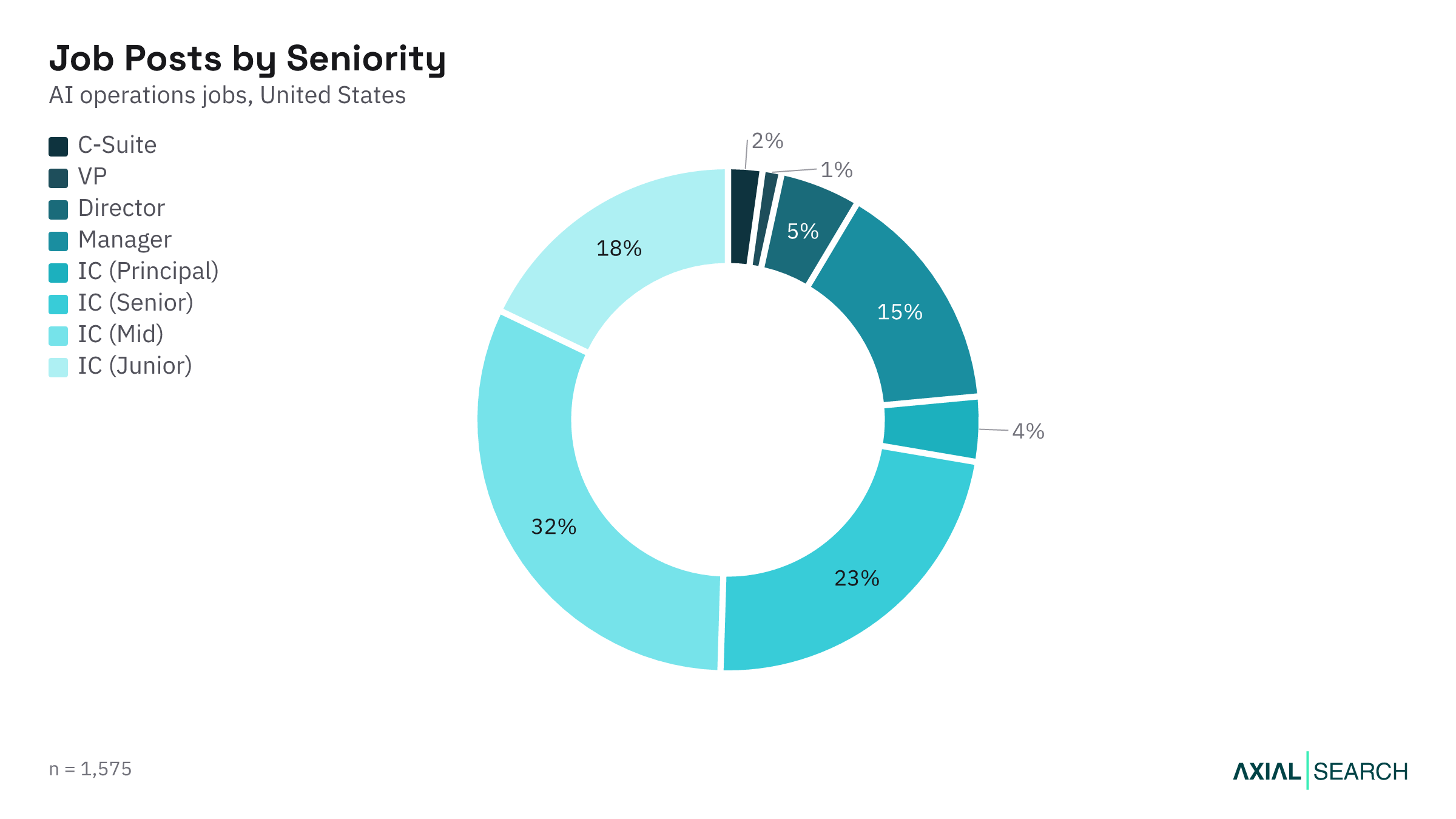
Nearly a third of postings are mid-level IC roles and another quarter are senior IC. Only 5% are Director-level and just 1% are C-suite. This is a hands-on function — employers are hiring people to manage pipelines, monitor models and fix deployment issues, not to set strategy from above. If you're early in your career and technically capable, the entry path here is wider than it is in AI strategy or product roles.
Full-time versus contract AI operations roles
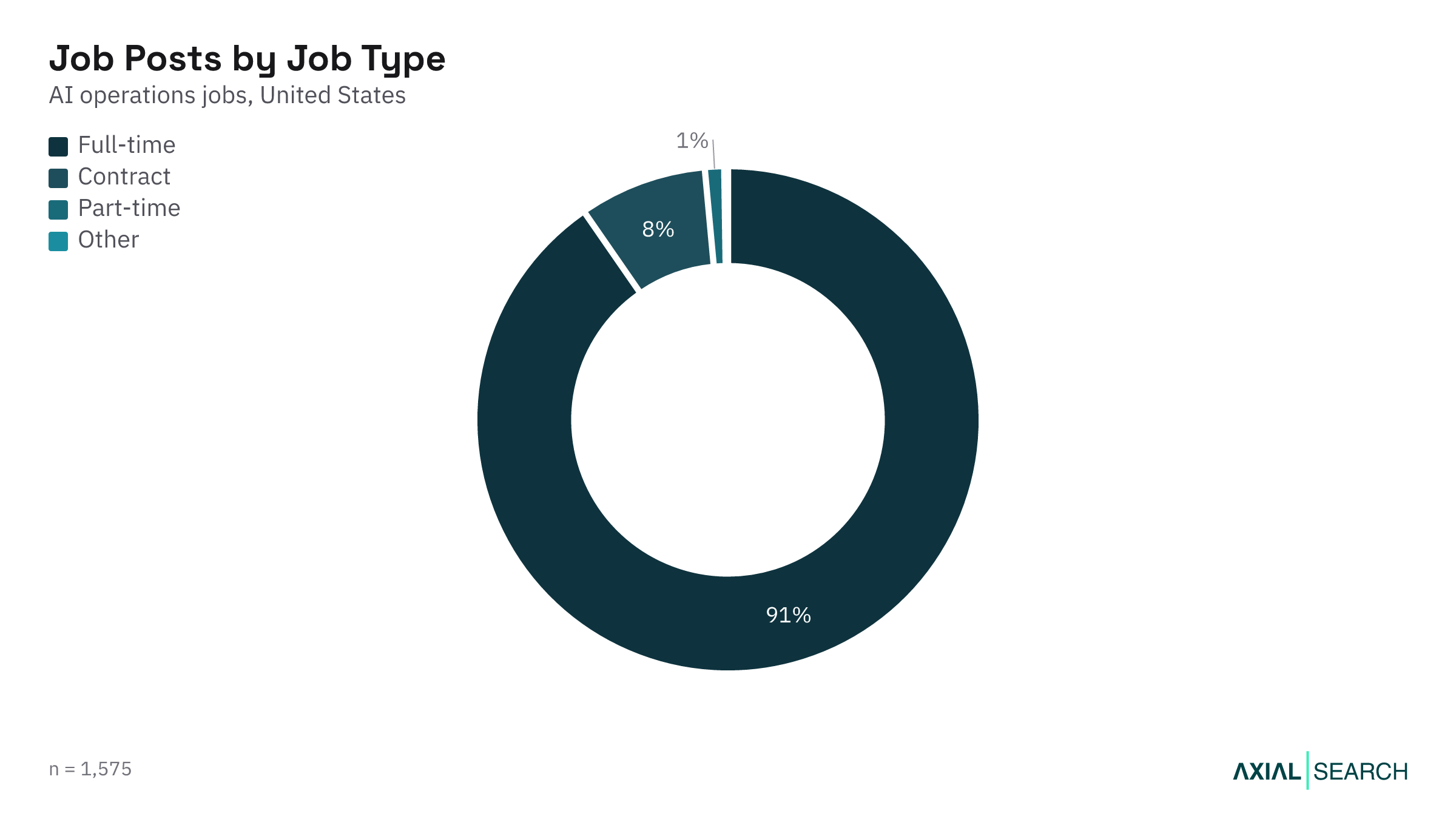
This is a permanent-hire market: 91% of postings are full-time. Companies are building AI operations as a standing capability, not staffing it with contractors or fractional help. The 8% contract share is higher than most AI functions, likely reflecting project-based deployment work at consulting firms or cloud providers.
Remote, hybrid and onsite AI operations roles
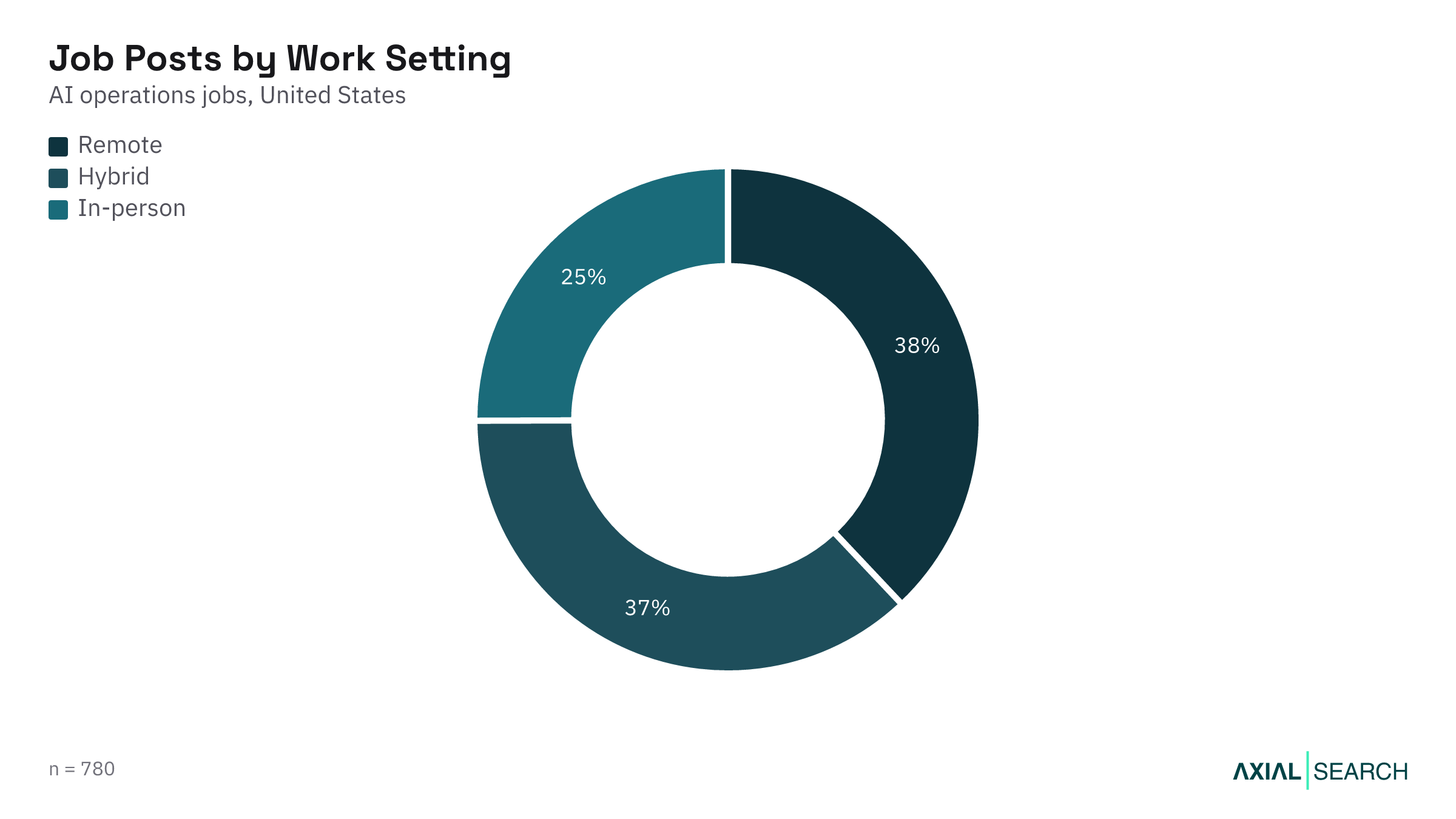
Half of all postings don't state a work model, but among those that do, remote and hybrid each hold 38% and only a quarter are strictly on-site. While the work clusters in a few cities, a meaningful share of it can be done from anywhere. For employers, that flexibility matters — the talent pool is narrow enough that requiring five days in-office cuts your candidate list in half.
Where AI operations jobs are located
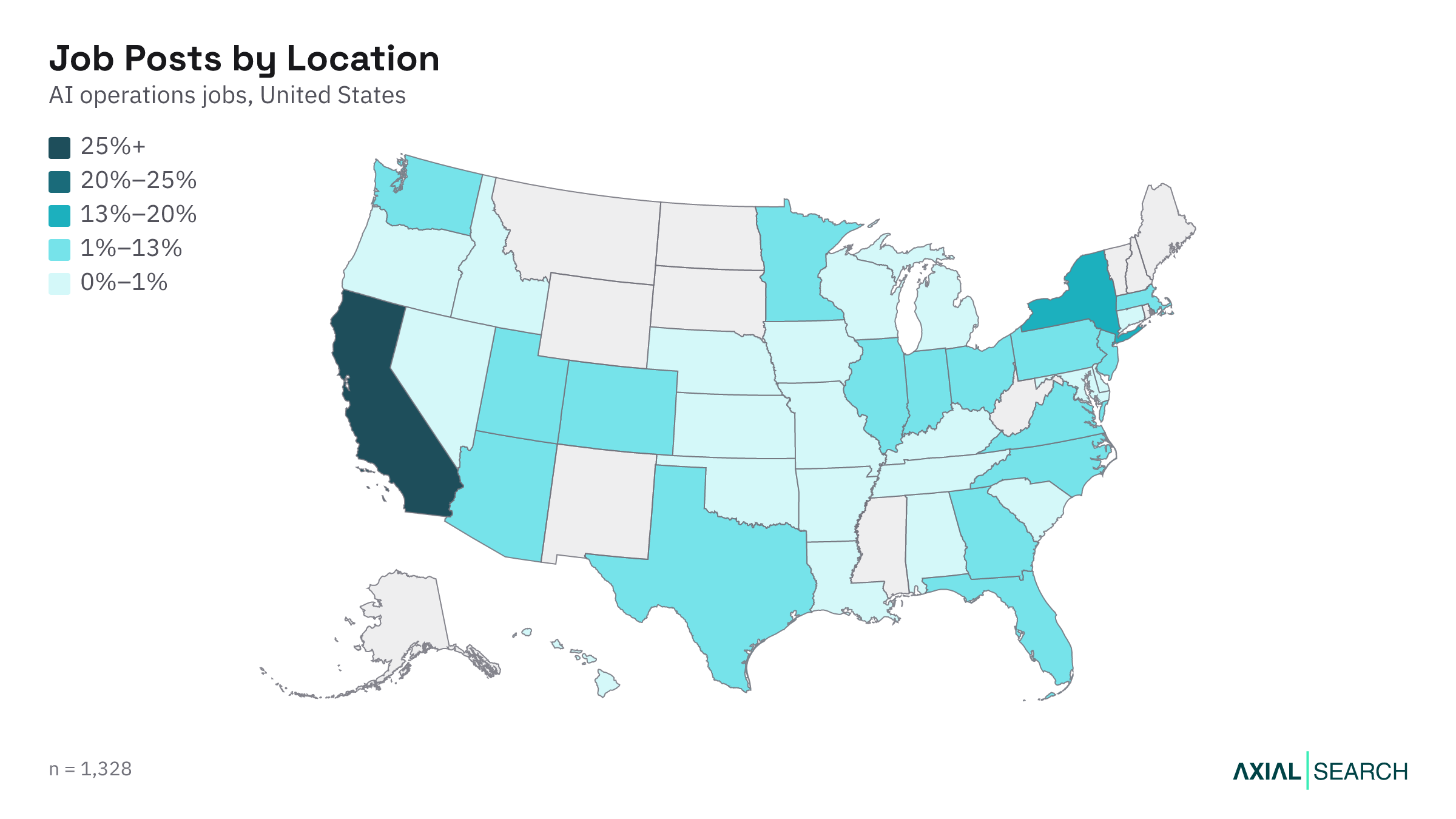
AI operations jobs cluster heavily in California and New York. California alone posts 30% of all openings and New York another 17%. Texas, Illinois, Colorado and Massachusetts form a clear second tier, but the top two states together hold nearly half the market.
| State | Share of postings |
|---|---|
| California | 30.2% |
| New York | 16.7% |
| Texas | 9.6% |
| Illinois | 4.1% |
| Colorado | 4.0% |
| Massachusetts | 3.4% |
The top cities for AI operations jobs
At the city level the concentration is even sharper. San Francisco accounts for nearly one in five US postings — almost as much as the next six cities combined.
| City | Share of postings |
|---|---|
| San Francisco, CA | 18.2% |
| Austin, TX | 4.4% |
| Chicago, IL | 4.3% |
| Boston, MA | 3.4% |
| Seattle, WA | 3.0% |
| Dallas, TX | 2.9% |
San Francisco's dominance reflects the city's concentration of AI-native companies and cloud infrastructure providers — the firms where AI operations is a core function rather than a support one. Austin, Chicago and Boston all rank highly, but none come close to San Francisco's share. For where these jobs pay the most, see AI operations salaries.
Final Thoughts
For candidates. AI operations is a practitioner market with a wide entry path for technically capable people early in their careers. With 32% of postings at mid-level and remote or hybrid work holding three-quarters of specified settings, you don't need a decade of experience or a Bay Area zip code to land one of these roles. The challenge is that the market is contained — 93 postings a week nationally — so competition is real even if the volume is manageable. Build hands-on deployment and model-monitoring experience, and you'll stand out in a pool where most candidates have only built models, not operationalized them. If you lean more toward building production systems than maintaining them, AI engineering hiring demand reflects that builder focus.
For employers. You're competing for a narrow pool of people who know how to operationalize models in production, and requiring five days in-office cuts that pool in half. The seniority mix shows most companies are hiring practitioners, not leaders — which means the bottleneck isn't finding a VP to set strategy, it's finding mid- and senior-level people who can execute.
Methodology & sources
- Data sources. Job data is collected from publicly available postings on online job boards and updated weekly, covering US roles posted since January 2026. Explore and filter it on our live AI job market dashboard.
- Hiring demand is the count of matching postings per week, reported as the recent stable average.
- Company size, seniority, job type and work setting are each group's share of postings. Work-setting shares are computed over the ~50% of postings that state a work model — the rest are silent, not counted as a category.
- Top states and cities are ranked by share of postings; remote-only postings are excluded from the cities list.

AI Operations Jobs: The 2026 Market in Numbers
The complete picture of the ai operations job market in 2026: hiring demand, what these roles pay, where the jobs are, who's hiring and what it takes to get in.

AI Operations Salary Benchmarks for 2026
What ai operations roles pay in 2026: median salary, pay by seniority, top-paying sectors and locations, and how often bonus and equity are mentioned in US job postings.

AI Operations Roles: How to Position Yourself in 2026
How to become a ai operations professional in 2026: the leadership capabilities employers screen for, the experience and degrees required, the certifications that matter, and the skills most in demand across US postings.
Turn AI ambition into lasting business value
Whether you're hiring your first AI leader or scaling enterprise transformation capability, we help you define, assess and recruit the people who make it stick.