
How Much Do AI Operations Leaders Make? 2026 Benchmarks
What AI operations roles pay in 2026: median salary, pay by seniority, top-paying sectors and locations, and how often bonus and equity are mentioned in US job postings.
 Updated: August 27, 2026
- The median sits at $156,000. AI operations pay scales linearly with seniority — each step up adds roughly $20,000 to $22,000 at the median, making title negotiation more valuable than sector choice.
- The Principal IC track pays near Director money. Staying technical doesn't cap your ceiling the way it does in most functions — the two bands converge at the median, so expertise can carry you past the management premium.
- Manufacturing leads AI operations pay at $220,000 median salary, $18,000 ahead of Professional Services and $30,000 above Technology — all five sectors cluster within a $22,000 band, tight enough that seniority outweighs sector in total comp.
- California holds 30% of the AI operations market and pays a median salary of $200,000, but San Jose ($254,600) outpaces San Francisco by nearly $50,000 — metro matters as much as state.
- Equity appears in 32% of AI operations postings, peaking at 49% among the postings that disclose pay at firms under 500 employees — small firms trade cash for upside, and the equity mention rate is what keeps them competitive.
- Remote work compresses AI operations pay gaps but doesn't flatten them — California still pays $24,000 more than Illinois at the median, enough that remote candidates shopping offers will benchmark against Bay Area comp.
How much do AI operations leaders make?
The median AI operations salary is competitive across all seniority levels, and the shape beneath that matters more than the headline number: the Principal IC track converges with Director pay, so staying technical doesn't cap your ceiling the way it does in most functions.
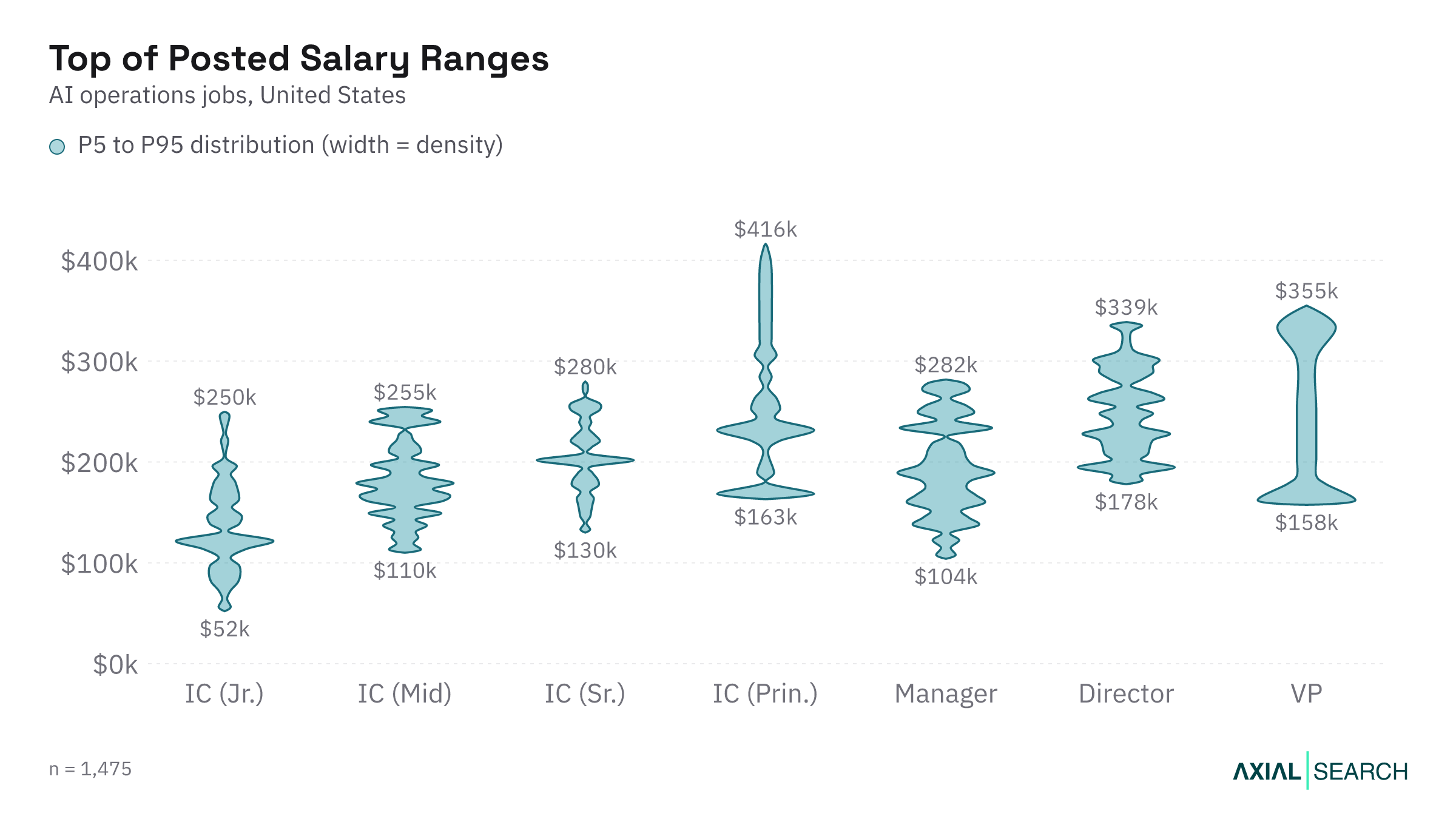
Top of the posted range by seniority — the median and typical maximum of what's posted, 5th to 95th percentile. This is the ceiling candidates can credibly negotiate toward, not the typical offer.
| Seniority | 5th percentile | 25th percentile | Median | 75th percentile | 95th percentile |
|---|---|---|---|---|---|
| IC (Junior) | $52,000 | $100,000 | $123,000 | $160,000 | $250,000 |
| IC (Mid) | $110,000 | $150,000 | $180,000 | $214,000 | $255,000 |
| IC (Senior) | $130,000 | $179,000 | $202,000 | $237,000 | $280,000 |
| IC (Principal) | $163,000 | $190,000 | $231,000 | $267,000 | $416,000 |
| Manager | $104,000 | $160,000 | $189,000 | $232,000 | $282,000 |
| Director | $178,000 | $206,000 | $250,000 | $290,000 | $339,000 |
| VP | $158,000 | $158,000 | $196,000 | $310,000 | $355,000 |
Where two percentiles show the same figure, employers are clustering on a round number at that end of the band.
Where most AI operations salaries cluster
The market is densest at Mid and Senior IC levels, so the middle of this distribution is where most candidates land.
Management pay steps up from the IC bands but not by as much as you'd expect: Managers earn more than Senior ICs, and Directors land close to the Principal IC track rather than clearly ahead of it. For candidates the progression is unusually linear — the seniority you negotiate matters more than the sector you pick. For hirers, the narrow spread at Senior and Principal IC levels means you're competing on total comp and scope, not just base — exactly the kind of offer-structuring AI recruitment helps you get right.
Why doesn't the AI operations table show a C-suite row?
C-suite roles are too rare in AI operations to produce a reliable read — just 23 of the 1,575 postings analyzed sit at that level, below the sample this report needs to post a seniority band.
In practice the top of the AI operations ladder is the VP band, where pay stabilizes before specialized titles like Chief AI Officer or Chief Data Officer step outside this function's boundaries.
What is the full salary range for AI operations leaders?
The full posted AI operations salary range runs from $52,000 at the 5th percentile for junior ICs to higher amounts at the 95th percentile for VPs — see the table above for the breakdown by seniority.
Where does the AI operations range widen the most at the top?
The gap between the 75th and 95th percentile is widest on the Principal IC track — wider than at Director or VP — because the top of that band blends deep technical specialists with de facto technical leaders.
Manager and VP are comparatively tight at the top, so the real negotiating room concentrates in the Principal IC track and, to a lesser extent, at Director.
Which industries pay AI operations leaders the most?
Manufacturing leads AI operations pay at a median salary, ahead of Professional Services and Technology.
| Sector | Median salary | Postings |
|---|---|---|
| Manufacturing | $210,000 | 58 |
| Professional Services | $202,000 | 158 |
| Telecom & Media | $196,000 | 60 |
| Technology | $190,000 | 632 |
| IT Services | $187,000 | 113 |
Technology dominates volume at 29% of the market but pays in the middle of the pack. Professional Services posts a smaller share and pays near the top, while Manufacturing's 4% reflects a smaller but higher-paying slice. Healthcare sits at the bottom, surprising given the regulatory complexity and the emphasis on observability and governance — it may reflect a tighter budget envelope or a slower pace of AI infrastructure adoption relative to manufacturing.
How much does sector really matter for AI operations pay?
Not as much as you'd think — all five sectors in this table cluster within a $22,000 band, tight enough that seniority moves your pay far more than sector choice.
For candidates, sector matters but not as much as seniority — a Director in Healthcare will out-earn a Senior IC in Manufacturing. For hirers, if you're in a lower-paying sector you'll need to make up the gap with equity or a faster promotion track.
Does company size affect AI operations pay?
Bigger usually pays more in AI operations — companies with 10,001+ employees post the highest median salary, well ahead of mid-market and smaller firms.
How AI operations pay varies across company-size tiers
Enterprise-scale companies (10,001+ employees) post higher median salaries, while mid-market firms (1,001–10,000 employees) and smaller firms (under 1,001 employees) both cluster closer to $180,000.
Scale buys pay in AI operations, but it isn't a dramatic premium — the gap between the top and bottom tiers is real but not the deciding factor in an offer the way seniority is.
How company size affects AI operations equity offers
Equity mention rates run the opposite direction from pay — among postings that disclose pay, firms under 500 employees mention equity most often at 49%, ahead of enterprise-scale firms at 42%.
Smaller firms are trading cash for upside. If you're a candidate evaluating an offer from a sub-500-employee firm, the equity percentage and the vesting schedule matter more than the base gap. If you're hiring at a startup, the data confirms your equity mention rate needs to be competitive with what candidates see elsewhere.
Where do AI operations leaders earn the most?
California captures 30% of all AI operations postings and pays a median salary of $200,000, the highest of the states with reliable volume.
| State | Median salary | Share of postings |
|---|---|---|
| Washington | $204,000 | 3.0% |
| North Carolina | $202,000 | 3.2% |
| California | $201,000 | 30.2% |
| Texas | $183,000 | 9.1% |
| Massachusetts | $180,000 | 3.7% |
New York follows with a median of $180,000, while Texas posts roles at a higher $196,000 — proof that volume and pay don't always move together.
How much does location matter for AI operations pay?
Not as much as sector or seniority — the gap between the top-paying state (California, $200,000) and the lowest in this table is about $24,000, and remote work has compressed it further without flattening it.
If you're hiring in a lower-paying state, you're competing with California firms that can offer remote roles at California-adjacent comp.
The top-paying cities for AI operations
San Jose pays the most among AI operations metros, with a median salary of $255,000 — well above San Francisco's $200,000 and Chicago's $175,000.
| City | Median salary | Postings |
|---|---|---|
| Santa Clara, CA | $259,000 | 23 |
| San Jose, CA | $255,000 | 27 |
| Atlanta, GA | $227,000 | 20 |
| San Francisco, CA | $200,000 | 216 |
| Austin, TX | $200,000 | 34 |
| Seattle, WA | $195,000 | 34 |
| Los Angeles, CA | $186,000 | 25 |
| Boston, MA | $180,000 | 33 |
| Chicago, IL | $175,000 | 47 |
| Denver, CO | $164,000 | 29 |
Austin and Seattle sit in the middle around $200,000, reflecting their position as second-tier tech hubs with lower cost-of-living but still-strong demand for AI operations talent. The surprise is Los Angeles, which pays less than other major tech hubs despite California's overall lead — likely a smaller concentration of AI-first companies relative to the Bay Area or the Texas corridor. For candidates the metro you pick moves your pay as much as the company-size tier; for hirers in lower-paying metros, you'll need to make the case on cost-of-living or remote flexibility if you're competing with Bay Area firms.
How often are AI operations bonus and equity offered?
Bonus is mentioned in 29% of AI operations postings and equity far less often — unusually close together, since in most functions bonus appears far more often than equity.
Dollar figures are almost never posted, so a mention rate is the best signal available.
How often a bonus is offered
A bonus is mentioned in 29% of AI operations postings overall, climbing to higher rates at VP level and 49% at Principal IC.
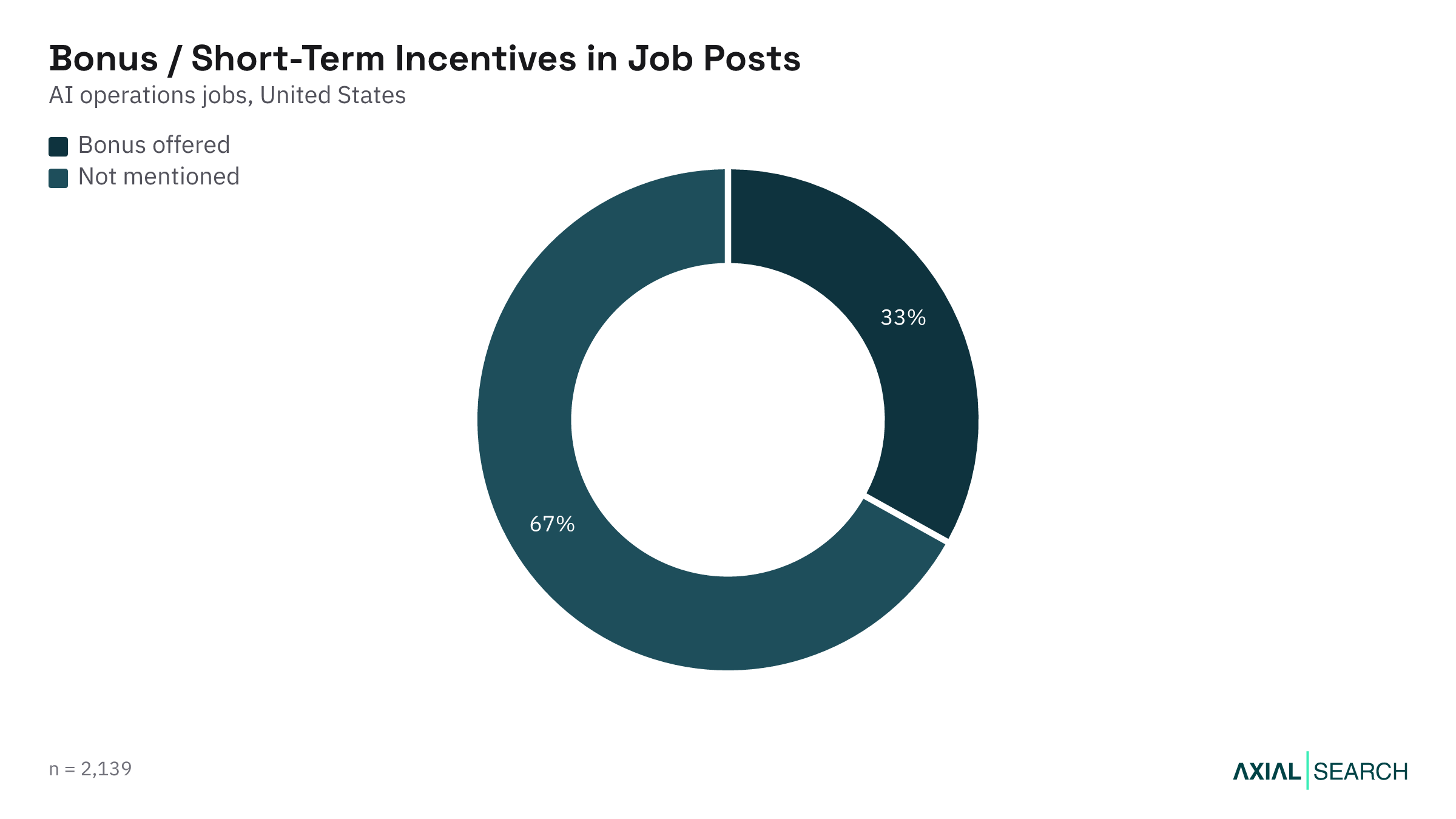
That's lower than the rate we see in AI strategy roles, but it's consistent with the operational nature of the work — bonus structures tend to be more common in strategic or revenue-adjacent functions than in infrastructure roles. If you're a candidate at Manager level or above, expect a bonus to be part of the conversation even if the posting doesn't mention it. If you're hiring, the absence of a bonus in the posting doesn't mean you won't need to offer one to close.
How often equity is offered
Equity is mentioned in AI operations postings, slightly more common than bonus, and unlike most functions it doesn't peak at the executive level — it appears most often at Mid IC and Manager levels, then drops at VP.
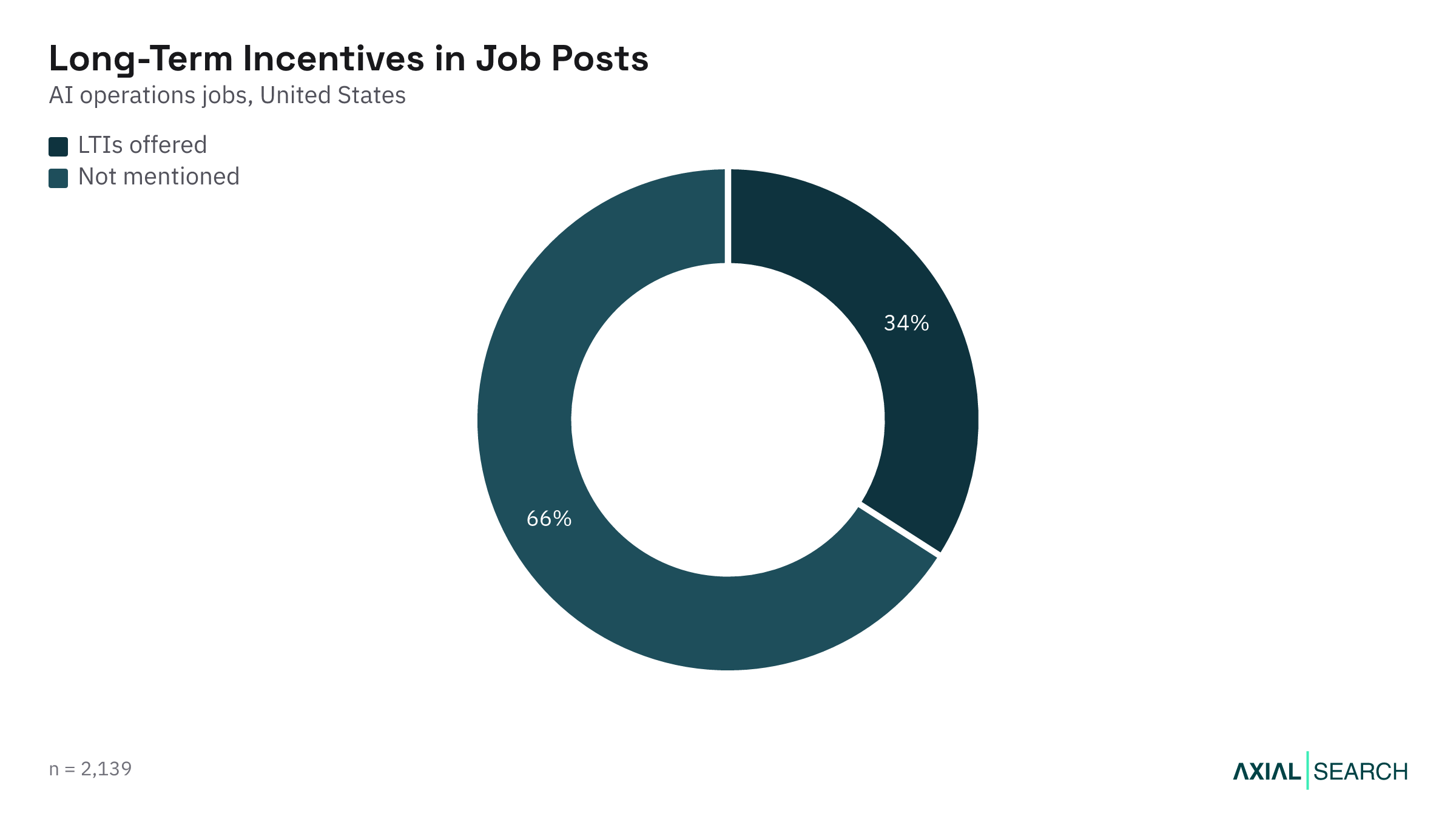
That pattern is the inverse of what you'd expect, and it likely reflects where equity is used as a retention lever versus where a high base does the work. At VP level the base is high enough that equity becomes optional in the posted comp structure; at mid-level IC and Manager it's the primary tool for competing with startup offers.
| Level | Bonus mentioned | Equity mentioned |
|---|---|---|
| IC (Junior) | 19% | 22% |
| IC (Mid) | 29% | 41% |
| IC (Senior) | 37% | 35% |
| IC (Principal) | 51% | 23% |
| Manager | 42% | 36% |
| Director | 47% | 24% |
| VP | 70% | 5% |
| C-Suite | 0% | 44% |
The C-suite row (0% bonus, 39% equity) is an artifact of a tiny sample and shouldn't be read as a market signal.
Final Thoughts
For candidates. AI operations pay rewards depth in observability, foundation models and workflow platforms more than it rewards a title — see our AI operations careers guide for the full skills breakdown. Seniority moves your pay more than sector: stay on the IC track and the Principal band will pay close to Director money. At mid-level IC and Manager, equity is your negotiation lever — it appears in 39% and 37% of postings respectively, higher than at VP where base is high enough to carry the offer. If you're evaluating a startup offer, the equity percentage and vesting schedule matter more than the base gap with enterprise firms. If you're drawn to building production systems rather than monitoring them, AI engineering salaries reflect that shift toward development work.
For employers. This is a 1,575-posting market concentrated in California (30.2%) and Texas, and nearly two-thirds of roles are individual contributors rather than managers. If you're hiring at startup scale (under 500 employees) your equity mention rate needs to be near 49% to compete with what candidates see elsewhere, but your base can run below enterprise bands. If you're in a lower-paying sector like Healthcare you'll need to close the gap with faster promotion tracks or a stronger equity story.
Methodology & sources
- Data sources. Job data is collected from publicly available postings on online job boards and updated weekly, covering US roles posted since January 2026. Explore and filter it on our live AI job market dashboard.
- All salary figures are derived from the minimum and maximum salary bands employers post, annualized and reported as percentiles, not averages.
- Every salary figure on this page is the top of the posted range — the ceiling employers advertise, not the typical offer. The seniority table reports it at the 5th, 25th, 50th (median), 75th and 95th percentiles. Median salary in the sector, company-size and location tables is the median of that ceiling within each group.
- Bonus and equity figures are mention rates — the share of postings that state a bonus or equity component. A posting silent on either is counted as "not mentioned"; it does not mean none is offered.

How Hot Is the AI Operations Job Market in 2026?
The complete picture of the AI operations job market in 2026: hiring demand, what these roles pay, where the jobs are, who's hiring and what it takes to get in.

Who's Hiring AI Operations Leaders in 2026
Where AI operations jobs are in 2026: hiring demand and trend, top states and cities, who's hiring by sector and company size, and the mix of seniority, contract type and remote work across US postings.

What It Takes to Land an AI Operations Role in 2026
How to become an AI operations professional in 2026: the leadership capabilities employers screen for, the experience and degrees required, the certifications that matter, and the skills most in demand across US…
Turn AI ambition into lasting business value
Whether you're hiring your first AI leader or scaling enterprise transformation capability, we help you define, assess and recruit the people who make it stick.