
What to Know When Hiring AI Strategy Leaders
What it takes to hire AI strategy leaders in 2026: what you'll need to pay, how competitive the market is, who you're bidding against, and where talent concentrates across US states and cities — plus a set of interview questions to assess candidates.
 June 10, 2026
- AI strategy hiring is climbing — postings rose 34% over the last quarter against the quarter before, not cooling off.
- Half the market is Director-level, and just 2% of AI strategy postings are for junior ICs; this is a leadership-heavy market with no internal farm system to promote from.
- Nearly half the jobs come from companies with 10,001+ employees, and Technology firms alone post a quarter of all AI strategy roles.
- Of postings that specify a work setting, half are hybrid and a third fully remote — only 16% require on-site presence five days a week.
- California and New York together hold 35% of postings, but the city mix is surprisingly national: Chicago, Atlanta and Austin all rank in the top five.
What will you need to pay to hire AI strategy leaders?
Budget an overall median of $208,000 for an AI strategy hire, climbing to $279,000 at Director and landing in the high $200,000s to $300,000 at VP and C-suite, which converge close together at the top. That's the posted band, not the final offer — bonus (mentioned in 37% of postings) and equity (14%) sit on top.
For the full breakdown by seniority, sector and location, see AI strategy salaries.
How AI strategy pay changes with seniority
Pay climbs steadily through Manager and Director, then the Principal IC track breaks the pattern — it pays close to Director money, which is unusual for a technical-track role in this function.
If you're leveling a req around a Manager title expecting to underpay a senior technical candidate, the data says otherwise — exactly the leveling mistake AI executive search helps you avoid before you're bidding against the wrong candidate.
Where bonus and equity fit into an AI strategy offer
37% of AI strategy postings mention a bonus and 14% mention equity, and neither is spread evenly — equity peaks at the Principal IC level (32%) while VPs see it least (9%).
If you're competing for a Principal IC candidate, an equity component is doing more work in that conversation than it will for a VP hire.
How competitive is the market for AI strategy leaders?
Competitive — 49% of AI strategy postings sit at Director level and just 2% are junior IC, so there's no farm system to promote from; you're bidding for people who've already led something.
The trend has edged upward through the first half of 2026 rather than cooling off. That means competition for senior AI strategy talent isn't letting up — if you're building a shortlist, expect to compete with other employers running the same search.
Why the AI strategy talent pipeline is thin at the top
Just 2% of AI strategy postings target junior ICs and only 7% mid-level, so there's almost no internal pipeline feeding this level — most Directors and VPs are hired from outside, not promoted up through an AI strategy track.
That means a realistic build-your-own-bench plan isn't really available; for an immediate need, external hiring is close to the only lever you have.
Who are you competing with for AI strategy talent?
You're competing against enterprise-scale companies most often — 46% of AI strategy postings come from organizations with 10,000+ employees. Technology and Professional Services firms lead on sector, together posting close to half the roles.
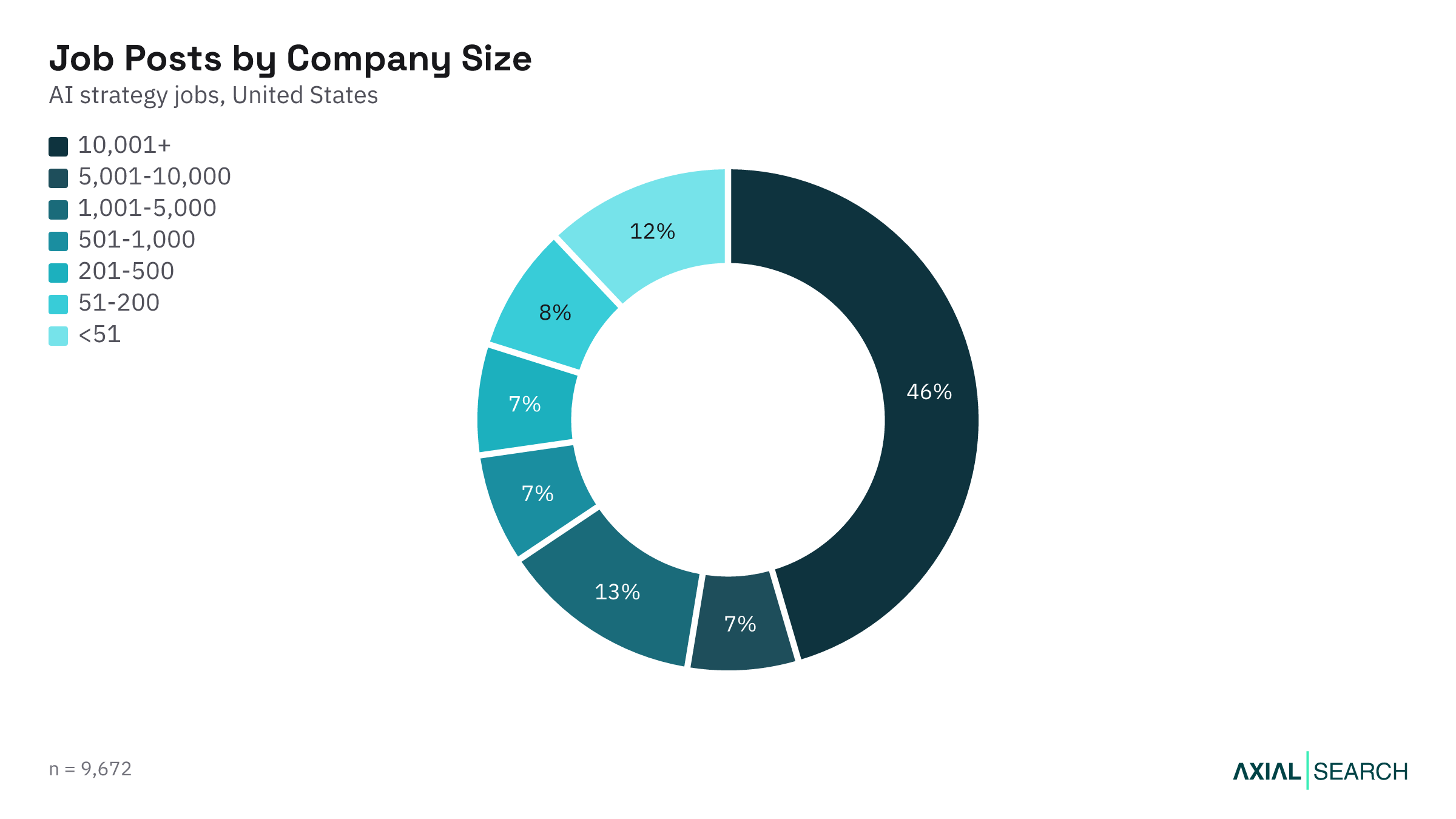
That enterprise weight shows up in the sector mix too:
| Sector | Share of postings |
|---|---|
| Technology | 25% |
| Professional Services | 20% |
| IT Services | 11% |
| Financial Services | 9% |
| Manufacturing | 4% |
| Life Sciences | 4% |
| Healthcare | 4% |
| Telecom & Media | 4% |
Technology firms post a quarter of the market, followed closely by Professional Services at 20%. IT Services contributes another 11%, and Financial Services 9%. The presence of Manufacturing, Life Sciences and Healthcare shows AI strategy hiring has spread well beyond tech-native companies into sectors that are operationalizing AI at scale.
What level of AI strategy hire do you actually need?
Roughly 80% of AI strategy postings sit in management — Director, Manager, VP or C-suite — so this is a senior hire almost by default, not an entry-level one. The three cuts below describe what a typical opening looks like.
Seniority levels in AI strategy hiring
Nearly half of all AI strategy postings are Director-level, and another 20% are Manager-level.
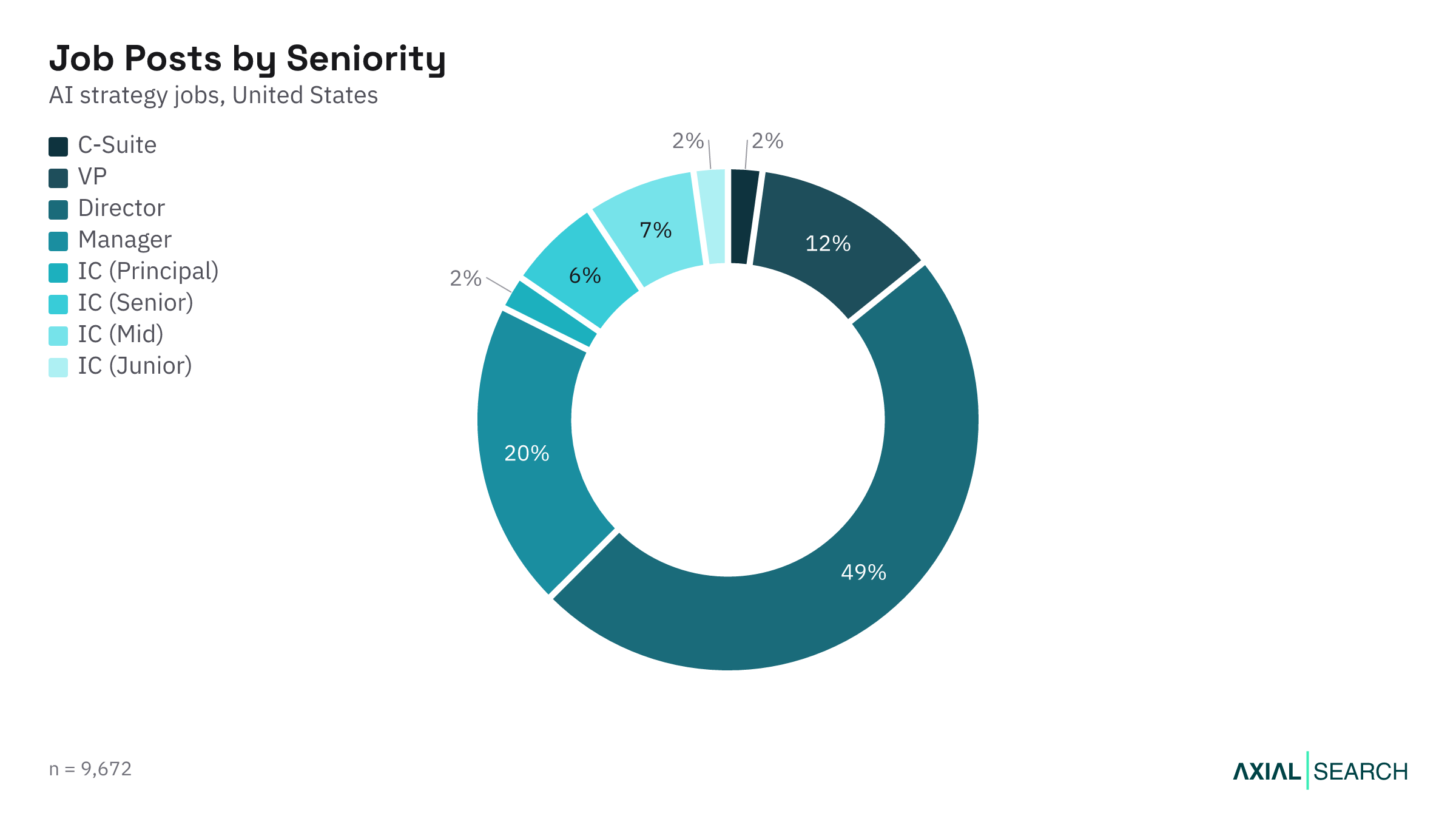
VP roles make up 12%, and C-suite positions just 1%, so roughly eight in ten AI strategy roles sit in management. On the individual-contributor side, mid-level ICs account for 7%, senior ICs another 6%, junior ICs only 2%, and the Principal IC track a slim 2%. If you're structuring a req for someone early-career, know that the direct route into AI strategy is narrow — most candidates arrive having led something adjacent first. We break down what each seniority band pays in AI strategy salaries.
Full-time versus contract AI strategy roles
This is a permanent-hire market: 94% of AI strategy postings are full-time.
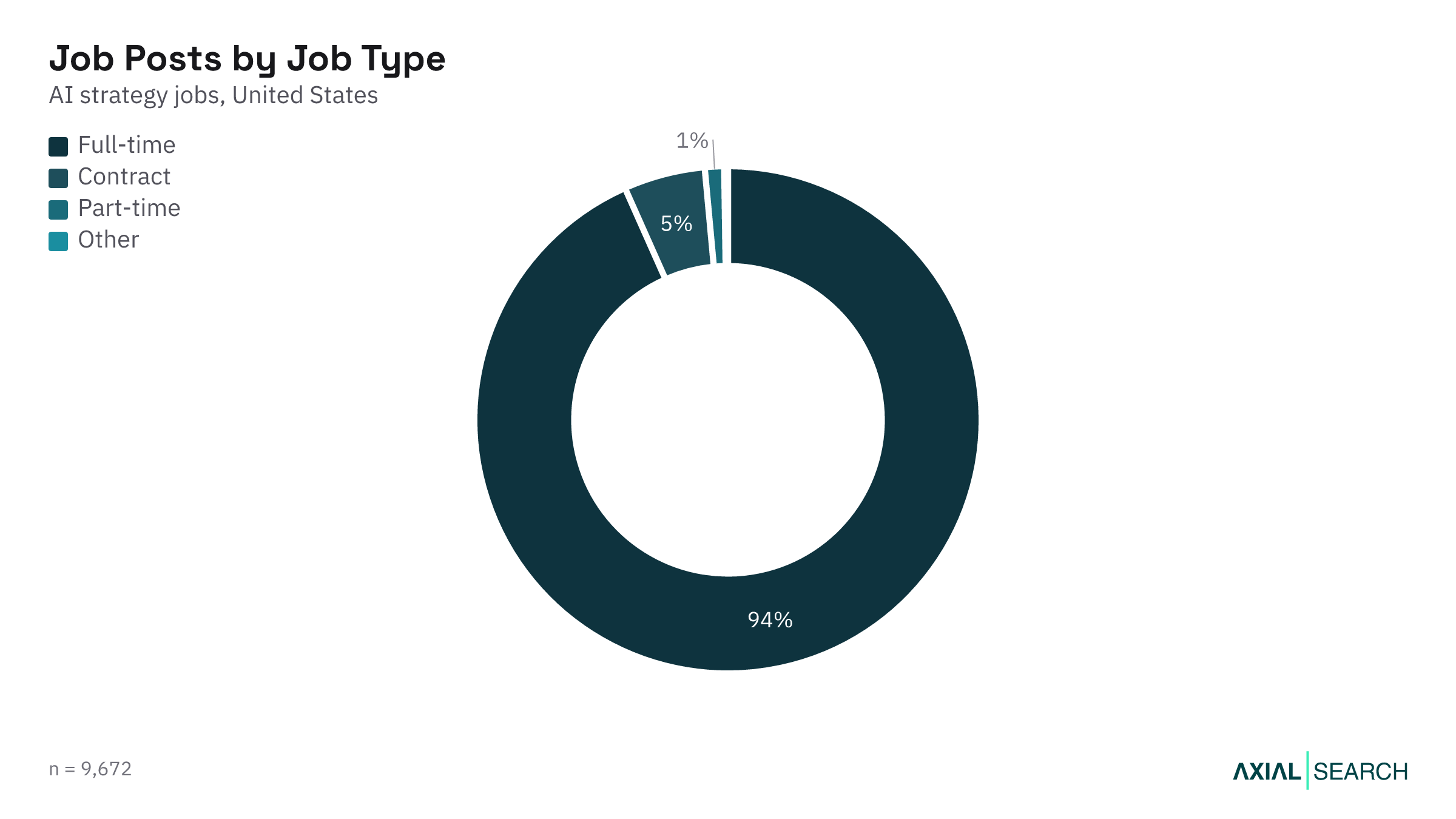
Only 5% are contract roles, and part-time and other arrangements together make up less than 2%. Companies are building AI strategy as a standing capability, not staffing it with contractors or interim leaders.
Remote, hybrid and onsite AI strategy roles
Most postings don't state a work model at all, but among those that do — roughly a third of the total — half are hybrid, a third are fully remote, and only 16% are strictly on-site.
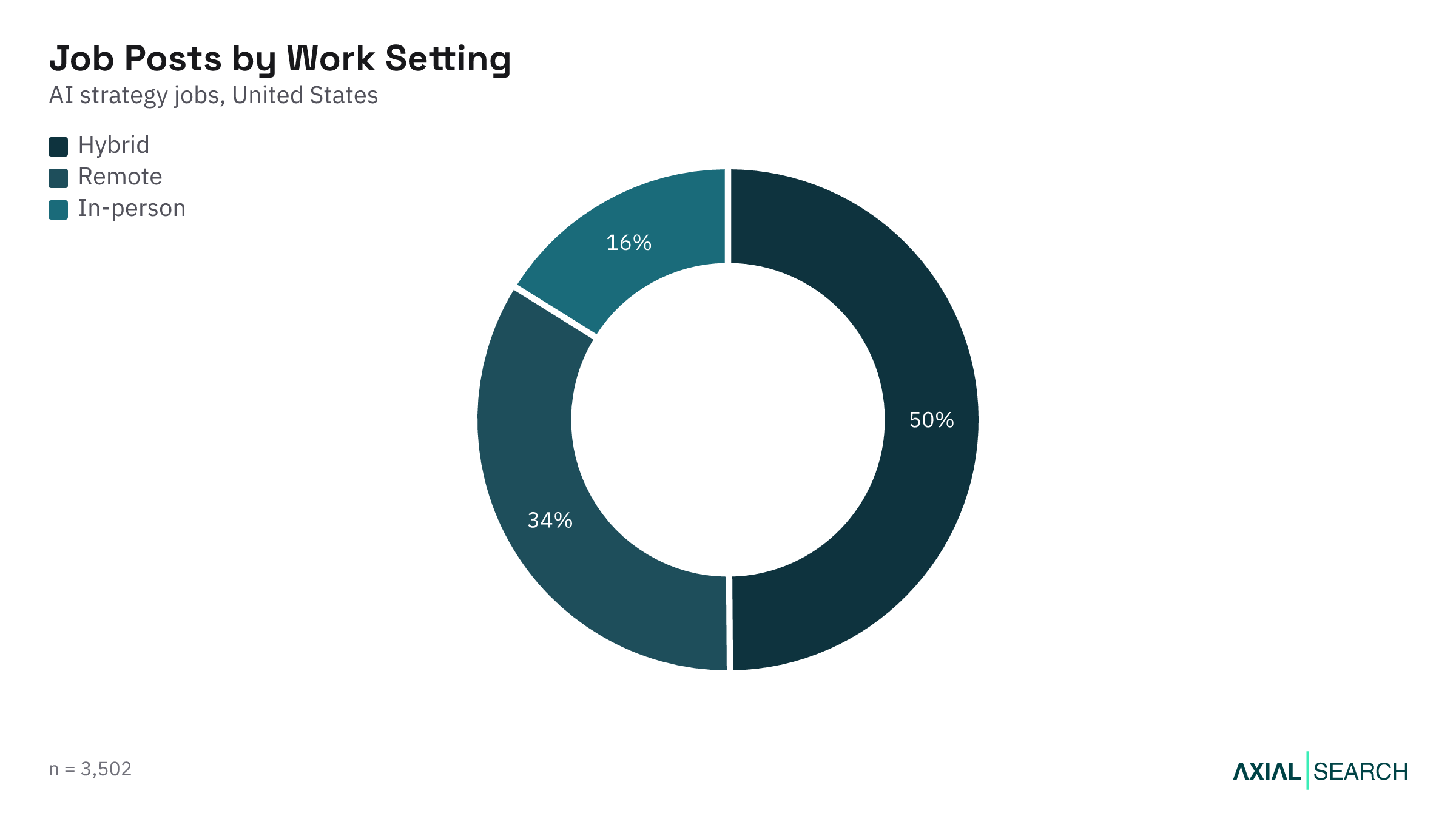
So while the work clusters in a few cities, a lot of it can be done from anywhere, and the hybrid share suggests employers want people in the room some of the time but not five days a week. Widening your remote posture is one of the cheapest ways to expand a thin candidate pool.
Where is AI strategy talent concentrated?
AI strategy talent concentrates in California (20% of postings) and New York (15%) — together more than a third of the market.
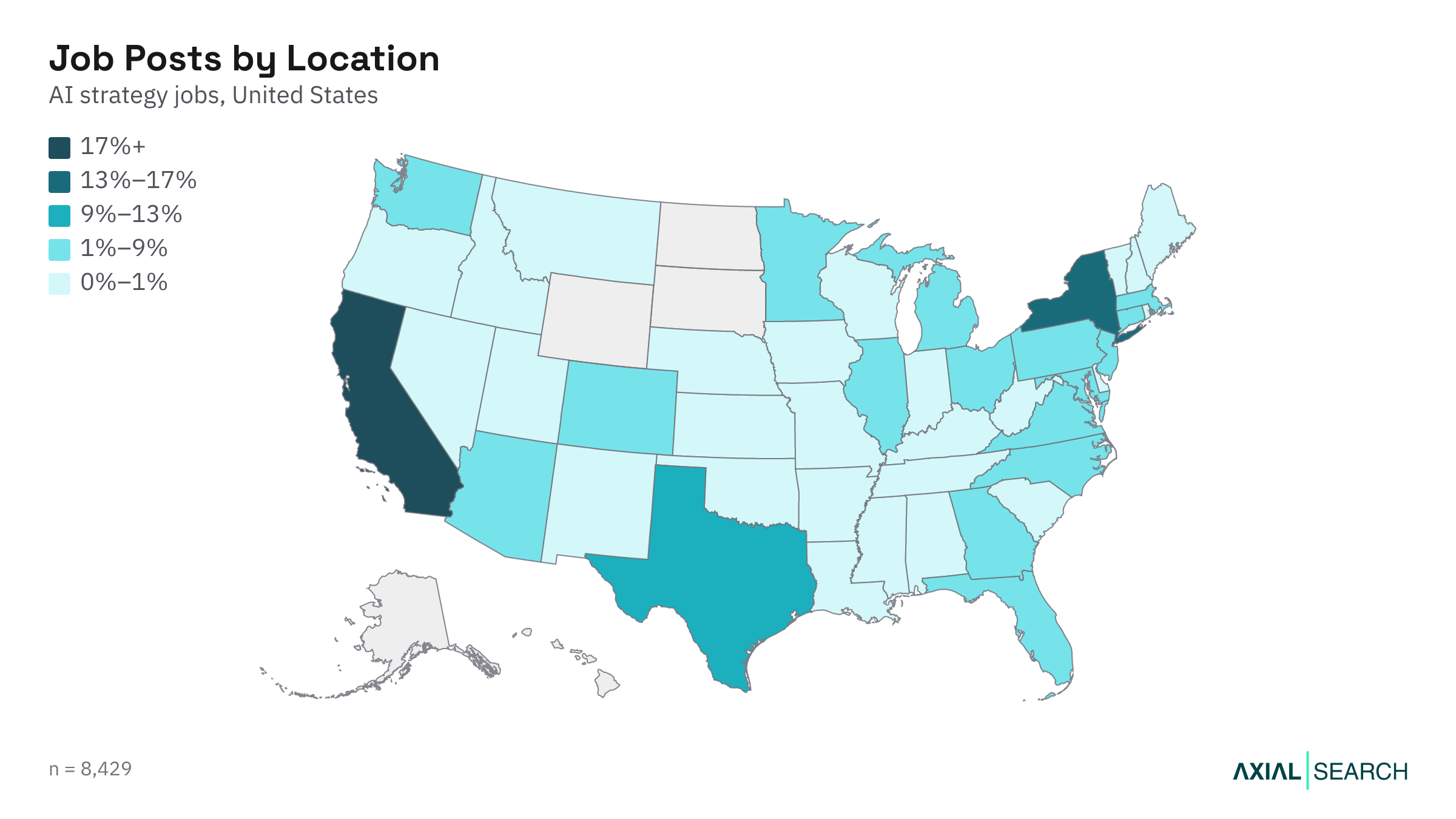
Texas sits at 9%, followed by Massachusetts at 5% and Georgia at 4%. Pennsylvania, Colorado and Maryland each contribute smaller shares, forming a clear second tier of hiring.
| State | Share of postings |
|---|---|
| California | 20% |
| New York | 15% |
| Texas | 9% |
| Massachusetts | 5% |
| Illinois | 5% |
| Georgia | 4% |
| Washington | 4% |
| New Jersey | 4% |
The rest of the country is more diffuse — roughly two-thirds of AI strategy postings sit outside California and New York, so a search confined to the coasts is leaving most of the market on the table.
The top cities for AI strategy jobs
At the city level the concentration is sharper, but the list is more national than the state view suggests. San Francisco leads with 7.2% of all AI strategy postings, Chicago follows at 5.1%, and Atlanta and Boston each hold 4.2% and 4.1% respectively.
| City | Share of postings |
|---|---|
| San Francisco, CA | 7.2% |
| Chicago, IL | 5.1% |
| Atlanta, GA | 4.2% |
| Boston, MA | 4.1% |
| Austin, TX | 3.3% |
| Seattle, WA | 3.1% |
| Dallas, TX | 2.4% |
| San Jose, CA | 2.3% |
San Francisco is the single biggest metro by a wide margin, but Chicago, Atlanta and Austin all rank highly — so a search anchored on the Bay Area is missing real, active talent pools elsewhere. For where these roles pay the most, see AI strategy salaries.
How do you assess AI strategy candidates?
Assess AI strategy candidates on judgment, not technical depth — use case selection and securing sponsorship rank highest across the 9,672 AI strategy postings we analyzed. Ask them to walk through one AI initiative they championed end to end, including how they got it funded and what happened when it didn't go as planned.
Judgment questions to screen AI strategy candidates on
Ask the candidate to walk through a real AI use case they picked: why they chose it over the alternatives, how they built the business case, and how they got an executive to fund it.
Push past the pitch — ask what they'd have done differently, and whether they ever killed a use case they'd championed once new information came in. A candidate who can only describe successes, never a call they reversed, hasn't been tested yet.
Questions for senior AI strategy candidates
For Director and VP candidates, ask them to design the operating model around a specific AI initiative — who owns which decisions, how the workflow changes, and who signs off when something goes wrong.
The Director band pays close to $279,000 at the median, so hold the bar to genuine operating-model thinking, not just a use-case pitch.
Red flags to watch for when interviewing AI strategy candidates
Watch for candidates who can talk fluently about AI trends but go vague the moment you ask how they got a specific initiative funded or who owned the decision rights.
That gap is common, and it's exactly the gap this market pays a premium to avoid — the leadership-profile data puts securing sponsorship and operating model design near the top of what employers screen for, and a candidate who's only ever advised from the sidelines hasn't demonstrated either.
Final Thoughts
For employers. You're competing for a thin pool of leaders who can move an organization, not just advise it. Roughly 80% of AI strategy postings sit in management, which means most candidates you'll interview already have options. Interview around real decisions — use cases picked, sponsors secured, operating models redesigned — not years in seat, and be ready to move quickly. The Director band pays close to $279,000 at the median, so if you're hiring at that level, expect candidates to negotiate hard.
Methodology & sources
- Data sources. Job data is collected from publicly available postings on online job boards and updated weekly, covering US roles posted since January 2026. Explore and filter it on our live AI job market dashboard.
- Hiring demand is the count of matching postings per week.
- Company size, seniority, job type and work setting are each group's share of postings. Work-setting shares are computed over the ~37% of postings that state a work model — the rest are silent, not counted as a category.
- Top states and cities are ranked by share of postings; remote-only postings are excluded from the cities list.
- Salary figures cited in this article are drawn from the subset of postings that state a salary range and are reported in full in AI strategy salaries. Bonus and equity figures reflect the share of postings that mention those forms of compensation.
- The interview questions are built from what postings in this dataset ask for, plus Axial Search's own placement experience — they are guidance, not a guarantee of what any single employer should require.

What AI Strategy Roles Pay in 2026
What AI strategy roles pay in 2026: median salary, pay by seniority, top-paying sectors and locations, and how often bonus and equity are mentioned. Drawn from 9,672 US job postings analyzed this year, this report also…

What 8,900 AI Strategy Job Posts Tell Us About the Market
AI strategy is one of the best-paid leadership mandates in AI hiring. Drawing on 8,901 US postings since January 2026, this is the complete picture: what AI strategy leaders do, how hot demand is, what the roles pay,…

How to Become an AI Strategy Leader in 2026
How to become an AI strategy leader in 2026: the leadership capabilities employers screen for, the experience and degrees required, the certifications that matter, and the technical skills most in demand — drawn from…
Turn AI ambition into lasting business value
Whether you're hiring your first AI leader or scaling enterprise transformation capability, we help you define, assess and recruit the people who make it stick.