
What It Takes to Land a Data Engineering Role in 2026
How to become a data engineering professional in 2026: the leadership capabilities employers screen for, the experience and degrees required, the certifications that matter, and the skills most in demand across US postings.
Updated: July 13, 2026

Data engineering is where infrastructure discipline meets AI readiness — and one of the biggest hiring categories in the AI job market.
This is what employers screen for: the leadership capabilities, qualifications, credentials and skills that appear in 18,786 US job postings analyzed this quarter, and how to position yourself against them.
- Data engineering is a build role, not a strategy one. Employers prize data readiness judgment, architectural fluency and hands-on execution — the capabilities that ship reliable systems at scale.
- IC roles dominate the market. 92% of data engineering postings sit at individual contributor levels, with Mid and Senior roles accounting for 70% of all openings.
- The platform stack is the real gatekeeper. AWS appears in 43% of postings, Azure in 41%, Snowflake in 32% — depth in one of the major cloud platforms beats shallow familiarity with all of them.
- Formal certifications barely register. The most common, AWS Certified Solutions Architect, appears in fewer than one in fifty data engineering postings.
- Hybrid is the norm. 49% of data engineering roles specify hybrid work, 28% remote, 23% in-person — expect flexibility but not full autonomy over location.
The data engineering leadership profile employers screen for
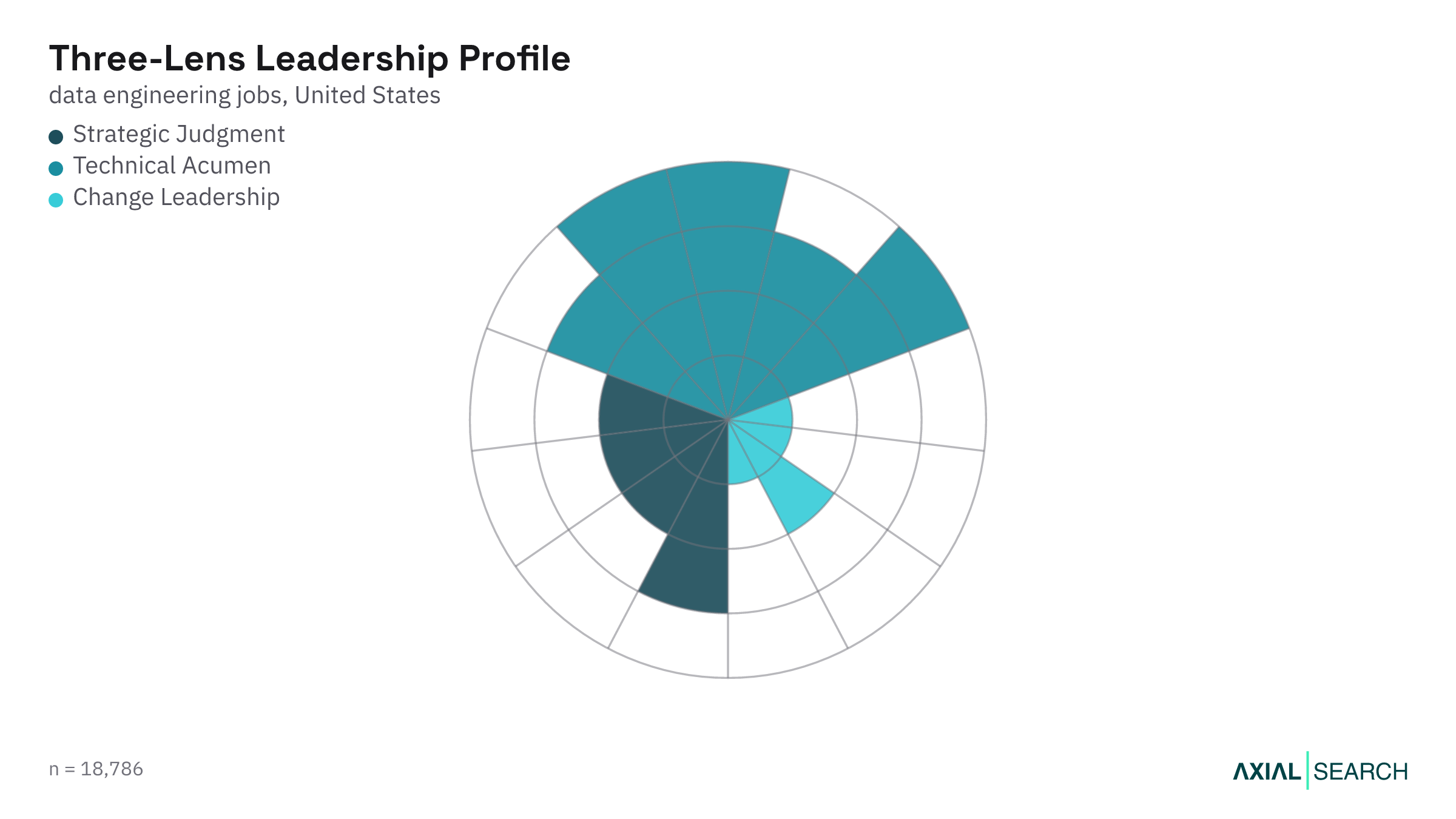
Data engineering is a build role, and the demand data makes the priorities plain.
Our Three-Lens Leader framework scores every role across strategic judgment, technical acumen and change leadership, and for data engineering the top five are almost entirely technical. Data readiness judgment leads: assessing whether data is available, trusted and structured well enough to support what is built on top of it. It is joined by architectural fluency and hands-on execution — the ability to design reliable data systems and ship them — and by governance discipline, which ranks higher here than in most functions because data engineers own the pipelines where privacy and reliability risk actually live.
AI literacy completes the profile.
That's the surprise: data engineers are increasingly expected to build for AI workloads specifically, not just maintain enterprise data warehouses. When you position yourself, foreground the systems you designed, the reliability they held and the data risks you managed. This is exactly the profile AI recruitment is built to identify.
What qualifications data engineering roles require
The baseline is experience plus a technical degree.
It's a high bar but a fairly conventional one — the surprises are in the leadership profile above and the platform demands below, not here.
How much experience data engineering roles expect
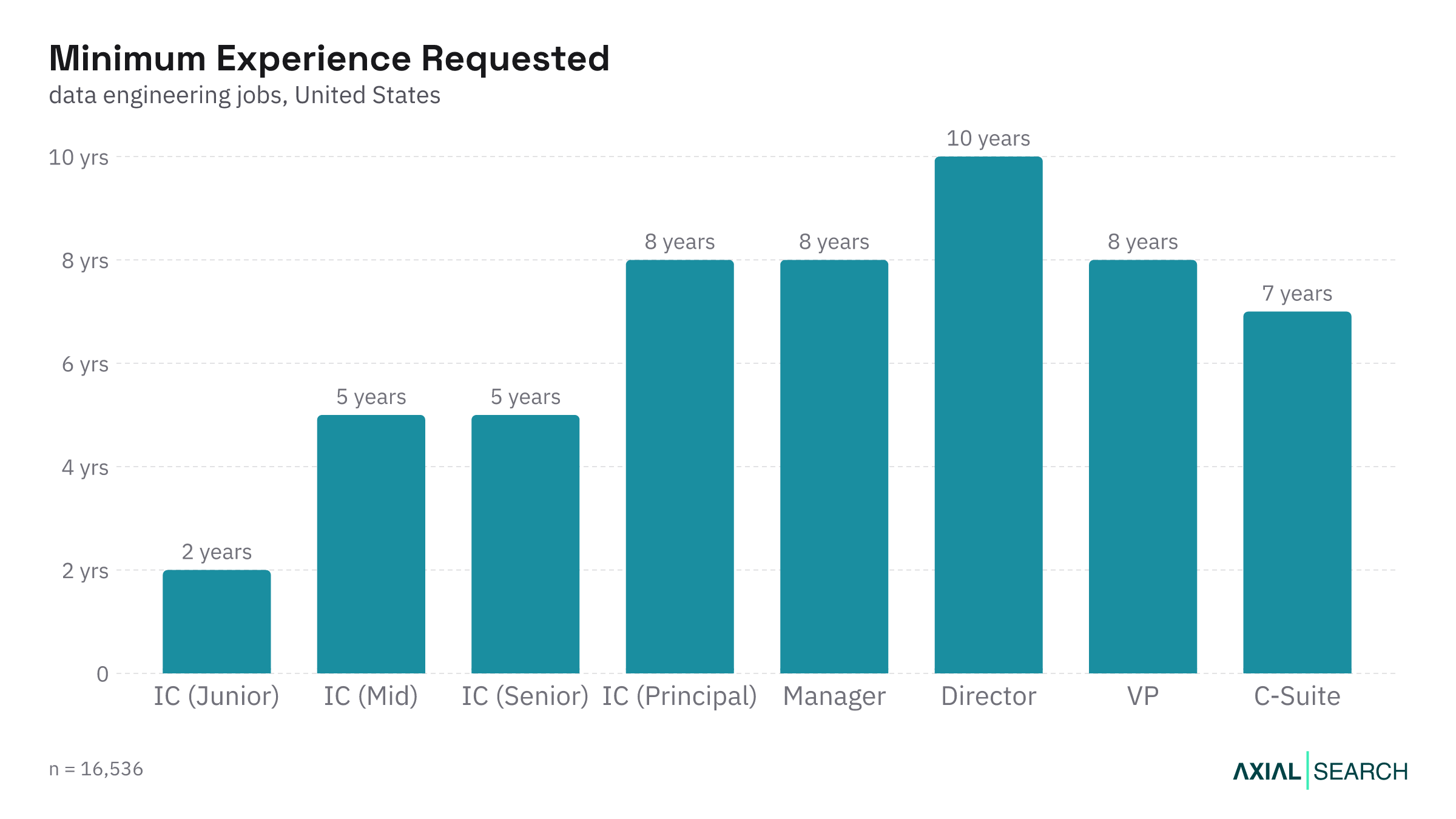
Most roles ask for around five years of experience, rising to a decade at Director level.
Given that the bulk of the market sits between mid-level IC and Manager, the realistic entry point for data engineering is earlier-career than many AI leadership tracks — you can enter with a few years of hands-on platform work and build the architecture fluency on the job. IC roles make up 92% of the market; management tracks are narrow.
Degrees and fields data engineering employers want
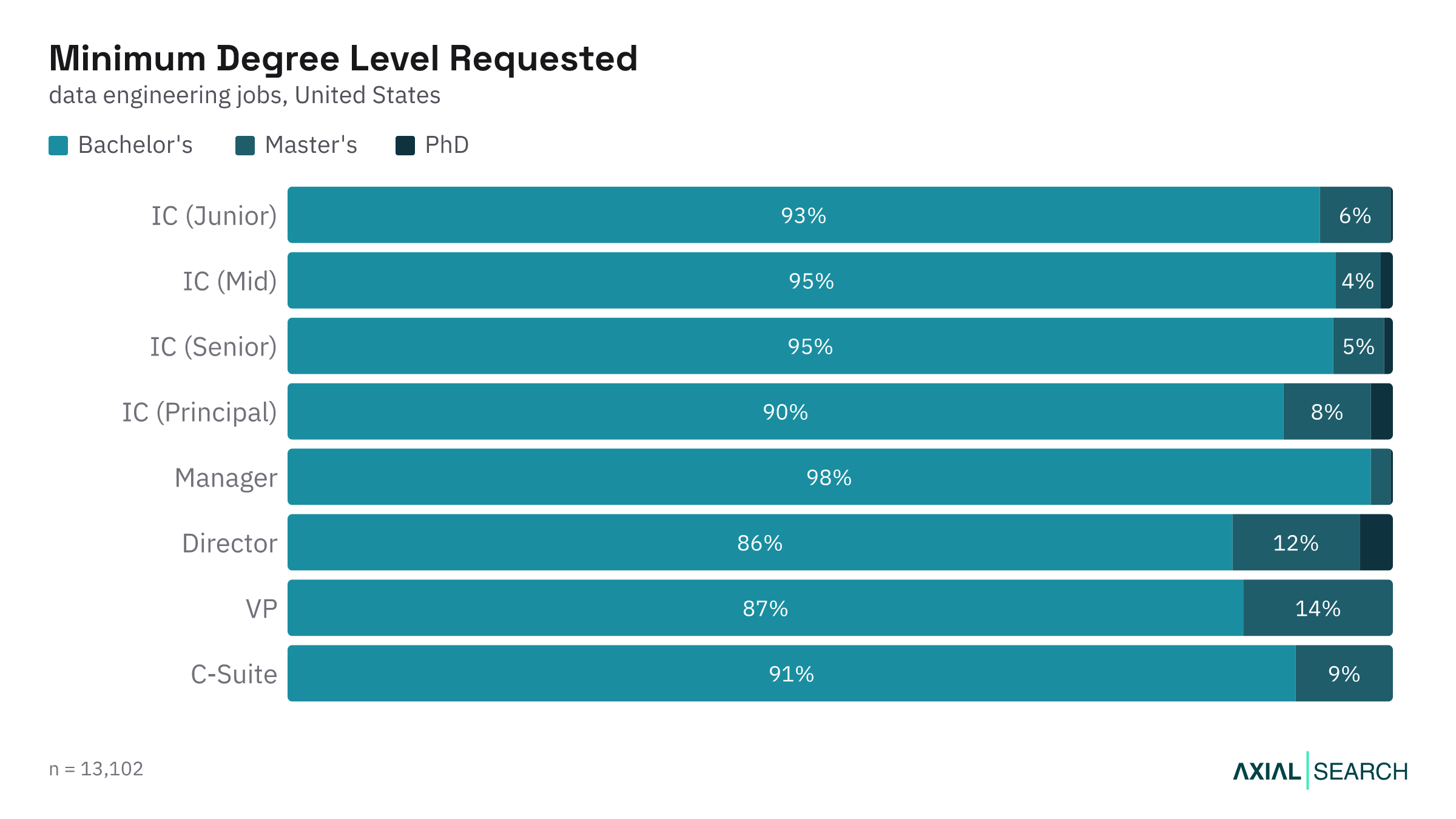
Just under 70% of postings require a degree, and a bachelor's clears the bar almost everywhere.
Advanced degrees rarely matter outside Director-level roles, where they're still optional. The field you studied matters a lot — this is one of the most technically homogeneous functions in the AI market:
| Degree field | Share of postings |
|---|---|
| Computer Science | 56.8% |
| Engineering | 26.6% |
| Information Systems | 15.4% |
| Data Science | 11.9% |
| Statistics | 10.6% |
| Mathematics | 9.9% |
Computer Science alone accounts for more than half of all degree-requiring postings.
Engineering, Information Systems and the quantitative sciences fill out the rest. There is no credible business-degree route into this function — data engineering is where the rubber meets the road, and employers expect you to have built systems before.
Certifications for data engineering roles
Be honest with yourself about certifications: they barely move the needle here.
The most common credential, AWS Certified Solutions Architect, appears in fewer than one in fifty postings, and the rest of the list is a long tail of single-digit-percentage cloud and platform badges.
| Certification | Share of postings |
|---|---|
| AWS Certified Solutions Architect | 1.6% |
| Databricks Certified Data Engineer Associate | 1.6% |
| AWS Certified Data Engineer - Associate | 1.5% |
| Google Cloud Certified - Professional Data Engineer | 1.4% |
| Certified Information Systems Security Professional (CISSP) | 1.0% |
| Certified Data Management Professional (CDMP) | 0.7% |
| SnowPro Core Certification | 0.6% |
| Project Management Professional (PMP) | 0.6% |
The signal here is what's absent: there is no dominant data engineering certification, so don't delay applying to go collect one.
The platform-specific credentials that do appear (AWS, Databricks, Google Cloud, Snowflake) are useful signals of hands-on familiarity, but they're not requirements. If you already hold one, mention it; if you don't, spend the time shipping a credible project instead.
The skills that matter for data engineering roles
Depth beats breadth in this function.
Employers want someone who can build production data systems at scale using the foundational tooling and the major cloud platforms — not a generalist who has touched everything once.
The capabilities data engineering leaders need
| Capability | Share of postings |
|---|---|
| SQL | 69.0% |
| Cloud Platforms | 64.6% |
| Python | 64.5% |
| Data Warehousing | 55.1% |
| Data Integration | 51.0% |
| ETL | 46.0% |
Three things jump out.
SQL and Python are baseline — seven in ten postings mention them, and you should assume the rest expect them without saying so. Cloud fluency is the same — the ability to design and operate data infrastructure on AWS, Azure or GCP is table stakes. The more specialized architectural patterns (data warehousing, ETL, data integration) round out the top of the list, a reminder that this is where the discipline lives.
Software and tools data engineering roles use
| Software / tool | Share of postings |
|---|---|
| AWS | 43.1% |
| Microsoft Azure | 41.0% |
| Snowflake | 32.0% |
| Databricks | 31.0% |
| Apache Spark | 28.5% |
| GCP | 23.0% |
The major cloud platforms dominate the list — AWS and Azure each appear in more than 40% of postings.
Snowflake and Databricks, the two most-cited modern data platforms, show up in roughly a third. Note that these are real architectural choices, not abstract fluency signals — employers expect you to have built on these platforms, not read about them.
Remember that these are the tools postings mention — a platform not listed isn't disqualifying. Treat the list as the core stack to be fluent in, not a checklist to complete.
How to position yourself for a data engineering role
Pull the threads together and a clear playbook emerges.
Lead with technical depth and delivery track record. The single strongest thing you can show is a history of building reliable data systems at scale — that's what the leadership profile rewards, and it's what separates an engineer from a tinkerer.
Back it with the conventional credentials. Evidence the roughly five years and the technical degree, and don't be shy about hands-on platform experience; data engineering is one of the few AI leadership tracks where being deep in the weeds is an asset.
Demonstrate fluency in the core stack. Be able to talk credibly about SQL, Python and cloud data architecture, and show hands-on experience with at least one of the major platforms (AWS, Azure, Snowflake, Databricks). Depth in one beats shallow familiarity with all of them.
Skip the certification treadmill unless you're already committed to a platform. There's no credential that unlocks this market, so invest that time in shipping a project that demonstrates architectural judgment at scale.
Final Thoughts
For candidates. Data engineering is one of the most technically meritocratic paths in the AI job market — the profile employers screen for is almost entirely build capability, not persuasion or strategy theater. If you can show a history of designing and shipping reliable data systems at scale, you're competitive. The credential bar is conventional (a technical degree, around five years), the certification treadmill is skippable, and the real filter is platform depth. Lead with what you built, how it held up and what risks you managed. If you prefer asking questions of data over building the systems that move it, data science skills focus on analysis and modeling instead of infrastructure.
For employers. Most data engineering hiring focuses on the tools (AWS, Snowflake, Databricks) and undershoots the judgment required to use them well. The market is flooded with engineers who can write ETL pipelines; the scarce capability is data readiness judgment — the ability to assess whether the data you have is trustworthy and structured enough to support what you're building on top of it. When you screen, test for architectural fluency and governance discipline, not just platform certifications. The best hires understand that reliability and trust are designed in, not bolted on.
Methodology & sources
- Data sources. Job data is collected from publicly available postings on online job boards and updated weekly, covering US roles posted since January 2026. Explore and filter it on our live AI job market dashboard.
- Requirements are extracted from job descriptions using a combination of programmatic rules and AI analysis. Minimum experience is the median minimum years requested by seniority; minimum degree is the lowest degree a posting requires.
- Top degree fields, certifications and skills are the items mentioned most often across postings.
- These are mention rates — the share of postings that state each item. A skill, degree or certification not appearing means it wasn't stated in the posting, not that it isn't valued.

Inside Data Engineering Jobs in 2026: 18,800 Postings Mapped
The complete picture of the data engineering job market in 2026: hiring demand, what these roles pay, where the jobs are, who's hiring and what it takes to get in.

Data Engineering Job Demand in 2026: 18,800 Postings Mapped
Where data engineering jobs are in 2026: hiring demand and trend, top states and cities, who's hiring by sector and company size, and the mix of seniority, contract type and remote work across US postings.

Data Engineering Salaries in 2026: Benchmarks from 18,800 Job Posts
What data engineering roles pay in 2026: median salary, pay by seniority, top-paying sectors and locations, and how often bonus and equity are mentioned in US job postings.
Turn AI ambition into lasting business value
Whether you're hiring your first AI leader or scaling enterprise transformation capability, we help you define, assess and recruit the people who make it stick.