
Data Engineering Pay in 2026: Salaries, Bonuses and Equity
What data engineering roles pay in 2026: median salary, pay by seniority, top-paying sectors and locations, and how often bonus and equity are mentioned in US job postings.
 Updated: August 6, 2026
- The ceiling matters more than the median. Data engineering roles pay a median of $155,000, but the Principal IC track pays close to Director money — staying technical doesn't cap your ceiling the way it does in most functions.
- Technology and Professional Services lead on pay. Technology posts a median salary around $209,000, Professional Services close behind at $208,000 — ahead of Financial Services at $198,000.
- California owns both volume and pay. The state accounts for 15% of all postings and posts among the highest median salaries, with San Francisco alone holding 5% of the US market.
- Equity appears most at Principal IC level. Only 15% of data engineering postings mention equity overall, but the mention rate reaches 38% for Principal ICs — more than ten times the Manager rate. Bonus is mentioned in 34% of postings, spiking to 91% at Manager.
- Enterprise scale dominates hiring. Companies with more than 10,000 employees post 35% of all data engineering roles and pay a meaningful premium over mid-market and startup-scale firms.
How much do data engineers make?
The median data engineering salary is $155,000. Pay tracks seniority closely, but the two career tracks diverge in a way that matters: Principal individual contributors earn close to Director money, so staying technical doesn't cap your earnings the way it does in many functions.
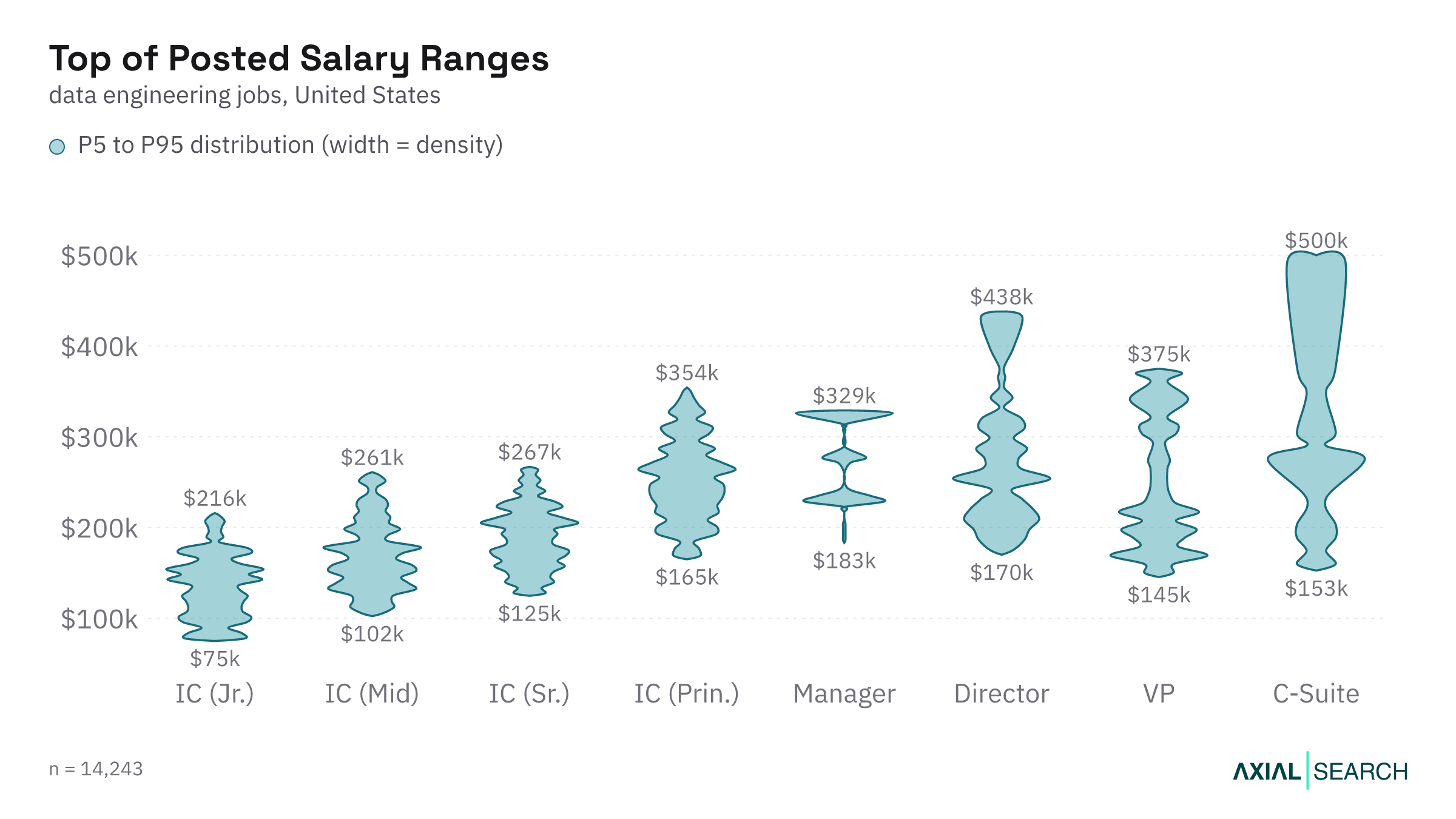
Top of the posted range by seniority — the median and typical maximum of what's posted, 5th to 95th percentile. This is the ceiling candidates can credibly negotiate toward, not the typical offer.
| Seniority | 5th percentile | 25th percentile | Median | 75th percentile | 95th percentile |
|---|---|---|---|---|---|
| IC (Junior) | $75,000 | $104,000 | $136,000 | $163,000 | $216,000 |
| IC (Mid) | $102,000 | $136,000 | $162,000 | $200,000 | $261,000 |
| IC (Senior) | $125,000 | $160,000 | $188,000 | $219,000 | $267,000 |
| IC (Principal) | $165,000 | $215,000 | $250,000 | $289,000 | $354,000 |
| Manager | $183,000 | $230,000 | $241,000 | $329,000 | $329,000 |
| Director | $170,000 | $210,000 | $252,000 | $311,000 | $438,000 |
| VP | $145,000 | $178,000 | $213,000 | $300,000 | $374,000 |
| C-Suite | $153,000 | $185,000 | $274,000 | $316,000 | $500,000 |
Where two percentiles show the same figure, employers are clustering on a round number at that end of the band. That ceiling has stayed roughly flat over the past year, consistent with a market that's steady rather than surging. Companies are still seeing strong data engineering hiring, but they aren't bidding up the top of the range the way a hotter market would.
The IC-versus-management pay divide in data engineering
Data engineering splits cleanly into two tracks: individual contributors who build systems, and managers who run teams — and the IC track tops out higher than most people expect.
The IC path starts at Junior, climbs through Mid and Senior, and tops out at Principal — a technical specialist tier that exists to keep deep experts from being forced into management. The management path runs Manager, Director, VP and C-suite. The surprise is at the top: the Principal IC track matches Director pay, and both sit well above Manager and VP. If you're optimizing for pay and prefer building to managing, data engineering is one of the few functions where staying technical doesn't cap your ceiling. Finding candidates who've made that trade-off deliberately is where AI recruitment that understands the technical bar pays off.
Where most data engineering salaries cluster
The market is densest at Mid and Senior IC levels, so the middle of this distribution is where most candidates land.
The band you're quoted matters far more than the headline median. At the executive tiers the medians converge — title moves your pay less than negotiation once you're past Director.
How much room is there to negotiate at the top of the data engineering range
More than the median suggests — among individual-contributor bands, the dollar gap between the 75th and 95th percentile is widest at Principal IC, wider than at Junior, Mid or Senior IC.
That spread is the real story: the strongest Principal IC candidates are negotiating against a bigger ceiling than the headline number implies.
What is the full salary range for data engineers?
The full posted data engineering salary range runs from roughly $75,000 at the 5th percentile for junior ICs up to $500,000 at the 95th percentile for C-suite roles — see the table above for the full ladder in between.
Which industries pay data engineers the most?
Data engineering pays the most where the data infrastructure is the product or where the product can't function without it. Technology tops the list with a median salary around $209,000, followed closely by Professional Services.
| Sector | Median salary | Postings |
|---|---|---|
| Technology | $209,000 | 2,628 |
| Professional Services | $208,000 | 2,974 |
| Financial Services | $200,000 | 1,130 |
| Capital Markets & PE | $200,000 | 234 |
| Manufacturing | $185,000 | 621 |
Financial Services trails both Technology and Professional Services despite conventional wisdom, landing fourth on this list rather than at the top. The volume story is different from the pay story: the highest volume of opportunities sits in IT and professional services, but the highest pay sits in product companies and financial markets firms — a trade-off between opportunity count and compensation ceiling.
How much does sector really matter for data engineering pay
Less than you'd think — about $24,000 separates the top sector (Technology) from the bottom of this list (Manufacturing).
Sector matters, but seniority moves your pay far more: the gap between a Junior IC and a Principal IC dwarfs any sector premium.
Does company size affect data engineering compensation?
Bigger usually pays more, and in data engineering the pattern is clean. Enterprise-scale companies with more than 10,000 employees post 35% of all data engineering roles and pay noticeably more than mid-market and startup-scale firms.
For candidates, this means you trade a lower base for a smaller company. For hirers, it means the mid-market squeeze is real — you can't compete on brand with enterprise firms and you can't compete on equity with well-funded startups, so you need to compete on clarity of role and speed of impact.
Does company size affect data engineering equity offers
Somewhat — of the postings that disclose pay, equity is mentioned in 23% at enterprise-scale firms (5,000+ employees), versus 20% at mid-market firms and 17% at startup-scale companies under 500 employees.
That's a modest but real gap, not the flat line it can look like at a glance, and these figures run a bit above the 15% equity-mention rate across all postings because they're limited to the subset that states a salary. Bigger companies use equity a bit more often on top of a bigger base, so the total-comp gap between company sizes is wider than the base-salary numbers alone suggest.
Where do data engineers earn the most?
Pay is geographically compressed for data engineering, but California is the standout: it posts a median salary around $210,000, pairing the country's highest posting volume with top-tier pay.
| State | Median salary | Share of postings |
|---|---|---|
| California | $210,000 | 15.3% |
| Louisiana | $208,000 | 0.3% |
| Oklahoma | $202,000 | 0.4% |
| Alabama | $202,000 | 0.7% |
| Connecticut | $200,000 | 1.2% |
The top states cluster within about $10,000 of each other, so where you work moves your salary far less than how senior you are. Louisiana, Alabama and Oklahoma reflect a concentration of oil-and-gas and heavy-industrial firms that need data engineers to instrument production systems and logistics; the pay is competitive, but the volume in each is under 1% of the market.
Which states are outliers in data engineering pay
Louisiana, Oklahoma and Alabama post some of the highest median salaries in the country, but each holds under 1% of postings — small samples driven by a handful of high-paying industrial mandates rather than a real regional market.
Treat them as noise, not a signal to chase; California's combination of volume and pay is the durable pattern.
The top-paying cities for data engineering
Zoom into the metro level and the picture sharpens. Five of the top six cities on pay are in Silicon Valley, where the highest-value data infrastructure work concentrates.
| City | Median salary | Postings |
|---|---|---|
| Santa Clara, CA | $242,000 | 85 |
| San Mateo, CA | $241,000 | 48 |
| San Jose, CA | $236,000 | 140 |
| Toledo, OH | $230,000 | 20 |
| Palo Alto, CA | $230,000 | 97 |
| San Francisco, CA | $230,000 | 703 |
| Menlo Park, CA | $230,000 | 34 |
| Mountain View, CA | $228,000 | 62 |
| New Orleans, LA | $224,000 | 24 |
| Sunnyvale, CA | $224,000 | 117 |
For hirers, this means you can't out-compete the Valley on base alone if you're remote or in a lower-cost metro — you need to compete on the work, not the number. For candidates, it means the premium for being on-site in the Valley is real but not enormous, and other metros (San Francisco alone posts 703 of these roles) offer solid volume at competitive pay.
How often are data engineering bonus and equity offered?
Bonus is mentioned in 34% of data engineering postings and equity in 15% — both are floors, not ceilings, since many roles that don't advertise either still offer one.
Dollar figures are almost never posted, so a mention rate is the best signal available.
How often a bonus is offered in data engineering
A bonus is mentioned in about a third of postings — common enough to ask about, but far from universal in the text. The mention rate climbs sharply at Manager level (91%) and stays high through Director (52%) and VP (72%), while Junior and Mid ICs sit lowest (28% and 22%).
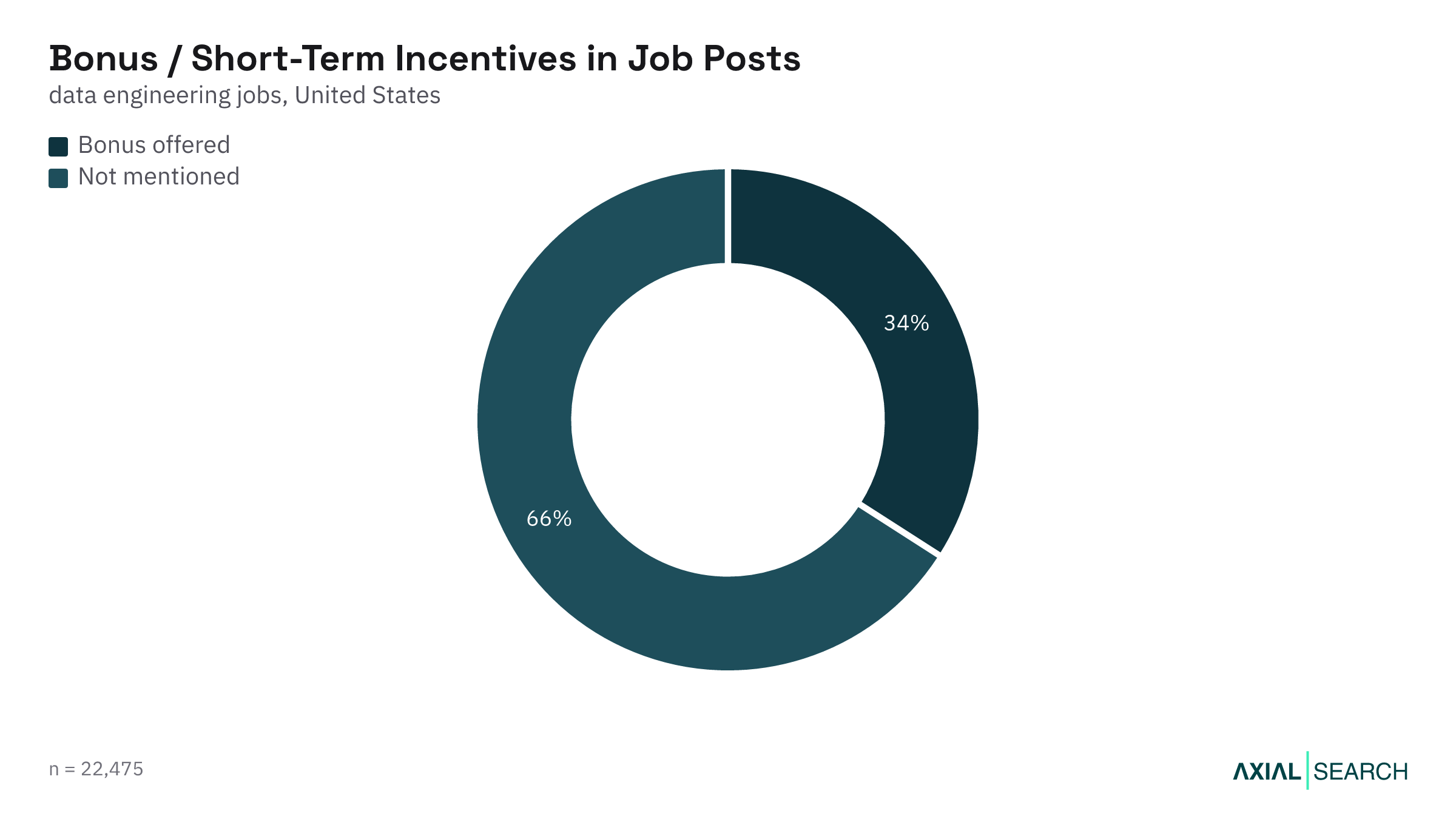
That pattern — low at Junior and Mid IC, higher at Senior and Principal, spiking at Manager — maps to how companies structure incentives: junior roles are salaried, senior technical roles get performance bonuses, and people-leadership roles get tied to team outcomes. For candidates at Senior IC and below, assume the base is the base unless the posting says otherwise.
How often equity is offered in data engineering
Equity is mentioned in just 15% of data engineering postings overall, and it doesn't climb with seniority the way bonus does. It peaks at Principal IC level at 38%, then collapses to 3% at Manager before climbing back to 22% at Director.
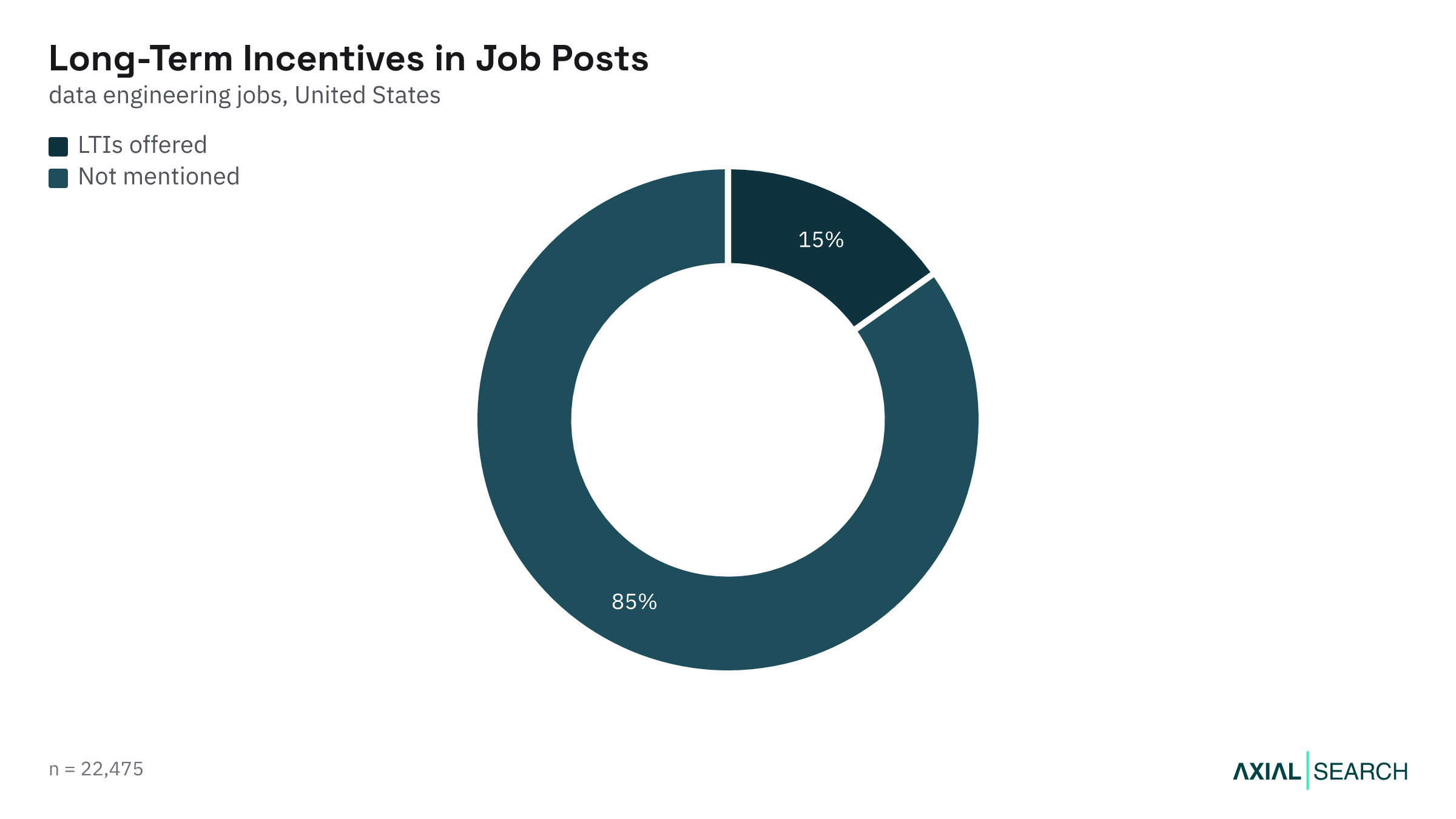
That Manager dip likely reflects the shift from equity to bonus as the primary incentive when you move into people leadership. For candidates, this means equity is most accessible when you're a high-value individual contributor, not when you're managing a team. For hirers, it means if you're using equity to attract senior ICs, say so — 38% of Principal postings mention it, which means it's close to table stakes at that level.
| Level | Bonus mentioned | Equity mentioned |
|---|---|---|
| IC (Junior) | 28% | 9% |
| IC (Mid) | 22% | 13% |
| IC (Senior) | 39% | 16% |
| IC (Principal) | 44% | 38% |
| Manager | 91% | 3% |
| Director | 52% | 22% |
| VP | 72% | 13% |
| C-Suite | 36% | 26% |
What the bonus-versus-equity split says about data engineering retention
Companies know where retention risk sits — with the technical architects who can credibly walk across the street, not the people managers.
That's why equity concentrates at Principal IC level while bonus concentrates in management: two different retention tools aimed at two different flight risks.
Final Thoughts
For candidates. Data engineering is a volume market, and demonstrating fluency in core data engineering skills puts negotiating power in your favor. The premium for staying technical is real — Principal ICs pay close to Director money — and equity is most accessible at Principal level, not in management. If you're negotiating, ask about the ceiling and ask about equity explicitly if the posting doesn't mention it; the offer rate is higher than the mention rate. If you prefer statistical modeling and experimentation over pipeline architecture, data science salaries reflect that analytical focus instead.
For employers. The market is deep, but competition for Principal ICs and Directors is sharper than the headline volume suggests, since those bands are the thinnest slice of the market. Build your offer around the ceiling, not the median, if you're chasing a Principal candidate, and expect equity to matter more in that conversation than it does anywhere else in your leveling structure.
Methodology & sources
- Data sources. Job data is collected from publicly available postings on online job boards and updated weekly, covering US roles posted since January 2026. Explore and filter it on our live AI job market dashboard.
- All salary figures are derived from the minimum and maximum salary bands employers post, annualized and reported as percentiles, not averages.
- Every salary figure on this page is the top of the posted range — the ceiling employers advertise, not the typical offer. The seniority table reports it at the 5th, 25th, 50th (median), 75th and 95th percentiles. Median salary in the sector, company-size and location tables is the median of that ceiling within each group.
- Bonus and equity figures are mention rates — the share of postings that state a bonus or equity. A posting silent on either is counted as "not mentioned"; it does not mean none is offered.

How to Advance Your Data Engineering Career
How to advance a data engineering career in 2026: the qualifications, certifications and career path 18,786 US job postings actually ask for.

The State of the Data Engineering Job Market in 2026
The data engineering job market in 2026, mapped from 18,786 US postings: what the role involves, how hot demand is, what it pays and whether the work is remote.

How to Hire Data Engineers in 2026
What it takes to hire data engineers in 2026: pay benchmarks, how competitive the market is and how to assess candidates, from 18,786 US postings.
Turn AI ambition into lasting business value
Whether you're hiring your first AI leader or scaling enterprise transformation capability, we help you define, assess and recruit the people who make it stick.