
How Much Do Data Scientists Make? 2026 Benchmarks
What data science roles pay in 2026: median salary, pay by seniority, top-paying sectors and locations, and how often bonus and equity are mentioned in US job postings.
 Updated: July 30, 2026
- Overall median: The data science salary median across all levels is $168,000, with the IC bands concentrated between mid-level and Principal driving the bulk of the market.
- IC track pays like leadership: Principal ICs earn close to Director money — higher than Managers and within striking distance of Directors — so staying technical doesn't cap your ceiling the way it does in most functions.
- Geography concentrates pay: California posts 19% of all data science roles and pays top-tier, with Bay Area metros (San Mateo, Santa Clara, Mountain View) leading the nation in median salary.
- Technology and Real Estate lead sectors: Both post median salaries around $225,000–$226,000, roughly $25,000 ahead of Financial Services — though the sector gap is narrower than the seniority or location gap.
- Equity tilts toward Principal ICs: Equity is mentioned in 49% of Principal IC postings but only 17% at Director and 12% at VP, signaling that stock is the retention lever for senior technical talent who don't manage.
- Bonus is standard at leadership levels: Three-quarters of data science Manager, Director and VP postings mention a bonus, versus fewer than half at Senior IC and below.
How much do data scientists make?
The median data science salary is $168,000. Pay climbs steadily through the IC track, and the Principal IC level is the standout — it reaches close to Director money, so staying technical doesn't cap your ceiling the way it does in most functions.
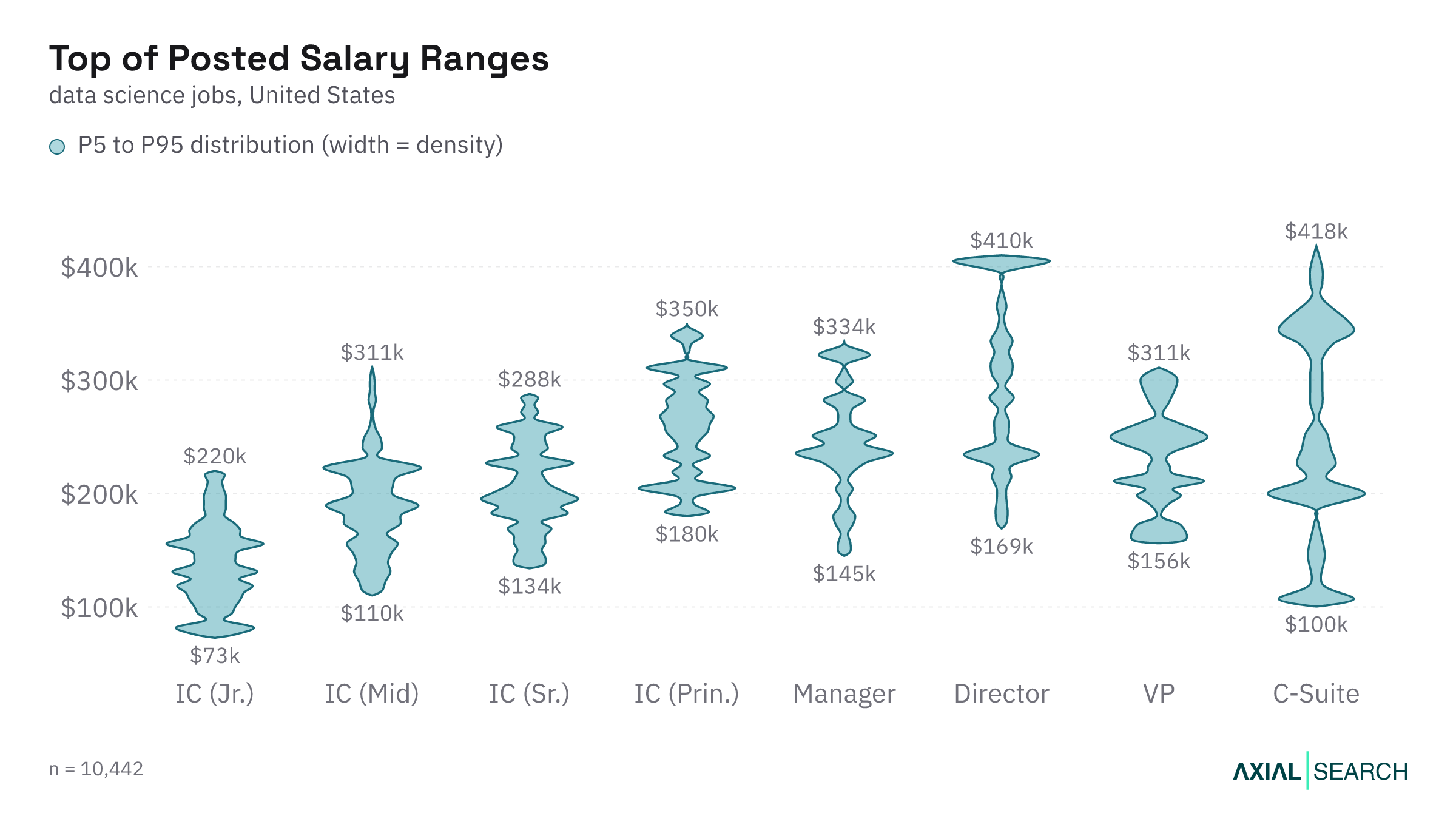
Top of the posted range by seniority — the median and typical maximum of what's posted, 5th to 95th percentile. This is the ceiling candidates can credibly negotiate toward, not the typical offer.
| Seniority | 5th percentile | 25th percentile | Median | 75th percentile | 95th percentile |
|---|---|---|---|---|---|
| IC (Junior) | $73,000 | $105,000 | $133,000 | $163,000 | $220,000 |
| IC (Mid) | $110,000 | $156,000 | $193,000 | $222,000 | $312,000 |
| IC (Senior) | $134,000 | $180,000 | $202,000 | $237,000 | $288,000 |
| IC (Principal) | $180,000 | $205,000 | $260,000 | $296,000 | $345,000 |
| Manager | $145,000 | $220,000 | $246,000 | $280,000 | $334,000 |
| Director | $170,000 | $232,000 | $288,000 | $410,000 | $410,000 |
| VP | $156,000 | $195,000 | $215,000 | $250,000 | $308,000 |
| C-Suite | $100,000 | $194,000 | $240,000 | $340,000 | $414,000 |
Where two percentiles show the same figure, employers are clustering on a round number at that end of the band. The ceiling has moved up over the past year, consistent with the rising demand we see across data science jobs — at the 95th percentile, Director roles have climbed roughly 8.7% year-over-year.
Where most data science salaries cluster
The market is densest at Mid and Senior IC levels — together well over half of postings — so the middle of this distribution is where most candidates land.
The band you're quoted matters more than the headline median. Two candidates at the same title can land tens of thousands of dollars apart depending on company, sector and negotiation. Benchmarking that band accurately is exactly what AI recruitment helps employers and candidates both get right.
Why data science pay gets noisier at VP and above
At the IC levels, the climb is steady, and the Principal IC track is the standout: it pays close to Director money, so staying technical doesn't cap your ceiling the way it does in most functions. Managers sit in between at the median, but the real pay action concentrates at Director and Principal.
Above that, the picture gets noisier. VP pay sits below both Manager and Director at the median, which likely reflects that most Data Science hiring happens at IC and Director level, not VP, so the VP sample is smaller and more idiosyncratic — often drawn from orgs that don't use the VP title for senior data roles.
Why VP pay looks like an outlier in data science
VP pay looks like an outlier because the role is uncommon in data science orgs — the posted median for VP sits below both Manager and Director.
That gap reinforces the point that VP-level data science hiring is uncommon enough that the posted bands reflect organizational idiosyncrasies more than a stable market rate: most companies either promote Directors internally to VP or don't use the VP title for the function at all. Manager roles top out higher than VP at both the median and the 95th percentile, which again signals that VP postings skew toward smaller or less data-mature orgs. The cleanest pay ladder runs from IC (Junior) through IC (Principal) and then Director; everything else is noisier.
What is the full salary range for data scientists?
The full posted data science salary range runs from roughly $73,000 at the 5th percentile for junior ICs up to $414,000 at the 95th percentile for C-suite roles — see the table above for the full ladder in between.
Which industries pay data scientists the most?
Data science pays the most where the technical infrastructure is mature and competition for talent is fiercest — Technology and Real Estate top the table at a median salary around $225,000.
| Sector | Median salary | Postings |
|---|---|---|
| Technology | $226,000 | 2,655 |
| Real Estate | $225,000 | 44 |
| Retail and Hospitality | $220,000 | 618 |
| Professional Services | $208,000 | 2,251 |
| Life Sciences | $202,000 | 363 |
Technology dominates on volume — roughly 19% of all postings — and ties Real Estate on pay, though Real Estate is a rounding error by count (just 40 postings). Retail and Hospitality sits in the middle at around 5% of all roles but pays near the top, likely driven by high-stakes personalization and supply-chain analytics at enterprise scale.
Sector matters, but seniority and location move your pay far more — a Director will out-earn a mid-level IC by a wide margin regardless of sector, so optimize for level first, sector second.
How much does sector really matter for data science pay?
Less than you'd think — Technology and Life Sciences, the top and bottom of this list, are only about $23,000 apart in median salary.
Sector matters, but seniority moves your pay far more: the difference between a Junior IC and a Principal IC is substantial across every sector in this list.
Does posting volume track with pay across data science sectors?
Not consistently — Professional Services posts the second-highest volume of data science roles but pays in the middle of the pack, well behind Technology and Real Estate.
That's consistent with the billable-hours model, where consulting comp is capped by client budgets rather than by internal product margins.
Does company size affect data science pay?
Company size drives pay in data science more directly than in most other AI functions — enterprise-scale companies (5,000+ employees) post a median salary around $209,650, compared with $180,000 at startups and small companies under 500 employees.
Mid-market firms (500–5,000 employees) land in between at roughly $197,200. The pattern is clean: bigger consistently pays more, and the gap between enterprise and startup-small is wide enough to matter when you're comparing offers. For candidates, that means the brand name carries real comp value; for hirers at smaller firms, it means you're competing on mission and upside, not base.
Does company size affect data science equity offers?
Yes, and in the direction you might not expect — equity is mentioned in 42% of postings from companies with 5,000 or more employees, of the postings that disclose pay, compared with 24% at startups and small companies under 500 employees.
Mid-market firms (500–5,000 employees) sit in between at 29%. That's the reverse of the usual startup-equity assumption: the biggest employers are also the most likely to dangle equity, likely because enterprise-scale tech and finance firms compete hardest for the same senior technical talent Principal ICs represent.
Where do data scientists earn the most?
Pay is geographically compressed at the top, but California stands out — it posts a median salary of $226,000, the highest in the country, while capturing 19% of all postings.
| State | Median salary | Share of postings |
|---|---|---|
| California | $228,000 | 19.1% |
| Washington | $222,000 | 9.2% |
| Arkansas | $220,000 | 1.0% |
| New York | $211,000 | 13.4% |
| Oregon | $209,000 | 0.4% |
California leads on both dimensions, posting roles at nearly double the rate of any other state. Washington State, driven by Seattle and Bellevue (Amazon, Microsoft, the broader cloud ecosystem), pays near the top at $222,000 and accounts for 9.2% of postings.
New York posts the second-highest volume at 13.6% but pays about $15,000 less than California in median salary. That gap is consistent with the broader tech-pay premium California commands, driven by concentration of high-margin product companies and venture-backed scale-ups. The long tail is thin: the bottom states collectively account for a small fraction of the market.
Which states are outliers in data science pay?
Arkansas and Arizona are the outliers on this list — each around 1% of postings but ranking among the top five states by pay, likely driven by a handful of high-paying employers rather than a broad regional market.
Arkansas's figure likely reflects Walmart's analytics hub in Bentonville. Treat both as noise, not a signal to chase — Washington's Seattle and Bellevue cloud-ecosystem concentration is the more durable pattern.
The top-paying cities for data science
Zoom into the metro level and the picture sharpens: San Mateo, Santa Clara and Mountain View top the list, the Silicon Valley core where the highest-value data science work concentrates.
San Jose, San Francisco and Oakland round out the California sweep. If you're optimizing for comp, the Bay Area still leads by a wide margin. Seattle is the highest-paying non-California metro, consistent with Washington State's statewide median, while New York City sits lower — a reminder that the California premium is real and persistent, even after adjusting for cost of living. On volume, Seattle leads all cities at 8.7% of US postings, so the work is geographically distributed even if the top pay concentrates in a handful of metros.
How often are data science bonus and equity offered?
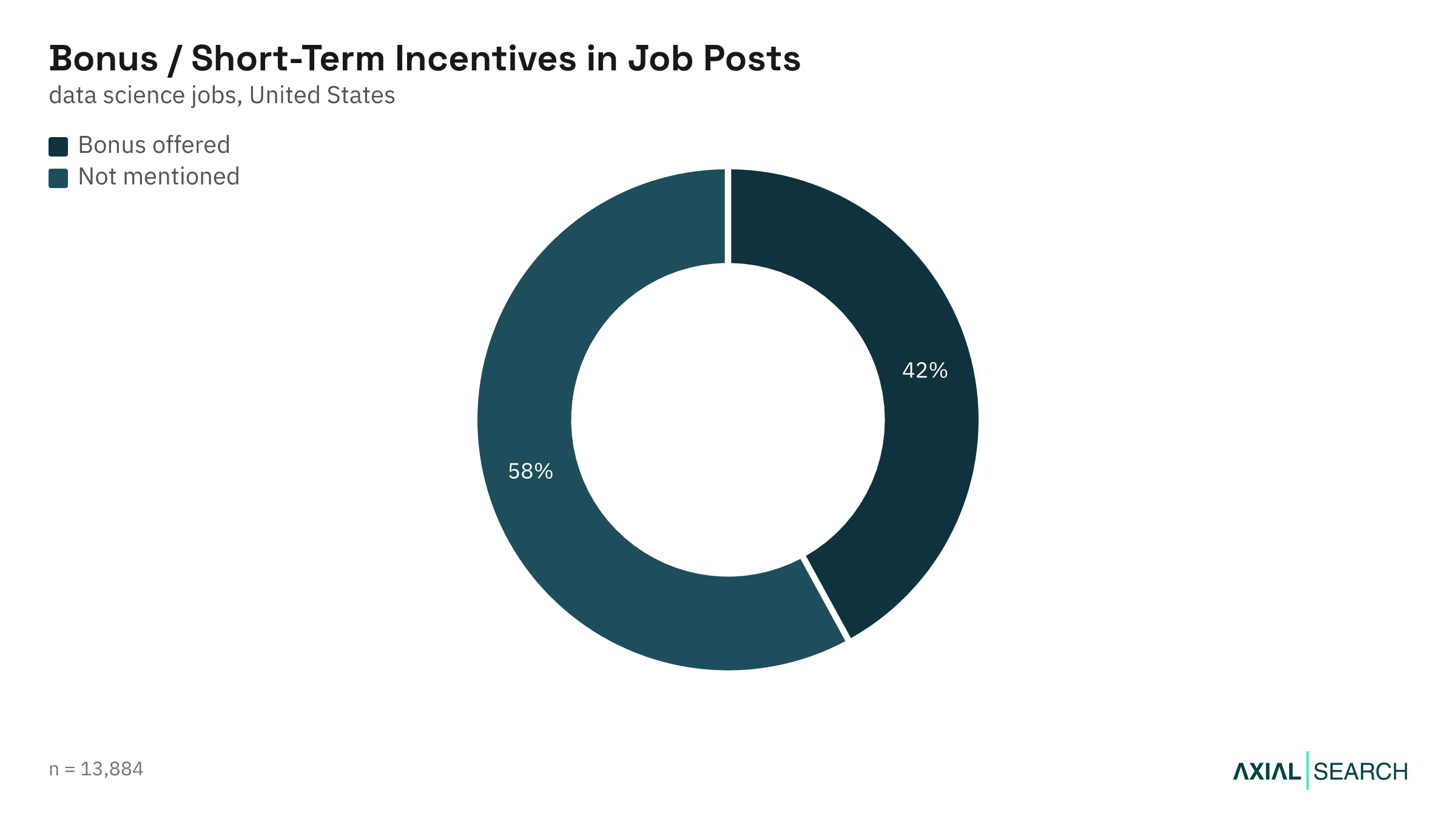
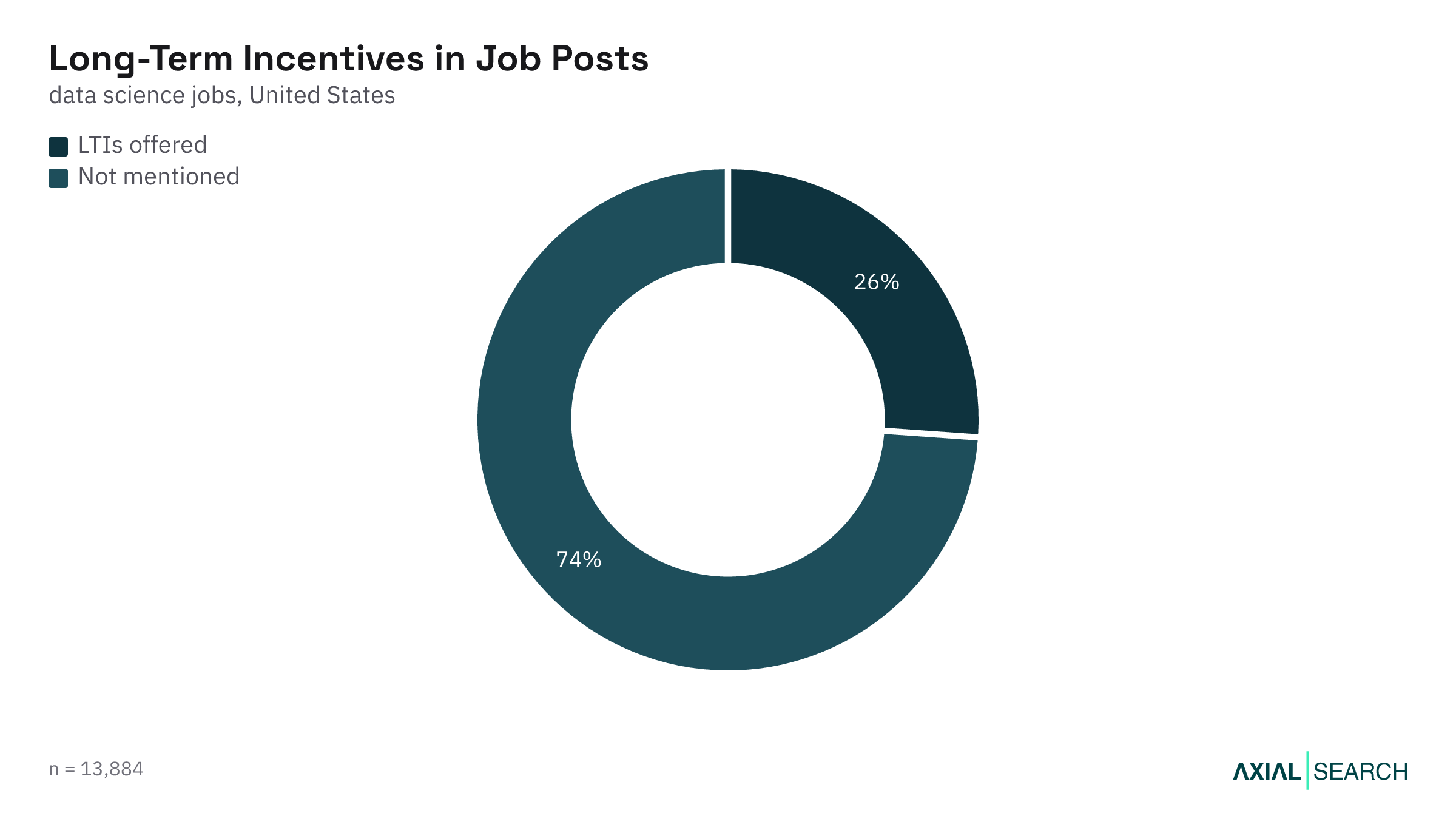
Bonus is mentioned in 43% of data science postings and equity in about 26% — both are floors, not ceilings, since many roles that don't advertise either still offer one.
Dollar figures are almost never posted, so what we can measure is how often each is mentioned at all. A mention rate is a floor, not a ceiling: absence in the data means the posting was silent, not that nothing is on the table.
How often a bonus is offered
A bonus is mentioned in 43% of data science postings — 5,262 roles out of 12,148 — common enough to expect at mid-level and above, but far from universal in the text.
The rate climbs with seniority until you hit C-suite, where it drops sharply. At Manager, Director and VP, bonus appears in roughly three-quarters of postings — the bands where annual incentives are most often baked into the structure. At IC (Principal), it's mentioned in nearly two-thirds of roles, and at IC (Senior) in 44%. For IC (Mid) and IC (Junior), the rates are lower — 30% and 27% — so bonus is the exception rather than the rule at early-career levels.
The C-suite anomaly — just 16% mention a bonus — likely reflects that executive comp is structured differently and rarely advertised in a job posting. The small sample makes the number noisier, but the direction is consistent: the higher you climb past Director, the less likely the posting spells out incentive details.
How often equity is offered
Equity is mentioned in data science postings at a rate that peaks at IC (Principal) level, where nearly half of postings reference it, and drops sharply for management roles.
That pattern likely reflects where equity is used as a retention and upside lever for senior ICs versus where a high base does the work for people-leaders. At IC (Senior) and IC (Mid), equity appears in 28% and 30% of postings respectively — more common than at junior level but still a minority of roles.
The management track inverts the pattern. Managers, Directors and VPs get equity less often than Principal ICs in the posted text — likely because those roles lean on base and bonus more heavily, and because equity at the leadership level is negotiated rather than advertised. C-suite equity mentions sit at just 5%, but that's a small and idiosyncratic sample.
| Level | Bonus mentioned | Equity mentioned |
|---|---|---|
| IC (Junior) | 27% | 10% |
| IC (Mid) | 29% | 30% |
| IC (Senior) | 44% | 28% |
| IC (Principal) | 63% | 47% |
| Manager | 78% | 19% |
| Director | 76% | 17% |
| VP | 76% | 13% |
| C-Suite | 17% | 5% |
What the bonus-versus-equity split says about data science retention
Companies know where retention risk sits — with the technical specialists who can credibly walk across the street, not the people managers.
That's why equity concentrates at Principal IC level while bonus concentrates in management: two different retention tools aimed at two different flight risks.
Final Thoughts
For candidates. Data science pay is concentrated in a narrow set of geographies and seniority bands, so your comp hinges on where you sit in the ladder and whether you're willing to move. Principal IC roles pay nearly as much as Directors and are far more likely to mention equity, so the IC track is a viable path to top-tier comp if you don't want to manage. Technology and Real Estate top the sector table, but the spread is modest — seniority and company size move your number more than industry. If you're optimizing for cash, target enterprise-scale employers in California or Washington; if you're optimizing for equity upside, look at Principal roles where the mention rate is highest. The median across all data science postings is $168,000, but that figure masks a wide range — the table above is where the real benchmarking lives. If you lean toward building pipelines over modeling algorithms, data engineering salaries reflect a different set of technical priorities.
For employers. This is a deep, liquid market, but the talent concentrates at IC (Mid) and IC (Senior). If you're hiring Directors or Principals, you're competing in a much thinner pool. Equity mention rates are highest at Principal, so if you're trying to retain senior ICs, stock is the lever that matters. For management roles, bonus shows up in three-quarters of postings, so candidates expect it spelled out.
Methodology & sources
- Data sources. Job data is collected from publicly available postings on online job boards and updated weekly, covering US roles posted since January 2026. Explore and filter it on our live AI job market dashboard.
- All salary figures are derived from the minimum and maximum salary bands employers post, annualized and reported as percentiles, not averages.
- Every salary figure on this page is the top of the posted range — the ceiling employers advertise, not the typical offer. The seniority table reports it at the 5th, 25th, 50th (median), 75th and 95th percentiles. Median salary in the sector, company-size and location tables is the median of that ceiling within each group.
- Bonus and equity figures are mention rates — the share of postings that state a bonus or equity. A posting silent on either is counted as "not mentioned"; it does not mean none is offered.

What It Takes to Land a Data Science Role in 2026
How to become a data science professional in 2026: the leadership capabilities employers screen for, the experience and degrees required, the certifications that matter, and the skills most in demand across US postings.

How Hot Is the Data Science Job Market in 2026?
The complete picture of the data science job market in 2026: hiring demand, what these roles pay, where the jobs are, who's hiring and what it takes to get in.

Who's Hiring Data Scientists in 2026
Where data science jobs are in 2026: hiring demand and trend, top states and cities, who's hiring by sector and company size, and the mix of seniority, contract type and remote work across US postings.
Turn AI ambition into lasting business value
Whether you're hiring your first AI leader or scaling enterprise transformation capability, we help you define, assess and recruit the people who make it stick.