
Who's Hiring Data Scientists in 2026
Where data science jobs are in 2026: hiring demand and trend, top states and cities, who's hiring by sector and company size, and the mix of seniority, contract type and remote work across US postings.
 Updated: October 14, 2026
- Steady flow, not frenzy: data science hiring runs at around 828 new US postings a week — substantial volume, but not the explosive growth some sectors see.
- Enterprise-scale companies post nearly half of all data science roles (49% from 10,000+ employee firms), led by Technology at 23% and Professional Services at 18%.
- The market wants doers, not managers: 86% of data science postings are IC roles, with mid-level (32%) and senior (30%) dominating — management tracks account for just 7%.
- This is a full-time market: 93% of data science postings are permanent roles, and where work setting is specified, 54% are hybrid and 23% fully remote.
- California and New York hold one-third of the data science market, but Seattle rivals San Francisco as the top hiring city — the opportunity is more nationally distributed than the coastal headline suggests.
What will you need to pay to hire data scientists?
Budget a median of $168,000 for a data science hire, with the Principal IC track commanding close to Director money.
That's the posted band, not the final offer. Bonus (mentioned in 43% of data science postings) and equity sit on top, and they're not spread evenly — equity peaks at the Principal IC level, bonus peaks at Manager, Director and VP. For the full breakdown by seniority, sector and location, see data science salaries.
How data science pay changes with seniority
Pay rises steadily through Mid and Senior IC, then splits: the Manager track tops out lower than the Principal IC track at the median, which is unusual and worth knowing before you set a leveling structure.
If you're building a req around a Manager title expecting to underpay a senior technical candidate, the data says otherwise — a Principal IC candidate can credibly ask for Director money, and often gets it. Getting that leveling call right is exactly the kind of judgment AI recruitment brings to a technical search.
Where bonus and equity fit into a data science offer
43% of data science postings mention a bonus, and neither is spread evenly across levels — bonus climbs with management seniority, equity peaks at Principal IC.
If you're competing for a Principal IC candidate, an equity component is doing more work in that conversation than it will for a Manager hire.
How competitive is the market for data scientists?
Competitive — 62% of data science postings target IC roles at Mid or Senior level, and the entry-level pipeline is thin, so growing your own talent takes longer than hiring it.
Two-thirds of the market sits in the Mid and Senior IC bands, where candidates have the most options and the least reason to take a below-market offer. The challenge isn't finding openings to compete against — it's finding people who can do the work that technical depth actually requires.
How data science hiring volume has trended
Data science hiring is running at roughly 828 new US postings a week with no clear slowdown, so competition for the best candidates isn't easing.
The volume has held through the first half of 2026, making this one of the larger and more consistently active markets tracked in this report.
Why the data science pipeline is thin at the top
Only about 9% of data science postings target the Principal IC level, so the deep-technical bench most teams want to promote into is thin on both ends.
That means a realistic build-your-own-bench plan takes years, not quarters — for an immediate need, hiring is faster than developing.
Who are you competing with for data science talent?
You're competing against enterprise-scale companies most often, but mid-sized firms still post meaningful volume.
Free to republish with credit and a link back to this article (terms). Cite as: Axial Search, "Who's Hiring Data Scientists in 2026," April 2026.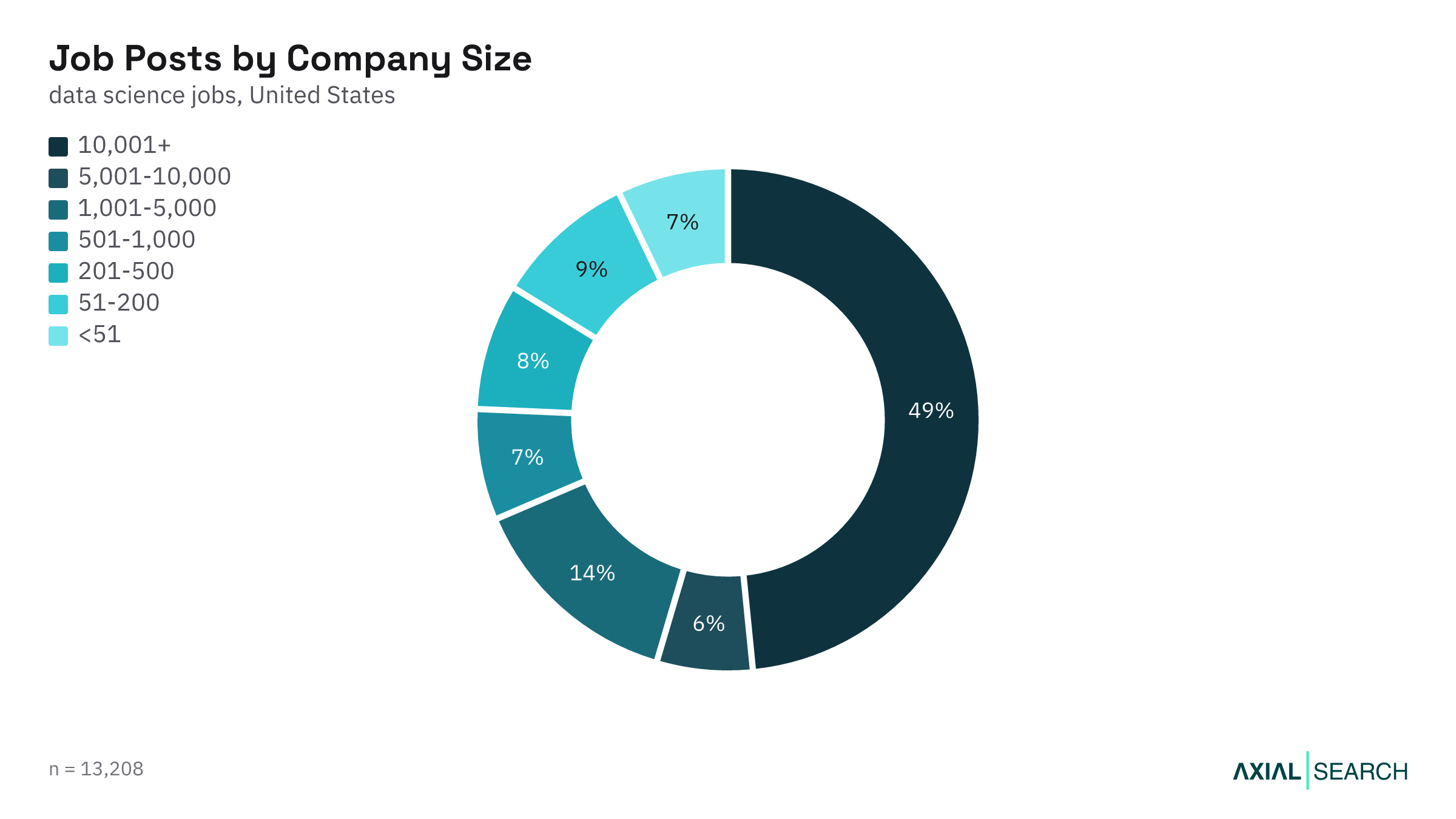
Technology leads in postings, Professional Services follows, IT Services is also represented, Financial Services at 10% — but the presence of Retail, Manufacturing and Healthcare shows data science hiring has spread well beyond tech-native companies.
| Sector | Share of postings |
|---|---|
| Technology | 23% |
| Professional Services | 17% |
| IT Services | 12% |
| Financial Services | 10% |
| Retail and Hospitality | 5% |
| Manufacturing | 5% |
| Healthcare | 4% |
| Life Sciences | 3% |
Professional Services and IT Services together account for nearly 30% of postings, reflecting the consulting and implementation work that surrounds enterprise AI adoption. There's also a small but real tail of sub-51-employee startups hiring at this level, though they represent less than 7% of the market.
What level of data science hire do you actually need?
62% of data science postings target a full-time, mid-to-senior IC — not a manager and not a junior generalist. The three cuts below describe the shape of the market so you can benchmark the req you're about to open.
Seniority levels in data science hiring
A third of data science postings are mid-level and another third are senior, while management and leadership combined account for only 7% of the market.
Free to republish with credit and a link back to this article (terms). Cite as: Axial Search, "Who's Hiring Data Scientists in 2026," April 2026.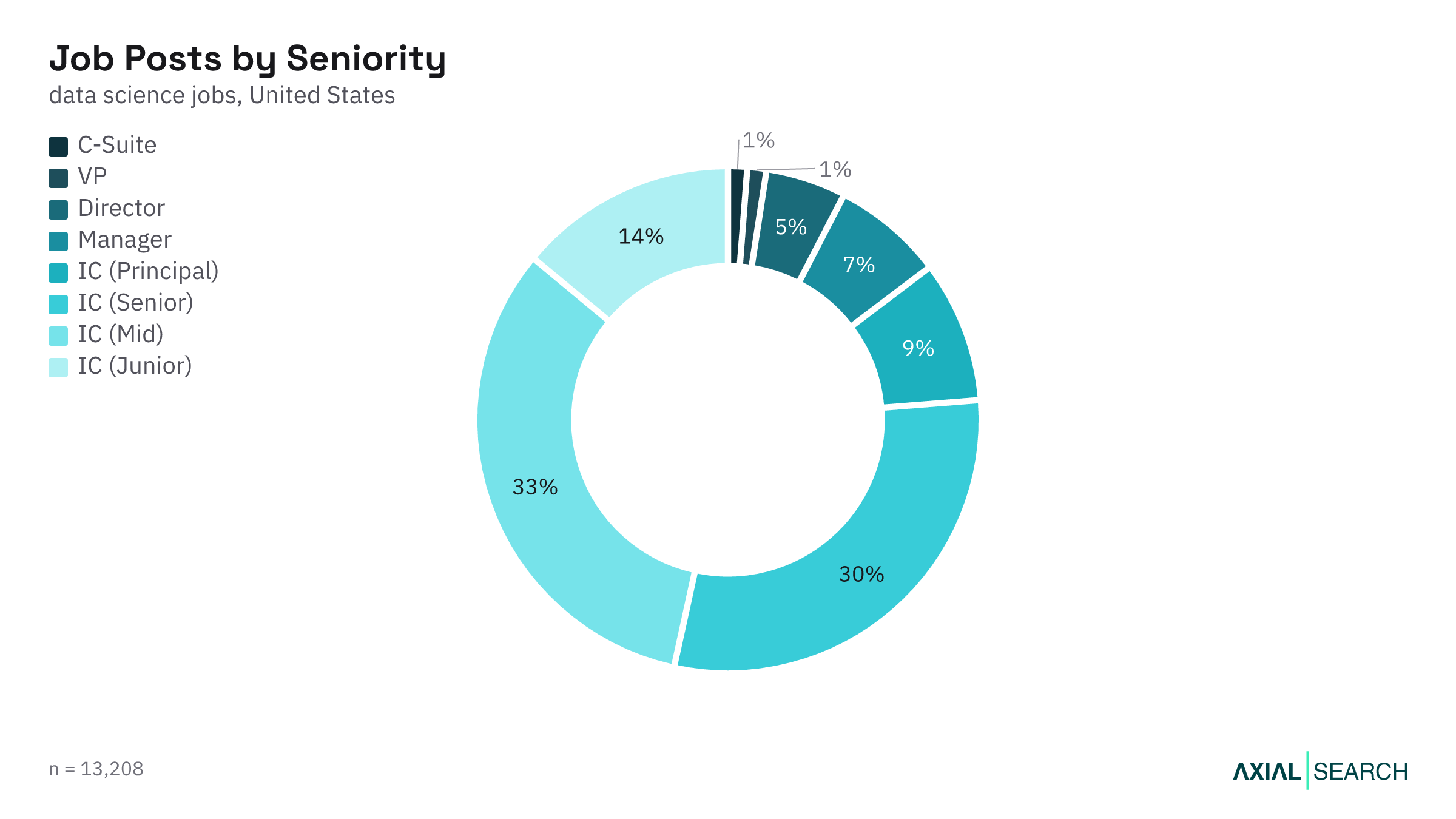
That distribution tells you two things. For candidates, there's a clear progression path from junior to senior IC, but the jump to management is narrow. For employers, most of the hiring is for people who do the work rather than lead the team, which makes sense given how specialized and hands-on the discipline still is.
Full-time versus contract data science roles
This is a permanent-hire market — 93% of data science postings are full-time roles, with contract work making up only 6%.
Free to republish with credit and a link back to this article (terms). Cite as: Axial Search, "Who's Hiring Data Scientists in 2026," April 2026.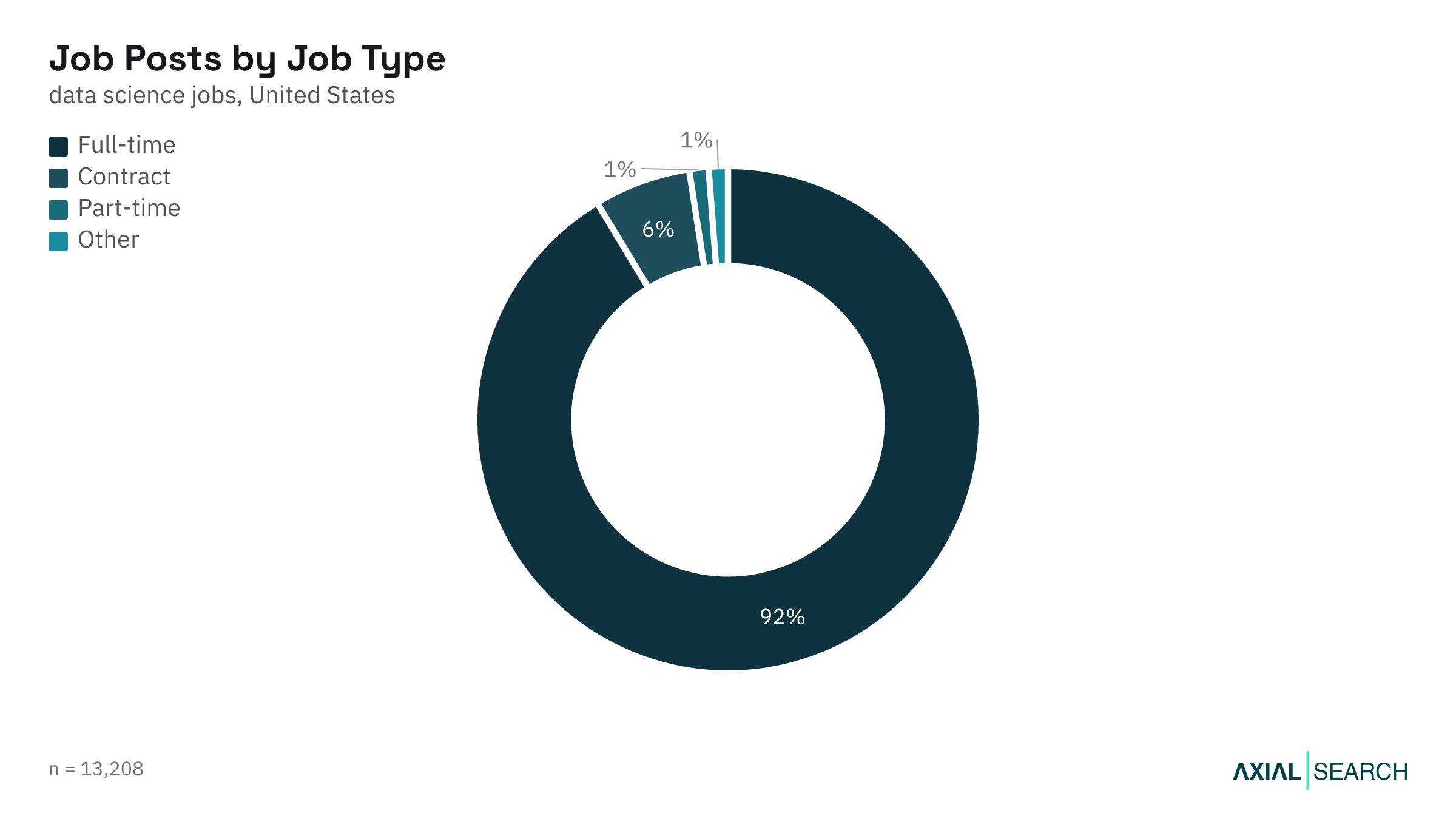
Companies are building data science as a standing capability, not staffing it project by project. That permanence reflects both the depth of work and the fact that most organizations need ongoing analytical capacity rather than one-off model builds.
Remote, hybrid and onsite data science roles
Most data science postings don't state a work model at all, but among the 23% that do, just over half are hybrid and roughly a quarter each are fully remote or strictly in-person.
Free to republish with credit and a link back to this article (terms). Cite as: Axial Search, "Who's Hiring Data Scientists in 2026," April 2026.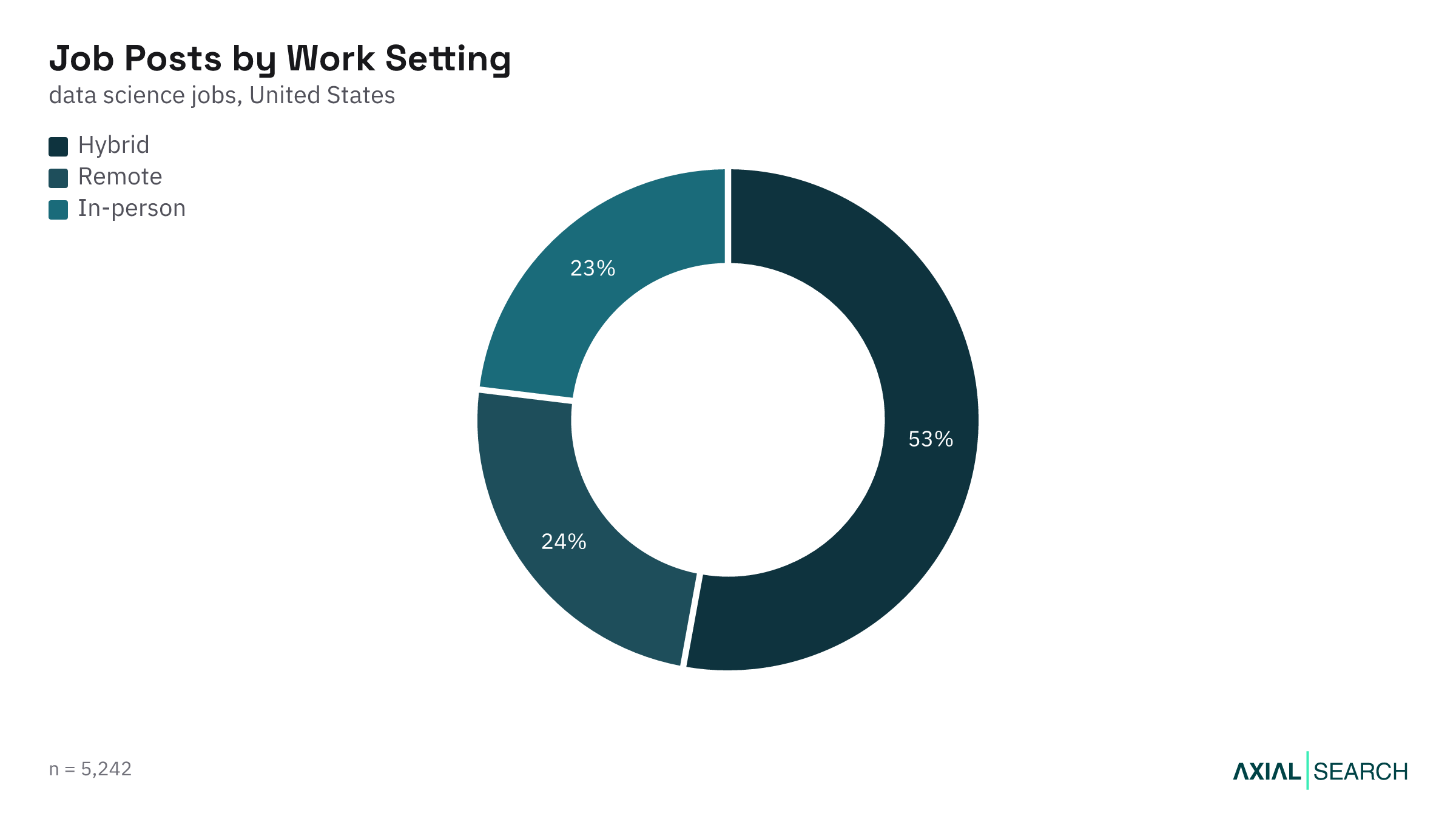
So while the work clusters geographically in a few major cities, a meaningful share can be done from anywhere. For candidates outside the top metros, the remote slice is real; for employers, the hybrid default suggests most teams still expect some physical proximity.
Where is data science talent concentrated?
Data science talent concentrates in California (18% of postings) and New York (14%) — the top five states hold more than half the market.
Free to republish with credit and a link back to this article (terms). Cite as: Axial Search, "Who's Hiring Data Scientists in 2026," April 2026.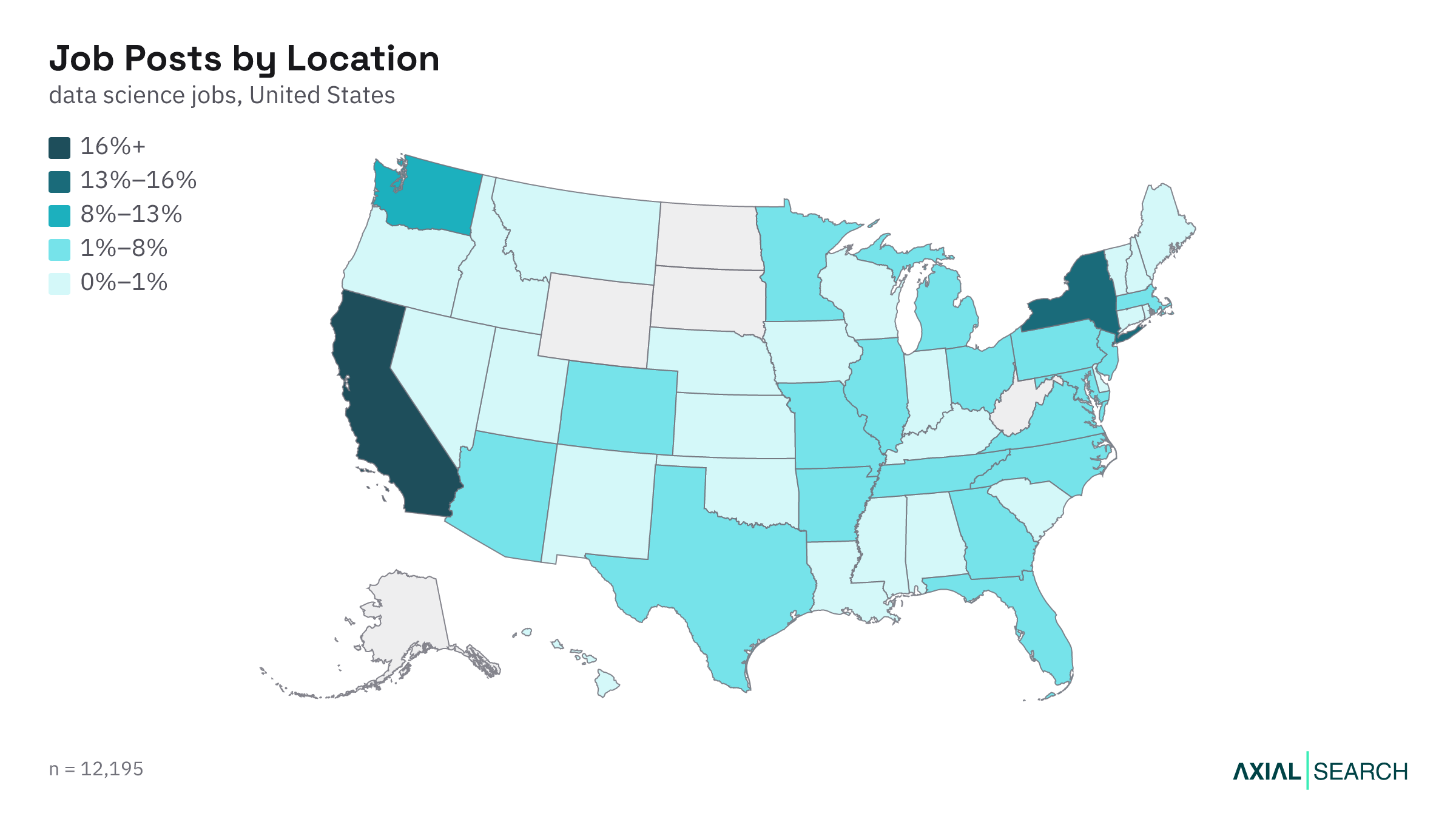
| State | Share of postings |
|---|---|
| California | 18% |
| New York | 13% |
| Washington | 10% |
| Texas | 7% |
| Virginia | 6% |
| Massachusetts | 4% |
| Illinois | 4% |
| Maryland | 3% |
The Washington concentration is driven largely by Seattle, which rivals San Francisco as a hiring hub, and the Virginia share reflects the Northern Virginia tech corridor around McLean and the surrounding DC area.
The top cities for data science jobs
At the city level the concentration is even sharper, though the list is more nationally distributed than the coastal headline suggests — Seattle (7.0%) and San Francisco (6.8%) are nearly tied as the top two hiring cities.
| City | Share of postings |
|---|---|
| Seattle, WA | 7.9% |
| San Francisco, CA | 6.0% |
| Chicago, IL | 3.2% |
| Boston, MA | 3.0% |
| Atlanta, GA | 2.5% |
| Bellevue, WA | 2.3% |
| Sunnyvale, CA | 2.2% |
| McLean, VA | 2.1% |
Chicago, Boston and Atlanta all rank in the top five, so while California dominates at the state level, the city-level view reveals a more national distribution of opportunities. For where these roles pay the most, see data science salaries.
How do you assess data science candidates?
Assess data science candidates on what they've shipped, not on trivia — Python, SQL and cloud platforms are the skills the market actually screens for, so start there.
Ask them to walk through one model they built end to end, including how they validated it and what happened after it shipped. That single question filters more effectively than a stack of algorithm puzzles, because data science is a craft-first discipline, not a whiteboard-trivia one.
Technical questions to screen data science candidates on
Ask the candidate to walk through a real model they built: what data they used, how they validated it and how they knew it was working. Follow with specifics on their stack, since Python, SQL (57%) and cloud platforms (35%) are what the market actually screens for.
Push past the happy path. Ask what broke after deployment, how they found out, and what they changed. A candidate who can only describe the build, not the operating of it, isn't ready for a production-heavy role.
Analysis and modeling questions for senior data science candidates
For Senior and Principal IC candidates, ask them to design a modeling approach end to end for an ambiguous business question: what data they'd need, how they'd validate the model, and how they'd know it's still working months later. The Principal IC band pays close to Director money, so hold that bar to a genuinely technical-judgment level, not just a coding one.
Ask how they'd detect a model that's silently drifted — still returning answers but no longer accurate. That question separates candidates who've operated models in production from candidates who've only trained them.
Red flags to watch for when interviewing data science candidates
Watch for candidates who can describe a modeling technique fluently but go vague the moment you ask how they validated it or what happened after deployment. That gap is common and it's the exact gap this market pays a premium to avoid.
Also watch for a portfolio that's all notebooks and no shipped models — the leadership profile data across the data science job market puts hands-on execution at the top of what employers screen for, and a candidate who's only run experiments in isolation hasn't demonstrated it yet.
Final Thoughts
For employers. You're competing for a thin pool of data scientists who can move from raw data to a validated model to a business decision. Data science hiring runs at 828 new postings a week with no sign of cooling, so speed matters, and the seniority mix — nearly two-thirds mid and senior IC — means most candidates have options. Interview around real modeling decisions, not years of experience, and be ready to move quickly on candidates who demonstrate hands-on execution and data readiness judgment. The Principal IC track competes with Director-level pay, so if you're hiring senior technical talent expect them to negotiate as hard as your management candidates do.
Methodology & sources
- Data sources. Job data is collected from publicly available postings on online job boards and updated weekly, covering US roles posted since January 2026. Explore and filter it on our live AI job market dashboard.
- Hiring demand is the count of matching postings per week.
- Company size, seniority, job type and work setting are each group's share of postings. Work-setting shares are computed over the postings that state a work model — the rest are silent, not counted as a category.
- Top states and cities are ranked by share of postings; remote-only postings are excluded from the cities list.
- Salary figures cited in this article are drawn from the subset of postings that state a salary range; percentiles and medians are calculated within each seniority band and reported in full in data science salaries. Bonus and equity figures reflect the share of postings that mention those forms of compensation.
- Interview questions and assessment guidance are built from what postings in this dataset ask for, plus Axial Search's own placement experience — they are guidance, not a guarantee of what any single employer should require.

How Much Do Data Scientists Make? 2026 Benchmarks
What data science roles pay in 2026: median salary, pay by seniority, top-paying sectors and locations, and how often bonus and equity are mentioned in US job postings.

What It Takes to Land a Data Science Role in 2026
How to become a data science professional in 2026: the leadership capabilities employers screen for, the experience and degrees required, the certifications that matter, and the skills most in demand across US postings.

How Hot Is the Data Science Job Market in 2026?
The complete picture of the data science job market in 2026: hiring demand, what these roles pay, where the jobs are, who's hiring and what it takes to get in.
Turn AI ambition into lasting business value
Whether you're hiring your first AI leader or scaling enterprise transformation capability, we help you define, assess and recruit the people who make it stick.