
The Skills That Land AI Architecture Roles in 2026
How to become an AI architecture professional in 2026: the leadership capabilities employers screen for, the experience and degrees required, the certifications that matter, and the skills most in demand across US postings.
 Updated: September 18, 2026
- Architectural fluency leads: AI architecture postings prize system design judgment and use-case selection over pure execution—this is a design role with a build component, not the reverse.
- Seven years and a degree: AI architecture roles expect around 7 years of experience and 69% require a degree, with Computer Science dominating at 59% of field mentions.
- Certifications barely register: Only CSM and AWS Solutions Architect appear above 2%; there is no dominant AI architecture certification to chase.
- Foundation models and RAG are now table stakes: AI architecture postings mention foundation models in 38% of roles and RAG in 28%, reflecting the shift toward retrieval-augmented and agentic systems.
- Cloud breadth beats depth: Azure and AWS each appear in more than 40% of AI architecture postings, with Databricks and Snowflake reflecting the data-infrastructure layer underneath.
What leadership profile do employers screen for in AI architecture roles?
4 of the 5 most-screened capabilities for AI architecture roles are technical — architectural fluency and use case selection top the list, ahead of hands-on execution.
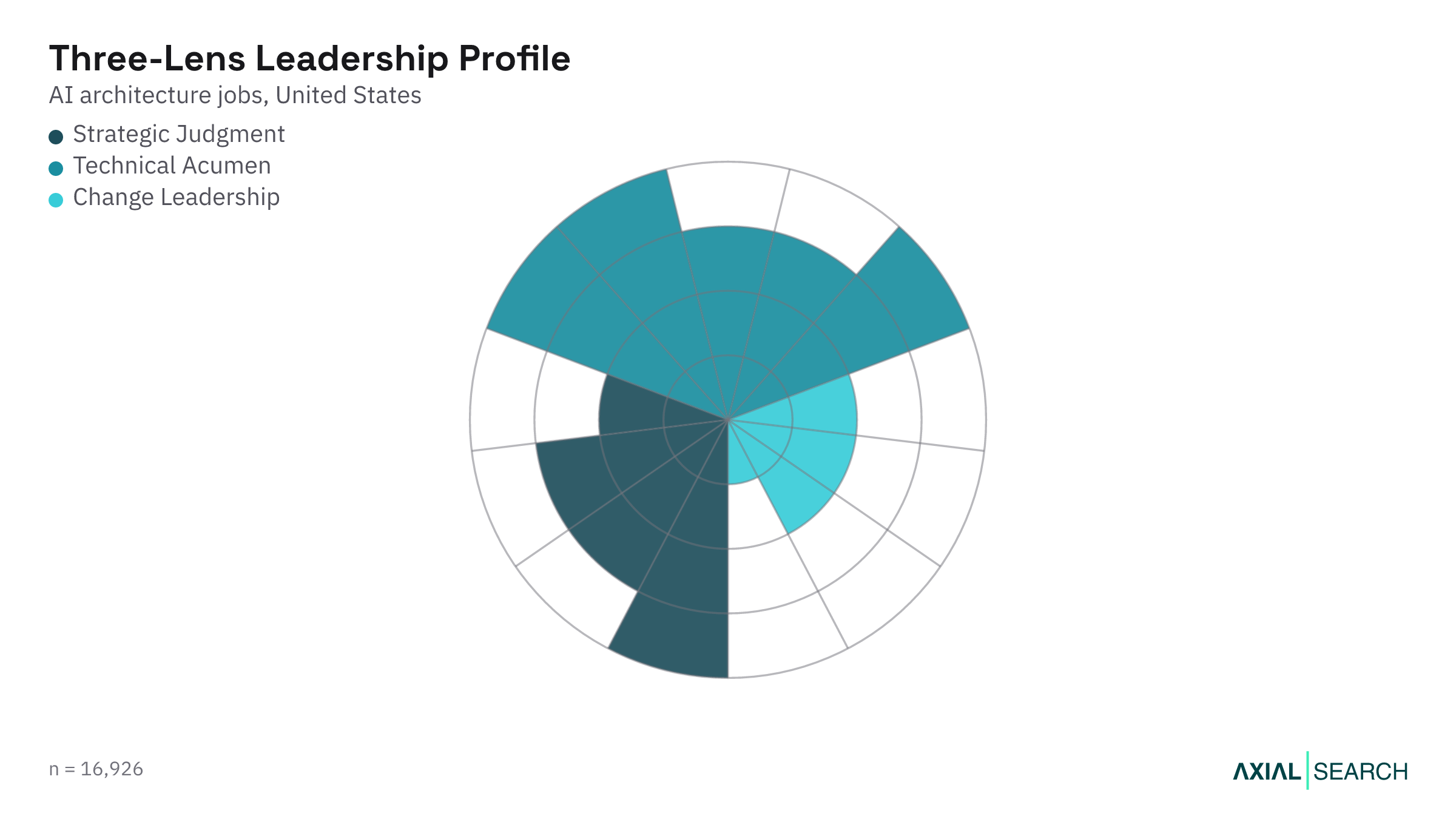
Our Three-Lens Leader framework scores every role across strategic judgment, technical acumen and change leadership. Architectural fluency leads: knowing how models, data and systems connect into a deployment that actually scales. It is backed by hands-on execution, because architects here are expected to build and not just diagram, and by data readiness judgment, the ability to tell whether the data can support the system you are proposing.
When you position yourself, foreground systems you designed and shipped and the scaling calls behind them, not stakeholder decks. This is exactly the profile AI recruitment is built to identify.
Which capabilities matter least for AI architecture roles
Securing sponsorship and engaging the organization barely register in AI architecture hiring, well behind architectural fluency and use case selection.
Employers want people who can design and build, not people who can sell what might be built — this is a technical judgment role with a delivery muscle, not a political one.
What qualifications do AI architects need?
The baseline is solid technical experience plus a computer science or engineering degree.
The bar is high but straightforward: the complexity is in the architectural judgment above and the breadth of platform fluency below, not the credential list.
How much experience AI architecture roles expect
Most AI architecture roles ask for around seven years of experience, rising to a decade at the Principal IC level.
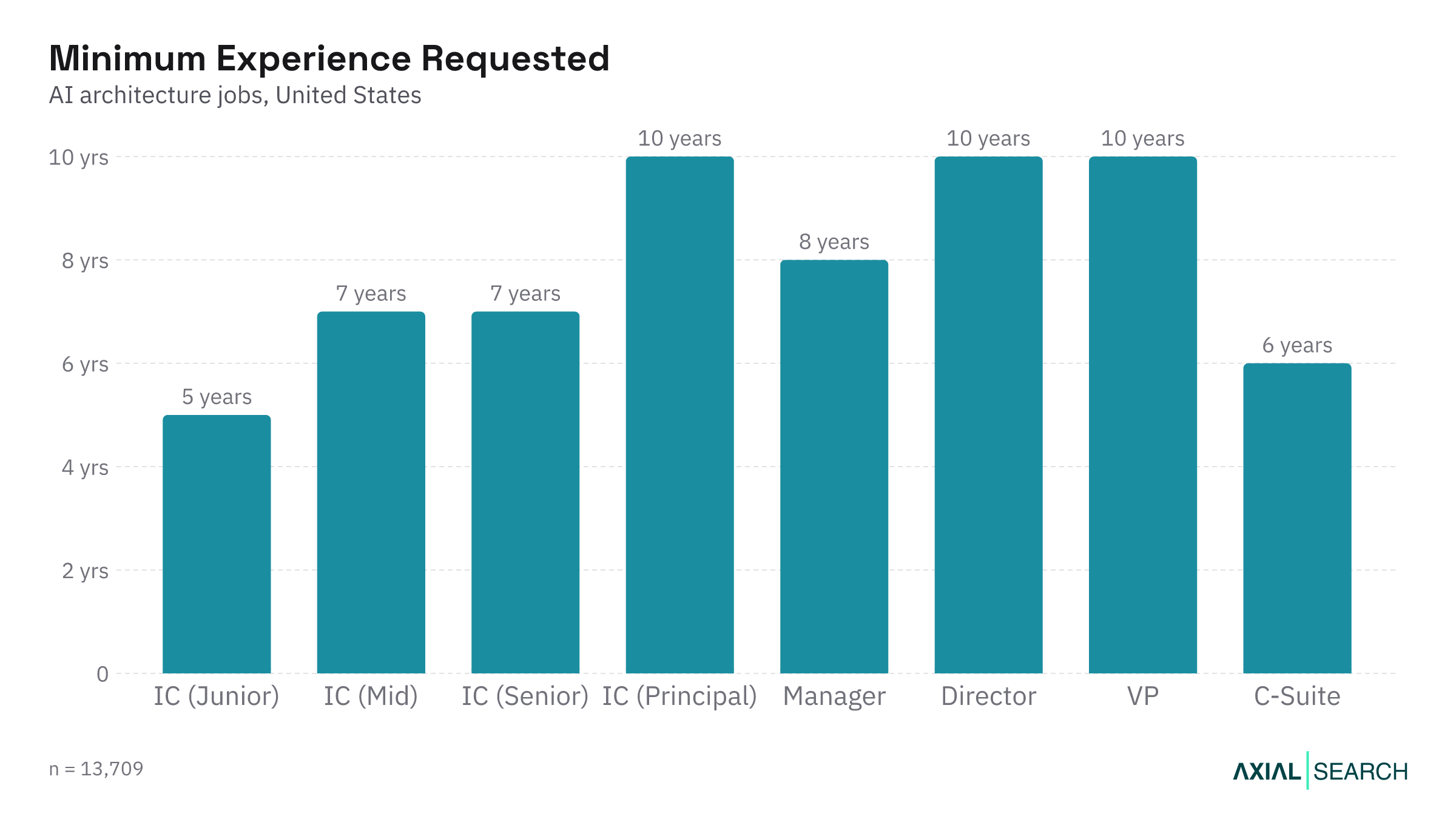
The market skews technical: 43.9% of postings target mid-level ICs and another 28.1% senior ICs, so the realistic entry point is mid-career, having built and scaled systems in a production environment first. Most AI architecture roles expect a track record of architecture decisions that survived contact with real workloads, not just time in the seat.
Degrees and fields AI architecture employers want
Just under a majority of AI architecture postings require a degree, and Computer Science dominates the fields employers name.
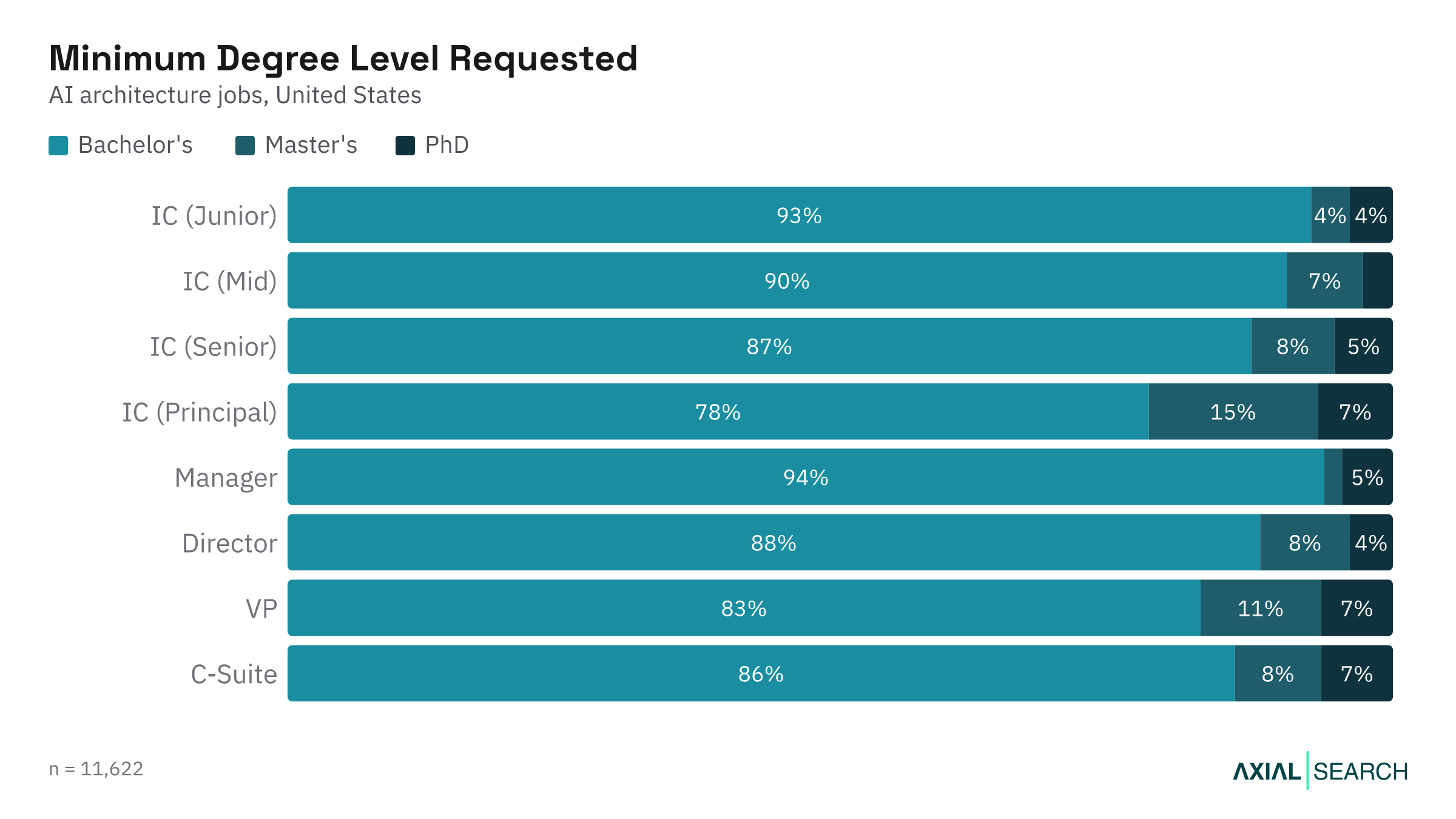
Engineering follows at 32.4%, and together the two account for the majority of the demand. While a bachelor's clears the bar for most roles, advanced degrees become more common at Principal and VP levels.
| Degree field | Share of postings |
|---|---|
| Computer Science | 56.2% |
| Engineering | 28.2% |
| Data Science | 12.2% |
| Information Systems | 11.6% |
| Electrical Engineering | 7.7% |
| Business | 6.6% |
| Information Technology | 6.4% |
| Mathematics | 6.2% |
Data Science and Information Systems add breadth around data and infrastructure literacy, but the core is technical. Business degrees make a brief appearance at 9.4%, the exception in one of the most technically rooted AI functions in the market.
Which certifications matter for AI architects?
Certifications barely move the needle in AI architecture — the highest-mentioned credential, CSM, appears in just 2.9% of postings.
| Certification | Share of postings |
|---|---|
| Certified ScrumMaster (CSM) | 2.1% |
| AWS Certified Solutions Architect | 2.1% |
| Certified Information Systems Security Professional (CISSP) | 1.5% |
| Microsoft Certified: Azure Solutions Architect Expert | 1.2% |
| Certified Cloud Security Professional (CCSP) | 0.9% |
| Microsoft Certified: Azure AI Engineer Associate | 0.8% |
| Certified Data Management Professional (CDMP) | 0.7% |
| Microsoft Certified: Azure Security Engineer Associate | 0.5% |
The signal here is what's absent: there is no dominant AI architecture certification, so don't delay applying to go collect one.
Which cloud and security certifications appear most in AI architecture postings
AWS Solutions Architect, CISSP, CCSP and the Azure certifications round out the list below CSM, each mentioned in under 2% of AI architecture postings.
The cloud and security credentials that do appear reflect that a lot of AI architecture work is, in practice, deploying AI systems into heavily regulated or cloud-native environments. If you already hold one, mention it; if you don't, spend the time sharpening the story of the systems you've built instead.
Which skills matter for AI architecture roles?
Breadth across the stack beats depth in any one layer, and the data backs it: cloud platforms appear frequently in AI architecture postings, Python in 43.9%.
Employers want someone who can design across cloud platforms, foundation models, data infrastructure and observability, not a specialist who only knows one corner of it.
The capabilities AI architecture roles need
| Capability | Share of postings |
|---|---|
| Cloud Platforms | 63.2% |
| Python | 43.5% |
| Foundation Models | 41.5% |
| Observability & Monitoring | 38.3% |
| Retrieval-Augmented Generation (RAG) | 28.2% |
| CI/CD (Continuous Integration / Continuous Delivery) | 28.1% |
Cloud platforms and Python are table stakes, and generalist cloud and data-engineering fluency is expected across the board. The newer AI techniques are catching up fast: foundation models (37.8%) and RAG (28.1%) now appear in more than a third and more than a quarter of postings respectively — a year ago they didn't — so being able to select the right foundation model and design a retrieval-augmented system is quickly becoming table stakes.
For candidates this means you need to talk credibly about both the infrastructure layer and the AI layer that sits on top of it.
For hiring managers it means the person who can only whiteboard a diagram but can't explain how it survives production isn't ready yet.
Software and tools AI architecture roles use
Azure leads AI architecture postings, with AWS close behind.
| Software / tool | Share of postings |
|---|---|
| Microsoft Azure | 42.1% |
| Amazon Web Services (AWS) | 41.5% |
| Google Cloud Platform (GCP) | 25.4% |
| Databricks | 15.8% |
| Snowflake | 12.6% |
| Docker | 12.5% |
GCP rounds out the top three cloud platforms at 25.4%. Knowing how Azure, AWS and GCP price, secure and scale AI workloads matters more than any single modeling library. Databricks (15.5%) and Snowflake (11.7%) are a sign that employers increasingly expect architecture candidates to have hands-on familiarity with the data-infrastructure platforms their AI systems will run on top of, and Docker (13.7%) rounds out the list as the containerization standard.
Remember that these are the tools postings mention — a platform not listed isn't disqualifying. Treat the list as the vocabulary to be fluent in, not a checklist to complete.
How do you become an AI architect?
Becoming an AI architect takes roughly seven years of hands-on building experience and a track record of design decisions that held up in production — a technical degree helps but doesn't replace that experience.
Pull the threads together and a clear playbook emerges.
What to lead with when applying for AI architecture roles
The single strongest thing you can show is a track record of designing AI systems that scaled and making the trade-off calls that kept them working in production — that's what the leadership profile rewards, and it's what separates an architect from a builder.
Frame it around the systems you designed, the trade-offs you navigated and the scaling decisions behind them, not stakeholder decks.
What credentials back up an AI architecture application
Evidence the roughly seven years and the computer science or engineering degree, and don't be shy about production-scale infrastructure experience — a lot of AI architecture is cloud-native data engineering with foundation models bolted on top.
If you're earlier in your career, demonstrate that you can already work across the full stack: cloud platforms, data infrastructure, foundation models and observability.
How to demonstrate AI fluency for an AI architecture role
Be able to talk fluently about foundation models, RAG, cloud platforms, observability and data infrastructure, without pretending to be a specialist in all of them.
Breadth, credibly held, is the goal. The shift toward agentic AI and retrieval-augmented systems is already baked into the market: lag behind and you'll read as out of date.
Do you need certifications to become an AI architect?
No — there's no credential that unlocks this market, so invest that time in sharpening the story of the systems you've designed and the trade-offs you made.
If you already hold a cloud or security cert, mention it; if you don't, the marginal value of going to get one is low compared to shipping another well-documented system.
What does an AI architecture career path look like?
An AI architecture career path runs from Junior IC (around 5 years of experience) through Mid IC (7 years) to a fork at Principal IC (10 years) or Manager (8 years) — and unlike most functions, staying on the technical Principal track pays close to Director money.
That means you don't have to choose between staying hands-on and maximizing your pay. The ladder has two rungs at the top, not one, and the compensation data backs going up either of them: Principal ICs and Directors land in the same neighborhood, so the choice comes down to whether you want to keep designing or start managing, not which one pays better.
Final Thoughts
For candidates. AI architecture is the design-and-build role, and employers screen for people who can make architecture decisions that survive production. Lead with systems you designed and shipped, demonstrate fluency across cloud platforms, foundation models and RAG, and don't wait to collect certifications that barely register in hiring decisions. The person who can talk about the trade-offs behind a scaled system is worth more than the one with a long list of courses completed. If you prefer implementing and optimizing models over designing their underlying structure, AI engineering careers focuses more on deployment than architecture.
For employers. The best AI architecture hires bring breadth across the stack — cloud platforms, foundation models, data infrastructure and observability — and a track record of making architectural calls that scaled under real workloads. Screen for use case selection and data readiness judgment, not just hands-on execution; this is a design role with a build component, not the reverse. Our AI architecture hiring guide maps just how tight that competition is, and candidates who lag behind on RAG and agentic systems will read as out of date.
Methodology & sources
- Data sources. Job data is collected from publicly available postings on online job boards and updated weekly, covering US roles posted since January 2026. Explore and filter it on our live AI job market dashboard.
- Requirements are extracted from job postings using a combination of programmatic rules and AI analysis. Minimum experience is the median minimum years requested by seniority; minimum degree is the lowest degree a posting requires.
- Top degree fields, certifications and skills are the items mentioned most often across postings.
- The leadership profile reflects the relative emphasis across leadership capabilities inferred from job-description language using our framework; skills are drawn from AI analysis plus programmatic scanning of posting text.
- These are mention rates — the share of postings that state each item. A skill, degree or certification not appearing means it wasn't stated in the posting, not that it isn't valued.

AI Architecture Jobs in 2026: What 16,900 Postings Reveal
The complete picture of the AI architecture job market in 2026: hiring demand, what these roles pay, where the jobs are, who's hiring and what it takes to get in.

How to Hire for AI Architecture in 2026
Where AI architecture jobs are in 2026: hiring demand and trend, top states and cities, who's hiring by sector and company size, and the mix of seniority, contract type and remote work across US postings.

AI Architecture Salaries: 16,900 Postings, Benchmarked
What AI architecture roles pay in 2026: median salary, pay by seniority, top-paying sectors and locations, and how often bonus and equity are mentioned in US job postings.
Turn AI ambition into lasting business value
Whether you're hiring your first AI leader or scaling enterprise transformation capability, we help you define, assess and recruit the people who make it stick.