
AI Governance Pay in 2026: Salaries, Bonuses and Equity
What AI governance roles pay in 2026: median salary, pay by seniority, top-paying sectors and locations, and how often bonus and equity are mentioned in US job postings.
 Updated: September 10, 2026
- Overall market: The median AI governance salary is $169,000, with Manager roles making up 28% of postings and Senior ICs another 24% — the two most common levels.
- Pay by seniority: The Principal IC track pays close to Director money, so staying technical in AI governance doesn't cap your ceiling. VP and C-suite pay actually trail Director and Manager, a smaller and more variable sample at the very top.
- Sector spread: Manufacturing, Life Sciences and Healthcare lead AI governance compensation — about $23,000+ above Professional Services, reflecting where regulatory scrutiny is tightest.
- Geography: California posts 13% of all AI governance roles and pays at the top; Mountain View and San Francisco lead metro pay by a wide margin.
- Bonus vs. equity: Bonus appears in 49% of AI governance postings, equity in just 11% — and equity clusters at C-suite (35%) and Principal-IC (23%), not mid-level.
- Company size: Enterprise-scale firms (10,001+ employees) post 56% of AI governance roles, and their equity mention rate runs only modestly ahead of the mid-market.
How much do AI governance leaders make?
The median AI governance salary is $169,000, and the ladder underneath that headline runs from Junior IC to C-suite with a wide spread at every rung.
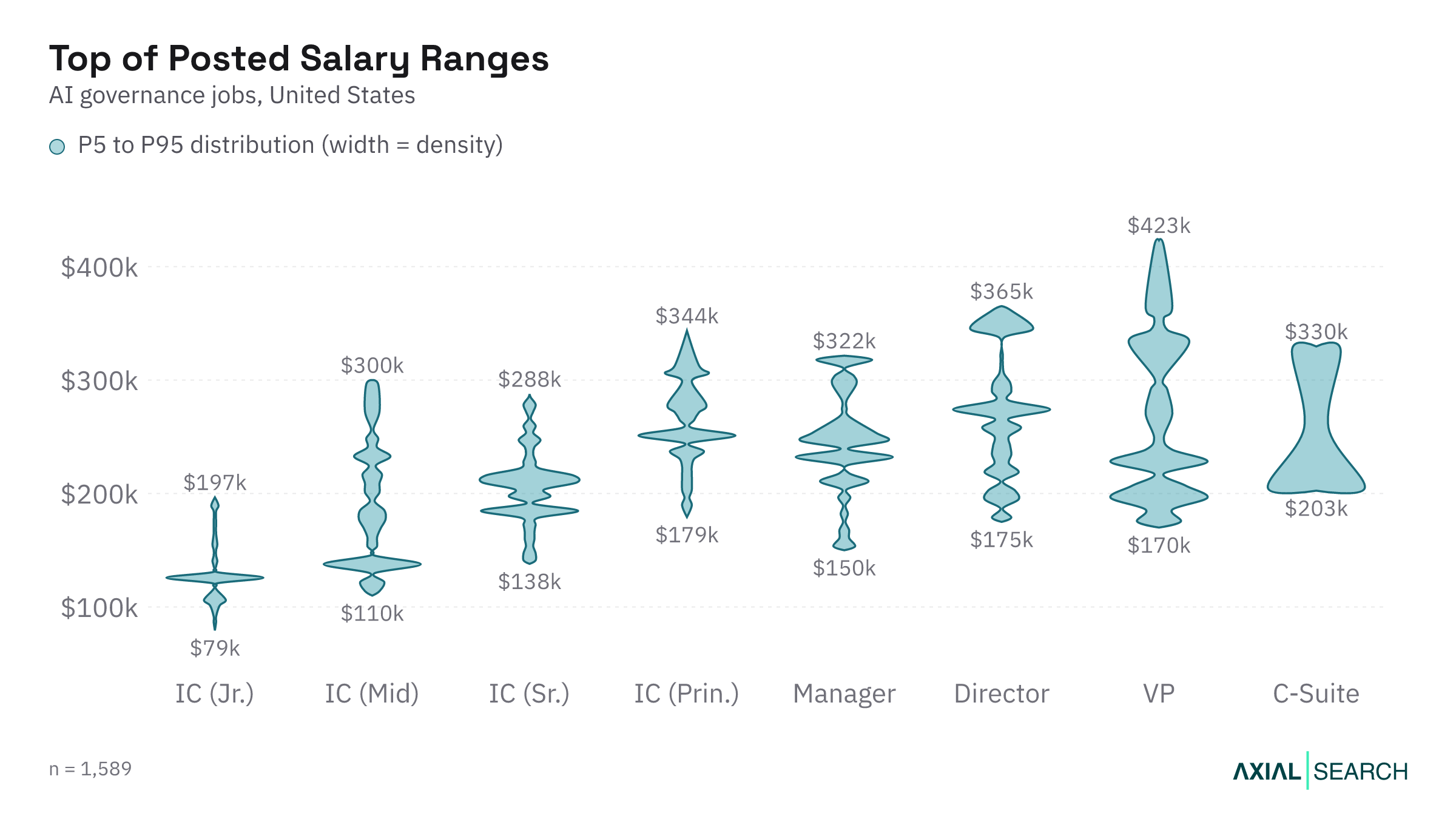
Top of the posted range by seniority — the median and typical maximum of what's posted, 5th to 95th percentile. This is the ceiling candidates can credibly negotiate toward, not the typical offer.
| Seniority | 5th percentile | 25th percentile | Median | 75th percentile | 95th percentile |
|---|---|---|---|---|---|
| IC (Junior) | $73,000 | $115,000 | $125,000 | $128,000 | $200,000 |
| IC (Mid) | $115,000 | $135,000 | $166,000 | $220,000 | $298,000 |
| IC (Senior) | $135,000 | $184,000 | $208,000 | $219,000 | $288,000 |
| IC (Principal) | $175,000 | $230,000 | $249,000 | $304,000 | $433,000 |
| Manager | $150,000 | $212,000 | $244,000 | $270,000 | $322,000 |
| Director | $161,000 | $220,000 | $268,000 | $289,000 | $370,000 |
| VP | $170,000 | $195,000 | $227,000 | $288,000 | $422,000 |
| C-Suite | $202,000 | $202,000 | $250,000 | $294,000 | $330,000 |
Where two percentiles show the same figure, employers are clustering on a round number at that end of the band. The top of the posted band is where the strongest candidates land, so it's the more useful number in a senior negotiation. Across all levels the pattern holds: Principal ICs reach nearly the same ceiling as Directors, and the VP spread is the widest in the dataset. Directors show the tightest clustering, VPs the widest.
Where AI governance pay clusters by seniority
What's unusual here is the Principal IC track: it pays close to Director money, so staying technical doesn't cap your earnings the way it does in most functions.
Pay climbs steadily up the IC ladder, and Directors top the management path. Above Director, though, the climb doesn't continue in a straight line — VP and C-suite medians actually sit below both Director and Manager, a smaller and more idiosyncratic sample at the very top rather than a real ceiling on the executive track.
What moving into management means for AI governance pay
The detailed breakdown lives in the table above; the takeaway for candidates is that the decision to move into people management is about the work you want to do, not a forced trade-off on pay.
For hirers, it means you're competing for a narrow band of senior ICs who can command management-level compensation without taking on direct reports — exactly the profile AI executive search is built to find.
What is the full salary range for AI governance leaders?
The full posted AI governance salary range runs from the 5th percentile for IC (Junior) up to $330,000 at the 95th percentile for C-Suite — see the table above for the full ladder.
How much room is there to negotiate at the top of the AI governance range?
That ceiling has moved up over the past year, which is consistent with the rising AI governance hiring we see in the market overview.
The spread between the median and the 95th percentile is also wider at Director and VP level than at IC levels, which tells you the negotiation range is real if you're a candidate with the right profile.
Which industries pay AI governance leaders the most?
AI governance pays the most where regulatory scrutiny is tightest: Manufacturing tops the sector table at $272,000, followed by Life Sciences and Healthcare.
| Sector | Median salary | Postings |
|---|---|---|
| Life Sciences | $272,000 | 56 |
| Healthcare | $249,000 | 108 |
| Technology | $242,000 | 304 |
| Manufacturing | $237,000 | 54 |
| Professional Services | $219,000 | 897 |
Manufacturing, Life Sciences and Healthcare lead the table — the sectors where a misstep in AI deployment can mean patient harm, product recalls or million-dollar fines. Technology and Professional Services trail by roughly $23,000, despite posting far more volume.
How much does sector really matter for AI governance pay?
Professional Services makes up a significant share of all postings but pays near the bottom of the sector table, which tells you governance work in consulting and advisory firms is more about building frameworks for clients than owning risk in a regulated environment.
For hirers in lower-paying sectors, the gap is modest enough to close with a strong equity package or a clear path to leadership. For candidates, the sector spread suggests you can optimize for mission or industry without leaving much on the table the way you might in product or engineering roles.
Does company size affect AI governance pay?
Bigger usually pays more, and in AI governance the pattern is clean: enterprise-scale firms with 5,000+ employees post the highest pay and are the most likely to mention equity.
| Company size | Median salary | Equity mention rate |
|---|---|---|
| Enterprise (5,000+) | $227,000 | 23% |
| Mid-market (500-5,000) | $180,000 | 20% |
| Startup-Small (<500) | $177,000 | 17% |
Mid-market firms with 500–5,000 employees post a median salary around $177,000, while startup and small firms with fewer than 500 employees land near $175,000.
How much does company size affect AI governance equity offers?
Among postings that disclose pay, equity mention rates at the smallest firms trail enterprise-scale firms by less than the pay gap would suggest. That's consistent with early-stage companies using equity to compete on total comp when they can't match the base.
For candidates, it means the smallest firms and the largest firms are the most likely to put equity on the table; mid-market firms are the least likely. For hirers at mid-sized companies, you're competing on base salary and mission, not total comp packages.
Where do AI governance leaders earn the most?
Pay is geographically compressed for AI governance — the top states cluster within about $21,000 of each other — but California is the standout, pairing the highest volume with a $250,000 median salary.
| State | Median salary | Share of postings |
|---|---|---|
| California | $250,000 | 14.1% |
| Washington | $229,000 | 4.1% |
| District of Columbia | $225,000 | 2.8% |
| New Jersey | $220,000 | 4.2% |
| North Carolina | $219,000 | 4.8% |
New York places second on volume with 13% of postings but doesn't appear in the top-five pay table, suggesting its governance market skews toward mid-level roles or lower-paying sectors like professional services. Texas posts 11% of all roles but doesn't crack the top-five pay list either, which tells you volume alone doesn't predict premium compensation.
Why Washington, DC pays so well for AI governance
The DC appearance is worth noting — it reflects the concentration of federal contractors, regulatory firms and compliance-heavy financial institutions.
For candidates, that means government-adjacent work doesn't mean a pay cut anymore; it means working in a market that pays near the top and values governance expertise as a strategic function, not a back-office cost.
The top-paying cities for AI governance
Zoom into the metro level and the picture sharpens. Mountain View, San Francisco and Seattle top the list — the Bay Area core and the Seattle tech corridor, where the highest-value AI mandates concentrate.
Mountain View leads despite posting fewer roles than San Francisco, a reflection of the enterprise AI and cloud-infrastructure firms headquartered there. San Francisco posts 5.4% of all roles at a $250,000 median salary. Charlotte and Atlanta both land around $230,000, reflecting the finance and healthcare concentration in the Southeast, while Chicago — the second city by volume — pays closer to the national median.
How often are AI governance bonus and equity offered?
Here the story is scarcity, not size: bonus is mentioned in some AI governance postings, equity in far fewer, and a mention rate is a floor, not a ceiling — many roles that don't advertise either still offer one.
How often a bonus is offered
A bonus is mentioned in AI governance postings — common enough that it's the norm, not the exception.
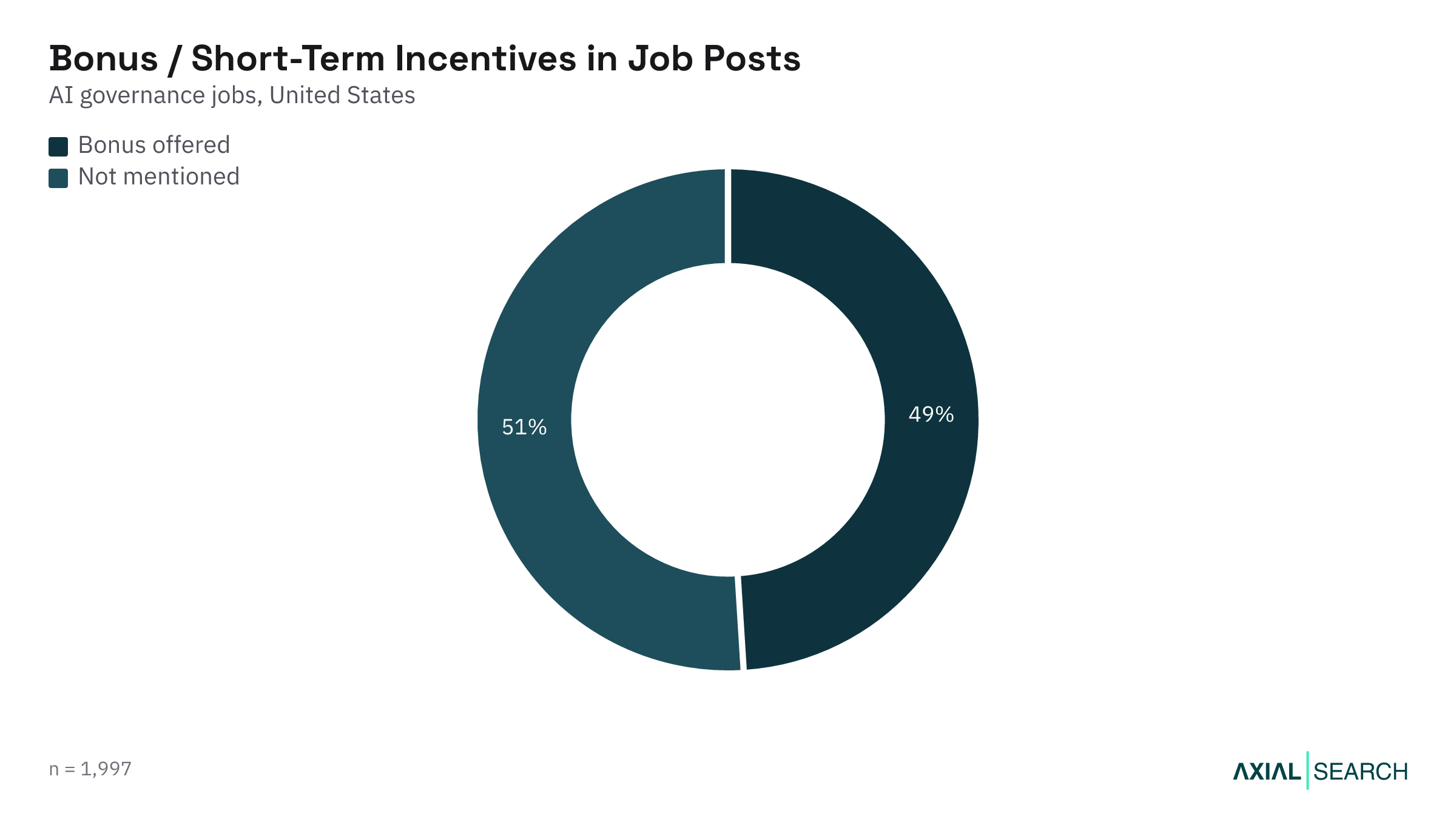
That's a higher mention rate than AI strategy salaries, which likely reflects the compliance and risk-mitigation work these roles do. Bonus structures in governance roles are often tied to audit outcomes, regulatory milestones or successful implementation of controls frameworks, so they're more likely to be codified in the posting than a discretionary performance bonus.
Manager-level roles show the highest bonus mention rate, followed by Principal ICs at 51%. Directors come in at 50% and VPs at 43%. The C-suite figure is lower, which suggests bonus structures at that level are either negotiated individually rather than stated in postings, or that equity and other long-term incentives replace the bonus as the variable comp lever.
How often equity is offered
Equity is mentioned in just 11% of AI governance postings — and the pattern across seniority is striking.
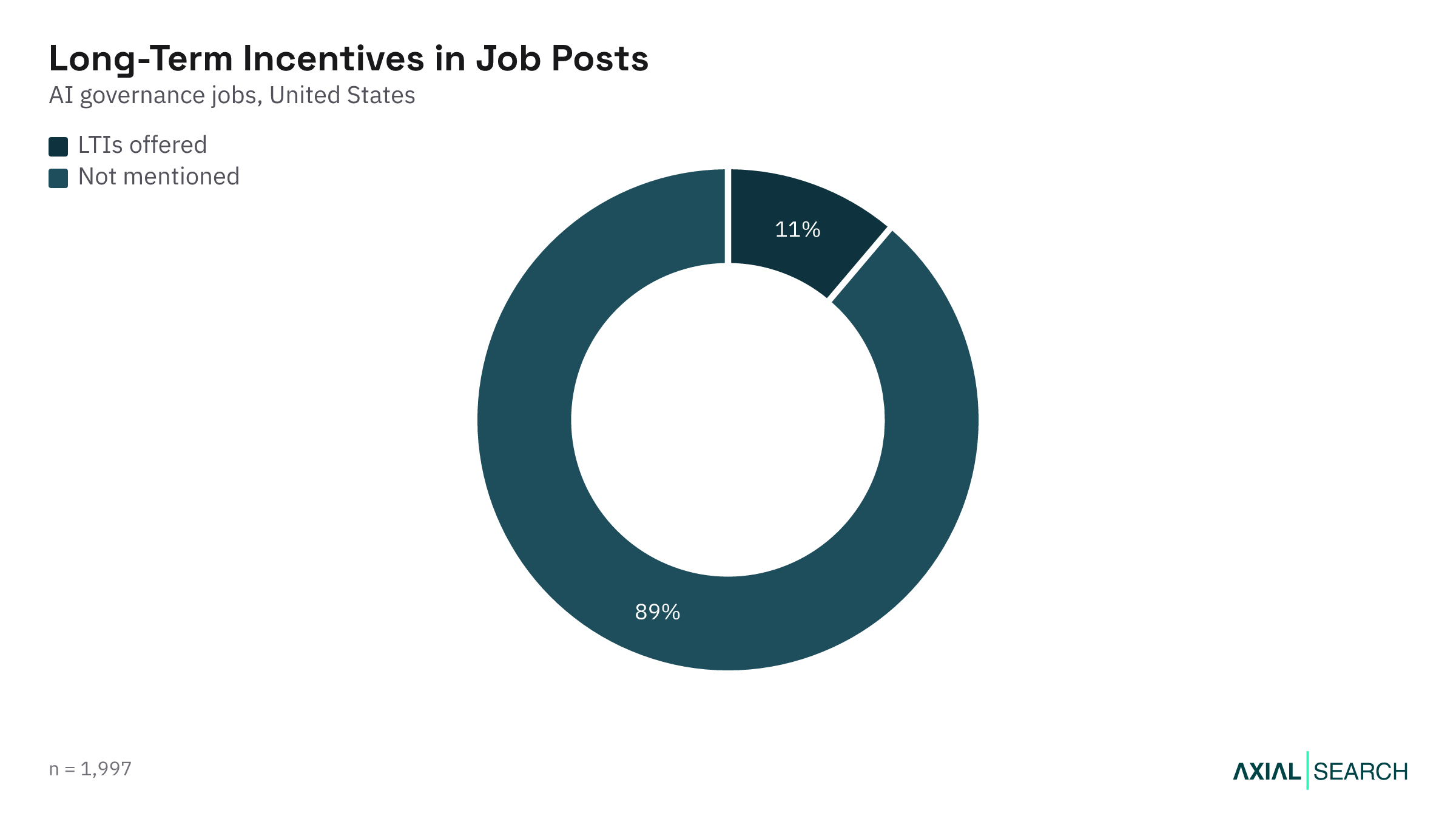
It peaks at Principal-IC level at 23%, and is lowest at Manager level. That's counter to intuition — you'd expect equity to climb steadily with seniority — but it's consistent with equity being used as a retention lever at the highest and most specialized levels, not as a broad-based comp tool.
| Level | Bonus mentioned | Equity mentioned |
|---|---|---|
| IC (Junior) | 48% | 5% |
| IC (Mid) | 30% | 11% |
| IC (Senior) | 57% | 11% |
| IC (Principal) | 51% | 31% |
| Manager | 59% | 12% |
| Director | 50% | 18% |
| VP | 54% | 20% |
| C-Suite | 19% | 38% |
What the bonus-versus-equity split says about AI governance retention
Principal ICs are scarce and hard to replace, so equity locks them in; C-suite leaders are being hired to own the governance function, so equity aligns them with long-term organizational outcomes.
Mid-level managers and ICs, by contrast, are more fungible and more likely to be compensated through base and bonus alone. For hirers, that means equity is a competitive tool at the top and at the Principal-IC level, but not table stakes at every level. For candidates at Principal-IC or higher, equity absence on an offer is a red flag your competitors probably aren't matching.
Final Thoughts
For candidates. AI governance is a judgment role, and the market pays for depth at the top: the Principal IC track out-earns management up to the Director level, and Directors who own the hardest mandates can push past the posted median. What moves your comp is seniority, sector and company size in that order — Manufacturing and Life Sciences pay $53,000+ more than Professional Services, and enterprise-scale firms are twice as likely to mention equity. Lead with frameworks you've built, regulations you've navigated and audit outcomes you've delivered, and negotiate around the top of the posted band. If you lean more toward shaping AI adoption roadmaps than compliance frameworks, AI strategy salaries reflect that different focus.
For employers. This is a thin, specialized pool: 1,997 postings across the US, and the capabilities that matter most — governance discipline, use-case selection and value framing per our framework — are the hardest to assess in a 45-minute interview. The market is bifurcated: you can hire at Manager or Director level where supply is stronger, or you can compete for the small group of VPs and Principal ICs who command VP-level pay without managing people. Bonus is common enough to be table stakes at Manager and Director level, equity matters most at Principal-IC, VP and C-suite.
Methodology & sources
- Data sources. Job data is collected from publicly available postings on online job boards and updated weekly, covering US roles posted since January 2026. Explore and filter it on our live AI job market dashboard.
- All salary figures are derived from the minimum and maximum salary bands employers post, annualized and reported as percentiles, not averages.
- Every salary figure on this page is the top of the posted range — the ceiling employers advertise, not the typical offer. The seniority table reports it at the 5th, 25th, 50th (median), 75th and 95th percentiles. Median salary in the sector, company-size and location tables is the median of that ceiling within each group.
- Bonus and equity figures are mention rates — the share of postings that state a bonus or equity. A posting silent on either is counted as "not mentioned"; it does not mean none is offered.

How to Hire AI Governance Leaders in 2026
Where AI governance jobs are in 2026: hiring demand and trend, top states and cities, who's hiring by sector and company size, and the mix of seniority, contract type and remote work across US postings.

Breaking Into AI Governance: Skills, Degrees and Certifications
How to become an AI governance professional in 2026: the leadership capabilities employers screen for, the experience and degrees required, the certifications that matter, and the skills most in demand across US…

The State of the AI Governance Job Market in 2026
The complete picture of the AI governance job market in 2026: hiring demand, what these roles pay, where the jobs are, who's hiring and what it takes to get in.
Turn AI ambition into lasting business value
Whether you're hiring your first AI leader or scaling enterprise transformation capability, we help you define, assess and recruit the people who make it stick.