
Breaking Into AI Governance: Skills, Degrees and Certifications
How to become a ai governance professional in 2026: the leadership capabilities employers screen for, the experience and degrees required, the certifications that matter, and the skills most in demand across US postings.
Updated: July 13, 2026

AI governance is where policy, risk and technical fluency converge. This is what employers screen for when they hire: the leadership capabilities, qualifications, credentials and skills that appear in 1,997 US job postings analyzed this quarter. The bar is high — 83% of roles require a degree and the most-cited capability isn't technical execution but judgment about what to govern and how.
- Governance discipline leads the capability profile for AI governance — employers want people who can design enforceable policy and anticipate where a deployment is exposed before it ships.
- 83% of AI governance postings require a degree, the highest credential bar across AI functions, with Computer Science and Data Science dominating at 45% and 21% respectively.
- Privacy and security certifications carry real weight in AI governance — CISSP appears in 9% of postings, CISM in 7%, and the new AI Governance Professional (AIGP) credential now registers at 7%.
- Observability appears in 42% of AI governance postings — governance work is often about watching systems behave, not just writing policy, and the function blends oversight with technical grounding.
- Foundation models and cloud platforms appear in roughly one in five AI governance roles — the function increasingly requires fluency with the current AI stack, not just legacy risk frameworks.
- The median AI governance role asks for five years of experience, rising to ten at Director level, reflecting that governance work rarely sits at entry level and requires organizational credibility with both engineers and compliance teams.
The AI governance leadership profile employers screen for
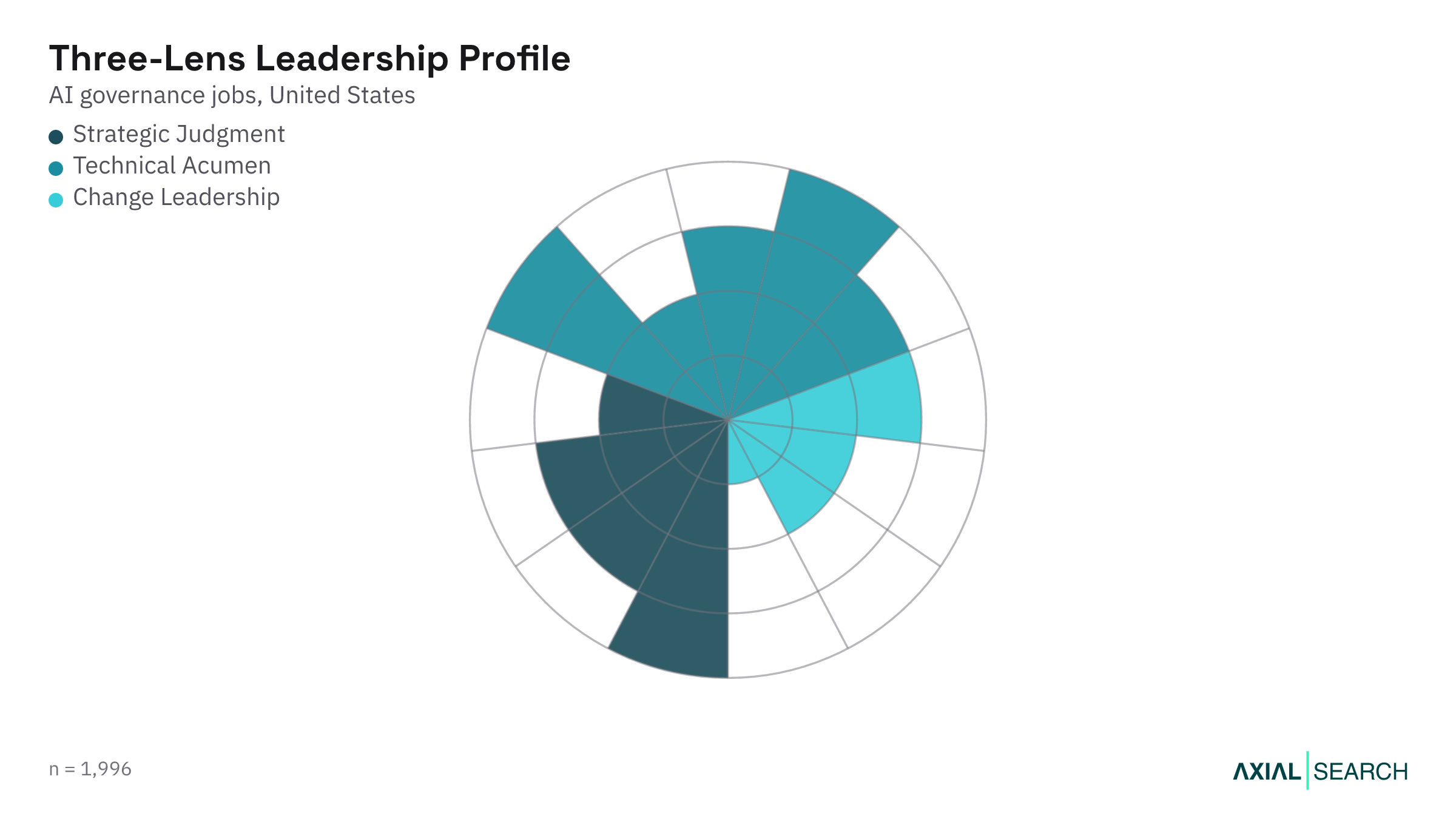
AI governance is where technical understanding meets risk judgment, and the demand data shows employers screening for both at once. Our Three-Lens Leader framework scores every role across strategic judgment, technical acumen and change leadership, and for AI governance one capability stands clear of the rest.
Governance Discipline tops the profile: anticipating where a deployment is exposed across model risk, security, data privacy, compliance and operational reliability before it ships rather than after. It is closely followed by AI Literacy, because you cannot govern what you do not understand, and the strongest governance leaders reason about model behaviour, not just policy.
The remaining three are strategic. Use Case Selection and Value Framing appear because governance increasingly means deciding which AI uses are worth the risk and articulating that tradeoff to the business, and Operating Model Design because someone has to redraw the decision rights and review gates that make responsible AI routine.
When you position yourself, pair a concrete risk you caught with the technical grasp that let you catch it. This is exactly the profile AI recruitment is built to identify.
What qualifications AI governance roles require
The baseline is experience plus a quantitative degree and the bar is higher than most AI functions.
How much experience AI governance roles expect
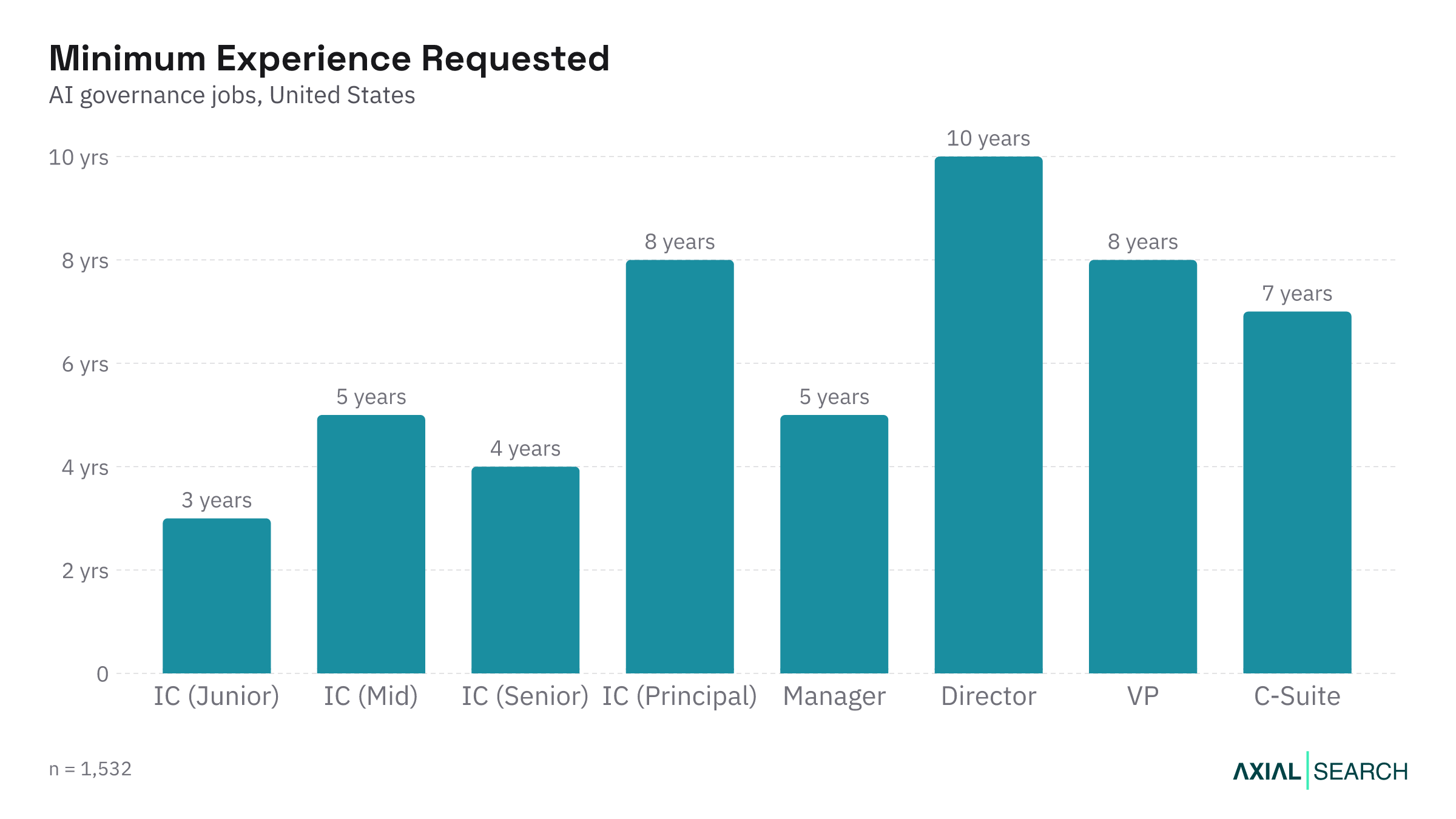
Most roles ask for around five years of experience, rising to a decade at Director level. The IC (Principal) band sits at eight years, reflecting that governance work often requires enough organizational seniority to have credibility with both engineers and compliance teams.
AI governance is rarely an entry-level function — you generally arrive having held a risk, security, compliance or technical role somewhere adjacent first.
Degrees and fields AI governance employers want
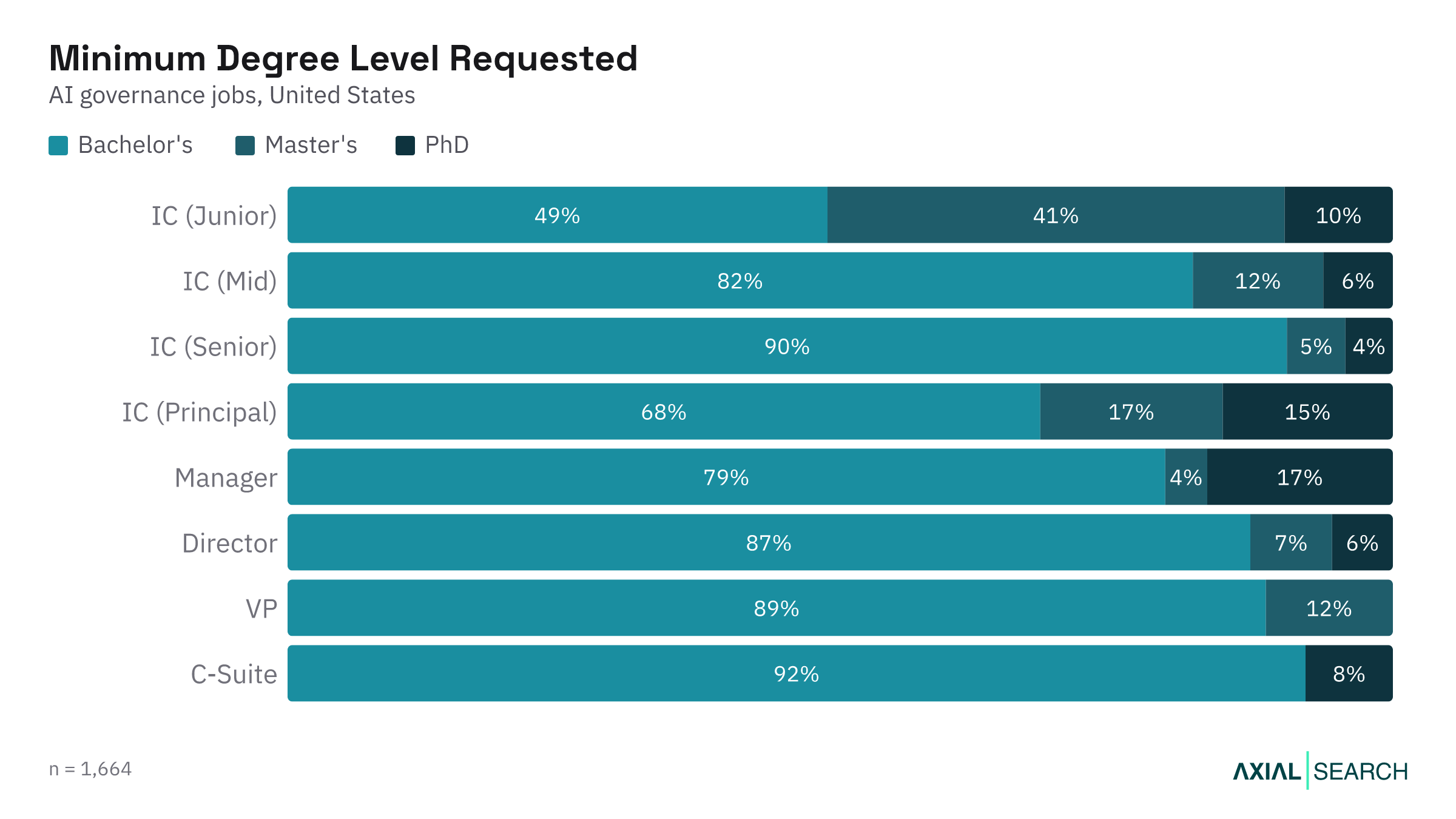
Just over 83% of postings require a degree, the highest rate across AI functions. A bachelor's clears the bar for most roles, but advanced degrees appear more often than in adjacent functions — nearly half of junior IC roles ask for a master's and the PhD share stays visible across the entire curve.
The field you studied matters and it skews hard technical:
| Degree field | Share of postings |
|---|---|
| Computer Science | 44.7% |
| Data Science | 20.6% |
| Engineering | 17.3% |
| Business | 13.5% |
| Mathematics | 12.1% |
| Statistics | 11.5% |
Computer Science alone accounts for nearly half of all degree-field mentions. The split is roughly five-to-one technical to business, a sign that AI governance is read first as a technical function that happens to interface with policy, not the other way around.
Certifications for AI governance roles
Unlike most AI functions, certifications carry real weight here. The privacy and security credential stack appears in more than one in five postings and the AI-specific governance certifications are starting to register:
| Certification | Share of postings |
|---|---|
| Certified Information Systems Security Professional (CISSP) | 8.6% |
| Certified Information Security Manager (CISM) | 6.6% |
| AI Governance Professional (AIGP) | 6.5% |
| Certified in Risk and Information Systems Control (CRISC) | 6.3% |
| Certified Information Privacy Professional (CIPP) | 6.1% |
| Certified Information Systems Auditor (CISA) | 5.4% |
| Certified Information Privacy Manager (CIPM) | 5.0% |
| Certified Data Management Professional (CDMP) | 2.4% |
CISSP and CISM are the security baseline and AIGP (AI Governance Professional) now appears in 7% of postings — a credential that didn't exist in volume two years ago.
If you already hold one of these, lead with it; if you don't and you're early in a governance career, AIGP or CISSP are credible investments.
The skills that matter for AI governance roles
Governance requires a blend of technical grounding and policy fluency. The knowledge and tooling lists reflect that split: observability and monitoring at the top, followed by Python and the NIST Cybersecurity Framework.
The capabilities AI governance leaders need
| Capability | Share of postings |
|---|---|
| Observability & Monitoring | 41.5% |
| Python | 27.1% |
| NIST Cybersecurity Framework | 25.5% |
| Foundation Models | 22.1% |
| Cloud Platforms | 18.6% |
| SAFe | 16.4% |
Observability and monitoring appear in more than two out of five postings, a reminder that governance work is often about watching systems behave, not just writing policy. Python follows at 27%, which is lower than in engineering roles but still substantial — governance professionals are expected to read code, even if they don't write it daily.
Foundation models and cloud platforms now sit at around one in five, a sign that governance roles increasingly require fluency with the current AI stack, not just legacy risk frameworks.
Software and tools AI governance roles use
| Software / tool | Share of postings |
|---|---|
| Microsoft Azure | 11.0% |
| AWS | 8.7% |
| OneTrust | 7.7% |
| Databricks | 5.3% |
| PyTorch | 4.6% |
| LangChain | 4.2% |
The cloud platforms lead, followed by OneTrust — the dominant governance and privacy management platform. PyTorch and LangChain both appear, evidence that employers expect governance professionals to understand the modeling tools their organizations use.
Be fluent in at least one cloud platform's security and compliance controls and conversant in how the major AI frameworks expose risk.
How to position yourself for an AI governance role
The playbook is clearer than in most AI functions because the requirements are more defined.
Lead with governance judgment and AI literacy. The single strongest thing you can show is a track record of designing enforceable policy for technical systems and the fluency to understand what those systems do — that's what the leadership profile rewards.
Back it with the conventional credentials. Evidence the roughly five years of experience and the quantitative degree and don't skip the certifications — the privacy and security stack carries real weight here and AIGP is now credible enough to list.
Demonstrate current AI fluency without pretending to be an engineer. Be able to talk credibly about foundation models, cloud platform security and observability tooling, and about how the NIST framework applies to AI workloads. Breadth, credibly held, is the goal.
Expect the bar to be high. AI governance roles ask for more education, more certifications and more policy-plus-technical fluency than most other AI functions. That's not a bug, it's the job — the function sits at the intersection of risk, engineering and regulation and all three demand precision.
Final Thoughts
For candidates. Lead with a concrete risk you spotted and the technical understanding that let you spot it — governance judgment plus AI literacy is the profile employers screen for most. Back it with the privacy or security credential stack and evidence fluency with the current AI stack without claiming to be an engineer. The bar is higher here than in most AI functions because the function sits at the intersection of risk, engineering and regulation, and all three demand precision. If you're drawn to shaping how organizations adopt AI rather than controlling its risks, AI strategy skills become the natural next step.
For employers. If you're building an AI governance team, the talent you need brings governance discipline and AI literacy in equal measure — people who can design enforceable policy and understand the systems it governs. The privacy and security credential stack matters here more than in most AI functions, and the current AI stack (foundation models, cloud platforms, observability tooling) is now table stakes. The strongest hires pair a track record of designing policy that engineers respect with the technical grounding to understand what those engineers build.
Methodology & sources
- Data sources. Job data is collected from publicly available postings on online job boards and updated weekly, covering US roles posted since January 2026. Explore and filter it on our live AI job market dashboard.
- Requirements are extracted from job descriptions using a combination of programmatic rules and AI analysis. Minimum experience is the median minimum years requested by seniority; minimum degree is the lowest degree a posting requires.
- Top degree fields, certifications and skills are the items mentioned most often across postings.
- These are mention rates — the share of postings that state each item. A skill, degree or certification not appearing means it wasn't stated in the posting, not that it isn't valued.

Where AI Governance Jobs Are in 2026
Where ai governance jobs are in 2026: hiring demand and trend, top states and cities, who's hiring by sector and company size, and the mix of seniority, contract type and remote work across US postings.

What AI Governance Roles Pay in 2026
What ai governance roles pay in 2026: median salary, pay by seniority, top-paying sectors and locations, and how often bonus and equity are mentioned in US job postings.

The State of AI Governance Jobs in 2026
The complete picture of the ai governance job market in 2026: hiring demand, what these roles pay, where the jobs are, who's hiring and what it takes to get in.
Turn AI ambition into lasting business value
Whether you're hiring your first AI leader or scaling enterprise transformation capability, we help you define, assess and recruit the people who make it stick.