
What It Takes to Land an AI Operations Role in 2026
How to become an AI operations professional in 2026: the leadership capabilities employers screen for, the experience and degrees required, the certifications that matter, and the skills most in demand across US postings.
 Updated: August 14, 2026
- AI operations is a hands-on execution role — employers prize use-case selection and hands-on execution over sponsorship or narrative, making it the most delivery-focused of the AI operations leadership tracks.
- Just over half of AI operations postings require a degree (51%), far below other AI functions, and Computer Science accounts for 38% of degree fields requested.
- The median experience bar is five years — genuinely mid-career, rising to eight years at Director level and ten at VP, making AI operations accessible without a decade of specialized background.
- Certifications remain marginal in AI operations — CSM and PMP each appear in under 2% of postings, so chasing credentials delays entry without improving signal.
- Foundation models (43%), observability (32%) and Python (30%) lead skill demand in AI operations — fluency in keeping models alive matters as much as building them.
- Platform demand in AI operations skews toward CRM and workflow tooling — Salesforce (24%), Clay (18%) and HubSpot (15%) outweigh generic cloud infrastructure, reflecting where operational AI work happens.
What leadership profile do employers screen for in AI operations roles?
Use-case selection and hands-on execution top what employers screen for across the 1,575 AI operations postings analyzed here, a blend of judgment and delivery that few AI leadership tracks combine in equal measure.
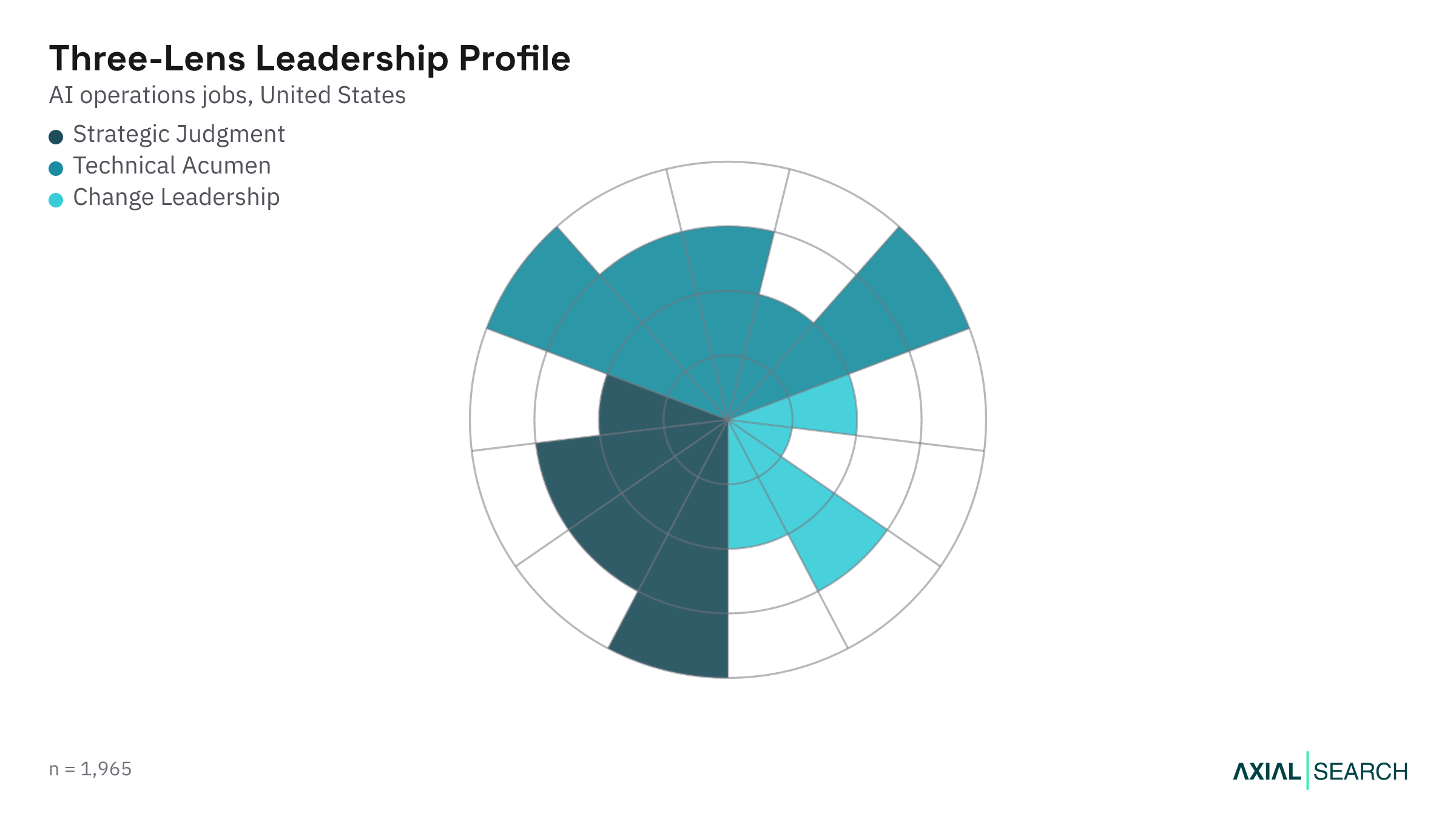
Our Three-Lens Leader framework scores every role across strategic judgment, technical acumen and change leadership, and for AI operations the top five span both sides of the model. Use case selection leads, closely followed by hands-on execution — the two held almost level — because employers want someone who can decide which operational problems AI should solve and then stand up the solution. AI literacy and data readiness judgment back them, since operations lives or dies on whether the data and tooling can support the workflow. Operating model design rounds out the profile, and it is the tell for this role: much of the job is redrawing processes and decision rights so AI actually runs in production.
When you position yourself, pair an operational problem you chose with the system you built to fix it. This is exactly the profile AI recruitment is built to identify.
Which capabilities matter least for AI operations roles
Securing sponsorship and shaping the narrative rank near the bottom of what AI operations postings screen for, the same strategic-framing skills that top the list for AI strategy roles.
Employers want people who can build and run, not people who can sell what might be built — a sharp contrast with more strategy-facing AI functions.
What qualifications do AI operations leaders need?
The baseline here is lower and more pragmatic than other AI functions — just over half of AI operations postings require a degree (51%), and the median asks for five years of experience.
Employers want evidence you can ship and run production systems; formal credentials take a back seat.
How much experience AI operations roles expect
Most AI operations roles ask for around five years of experience, rising to eight at Director level and a decade at VP and above.
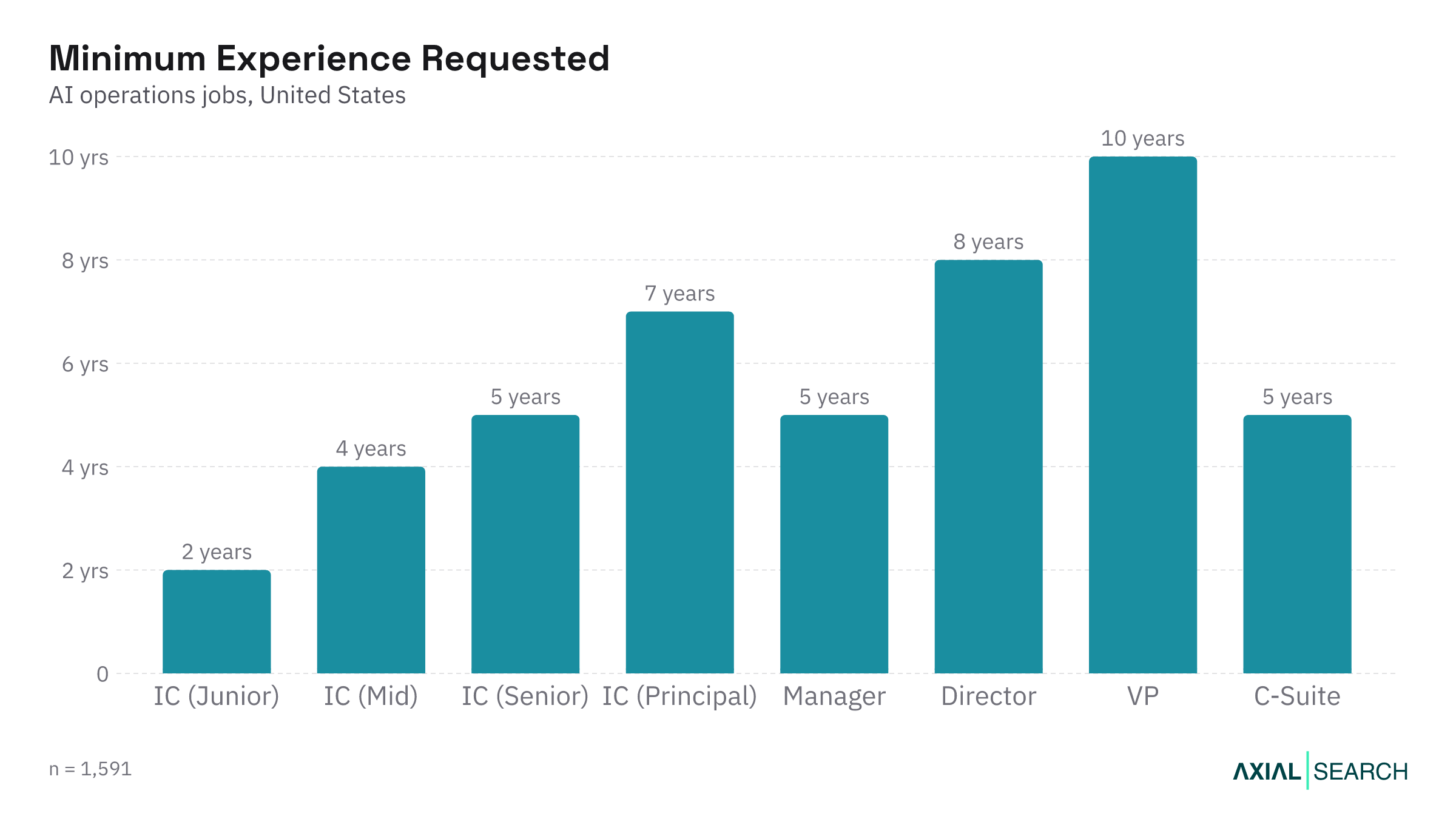
The distribution is flatter than in strategy or product — 32% of postings sit in the IC (Mid) band and 29.7% in IC (Senior), meaning the entry point is genuinely mid-career, not a decade in. If you've run infrastructure, deployed models or kept complex systems alive in another domain, you have a credible path into AI operations without needing to have done it under that exact title first.
Degrees and fields AI operations employers want
Just over half of AI operations postings require a degree, the lowest bar of any AI leadership function — and where one is requested, a bachelor's clears it for nearly every level.
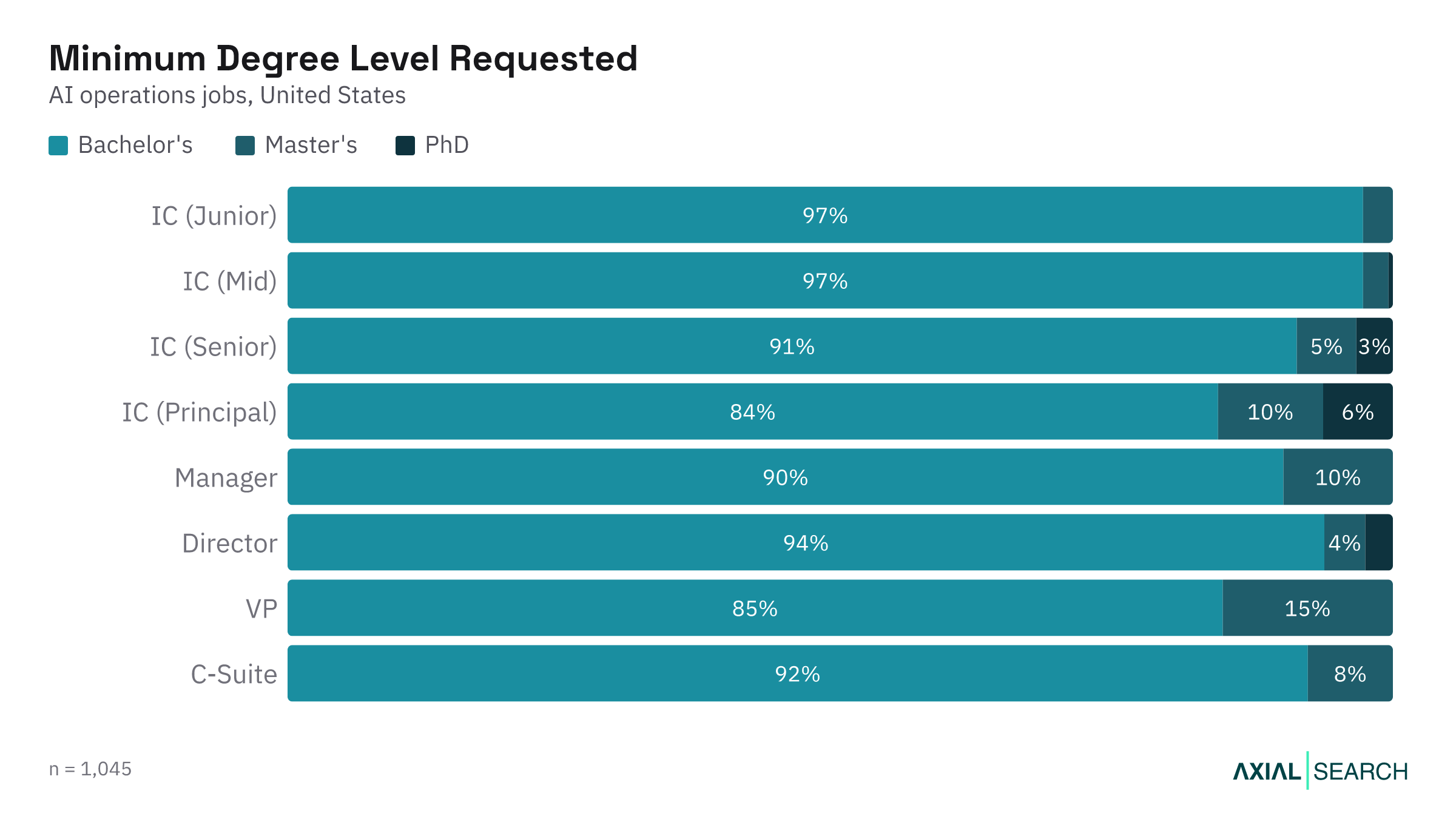
Among Senior ICs who need one, 90% ask for a bachelor's, with master's (6%) and PhD (4%) staying in single digits. The field you studied matters more than the level; the table below shows what employers look for:
| Degree field | Share of postings |
|---|---|
| Computer Science | 35.2% |
| Engineering | 16.0% |
| Information Technology | 10.5% |
| Business | 9.2% |
| Data Science | 6.7% |
| Information Systems | 5.1% |
| Economics | 4.1% |
| Artificial Intelligence | 3.1% |
The fields skew heavily technical — Computer Science, Engineering and IT together account for two-thirds of degree-requiring postings. Business and Data Science make up the remainder, but the center of gravity is system-building and infrastructure, not analytics or commercial judgment. If your degree is in a quantitative or technical field, you're in the right ballpark; if it isn't, a portfolio of production work will carry more weight than going back for another credential.
Which certifications matter for AI operations leaders?
Certifications barely move the needle in AI operations — the highest-mentioned credential, Certified ScrumMaster (CSM), appears in just 1.7% of postings.
| Certification | Share of postings |
|---|---|
| Project Management Professional (PMP) | 1.5% |
| Certified ScrumMaster (CSM) | 1.5% |
| Security Essentials Certification (GSEC) | 0.7% |
| Systems Security Certified Practitioner (SSCP) | 0.6% |
| ITIL Certification | 0.4% |
| Certified Information Systems Security Professional (CISSP) | 0.4% |
| Salesforce Certified Service Cloud Consultant | 0.4% |
| Certified Kubernetes Administrator (CKA) | 0.3% |
The pattern is the absence of a pattern — there is no dominant credential employers look for in AI operations, so don't delay applying to chase one.
Which project-management certifications appear most in AI operations postings
Certified ScrumMaster (1.7%) and Project Management Professional (1.5%) are the two most-mentioned credentials in AI operations postings, ahead of a long tail of security and cloud certifications.
The scrum and project-management certifications that do show up reflect that some operations roles sit inside delivery teams, but they're nowhere near universal. If you hold one of these already, mention it; if you don't, your time is better spent demonstrating you can deploy and run systems under load.
Which skills matter for AI operations roles?
Operational fluency matters more than cutting-edge technique in AI operations — foundation models lead, with observability and monitoring close behind.
Employers want someone who can keep production AI systems running reliably, which means a blend of model understanding, monitoring discipline and workflow tooling.
The capabilities AI operations leaders need
Three themes run through the top AI operations capabilities: foundation-model fluency, monitoring discipline and the workhorse languages that keep systems queryable and scriptable.
| Capability | Share of postings |
|---|---|
| Foundation Models | 43.8% |
| Python | 31.1% |
| Observability & Monitoring | 30.0% |
| CRM Platforms | 29.9% |
| SQL | 21.5% |
| Agentic AI | 21.4% |
Foundation-model fluency is expected — not building them from scratch, but understanding how they behave in production and where they break. Observability and monitoring discipline appears in nearly a third of postings, a reminder that keeping systems alive is as much of the job as deploying them in the first place. Python and SQL are the workhorse languages; if you can't script infrastructure changes or query logs, you'll struggle. Agentic AI appears in one in five postings, a sign that the operational challenge is shifting from single-model serving to orchestrating multi-step agentic workflows.
Software and tools AI operations roles use
The platform mix in AI operations is a surprise — the top of the list is dominated by CRM and workflow automation tools, not generic cloud infrastructure, led by Salesforce at 23.6%.
| Software / tool | Share of postings |
|---|---|
| Salesforce | 23.6% |
| Claude (Anthropic) | 21.1% |
| Clay | 18.1% |
| HubSpot | 14.7% |
| Amazon Web Services (AWS) | 14.6% |
| n8n | 12.1% |
Salesforce, Clay, HubSpot and n8n together account for more mentions than AWS on its own, a sign that a large share of AI operations work is embedding intelligence into go-to-market and customer-facing workflows rather than building greenfield ML infrastructure. Anthropic's strong appearance reflects the practical reality that many operations teams are deploying Claude and other foundation models via API, not training their own. If you're fluent in one of the major CRM platforms and know how to instrument agentic workflows inside them, you're better positioned than someone who only knows Kubernetes.
Remember these are mention rates — a platform not listed isn't disqualifying. Treat the list as the vocabulary to be conversant in, not a checklist to complete.
How do you become an AI operations leader?
Becoming an AI operations leader takes roughly 5 years of systems experience and a track record of deploying AI that stayed up under real load — a technical degree helps (51% of postings ask for one) but doesn't replace production experience.
Pull the threads together and a playbook emerges.
What to lead with when applying for AI operations roles
The single strongest thing you can show is a track record of deploying AI systems that stayed up and delivered value under real load — that's what the leadership profile rewards, and it's what separates an operations practitioner from a researcher or a strategist.
Frame it around the operational problem you chose and the system you built to fix it.
What credentials back up an AI operations application
The credential bar is low, so don't wait for perfect qualifications — around five years of systems work, a technical undergraduate degree or equivalent experience, and fluency in Python and observability tooling puts you in the right ballpark.
Advanced degrees and certifications add little marginal signal here.
How to demonstrate AI fluency for an AI operations role
Be able to talk fluently about foundation models, agentic workflows and the monitoring discipline that keeps them running, and about the CRM and workflow platforms where much of this work now happens.
Breadth across the stack, credibly held, is the goal — not specialist depth in any one layer.
Do you need certifications to become an AI operations leader?
No — there's no credential that unlocks this market, so invest that time in building a portfolio of production work you can point to and talk through in detail.
If you already hold one of the certifications above, mention it; if you don't, the marginal value of going to get one is low compared to shipping and operating another system.
What does an AI operations career path look like?
An AI operations career path runs from Junior IC (2 years of experience) through Mid and Senior IC (4–5 years) to a fork at Principal IC (7 years) or Manager — and the Principal IC track lands almost exactly on Director pay, so staying hands-on doesn't cost you ceiling.
That means you don't have to choose between staying hands-on and maximizing your pay. The data backs going up either fork: Principal ICs and Directors land in almost the same compensation neighborhood, so the choice comes down to whether you want to keep operating systems or start managing people, not which one pays better.
Final Thoughts
For candidates. AI operations is the most accessible of the AI leadership tracks — just over half of postings require a degree, the experience bar sits at five years for most roles, and certifications add almost no signal. What matters is whether you can deploy systems that run reliably in production and keep them there. If you've done that work in another domain — infrastructure, DevOps, platform engineering — you have a credible path in without needing the exact title first. Lead with the operational problems you chose to solve and the systems you stood up to fix them, and be conversant in the CRM and workflow platforms where most of this work now happens. If you prefer building and optimizing model infrastructure over monitoring deployments, AI engineering careers focus more on architecture than operations.
For employers. The AI operations talent pool is broader than the posting patterns suggest. Most roles cluster in the IC (Mid) to IC (Senior) bands, but the capabilities employers prize — use-case selection, hands-on execution, operating model design — span strategic judgment and technical delivery in equal measure, and those skills transfer from adjacent domains. If you're filtering only for candidates who already hold "AI operations" titles, you're missing practitioners who've run production systems at scale in platform engineering, DevOps or enterprise software delivery. The degree and certification bars add little predictive signal here; what separates strong operators from weak ones is a track record of deploying systems under real load and keeping them alive.
Methodology & sources
- Data sources. Job data is collected from publicly available postings on online job boards and updated weekly, covering US roles posted since January 2026. Explore and filter it on our live AI job market dashboard.
- Requirements are extracted from job postings using a combination of programmatic rules and AI analysis. Minimum experience is the median minimum years requested by seniority; minimum degree is the lowest degree a posting requires.
- Top degree fields, certifications and skills are the items mentioned most often across postings.
- These are mention rates — the share of postings that state each item. A skill, degree or certification not appearing means it wasn't stated in the posting, not that it isn't valued.

Who's Hiring AI Operations Leaders in 2026
Where AI operations jobs are in 2026: hiring demand and trend, top states and cities, who's hiring by sector and company size, and the mix of seniority, contract type and remote work across US postings.

How Much Do AI Operations Leaders Make? 2026 Benchmarks
What AI operations roles pay in 2026: median salary, pay by seniority, top-paying sectors and locations, and how often bonus and equity are mentioned in US job postings.

How Hot Is the AI Operations Job Market in 2026?
The complete picture of the AI operations job market in 2026: hiring demand, what these roles pay, where the jobs are, who's hiring and what it takes to get in.
Turn AI ambition into lasting business value
Whether you're hiring your first AI leader or scaling enterprise transformation capability, we help you define, assess and recruit the people who make it stick.