
AI Product Management Salaries: 12,400 Postings, Benchmarked
What AI product roles pay in 2026: median salary, pay by seniority, top-paying sectors and locations, and how often bonus and equity are mentioned in US job postings.
 Updated: August 13, 2026
- Management vs IC divergence: AI product roles split into two distinct compensation tracks once you pass mid-level — staying technical doesn't cap your ceiling the way it does in most functions.
- Sector premium: Telecom & Media pays 50% more than Professional Services for the same AI product title, and Technology accounts for a third of all postings.
- Geography matters less than you'd expect: California and Oregon lead, but the gap between the top-paying states and the national median is only about 8% — seniority band moves your pay more than location.
- Bonus is the norm, equity is not: 48% of AI product postings mention bonus while only 24% mention equity, and both peak at different seniority levels than you'd guess.
- The market compresses at Manager and Director: 71% of AI product postings sit in those two bands, which means if you're hiring at scale you're competing for the same pool everyone else is.
How much do AI product managers make?
The median AI product salary is $194,000. Pay tracks seniority unevenly: the Principal IC track pays close to Director money, so staying technical doesn't cap your ceiling the way it does in most functions.
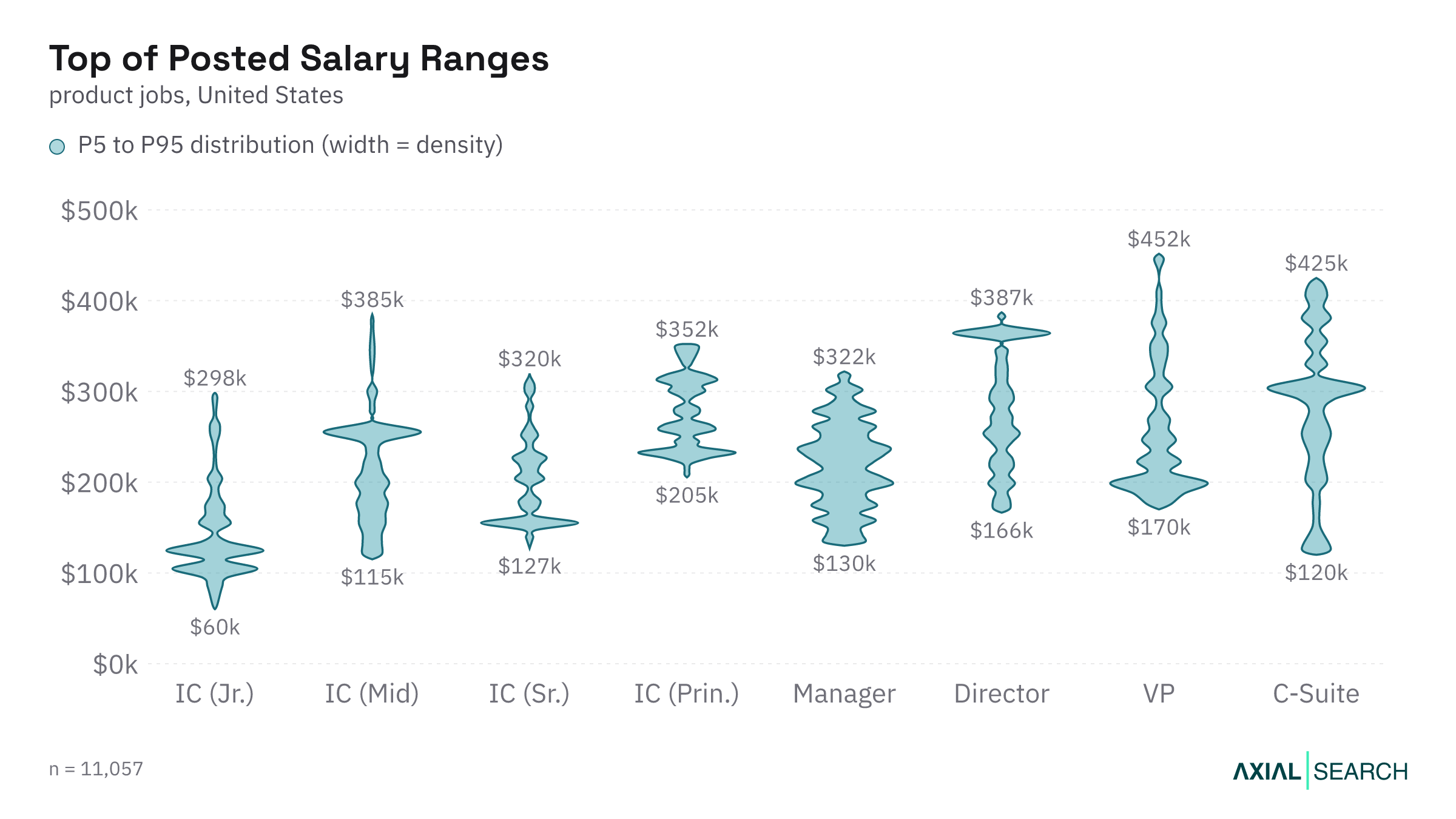
Top of the posted range by seniority — the median and typical maximum of what's posted, 5th to 95th percentile. This is the ceiling candidates can credibly negotiate toward, not the typical offer.
| Seniority | 5th percentile | 25th percentile | Median | 75th percentile | 95th percentile |
|---|---|---|---|---|---|
| IC (Junior) | $60,000 | $104,000 | $125,000 | $166,000 | $298,000 |
| IC (Mid) | $115,000 | $161,000 | $206,000 | $256,000 | $385,000 |
| IC (Senior) | $127,000 | $151,000 | $199,000 | $236,000 | $320,000 |
| IC (Principal) | $205,000 | $230,000 | $265,000 | $309,000 | $352,000 |
| Manager | $130,000 | $178,000 | $219,000 | $258,000 | $322,000 |
| Director | $166,000 | $220,000 | $275,000 | $360,000 | $387,000 |
| VP | $170,000 | $200,000 | $228,000 | $309,000 | $452,000 |
| C-Suite | $120,000 | $250,000 | $300,000 | $350,000 | $425,000 |
Where two percentiles show the same figure, employers are clustering on a round number at that end of the band.
That ceiling has widened over the past year, which tracks with the rising demand we see in the broader AI product hiring market. AI product leadership is expensive because it's scarce, and the C-suite figures above reflect a small sample concentrated at large, well-funded firms where AI product is a board-level priority — reference the full distribution when you're calibrating an offer or deciding whether to counter.
Where most AI product salaries cluster
The market is densest at Manager and Director — where most candidates land — and where AI recruitment spends most of its time sourcing against the same compressed pool.
The band you're quoted matters far more than the headline median. Roughly 48% of postings mention a bonus and another 24% mention equity, so the middle of this market compresses into a narrow range where differentiation matters more than the band itself.
What is the full salary range for AI product managers?
The full posted AI product salary range runs from the 5th percentile for junior ICs to the 95th percentile for C-suite roles — see the table above for the breakdown by seniority.
How much room is there to negotiate at the top of the AI product range?
More room than the median suggests, but unevenly so — the 75th-to-95th percentile spread is widest at VP and C-suite, and comparatively tight right below them at Director.
That spread is the real story: the higher you sit in the band, the more the posted maximum is a starting point rather than a hard ceiling.
What to make of the AI product VP figures
VP pay is the widest band in the table — the gap between a typical VP offer and the ceiling is wider than the tiers just above and below it.
That width reflects deal-specific negotiation more than a single market rate: a VP offer depends heavily on scope, equity mix and the specific company's stage.
Which industries pay AI product managers the most?
AI product pays the most where the platforms are richest and the velocity is highest. Telecom & Media tops the table at $360,000 median salary, more than $113,000 ahead of the next tier.
| Sector | Median salary | Postings |
|---|---|---|
| Telecom & Media | $360,000 | 738 |
| Life Sciences | $247,000 | 215 |
| Technology | $243,000 | 3,681 |
| Professional Services | $231,000 | 1,463 |
| Manufacturing | $230,000 | 458 |
The compensation arms race sits at the streaming and social platforms, where AI product decisions move billions in revenue — that's why Telecom & Media leads by such a wide margin.
How much does sector really matter for AI product pay?
More than in most AI functions — roughly $129,000 separates the top sector (Telecom & Media) from the bottom of this list (Professional Services).
AI product comp is tightly coupled to the business model and the velocity of the revenue cycle, so a Director at a streaming platform earns more than a Director at a consulting firm even when the technical challenges are identical.
Which sectors post the most AI product roles?
Technology accounts for a third of all AI product postings — the largest sector by volume, even though it isn't the top payer.
Healthcare (401 postings), Retail and Hospitality (400 postings) and Capital Markets & PE (331 postings) also post substantial volumes but sit below the pay leaders.
Does company size affect AI product pay?
Bigger usually pays more, and the pattern holds cleanly for AI product roles — enterprise-scale companies with more than 10,000 employees post the highest median salaries and account for 42% of all postings.
Mid-market firms with 1,001–5,000 employees sit lower on both counts, and smaller companies under 500 employees post lower figures still while together accounting for a meaningful share of the market.
Where do AI product managers earn the most?
Pay is geographically concentrated for AI product roles. California posts the highest median salary at $250,000 and accounts for 25% of all postings nationally, so it's both the highest-paid and the deepest market.
| State | Median salary | Share of postings |
|---|---|---|
| California | $250,000 | 25.1% |
| Oregon | $245,000 | 0.7% |
| Washington | $237,000 | 6.6% |
| Pennsylvania | $232,000 | 2.2% |
| Michigan | $232,000 | 1.2% |
Washington follows at $237,000 and posts 7% of roles — the Seattle tech corridor and the concentration of AI product roles at the cloud platforms. The spread between the top and the bottom of this list is modest: where you work moves your salary far less than which company and which seniority band you land in.
Which states are outliers in AI product pay?
Oregon and Michigan both post top-five pay despite tiny sample shares — 0.6% and 1.3% of postings respectively — a sign of a handful of high-paying mandates rather than a deep regional market.
Treat them as noise, not a signal to chase; Michigan's showing does reflect real strength in automotive and manufacturing AI product teams, even if the sample is thin.
The top-paying cities for AI product roles
The Silicon Valley core, where the platforms and the best-funded AI startups concentrate, commands the highest compensation — San Francisco alone accounts for about 10% of all AI product postings.
The pattern is tight geographic clustering. If you're optimizing for top-of-market comp in AI product, the Bay Area and the Seattle corridor are still the places that pay the most.
How often are AI product bonus and equity offered?
Bonus is mentioned in 48% of AI product postings and equity in 24% — both are floors, not ceilings, since many roles that don't advertise either still offer one.
Dollar figures are almost never posted, so a mention rate is the best signal available.
How often a bonus is offered
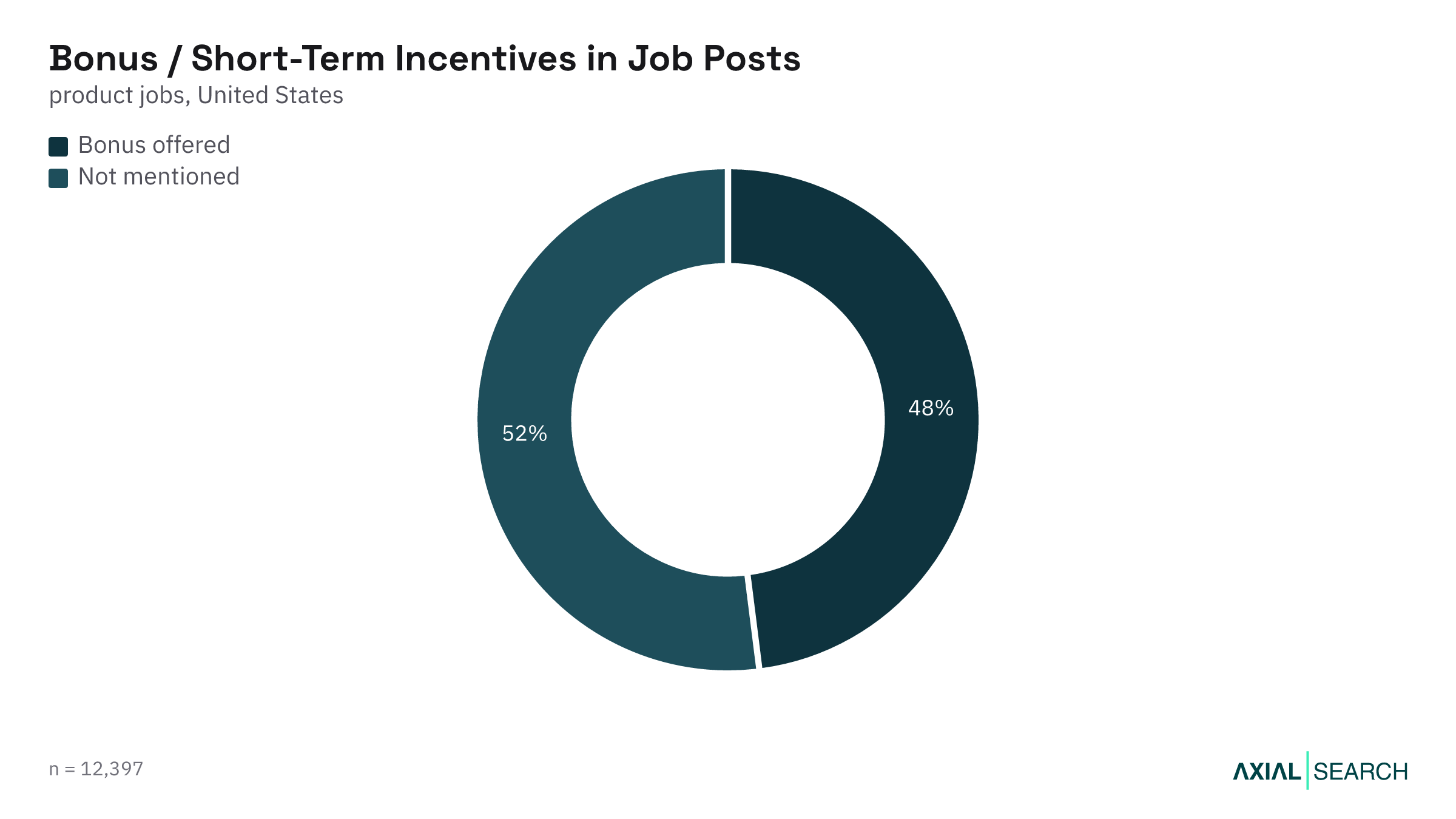
A bonus is mentioned in 48% of AI product postings — common enough to expect it, but far from universal in the text.
That's roughly double the rate in some other AI functions, which makes bonus a stronger norm in AI product roles. Bonus mention climbs with seniority, peaking at VP (68%), followed by Senior IC (54%) and Principal IC (42%). Junior and mid-level ICs sit at different levels, which reflects where bonus is used as a retention lever versus where a high base does the work.
How often equity is offered
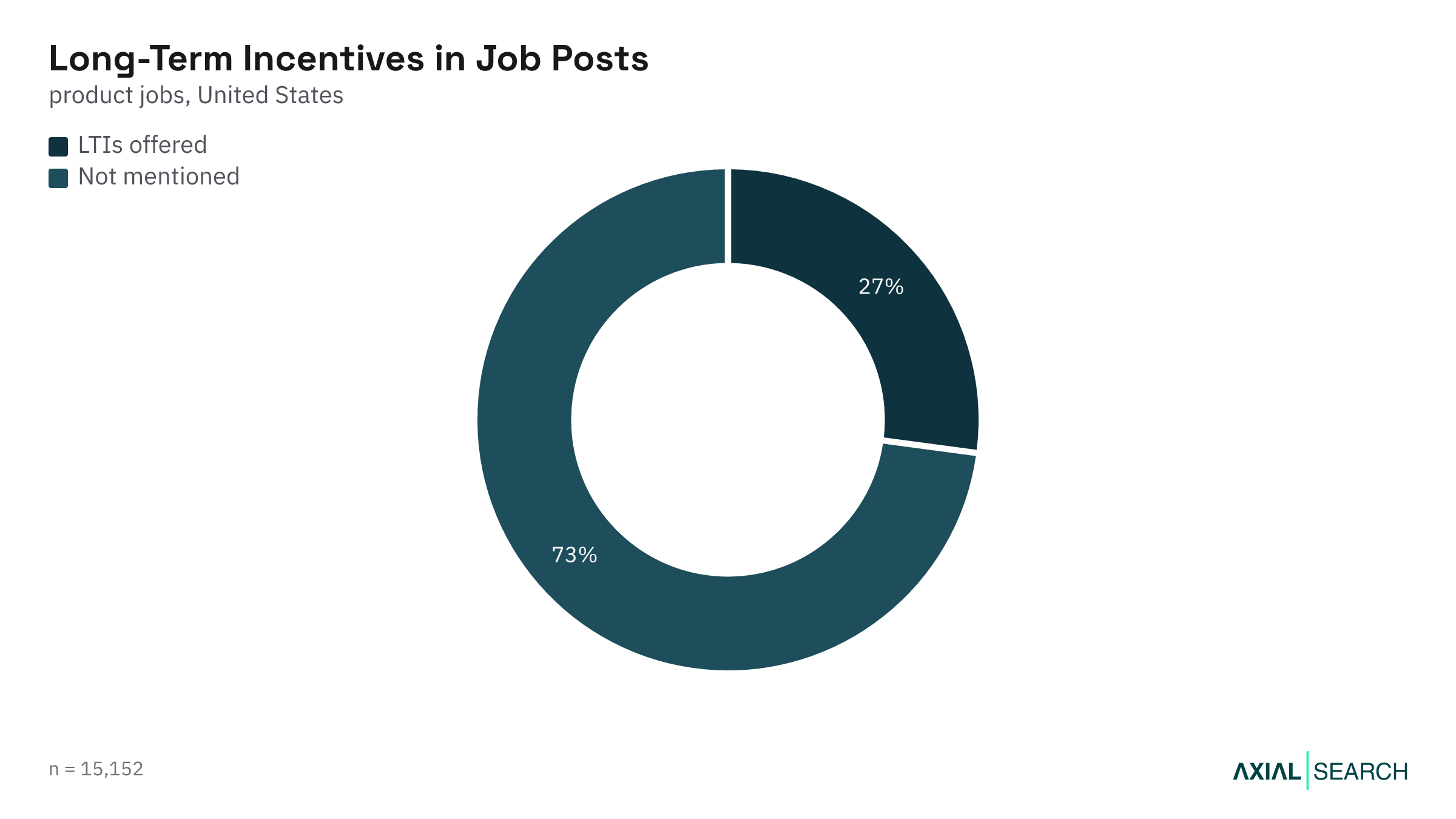
Equity is mentioned in 24% of AI product postings, double the rate for AI strategy salaries roles but still a minority of the market.
The pattern by seniority is more interesting than the overall rate: equity mention peaks at Principal-IC level and drops sharply at VP, which likely reflects where equity is used as a retention lever versus where a high base does the work. Director (24%) and Manager roles sit in the mid-20s, close to the overall average, and mid-level ICs are at 10%, the lowest bands in the seniority ladder.
The table below breaks down the full picture.
| Level | Bonus mentioned | Equity mentioned |
|---|---|---|
| IC (Junior) | 23% | 14% |
| IC (Mid) | 21% | 14% |
| IC (Senior) | 54% | 24% |
| IC (Principal) | 46% | 37% |
| Manager | 43% | 31% |
| Director | 52% | 26% |
| VP | 68% | 20% |
| C-Suite | 31% | 29% |
What the bonus-versus-equity split says about AI product retention
Bonus mention climbs steadily with seniority, peaking at VP (68%), while equity mention does not — it's most common where it's used to attract and retain technical talent with long vesting schedules, not where it's used to align executives with shareholders.
That's the opposite of the pattern in most non-tech industries, where equity concentrates at the top. Principal ICs mentioning equity more often than any other level, including C-suite, tells you that the people building the product have leverage.
Final Thoughts
For candidates. AI product compensation rewards scope and seniority more than sector or location, though both still matter. If you're optimizing for pay, aim for Director level or above in Technology, Telecom & Media or Life Sciences, and be willing to relocate to the Bay Area or Seattle. If you're staying technical, the Principal IC track is competitive with management, and the equity mention rate at that level is the highest in the market. Ask about bonus and equity even when the posting is silent — the mention rates are floors, not ceilings, and the real packages are often richer than what's advertised. If you're calibrating an offer, the 75th- and 95th-percentile figures in the seniority table above are the benchmarks that matter, not the median. If you focus more on long-term direction than execution, the AI strategy job market reflects that shift in scope.
For employers. The AI product market is both deep and expensive. Managers and Directors together make up 73% of postings, so if you're hiring at scale you're competing for the same compressed middle band that everyone else is. The ceiling climbs steeply at Director and above, so your offer needs to be competitive with both the platforms and the late-stage startups chasing the same senior candidates.
Methodology & sources
- Data sources. Job data is collected from publicly available postings on online job boards and updated weekly, covering US roles posted since January 2026. Explore and filter it on our live AI job market dashboard.
- All salary figures are derived from the minimum and maximum salary bands employers post, annualized and reported as percentiles, not averages.
- Every salary figure on this page is the top of the posted range — the ceiling employers advertise, not the typical offer. The seniority table reports it at the 5th, 25th, 50th (median), 75th and 95th percentiles. Median salary in the sector, company-size and location tables is the median of that ceiling within each group.
- Bonus and equity figures are mention rates — the share of postings that state a bonus or equity. A posting silent on either is counted as "not mentioned"; it does not mean none is offered.

The Skills That Land AI Product Management Roles in 2026
How to become a product professional in 2026: the leadership capabilities employers screen for, the experience and degrees required, the certifications that matter, and the skills most in demand across US postings.

AI Product Management Jobs in 2026: What 12,400 Postings Reveal
The complete picture of the AI product job market in 2026: hiring demand, what these roles pay, where the jobs are, who's hiring and what it takes to get in.

Analyzing AI Product Management Hiring in 2026
Where AI product jobs are in 2026: hiring demand and trend, top states and cities, who's hiring by sector and company size, and the mix of seniority, contract type and remote work across US postings.
Turn AI ambition into lasting business value
Whether you're hiring your first AI leader or scaling enterprise transformation capability, we help you define, assess and recruit the people who make it stick.