
How to Land an AI Product Role: Skills 12,400 Postings Ask For
How to become a product professional in 2026: the leadership capabilities employers screen for, the experience and degrees required, the certifications that matter, and the skills most in demand across US postings.
Updated: July 14, 2026

The AI product job market — what employers screen for
AI product is one of the most competitive leadership tracks in the AI job market, and the judgment bar is higher than candidates realize. This is what employers screen for: the capabilities, qualifications and skills that appear in 12,397 US job postings analyzed this quarter, and how to position yourself against them. The bar is high but learnable: know the leadership profile hiring managers are listening for, understand the experience and degree expectations that clear you through the first screen, and build fluency in the tools and techniques that appear most often in postings.
- Use-case selection is the game: AI product employers prize judgment about picking the right problems above delivery execution — this is a strategic role disguised as a shipping one.
- Seven years and a technical degree are table stakes: 73% of AI product postings require a degree, with Computer Science and Engineering accounting for 59% of the fields mentioned.
- Current AI fluency is now baseline: Foundation Models appear in 19% of AI product postings, Agentic AI in 9%, and the gap between knowing the vocabulary and demonstrating hands-on use is narrowing fast.
- Cloud platform literacy matters more than certifications: AWS appears in 9% of AI product postings, Azure in 7%, and no credential cracks 2% — knowing how platforms support AI workloads beats collecting badges.
- Agile and delivery orchestration remain non-negotiable: 29% of AI product postings mention Agile explicitly, and nearly half the leadership profile is about coordinating cross-functional work at speed.
The AI product leadership profile employers screen for
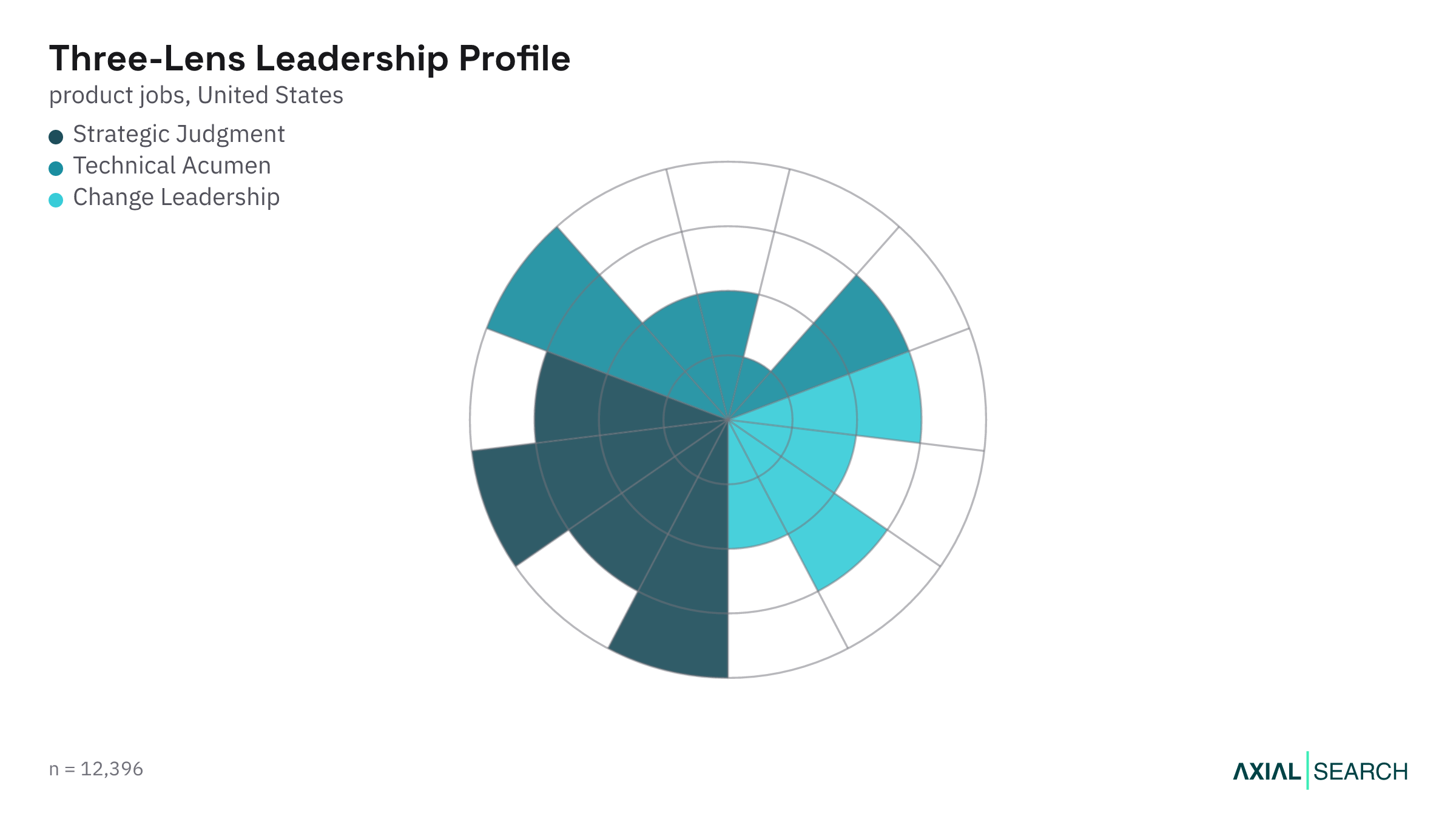
The market for AI product leadership has changed, and most candidates haven't updated their pitch. Our Three-Lens Leader framework scores every role across strategic judgment, technical acumen and change leadership, and for AI product five capabilities separate the leaders employers compete for.
Two of the three most-screened are matters of judgment, not execution. Use case selection tops the list at a mean score of 2.86: employers want a leader who can point a team at the right customer problem and kill the ones that won't pay off, not one who ships the most features. AI literacy comes next at 2.28 — a working grasp of what today's models can and can't do, so scope stays realistic — and value framing rounds out the strategic core at 2.21, because defining the business case and the measures of success is what keeps an AI product bet alive past the first quarter.
The other two are credibility and cover. Hands-on execution ranks fourth at 2.20: enough building fluency to prototype and pressure-test, so you lead the work rather than manage it from a distance. And securing sponsorship sits at 2.08, unusually high for a product role, because AI bets need sustained executive air cover to survive contact with the organization. The lower-ranked capabilities — architectural fluency (1.59), data readiness (1.58), governance discipline (1.12) and driving adoption (1.23) — matter less here than in Strategy or Operations; this is a role that's won on the decisions you make about what to build, not on the infrastructure you inherit or the change-management machinery you deploy.
When you position yourself, foreground the calls you made about what to build and why it mattered, not the number of releases you shipped. This is exactly the profile AI recruitment is built to identify.
What qualifications AI product roles require
The baseline is experience plus a technical degree. It's a conventional bar but a high one. The surprises are in the leadership profile above and the skills below, not here.
How much experience AI product roles expect
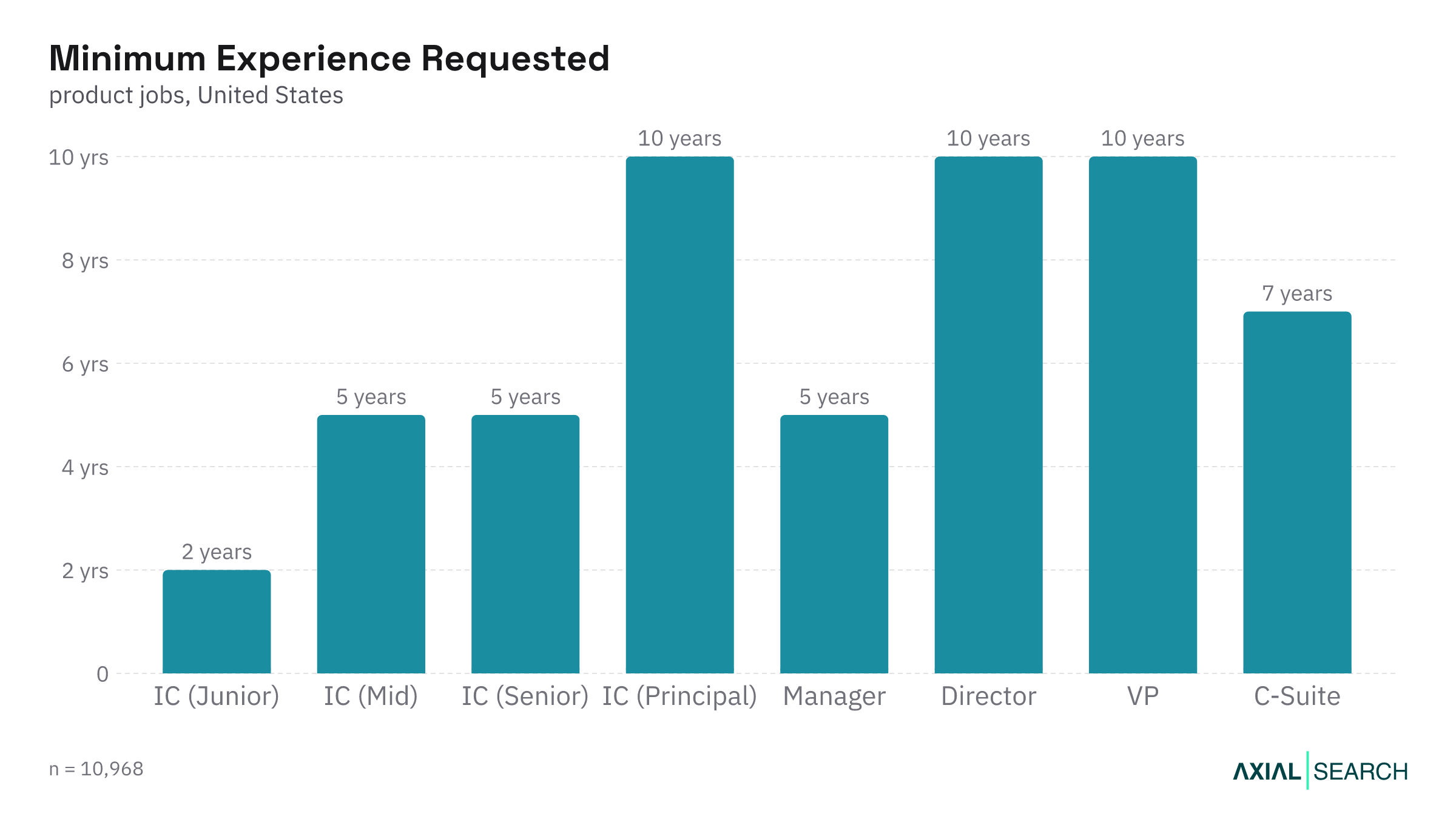
Most roles ask for around seven years of experience as a median, but that figure hides a wide and deliberate ladder. Director and VP levels both expect 10 years, and Principal ICs also reach 10 years, meaning the senior technical track doesn't cap out early the way it does in some functions. Managers sit at 5 years, mid- and senior-level ICs both ask for 5 years, and junior ICs start at 2 years. Even C-suite roles expect only 7 years, which tells you this is a market where impact and judgment matter more than tenure.
Given that nearly half the market sits at the Manager tier and 24% at Director, the realistic entry point for AI product leadership is mid-career: you generally arrive having led product, engineering or a technical function somewhere adjacent first. The experience curve is flatter than in some other AI leadership tracks, meaning the jump from mid-level to senior is less steep, but the Director threshold is a clear step up to a decade.
Degrees and fields AI product employers want
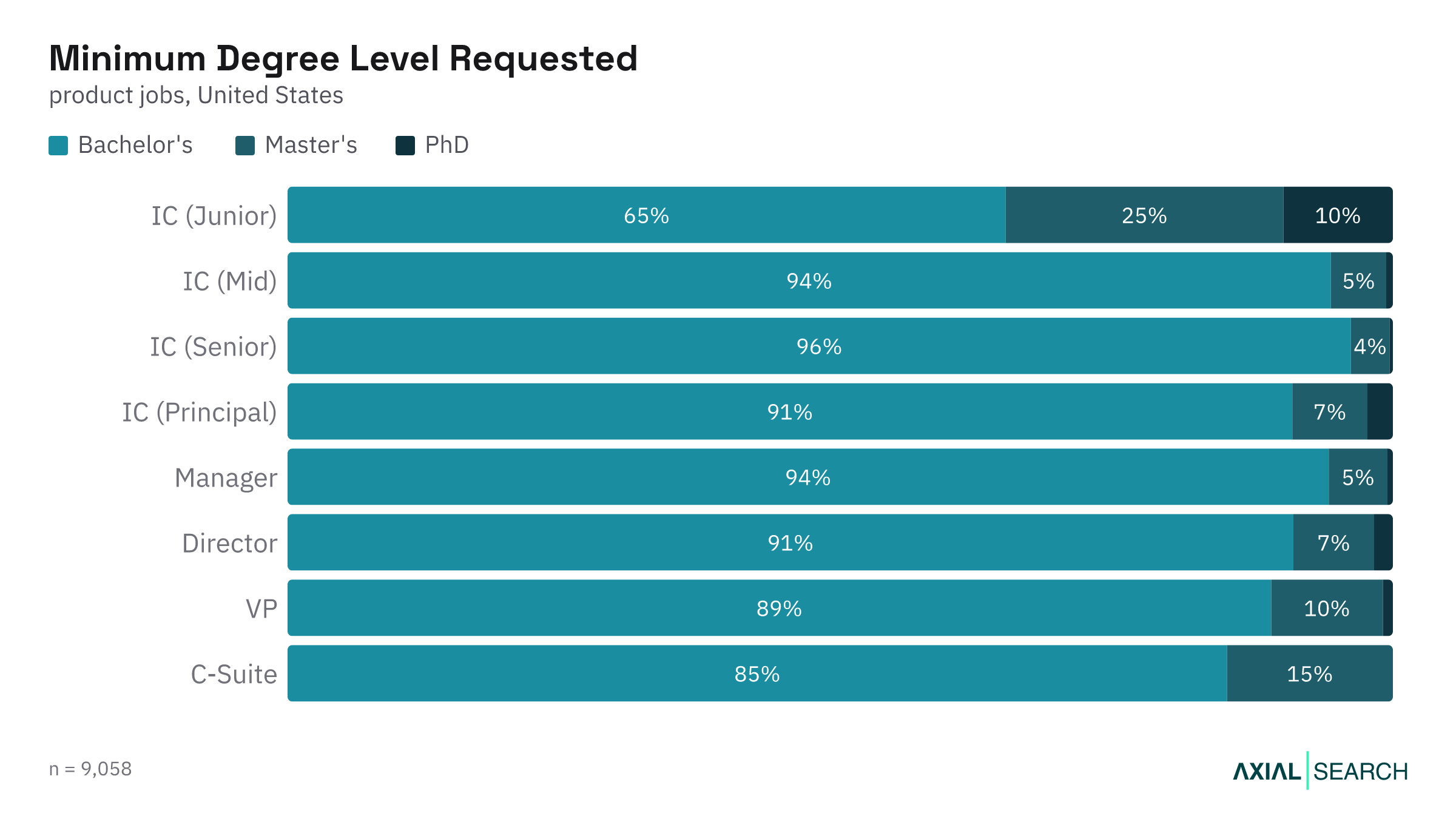
Just over seven in ten postings require a degree, and while a bachelor's clears the bar for most roles, advanced degrees become more common at the VP and C-suite tiers. At the Manager level, 94% of postings ask for at least a bachelor's, 5% for a master's and 1% for a PhD. Directors rise slightly: 91% bachelor's, 7% master's, 2% PhD. VPs track higher: 89% bachelor's, 10% master's, 1% PhD. C-suite roles land at 85% bachelor's and 15% master's, with no PhD requirement.
The field you studied matters more than in some other AI functions: this is a technical role, and the degree distribution proves it.
| Degree field | Share of postings |
|---|---|
| Computer Science | 34% |
| Engineering | 25% |
| Business | 15% |
| Data Science | 8% |
| Information Systems | 5% |
| Business Administration | 4% |
Technical fields account for nearly 72% of postings: Computer Science, Engineering, Data Science and Information Systems together. Business and Business Administration make up around 19%. The split is more tilted toward the technical side than in Strategy or Operations, which tells you something useful: AI product sits closer to the build than the business case, and employers are screening for people who can hold their own in a technical conversation. If you came up through a business or liberal-arts track, you'll need to demonstrate credible AI literacy to compensate.
Certifications for AI product roles
Be honest with yourself about certifications: they're nearly invisible in this market. PMP and CSPO each appear in under 2% of postings, and everything below them is a long thin tail.
| Certification | Share of postings |
|---|---|
| Project Management Professional (PMP) | 1.7% |
| Certified Scrum Product Owner (CSPO) | 1.7% |
| Certified ScrumMaster (CSM) | 1.1% |
| Certified Public Accountant (CPA) | 1.0% |
| Chartered Financial Analyst (CFA) | 0.7% |
| Certified Information Systems Security Professional (CISSP) | 0.4% |
The signal here is what's absent: there is no dominant AI product certification, so don't delay applying to go collect one. The Agile and Scrum credentials that do appear reflect that a lot of AI product work is coordinating cross-functional delivery, but even those barely crack 2%. If you already hold one, mention it; if you don't, spend the time sharpening the story of the decisions you've made instead.
The skills that matter for AI product roles
Fluency beats depth in this function. Employers want someone who can hold a credible conversation about the current wave of AI techniques and about how to ship them at scale, not a specialist in any one tool.
The capabilities AI product leaders need
| Capability | Share of postings |
|---|---|
| Agile | 29% |
| Foundation Models | 19% |
| Observability & Monitoring | 18% |
| Cloud Platforms | 15% |
| Agentic AI | 9% |
| SAFe | 9% |
| Scrum | 8% |
| Lean | 8% |
| SQL | 8% |
| RAG | 8% |
Two themes run through this list. Delivery literacy (Agile, SAFe, Scrum, Lean, Observability & Monitoring) is expected — Agile appears in 29% of postings, and the other delivery frameworks add another 25% together — because AI product still has to ship. The newer AI techniques, Foundation Models and Agentic AI, now appear in 19% and 9% of postings; being able to speak credibly about their trade-offs and use cases is quickly becoming table stakes. A year ago neither term appeared with any frequency. Now they're baseline fluency. RAG (Retrieval-Augmented Generation) sits at 8%, a reminder that knowing how to ground models in real data is increasingly non-negotiable.
Software and tools AI product roles use
| Software / tool | Share of postings |
|---|---|
| AWS | 9% |
| Atlassian Jira | 7% |
| Microsoft Azure | 7% |
| Anthropic Claude | 6% |
| Microsoft Excel | 5% |
| GCP | 4% |
| Figma | 4% |
| Atlassian Confluence | 4% |
| Salesforce | 4% |
| Cursor | 3% |
The cloud platforms lead, and Jira sits high on the list: knowing how AWS and Azure price, secure and scale AI workloads matters, and so does fluency with the tools teams use to coordinate work. Note that Anthropic Claude now shows up in 6% of postings as a named platform in its own right, a sign that employers increasingly expect AI product leaders to have hands-on familiarity with the assistants and APIs their teams will build on top of. Figma signals the continuing overlap between AI product and design; Cursor and Microsoft Copilot reflect that AI coding assistants are now part of the working vocabulary.
Remember that these are the tools postings mention: a platform not listed isn't disqualifying. Treat the list as the vocabulary to be fluent in, not a checklist to complete. If you've worked with Claude or GPT-4 in a real product context, say so. If you haven't, get your hands on one and build something small, because an employer will ask.
How to position yourself for an AI product role
Pull the threads together and a clear playbook emerges.
Lead with judgment and AI literacy. The single strongest thing you can show is a track record of picking the right AI use cases (mean score 2.86) and understanding what's technically feasible (AI literacy 2.28): that's what the leadership profile rewards, and it's what separates an AI product leader from a project manager who happens to work on AI.
Back it with the conventional credentials. Evidence the roughly seven years and the technical degree — 73% of postings require one, and Computer Science and Engineering together account for 59% of the fields mentioned — and don't be shy about Agile and delivery experience, because 29% of postings mention Agile explicitly and a lot of AI product work is cross-functional orchestration in disguise. If you came up through a non-technical field, lean harder on demonstrated AI fluency to compensate.
Demonstrate current AI fluency over depth. Be able to talk fluently about Foundation Models (19% of postings), Agentic AI (9%) and Observability (18%), and about how the major cloud platforms support them (AWS 9%, Azure 7%, GCP 4%), without pretending to be an ML engineer. Know what RAG is, because it's the technique that's crossed from research into production fastest. Breadth credibly held is the goal. If you've shipped a product that uses Claude (6%) or GPT-4, lead with that; if you haven't, get your hands on one and build something small, because an employer will ask.
Skip the certification treadmill. There's no credential that unlocks this market — PMP and CSPO each appear in just 1.7% of postings, and nothing else cracks 1% — so invest that time in sharpening the story of the decisions you've made and the outcomes they drove. The CSPO and PMP credentials that do appear are useful signals if you already hold them, but they won't open doors on their own.
If you're on the other side of the table, building an AI product team rather than joining one, this is exactly the profile AI recruitment is built to find.
Final Thoughts
For candidates. AI product is won on the decisions you make about what to build, not the features you ship. Lead with use-case selection and AI literacy (mean scores 2.86 and 2.28), back it with seven years and a technical degree (73% of roles require one, with Computer Science and Engineering accounting for 59% of fields mentioned), and demonstrate fluency with Foundation Models (19% of postings) and the cloud platforms that serve them. The certification that matters most is the one that doesn't exist: proof you can pick the right problems and kill the wrong ones. If you focus more on shaping company direction than shipping features, AI strategy skills may fit better.
For employers. This is a thin, high-judgment pool, and the bar is rising fast. The capabilities that separate the best candidates — use-case selection, AI literacy and value framing — are the hardest to read off a resume, and the technical-degree requirement screens out a lot of strong AI product leaders who came up through other paths. Interview around real decisions, not credentials, and be ready to move quickly when you find someone who can demonstrate judgment under uncertainty.
Methodology & sources
- Data sources. Job data is collected from publicly available postings on online job boards and updated weekly, covering US roles posted since January 2026. Explore and filter it on our live AI job market dashboard.
- Requirements are extracted from job descriptions using a combination of programmatic rules and AI analysis. Minimum experience is the median minimum years requested by seniority; minimum degree is the lowest degree a posting requires.
- Top degree fields, certifications and skills are the items mentioned most often across postings.
- The leadership profile reflects the relative emphasis across leadership capabilities inferred from job-description language, reported as mean scores across the Three-Lens Leader framework; skills and software are drawn from AI analysis plus programmatic scanning of posting text.
- These are mention rates: the share of postings that state each item. A skill, degree or certification not appearing means it wasn't stated in the posting, not that it isn't valued.

AI Product Jobs in 2026: What 12,400 Postings Reveal
The complete picture of the AI product job market in 2026: hiring demand, what these roles pay, where the jobs are, who's hiring and what it takes to get in.

Where AI Product Jobs Are in 2026: Demand and Top Employers
Where AI product jobs are in 2026: hiring demand and trend, top states and cities, who's hiring by sector and company size, and the mix of seniority, contract type and remote work across US postings.

What AI Product Roles Pay in 2026: Benchmarks from 12,400 Posts
What AI product roles pay in 2026: median salary, pay by seniority, top-paying sectors and locations, and how often bonus and equity are mentioned in US job postings.
Turn AI ambition into lasting business value
Whether you're hiring your first AI leader or scaling enterprise transformation capability, we help you define, assess and recruit the people who make it stick.