
How to Advance Your ML Engineering Career
How to become an ML engineering professional in 2026: the leadership capabilities employers screen for, the experience and degrees required, the certifications that matter, and the skills most in demand across US postings.
 Updated: September 11, 2026
- Execution over strategy: ML engineering roles prize hands-on delivery and architectural judgment; strategic influence ranks low — this is a build-it function, not a shape-the-business one.
- The degree bar is high: 78% of ML engineering postings require a degree, with Computer Science dominating at 69% and PhD requirements climbing to a third of Principal roles.
- Five years gets you in the door: Mid-level roles cluster around four to five years of experience in ML engineering, making this a faster entry point than most AI leadership tracks.
- Certifications are invisible: The entire top-8 certification list sits below 0.2% mention rates in ML engineering — portfolio work outweighs credentials by a wide margin.
- Python and PyTorch are the table stakes: 79% of ML engineering roles expect Python, 45% mention PyTorch and 44% require cloud-platform fluency — if you lack these, you're not in the conversation.
What leadership profile do employers screen for in ML engineering roles?
4 of the 5 most-screened capabilities for ML engineering roles are technical — hands-on execution and AI literacy top the list, and the business-facing capabilities that dominate AI strategy postings rank near the bottom here.
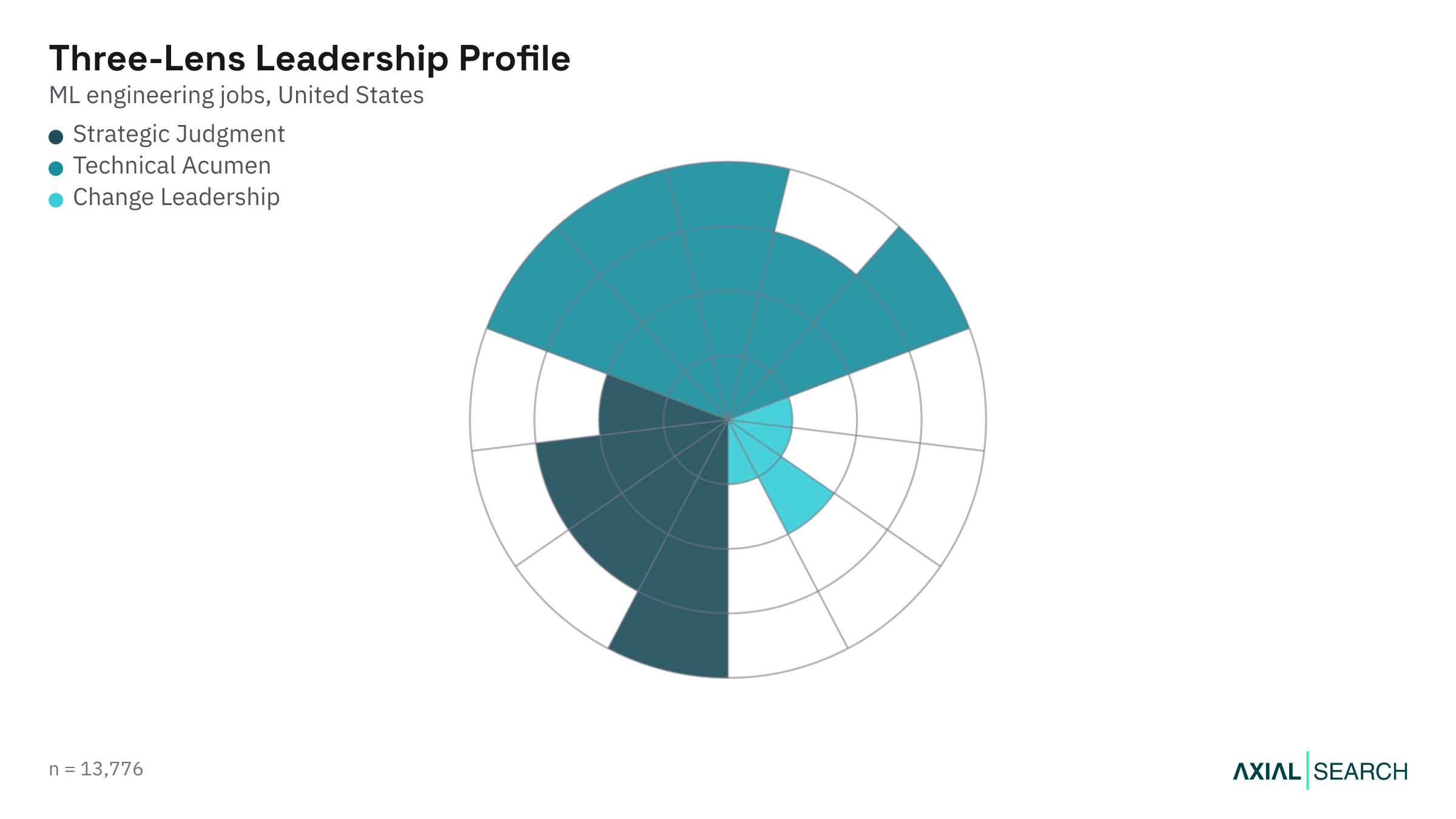
Our Three-Lens Leader framework scores every role across strategic judgment, technical acumen and change leadership. Hands-on execution and AI literacy top the profile together: employers want people who can design, train and ship working ML systems, and who have a deep, current grasp of what the models can and can't do. Architectural fluency and use case selection follow — engineers here own how the pieces fit together and whether they're building the right model, not just a working one. Data readiness judgment rounds out the top five, because a production ML system lives or dies on whether the data can carry it.
When you position yourself, lead with what you've put into production and the technical decisions behind it. This is exactly the profile AI recruitment is built to identify.
Which capabilities matter least for ML engineering roles
Securing sponsorship, shaping the narrative and driving adoption barely register in ML engineering hiring.
Employers want people who can build, not people who can sell what might be built — a sharp contrast with AI strategy roles, where those same capabilities top the list.
What qualifications do machine learning engineers need?
The baseline is experience plus a technical degree — about 5 years and a bachelor's in a quantitative field clears the bar for most roles, and there's no business-school route into ML engineering.
How much experience ML engineering roles expect
The median ML engineering role asks for 5 years of experience, rising to 7 at Principal and 8 at Director.
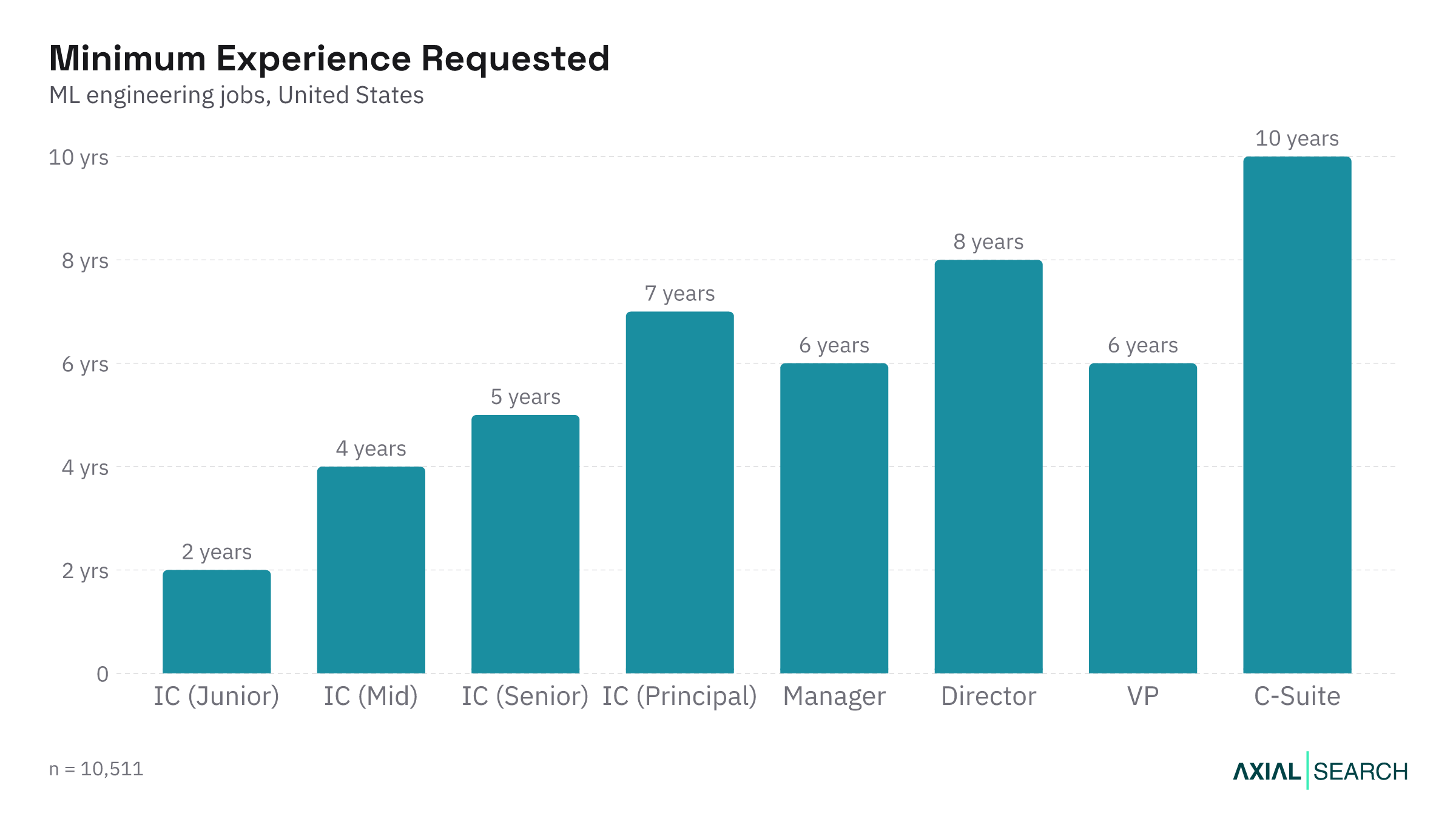
Mid-level IC roles cluster around 4 years, meaning someone who spent their early career in software engineering or data science careers can credibly pivot into ML engineering without a decade of adjacent experience. At the top end, VP and C-Suite bands land at 6 and 9 years respectively — a reminder that executive ML roles are rare and the market skews individual-contributor-heavy.
For candidates this means you don't need to have led transformation programs or sat in executive meetings. You need to have built things that worked.
For hiring managers it means you can recruit earlier-career talent and grow them internally rather than competing for the small pool of ten-year veterans.
Degrees and fields ML engineering employers want
79% of ML engineering postings require a degree, and while a bachelor's clears the bar for most roles, a PhD becomes common at Principal level and above.
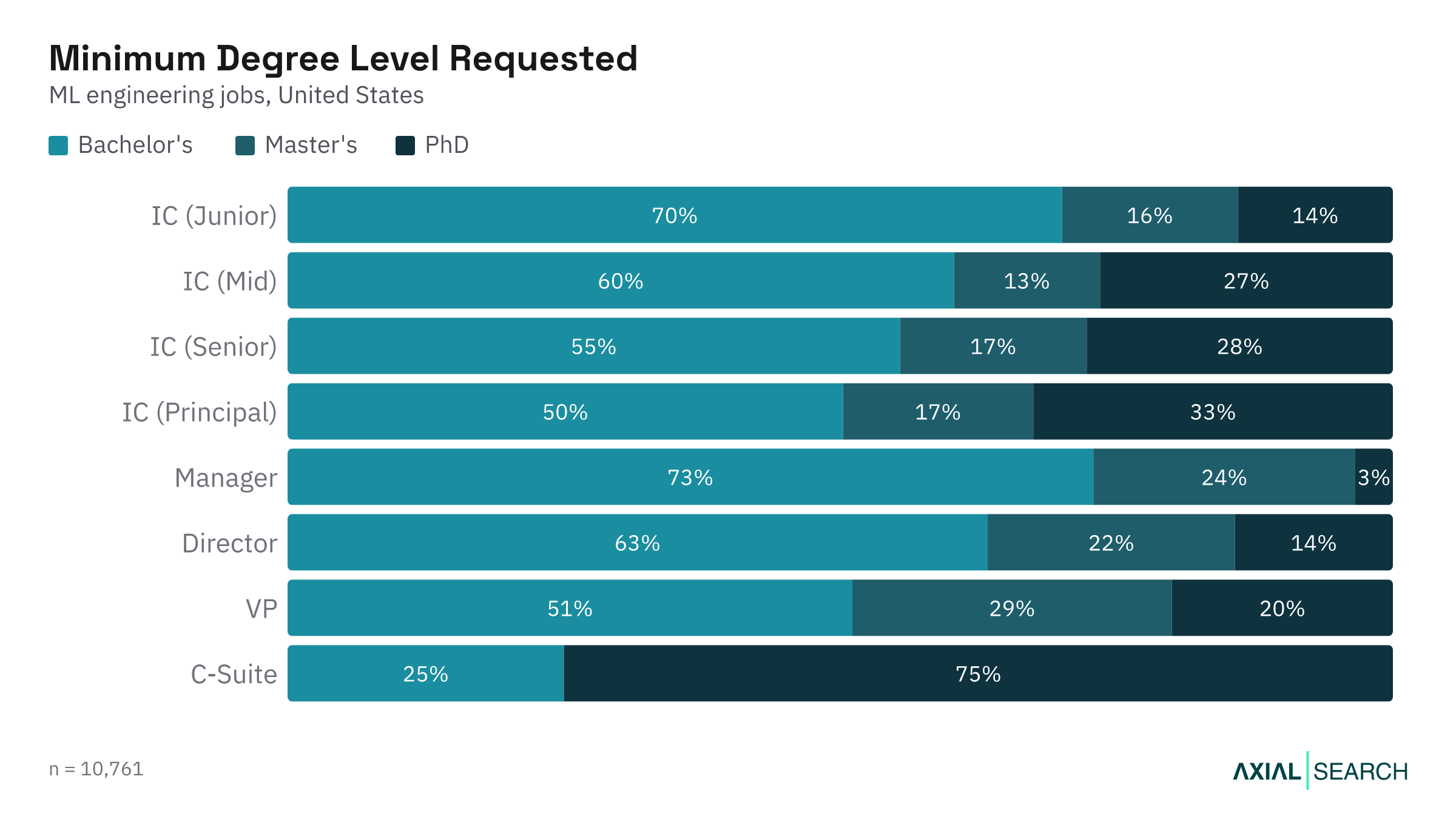
Across Junior, Mid, Senior and Manager bands, bachelor's degrees appear in the large majority of ML engineering postings. Master's and PhD requirements climb from there, with PhD requirements rising further at Principal level. C-Suite leans hardest toward a PhD, but that's a tiny sample of just a handful of roles, so treat it as directional, not a hard rule.
The field you studied matters, and the list is overwhelmingly technical:
| Degree field | Share of postings |
|---|---|
| Computer Science | 64.5% |
| Machine Learning | 26.0% |
| Engineering | 24.3% |
| Statistics | 14.7% |
| Mathematics | 14.3% |
| Data Science | 12.7% |
| Electrical Engineering | 9.4% |
| Computer Engineering | 7.9% |
Computer Science accounts for nearly 70% of degree mentions, with Machine Learning and Engineering close behind. The three quantitative disciplines — Statistics, Mathematics and Data Science — make up a substantial portion combined among postings that name a field.
There is no business-background route here; this is a technical function and the degree requirements reflect it.
If you hold a non-technical degree and want to break into ML engineering, the path is to demonstrate hands-on building ability in a way that's visible and credible — deployed models, a portfolio that shows you can train, evaluate and ship systems, not just notebooks. The degree won't disqualify you but you'll need stronger evidence elsewhere.
Which certifications matter for machine learning engineers?
Certifications barely register in ML engineering — the entire top-8 list sits below 0.2% mention rates, well behind the credentials that matter in adjacent, more compliance-heavy fields.
| Certification | Share of postings |
|---|---|
| AWS Certified Machine Learning - Specialty | 0.1% |
| Databricks Certified Machine Learning Professional | 0.1% |
| Certified Public Accountant (CPA) | 0.1% |
| Certified Information Systems Security Professional (CISSP) | 0.1% |
| AWS Certified Solutions Architect | 0.1% |
| Certified Kubernetes Application Developer (CKAD) | 0.1% |
| Microsoft Certified: Azure AI Engineer Associate | 0.1% |
| Certified Safety Professional (CSP) | 0.1% |
The signal here is what's absent: there is no dominant ML engineering certification, and even the vendor-specific credentials that do appear — Databricks, AWS, Azure — barely move the needle. Hiring managers care about the models you've deployed and the systems you've built, not the courses you've passed. If you already hold a relevant certification, mention it; if you don't, spend the time building a portfolio instead.
Which cloud and data-platform certifications appear most in ML engineering postings
The certifications that do appear — CISSP, Databricks, AWS Solutions Architect — sit in adjacent disciplines like security, cloud architecture or data platforms, not ML-specific credentials, and each sits at just 0.1% of postings.
That reflects how much ML engineering work happens on managed infrastructure, but it's not where employers are screening. If you don't hold one, it isn't disqualifying — spend the time shipping instead.
Which skills matter for ML engineering roles?
Depth beats breadth in ML engineering — Python appears in most postings and employers want someone who can implement, debug and scale production ML systems across the full stack, not talk about them in the abstract.
The capabilities ML engineering roles need
| Capability | Share of postings |
|---|---|
| Python | 79.3% |
| Deep Learning | 55.8% |
| Cloud Platforms | 42.6% |
| Foundation Models | 38.6% |
| Observability & Monitoring | 35.9% |
| Big Data Processing | 29.8% |
Python sits at the top with a 79.4% mention rate — it's the baseline skill for this function, not a differentiator. Deep learning and cloud platforms follow, meaning more than half of ML engineering roles now assume you can train neural networks and deploy them to production infrastructure. Observability and monitoring at 38.5% is the reminder that this is an operational role — you're expected to instrument, debug and maintain what you build. Foundation models at 35.1% reflects the current wave: fluency with large pretrained models is quickly becoming table stakes.
For candidates this means you need to be able to talk credibly about the full lifecycle of an ML system: how you trained it, how you evaluated it, how you deployed it and how you monitored it in production.
For hiring managers it means the person who can only talk about model accuracy but can't explain how they'd serve it at scale isn't ready yet.
Software and tools ML engineering roles use
| Software / tool | Share of postings |
|---|---|
| PyTorch | 43.2% |
| Amazon Web Services (AWS) | 34.5% |
| TensorFlow | 34.2% |
| Microsoft Azure | 19.9% |
| Apache Spark | 17.4% |
| Google Cloud Platform (GCP) | 16.0% |
The framework landscape is now close to a two-horse race: PyTorch and TensorFlow sit at 43% and 35.5%, meaning one of them appears in nearly every other posting. The cloud platforms follow at 35.7% (AWS) and 20% (Azure), a reminder that ML engineering is increasingly about deploying models to managed infrastructure, not building bespoke training clusters. Apache Spark and Docker round out the list, both around 17%: the data-pipeline and container-orchestration tools that turn research code into production systems.
Remember that these are the tools postings mention — a framework not listed isn't disqualifying. Treat the list as the vocabulary to be fluent in, not a checklist to complete.
How do you become a machine learning engineer?
Becoming a machine learning engineer takes roughly 5 years of hands-on experience and a portfolio of models you've deployed — a technical degree helps (79% of postings ask for one) but doesn't replace production experience.
Pull the threads together and a clear playbook emerges.
What to lead with when applying for ML engineering roles
The single strongest thing you can show is a track record of deploying ML systems that worked in production — that's what the leadership profile rewards and it's what separates an ML engineer from a researcher.
Frame it around the technical decisions you made, the tradeoffs you navigated and the business outcomes those decisions delivered.
What credentials back up an ML engineering application
Evidence the roughly five years and the technical degree, and don't be shy about production-engineering experience — a lot of ML engineering is systems work in disguise.
If you're earlier in your career, demonstrate that you can already work across the full stack: training, evaluation, deployment, monitoring.
How to demonstrate ML fluency for an ML engineering role
Be able to talk fluently about Python, deep learning frameworks and cloud platforms, and about how you'd deploy and monitor a model in production without pretending to be a research specialist.
Depth, credibly held, is the goal. Show you understand the full lifecycle, not just the modeling part.
Do you need certifications to become a machine learning engineer?
No — there's no credential that unlocks this market, so invest that time in shipping models and building a portfolio that shows you can work across the full ML stack.
If you already hold a cloud or data-platform cert, mention it; if you don't, the marginal value of going to get one is low compared to just shipping another project.
What does an ML engineering career path look like?
An ML engineering career path runs from Junior IC (2 years of experience) through Mid and Senior IC (4-5 years) to a fork at Principal IC or Manager (6-7 years) — and staying on the technical Principal track pays close to Director money.
That means you don't have to choose between staying hands-on and maximizing your pay. Principal ICs now edge out Directors at the median, so the choice comes down to whether you want to keep building or start managing, not which one pays better.
Final Thoughts
For candidates. The ML engineering market rewards builders: show production systems you've shipped, the scale they ran at and the operational problems you solved to keep them running. A portfolio of deployed work beats a wall of certifications every time, and the roughly five years of experience most roles ask for means you can pivot into this function earlier than most AI leadership tracks. If you focus more on deploying models in production apps than training them, AI engineering skills become the central discipline.
For employers. The ML engineering talent pool is deep on paper and shallow in practice: lots of people can talk about models, far fewer can deploy them to production and operate them at scale. The leadership profile you're hiring for sits almost entirely in the technical-acumen lens — hands-on execution, architectural fluency and data-readiness judgment — which means your screening process needs to test for build capability, not strategic vision. Our ML engineering hiring guide covers pay benchmarks and interview questions for exactly that.
Methodology & sources
- Data sources. Job data is collected from publicly available postings on online job boards and updated weekly, covering US roles posted since January 2026. Explore and filter it on our live AI job market dashboard.
- Requirements are extracted from job descriptions using a combination of programmatic rules and AI analysis. Minimum experience is the median minimum years requested by seniority; minimum degree is the lowest degree a posting requires.
- Top degree fields, certifications and skills are the items mentioned most often across postings.
- These are mention rates — the share of postings that state each item. A skill, degree or certification not appearing means it wasn't stated in the posting, not that it isn't valued.

The State of the ML Engineering Job Market in 2026
The complete picture of the ML engineering job market in 2026: hiring demand, what these roles pay, where the jobs are, who's hiring and what it takes to get in.

How to Hire Machine Learning Engineers in 2026
Where ML engineering jobs are in 2026: hiring demand and trend, top states and cities, who's hiring by sector and company size, and the mix of seniority, contract type and remote work across US postings.

ML Engineering Pay in 2026: Salaries, Bonuses and Equity
What ML engineering roles pay in 2026: median salary, pay by seniority, top-paying sectors and locations, and how often bonus and equity are mentioned in US job postings.
Turn AI ambition into lasting business value
Whether you're hiring your first AI leader or scaling enterprise transformation capability, we help you define, assess and recruit the people who make it stick.