
Who's Hiring MLOps Engineers in 2026
Where MLOps jobs are in 2026: hiring demand and trend, top states and cities, who's hiring by sector and company size, and the mix of seniority, contract type and remote work across US postings.
 Updated: September 2, 2026
- MLOps is a narrow, technical market: never high-volume, and the floor is not falling out — the floor isn't falling out, but demand isn't spiking either.
- This is an IC market for MLOps: 36% of postings target mid-level ICs, 33% senior ICs and 13% Principal ICs; management roles account for only 8% of all MLOps demand.
- Enterprise employers lead but startups show up in MLOps: 34% of postings come from 10,000+ employee firms, yet companies under 50 employees post 13% of MLOps roles.
- Remote flexibility runs higher in MLOps than most AI functions: 40% of specified roles are fully remote, 38% hybrid and only 19% require in-person presence.
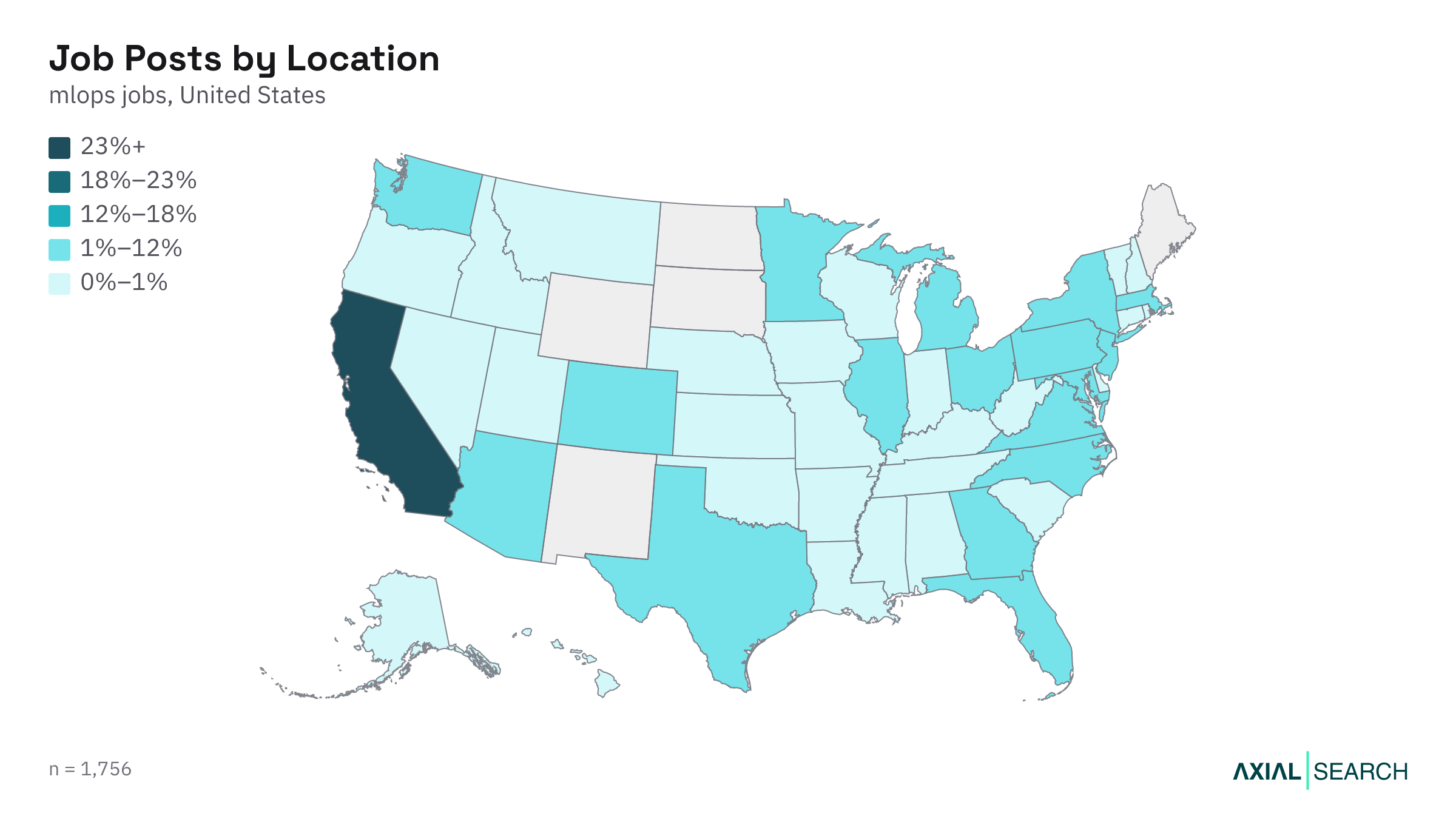
- California dominates MLOps geography: 27% of all US postings come from CA; San Francisco alone accounts for 9% of national MLOps hiring.
- Contract work is more common in MLOps: 13% of postings are contract roles — double the share in many AI functions — reflecting project-based deployments and temporary infrastructure buildouts.
What will you need to pay to hire MLOps engineers?
Budget a median of $185,000 for an MLOps hire, which commands more than Director or VP roles.
That's the posted band, not the final offer. Bonus (mentioned in MLOps postings) and equity sit on top, and they're not evenly spread. For the full breakdown by seniority, sector and location, see MLOps salaries.
How MLOps pay changes with seniority
Pay rises through Mid and Senior IC, then splits: the Principal IC track actually out-earns Director and VP roles at the median, which is unusual and worth knowing before you set a leveling structure.
If you're building a req around a Manager or Director title expecting to underpay a senior technical candidate, the data says otherwise — a Principal IC candidate can credibly ask for more than either, and often gets it, which is exactly the kind of pay-band mismatch AI recruitment that already knows this market helps you avoid before you lose the candidate.
Where bonus and equity fit into an MLOps offer
MLOps postings mention bonuses and equity, and neither is spread evenly — bonus peaks at VP (55%), equity peaks at Principal IC and Manager level.
If you're competing for a Principal IC or Manager candidate, an equity component is doing more work in that conversation than it will for a junior hire.
How competitive is the market for MLOps engineers?
Competitive — 69% of MLOps postings target IC roles at Mid or Senior level, and the entry-level pipeline is thin, so growing your own talent takes longer than hiring it.
Two-thirds of the market sits in the Mid and Senior IC bands, where candidates have the most options and the least reason to take a below-market offer. The challenge isn't finding openings to compete against — it's finding people who can do the work.
Why the MLOps entry-level pipeline is thin
Only 9% of MLOps postings target junior roles, the thinnest band in the market, so the deep-technical bench most teams want to promote into is thin at the entry point.
That means a realistic build-your-own-bench plan takes years, not quarters — for an immediate need, hiring is faster than developing.
Who are you competing with for MLOps talent?
You're competing against enterprise-scale companies most often — 34% of MLOps postings come from organizations with 10,000+ employees — but also against a meaningful startup segment: 13% of postings come from companies under 51 employees.
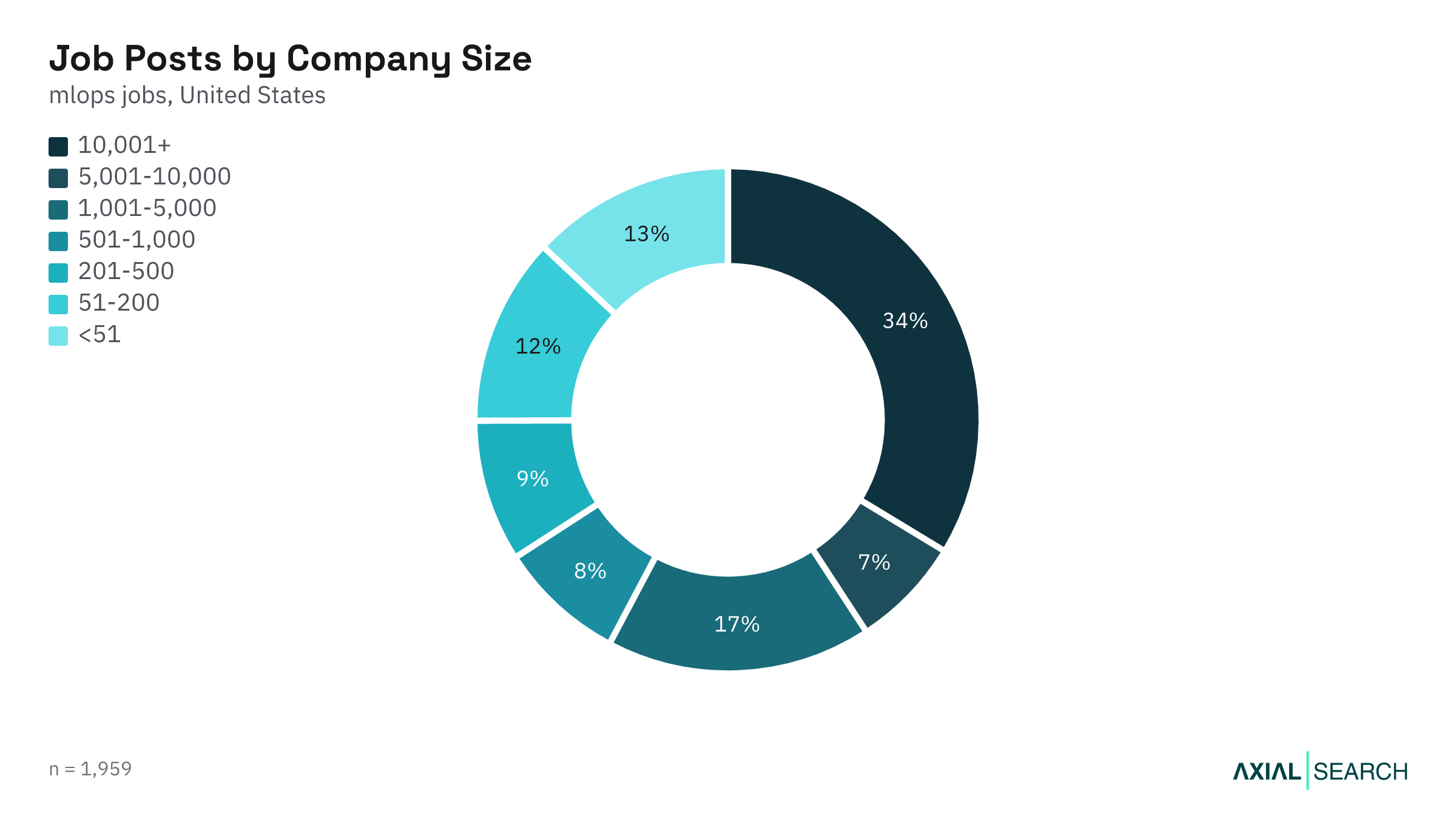
That split tells you MLOps is both a big-company infrastructure play and a startup technical hire. Mid-sized firms with 1,001–5,000 employees post another 17%, spread across a company-size range wider than most senior AI leadership hiring.
The sector breakdown shows the same spread:
| Sector | Share of postings |
|---|---|
| Technology | 33% |
| IT Services | 17% |
| Manufacturing | 9% |
| Professional Services | 7% |
| Financial Services | 6% |
| Retail and Hospitality | 5% |
| Healthcare | 3% |
| Life Sciences | 2% |
Technology leads by a wide margin, but IT Services hiring is more than half the size of the leader on its own, and Manufacturing, Financial Services and Healthcare all show up with meaningful shares. MLOps is no longer a tech-only discipline; it's infrastructure work that every industry running models in production eventually needs.
What level of MLOps hire do you actually need?
66% of MLOps postings target a full-time, mid-to-senior IC — not a manager and not a junior generalist. The three cuts below describe the shape of the market so you can benchmark the req you're about to open.
Seniority levels in MLOps hiring
Two-thirds of MLOps postings are mid-level or senior IC roles.
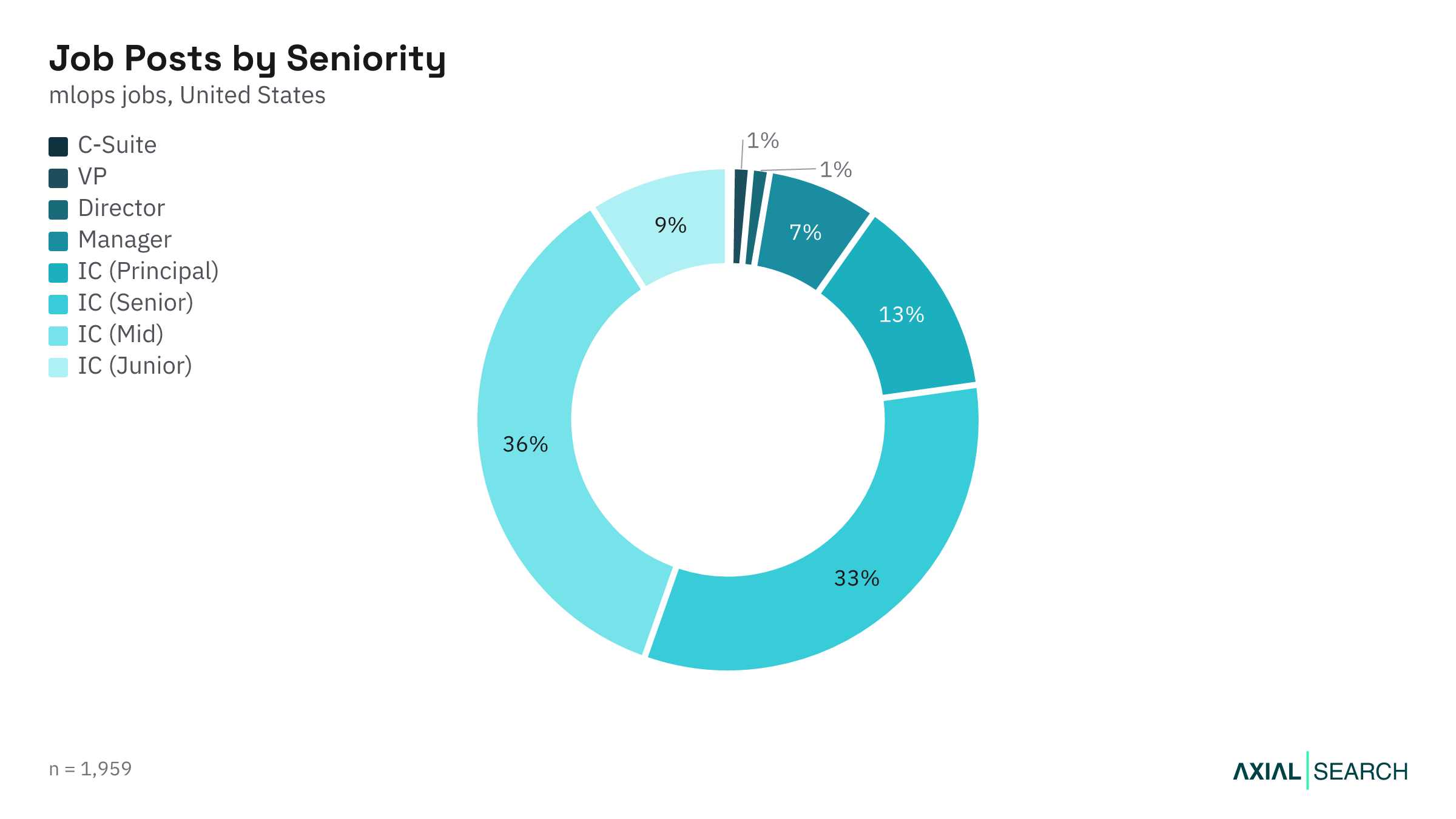
Senior ICs add another 33% and the two bands together represent the core of the market. Principal ICs — the deep-specialist track — account for 13%, junior ICs 9%. Manager roles make up 7%, and leadership positions above that are minimal.
If you're structuring a req around a Manager title expecting to underpay a senior IC, the data says the reverse: a Principal IC candidate has options and a pay ceiling that beats your Director band. We break down what each seniority band pays in MLOps salaries.
Full-time versus contract MLOps roles
Most MLOps postings are full-time (86%), but 13% are contract roles — a higher contract share than most AI functions see.
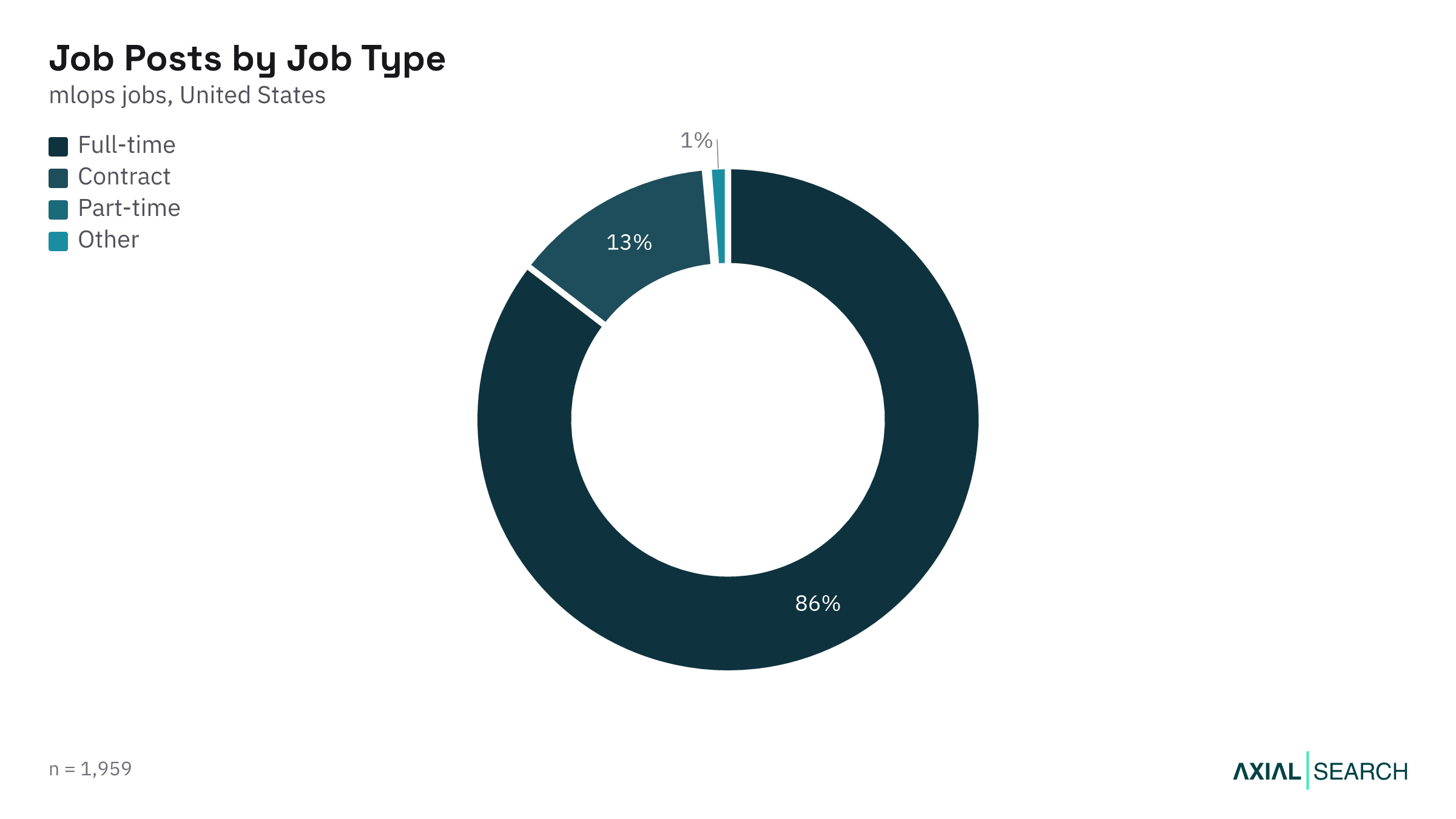
Part-time roles are statistically zero. The contract volume reflects two patterns: project-based MLOps work at consulting firms, where a model pipeline gets built and handed off, and companies that need a deployment system stood up but aren't ready to staff it permanently.
Remote, hybrid and onsite MLOps roles
Among postings that specify a work arrangement, the split tilts remote: 40% fully remote, 38% hybrid and 22% strictly on-site.
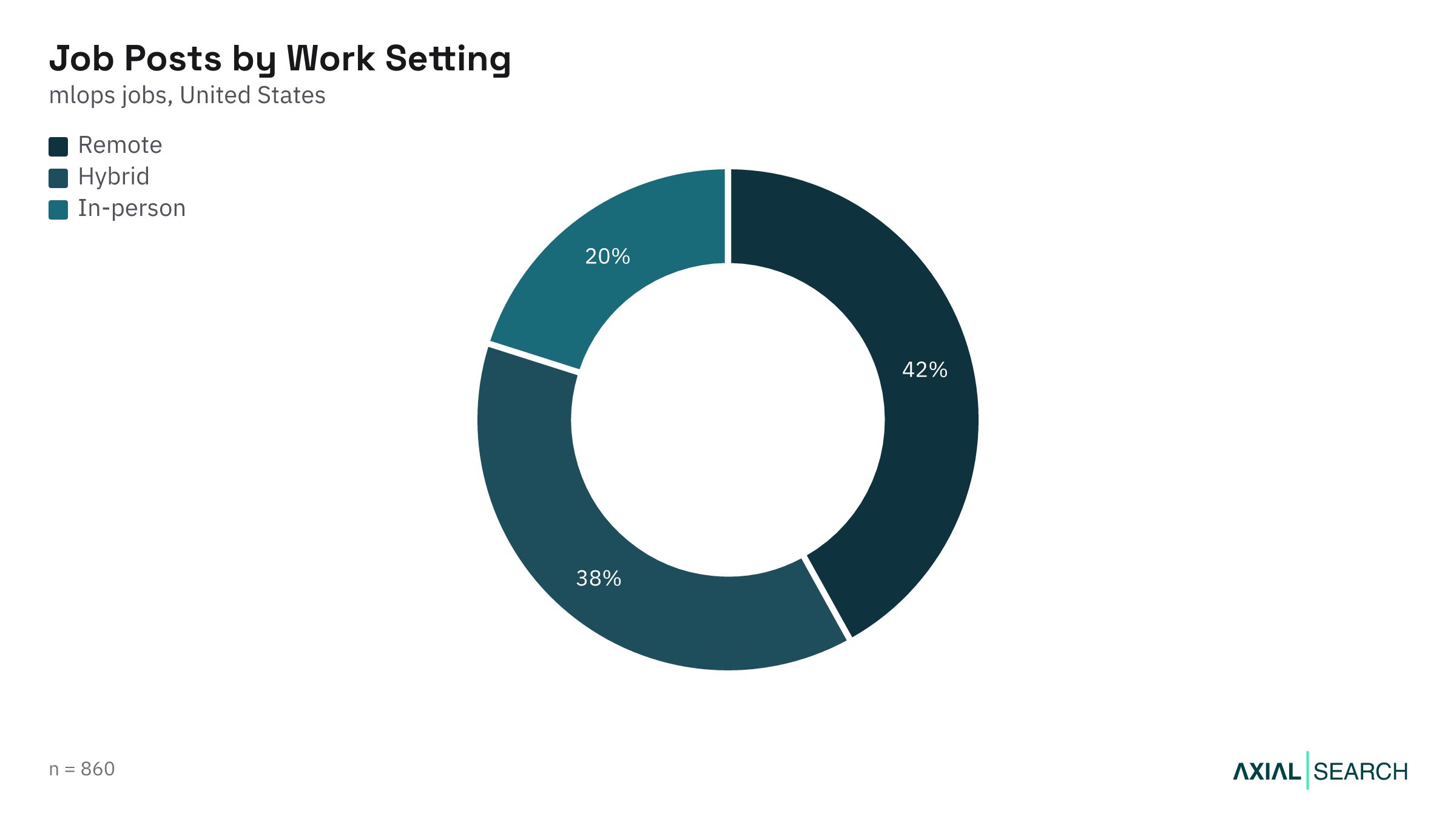
So while the work clusters in a few cities — as we'll see next — a meaningful share of it can be done from anywhere, which widens your candidate pool if you're willing to hire remote. The remote share is higher in MLOps than in most AI functions, likely because the work is infrastructure-focused and doesn't require constant face-to-face collaboration.
Where is MLOps talent concentrated?
MLOps talent concentrates in California, Texas and New York — the top six states hold the majority of the market.
| State | Share of postings |
|---|---|
| California | 28% |
| Texas | 10% |
| New York | 8% |
| Washington | 5% |
| Massachusetts | 5% |
| Virginia | 4% |
| Pennsylvania | 4% |
| Georgia | 3% |
California's dominance is partly a function of sheer volume in the Bay Area, but Texas, New York, Washington and Massachusetts all show up with meaningful counts. The work is more geographically concentrated than most AI hiring, yet a dozen states each post more than 50 roles, so employers outside the Bay Area can still build teams locally if they're willing to compete on comp and remote flexibility.
The top cities for MLOps roles
San Francisco is the single biggest market by a wide margin, posting nearly one in ten of all US MLOps roles — 9.3% when remote-only postings are excluded.
Sunnyvale follows at 4.2%, Seattle at 4.1%, Austin at 3.5%, Boston at 3.3% and Chicago at 3.2%. The Bay Area cities together account for roughly a sixth of the national market, but Seattle, Austin and Boston each post a meaningful share of their own.
How do you assess MLOps candidates?
Assess MLOps candidates on what they've operated in production, not on modeling trivia — Python (78%), cloud platforms (69%) and MLOps tooling (69%) are the skills the market actually screens for, so start there.
Ask them to walk through one production incident they resolved, including how they found out something was wrong and what they changed. That single question filters more effectively than a stack of algorithm puzzles, because MLOps is a delivery-and-reliability discipline, not a research one.
Technical questions to screen MLOps candidates on
Ask the candidate to walk through a real deployment pipeline they built: how models got from development into production, how they monitored them, and how they knew something had broken. Follow with specifics on their stack — which cloud platform, whether they've used Docker and Kubernetes, whether they've worked with an MLOps orchestration tool like MLflow — since cloud platforms (69%) and containerization (51%) are what the market actually screens for.
Push past the happy path. Ask what broke after launch, how they found out, and what they changed. A candidate who can only describe the build, not the operating of it, isn't ready for a production-heavy role.
System-design questions for senior MLOps candidates
For Senior and Principal IC candidates, ask them to design a deployment pipeline end to end on a whiteboard: model packaging, serving infrastructure, monitoring and rollback. The Principal IC band pays more than Director or VP roles, so hold that bar to a genuinely architectural level, not just a scripting one.
Ask how they'd detect a model that's still returning answers but has drifted silently in production. That question separates candidates who've operated systems from candidates who've only trained them.
Red flags to watch for when interviewing MLOps candidates
Watch for candidates who can describe model training fluently but go vague the moment you ask about deployment, monitoring or what happens when a system fails. That gap is common and it's the exact gap this market pays a premium to avoid.
Also watch for a portfolio that's all notebooks and no shipped pipelines — the leadership profile data across the MLOps job market puts hands-on execution and architectural fluency at the top of what employers screen for, and a candidate who's only trained models in isolation hasn't demonstrated it yet.
Final Thoughts
For employers. You're competing for a narrow, technical pool, with two-thirds of demand concentrated in mid-to-senior IC roles. The capabilities that matter most — hands-on execution and architectural fluency — are the hardest to screen for on paper. Interview around production systems candidates have built and operated, not certifications they hold, and be ready to move quickly. The Principal IC band pays above Director and VP, so if you're hiring senior technical talent, expect them to negotiate as hard as your management candidates do.
Methodology & sources
- Data sources. Job data is collected from publicly available postings on online job boards and updated weekly, covering US roles posted since January 2026. Explore and filter it on our live AI job market dashboard.
- Hiring demand is the count of matching postings per week.
- Company size, seniority, job type and work setting are each group's share of postings. Work-setting shares are computed over the postings that state a work model — the rest are silent, not counted as a category.
- Top states and cities are ranked by share of postings; remote-only postings are excluded from the cities list.
- Salary figures cited in this article are drawn from the subset of postings that state a salary range; percentiles and medians are calculated within each seniority band and reported in full in MLOps salaries. Bonus and equity figures reflect the share of postings that mention those forms of compensation.
- The interview questions are built from what postings in this dataset ask for, plus Axial Search's own placement experience — they are guidance, not a guarantee of what any single employer should require.

What It Takes to Land an MLOps Role in 2026
How to become an MLOps professional in 2026: the leadership capabilities employers screen for, the experience and degrees required, the certifications that matter, and the skills most in demand across US postings.

How Much Do MLOps Engineers Make? 2026 Benchmarks
What MLOps roles pay in 2026: median salary, pay by seniority, top-paying sectors and locations, and how often bonus and equity are mentioned in US job postings.

How Hot Is the MLOps Job Market in 2026?
The complete picture of the MLOps job market in 2026: hiring demand, what these roles pay, where the jobs are, who's hiring and what it takes to get in.
Turn AI ambition into lasting business value
Whether you're hiring your first AI leader or scaling enterprise transformation capability, we help you define, assess and recruit the people who make it stick.