
What It Takes to Land an MLOps Role in 2026
How to become an MLOps professional in 2026: the leadership capabilities employers screen for, the experience and degrees required, the certifications that matter, and the skills most in demand across US postings.
 Updated: July 31, 2026
- MLOps prioritizes hands-on execution over strategic vision — employers want delivery engineers who can operationalize models, not architects designing from 30,000 feet.
- The market skews mid-level IC: 69% of MLOps postings target individual contributors at mid or senior level, making the function more accessible early-career than most AI roles.
- Computer Science dominates the degree requirement — 68% of postings naming a field specify CS, more than double the next closest discipline.
- Certifications barely register in MLOps hiring — the highest-cited credential (CKA) appears in under 1% of postings; build systems, not badge collections.
- Cloud fluency is non-negotiable for MLOps roles: AWS alone appears in over half of postings, and the big three platforms (AWS, Azure, GCP) together define infrastructure expectations.
- Only 13% of MLOps postings mention equity and 24% mention bonus structures — total comp in this function tilts heavily toward base salary.
What leadership profile do employers screen for in MLOps roles?
MLOps is a hands-on execution role, and the profile screened for across 1,959 US postings flips the strategy playbook on its head — hands-on execution and architectural fluency top the list nearly level, with AI literacy close behind.
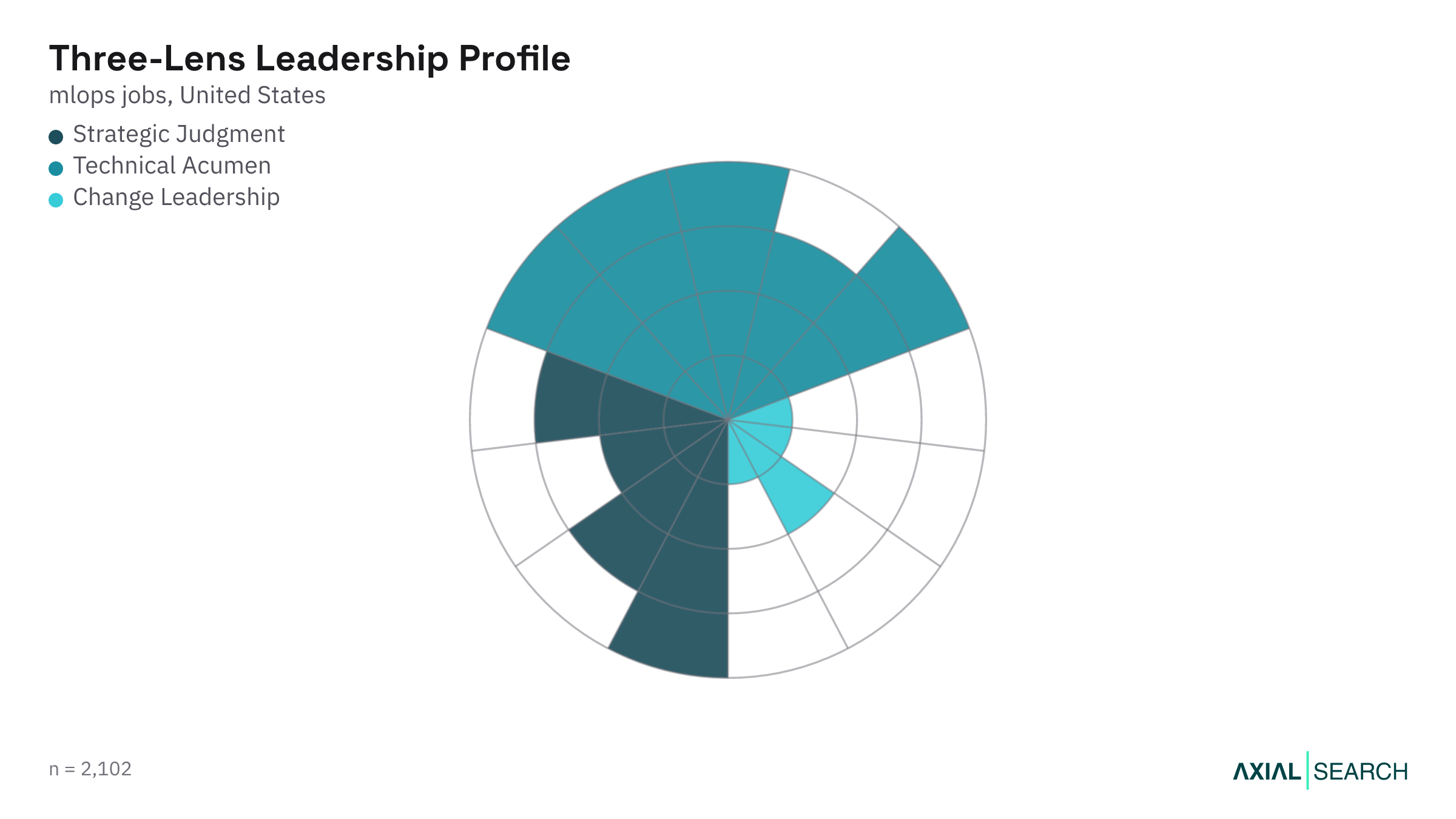
Our Three-Lens Leader framework scores every role across strategic judgment, technical acumen and change leadership, and for MLOps the four highest-scoring capabilities are all technical: building and running the systems that get models into production reliably, understanding how those systems fit together, and knowing what models do and where they break. Data readiness judgment rounds out the top five, because pipelines and monitoring are the heart of the job.
When you position yourself, lead with deployment reliability: the pipelines and monitoring you built, the incidents you engineered away, the systems you kept running under load. This is exactly the profile AI recruitment is built to identify.
Which capabilities matter least for MLOps roles?
Securing sponsorship, shaping the narrative and engaging the organization rank at the bottom of what employers screen for in MLOps roles.
Employers want people who can build and operate, not people who can sell what might be built — a sharp contrast with AI strategy roles, where those same capabilities top the list.
What qualifications do MLOps engineers need?
The baseline is roughly 5 years of experience plus a technical degree, which 64% of MLOps postings require. It's a pragmatic bar — lower than strategy or product leadership but still substantive.
The real differentiator is in the skills below, not the credentials here.
How much experience MLOps roles expect
Most MLOps roles ask for around five years of experience, rising to six at Principal IC and Manager level and eight at Director.
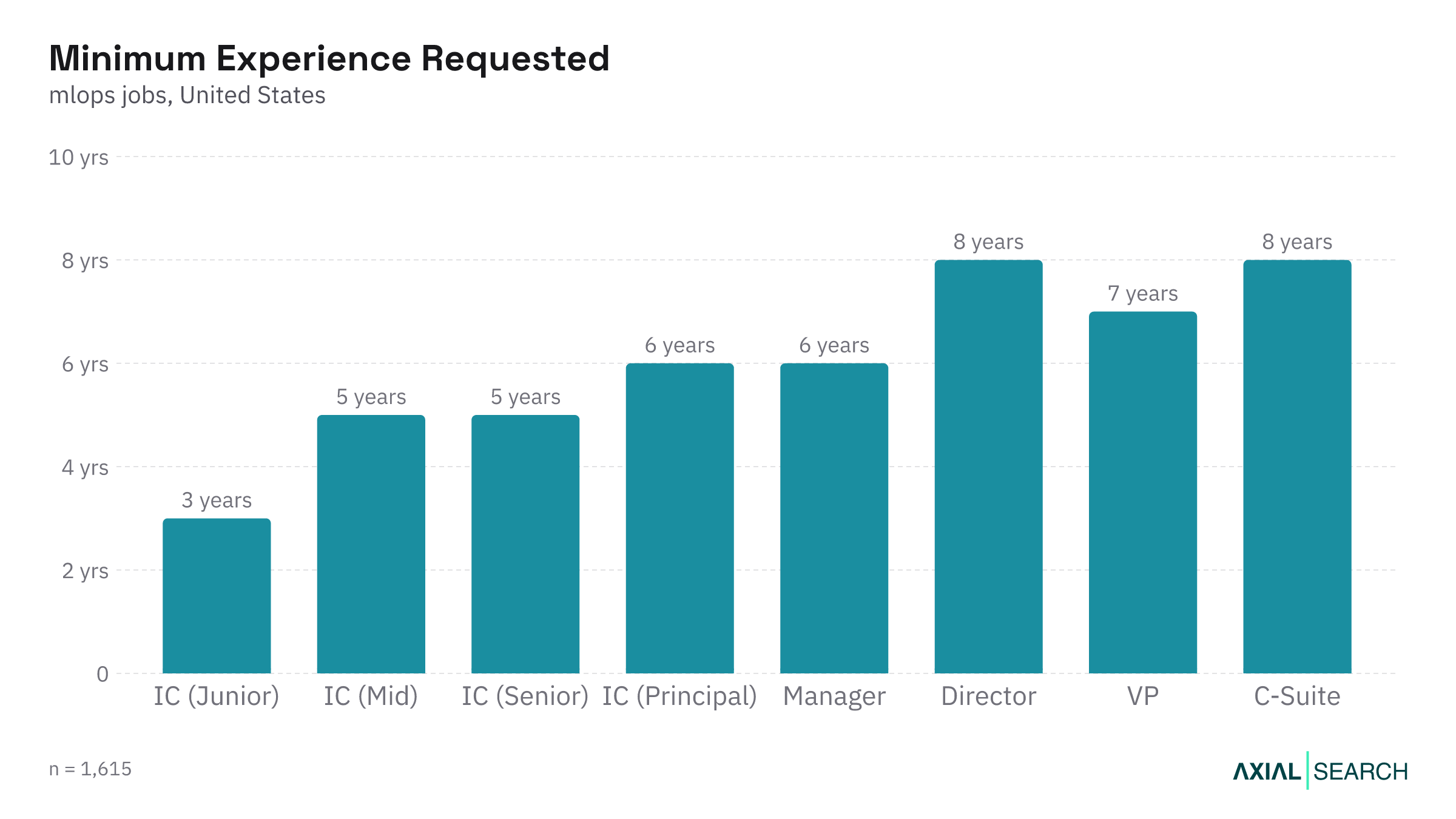
Given that 69% of the market sits at mid or senior IC roles, MLOps is more accessible earlier in your career than most AI functions. You can arrive having spent a few years as a software engineer or data engineer and make the jump without a decade under your belt.
Degrees and fields MLOps employers want
Just under two-thirds of MLOps postings require a degree, and a bachelor's clears the bar for the vast majority of roles.
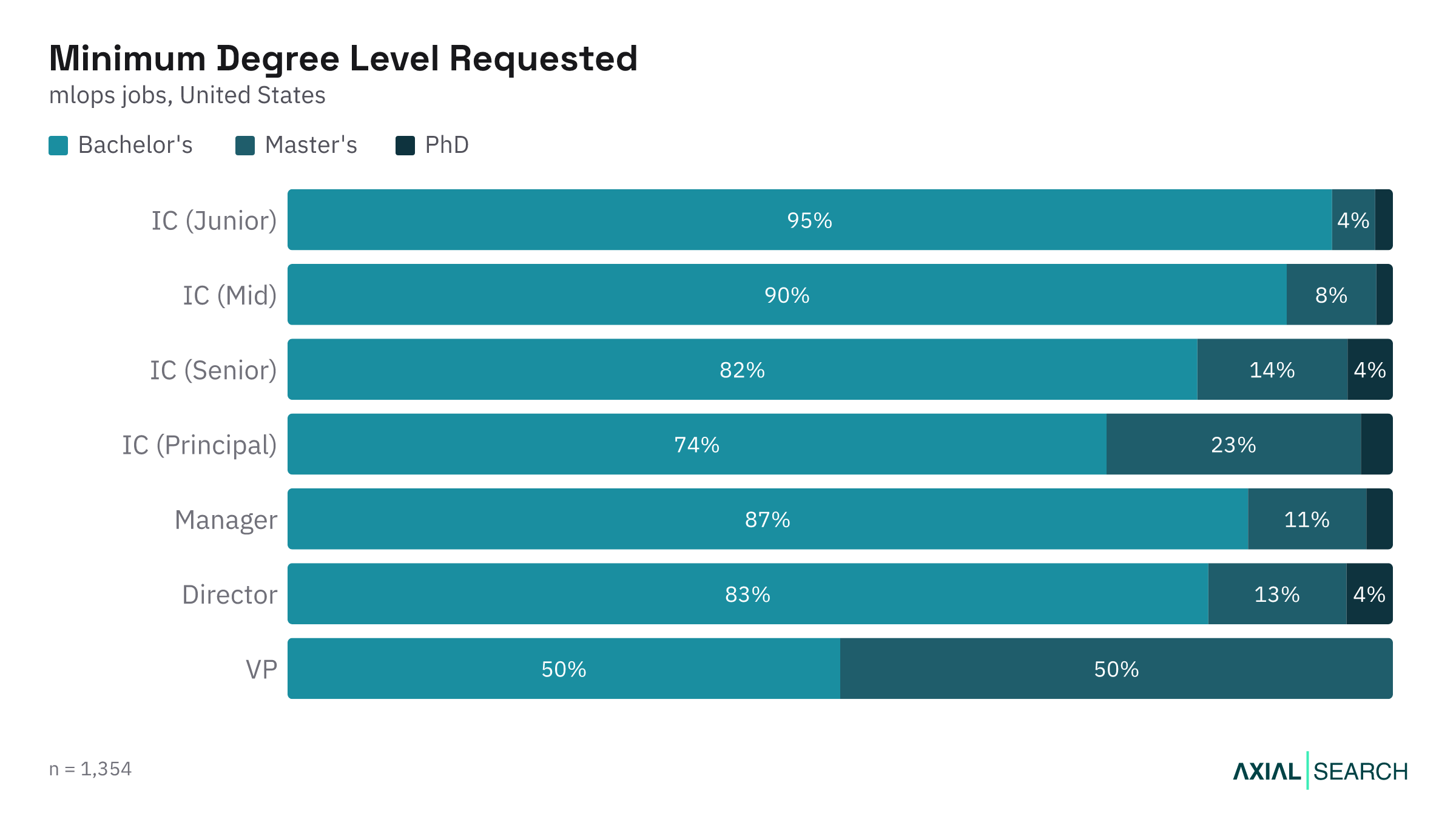
Advanced degrees stay rare even at the top — half of VP postings ask for a master's, but PhDs remain a small share across all levels. The field you studied matters, and it matters a lot:
| Degree field | Share of postings |
|---|---|
| Computer Science | 67.8% |
| Engineering | 32.9% |
| Machine Learning | 17.5% |
| Data Science | 17.1% |
| Software Engineering | 12.8% |
| Mathematics | 9.1% |
| Statistics | 8.6% |
| Electrical Engineering | 4.7% |
Computer Science alone accounts for two-thirds of degree requirements — more than double the next field. Engineering, Machine Learning and Data Science together make up another chunk, but the message is clear: this is a computer-science-first function. If your degree is in a business or social-science field, you'll need to demonstrate unusually strong technical delivery to compensate, or consider that your route in may be through a different AI role first.
Which certifications matter for MLOps engineers?
Certifications barely move the needle in MLOps hiring — the highest-mentioned credential, CKA (Certified Kubernetes Administrator), appears in under 1% of postings.
| Certification | Share of postings |
|---|---|
| Certified Kubernetes Administrator (CKA) | 0.7% |
| Security Essentials Certification (GSEC) | 0.6% |
| Cisco Certified Network Associate (CCNA) | 0.6% |
| Systems Security Certified Practitioner (SSCP) | 0.6% |
| Certified Kubernetes Security Specialist (CKS) | 0.5% |
| Certified Information Systems Security Professional (CISSP) | 0.5% |
| AWS Certified Machine Learning - Specialty | 0.5% |
| Google Cloud Certified - Professional Data Engineer | 0.3% |
The signal here is what's absent: there is no MLOps certification that moves the hiring needle. Employers hiring MLOps engineers care vastly more about what you've built than what course you passed.
Which cloud and infrastructure certifications appear most in MLOps postings
The few credentials that do appear split between Kubernetes (CKA, CKS), security (GSEC, SSCP, CISSP) and cloud-specific badges (AWS ML Specialty), each mentioned in under 1% of postings.
These are niche markers for deep specialists, not general requirements. If you already hold one, mention it; don't delay applying to go collect one.
Which skills matter for MLOps roles?
Depth and breadth both matter here — Python appears in 78% of MLOps postings, cloud platforms in 69% and MLOps tooling itself in 69%.
Employers want fluency across the stack — languages, platforms, orchestration, monitoring — and they want to see it in nearly every posting.
The capabilities MLOps roles need
Python is table stakes — more than three-quarters of postings name it explicitly.
| Capability | Share of postings |
|---|---|
| Python | 77.5% |
| Cloud Platforms | 68.9% |
| MLOps (Machine Learning Operations) | 68.7% |
| Observability & Monitoring | 65.1% |
| CI/CD (Continuous Integration / Continuous Delivery) | 57.8% |
| Containerization | 51.2% |
Cloud fluency and MLOps tooling follow immediately behind, which tells you the job is less about writing models and more about operationalizing them. Observability and monitoring remain a top priority, a reminder that keeping systems running matters as much as standing them up in the first place. CI/CD and containerization round out the top six, the delivery-engineering backbone that separates MLOps from pure data science.
Software and tools MLOps roles use
AWS leads by a significant margin, named in more than half of all MLOps postings.
| Software / tool | Share of postings |
|---|---|
| Amazon Web Services (AWS) | 54.6% |
| Docker | 43.5% |
| Microsoft Azure | 38.3% |
| PyTorch | 34.2% |
| MLflow | 30.2% |
| Google Cloud Platform (GCP) | 29.6% |
Docker sits second — containerization is not optional. Azure and GCP together cover another two-thirds of the market, so fluency in at least one of the big three clouds is a practical requirement. PyTorch appears more often than TensorFlow in this dataset, though both frameworks still trail the infrastructure platforms. MLflow, the most-cited MLOps orchestration tool, shows up in just under 30% of postings, which means it's common but not universal. Remember that these are the tools postings mention — a platform not listed isn't disqualifying.
How do you become an MLOps engineer?
Becoming an MLOps engineer takes roughly 5 years of hands-on delivery experience and a track record of production systems you've operated, not just built.
Pull the threads together and a clear playbook emerges.
What to lead with when applying for MLOps roles
The single strongest thing you can show is a track record of building and maintaining production ML systems — that's what the leadership profile rewards, and it's what separates an MLOps engineer from a data scientist or a software engineer.
Lead with what you've shipped and kept running, not what you might build someday.
What credentials back up an MLOps application
Evidence the roughly five years, the computer-science degree if you have it, and fluency in Python, cloud platforms, CI/CD and observability.
These aren't nice-to-haves — they're the baseline this market screens against.
How to demonstrate platform breadth for an MLOps role
Be able to talk credibly about AWS, Azure or GCP infrastructure, Docker and Kubernetes, and MLOps orchestration tools like MLflow or Kubeflow, without needing to be the world expert in any one.
Breadth across the deployment stack is the goal, demonstrated through what you can discuss with confidence, not a checklist of tools you've merely touched.
Do you need certifications to become an MLOps engineer?
No — there's no credential that unlocks this market, so invest that time in contributing to open-source MLOps projects, writing about production incidents you've resolved, or building a portfolio of deployed systems.
Artifacts beat badges. If you're on the other side of the table, building an MLOps team rather than joining one, this is exactly the profile that makes AI recruitment challenging — the combination of depth and breadth is rare, and the candidates who have it are in high demand.
What does an MLOps career path look like?
An MLOps career path runs from Junior IC (3 years of experience) through Mid and Senior IC (5 years) to a fork at Principal IC or Manager (6 years) — and unlike most functions, the Principal IC track pays more than Director or VP roles at the median, not just close to it.
That means you don't have to trade deep technical work for a bigger paycheck. The ladder has two rungs at the top, and the data favors staying on the technical one: Principal ICs out-earn both Director and VP roles at the median, so the choice comes down to whether you want to keep building or start managing, not which one pays better.
Final Thoughts
For candidates. MLOps roles reward execution over vision, so your strongest positioning move is showing what you've operationalized — not what you might build someday. Lead with deployed systems, resolved incidents and the pipelines you kept running under load; back it with Python, cloud fluency and the roughly five years most postings expect. Certifications barely register in this market, so skip the badge-collecting and put that energy into open-source contributions or a portfolio of production work. If you're coming from software or data engineering, the jump is accessible earlier in your career here than in most AI functions. If you lean more toward building scalable inference systems than managing deployment workflows, ML engineering careers offer a closer technical fit.
For employers. The MLOps profile combines technical breadth — cloud platforms, containerization, CI/CD, monitoring — with hands-on delivery experience, and that combination is rare. Most postings target mid-level ICs, which means you're competing for a concentrated talent pool that gets snapped up quickly. If you're asking for five years of experience, Computer Science degrees and fluency across AWS, Docker and MLOps tooling, you're describing the baseline, not a differentiator — so lead with what makes your environment compelling: the scale of your production ML systems, the autonomy your engineers have, the incidents they'll get to solve. Certifications won't help you filter candidates; shipped systems will.
Methodology & sources
- Data sources. Job data is collected from publicly available postings on online job boards and updated weekly, covering US roles posted since January 2026. Explore and filter it on our live AI job market dashboard.
- Requirements are extracted from job descriptions using a combination of programmatic rules and AI analysis. Minimum experience is the median minimum years requested by seniority; minimum degree is the lowest degree a posting requires.
- Top degree fields, certifications and skills are the items mentioned most often across postings.
- These are mention rates — the share of postings that state each item. A skill, degree or certification not appearing means it wasn't stated in the posting, not that it isn't valued.

How Much Do MLOps Engineers Make? 2026 Benchmarks
What MLOps roles pay in 2026: median salary, pay by seniority, top-paying sectors and locations, and how often bonus and equity are mentioned in US job postings.

How Hot Is the MLOps Job Market in 2026?
The complete picture of the MLOps job market in 2026: hiring demand, what these roles pay, where the jobs are, who's hiring and what it takes to get in.

Who's Hiring MLOps Engineers in 2026
Where MLOps jobs are in 2026: hiring demand and trend, top states and cities, who's hiring by sector and company size, and the mix of seniority, contract type and remote work across US postings.
Turn AI ambition into lasting business value
Whether you're hiring your first AI leader or scaling enterprise transformation capability, we help you define, assess and recruit the people who make it stick.