
Analyzing AI Product Management Hiring in 2026
Where AI product jobs are in 2026: hiring demand and trend, top states and cities, who's hiring by sector and company size, and the mix of seniority, contract type and remote work across US postings.
 Updated: August 26, 2026
- Steady demand: AI product hiring runs at a stable clip with no boom-bust cycle — candidates see a predictable flow, employers face consistent competition.
- Manager-heavy market: 47% of AI product postings are Manager-level — this is a mid-to-senior leadership market where the direct entry route is narrow.
- Enterprise leads, but SMBs show up: Large companies (10,001+ employees) post 41% of roles, but small and mid-size firms under 500 employees account for 30% — AI product hiring spans the size spectrum.
- Real flexibility on location: Of AI product postings that specify work setting, 48% are hybrid and 32% are fully remote — only one in five requires strict on-site presence.
- San Francisco leads, but it's national: California and New York hold 41% of AI product postings, yet Seattle, Austin and Chicago all show meaningful volume — the work is more nationally distributed than the coastal headline suggests.
What will you need to pay to hire AI product managers?
Budget a median AI product salary across the ladder, with median salary running higher for Directors than for Managers — and the Principal IC track landing close behind, nearly matching Director money.
That's the posted band, not the final offer. Bonus (mentioned in 48% of AI product postings) and equity (5%) sit on top, and they're not evenly spread — equity peaks at the Principal IC level, bonus peaks at VP. For the full breakdown by seniority, sector and location, see AI product salaries.
How AI product pay changes with seniority
Pay climbs through Manager and Director, then splits at the top: the Principal IC track pays close to Director money, which is unusual and worth knowing before you set a leveling structure for a technical product hire.
If you're building a req around a Manager title expecting to underpay a senior technical candidate, the data says otherwise — a Principal IC candidate can credibly ask for Director money, and often gets it, exactly the kind of leveling mistake AI recruitment helps you avoid before you're bidding against the wrong candidate pool.
Where bonus and equity fit into an AI product offer
48% of AI product postings mention a bonus and 5% mention equity, and neither is spread evenly across levels — bonus peaks at VP, equity peaks at Principal IC (33%).
If you're competing for a Principal IC candidate, an equity component is doing more work in that conversation than it will for a Manager hire.
How competitive is the market for AI product managers?
Competitive — just 2% of AI product postings target junior roles, and the market is built around ownership at Manager level and above, so growing your own talent internally takes longer than hiring it.
The direct entry route into AI product is narrow, and roughly 714 new US roles post every week with no slowdown, so the candidates you want are fielding multiple offers. Screening for judgment, not just delivery experience, is what separates a fast hire from a good one.
Why the AI product pipeline is thin at the top
Only a small fraction of AI product postings are individual-contributor roles at all, and just 2% of those are junior — so there's little of an internal ladder to promote from.
That means most experienced AI product leaders arrive having already led product, engineering or a technical function somewhere adjacent — a realistic build-your-own-bench plan takes years, not quarters.
Who are you competing with for AI product talent?
You're competing against enterprise-scale companies most often — 41% of AI product postings come from organizations with 10,000+ employees — but also against a meaningful small-company segment.
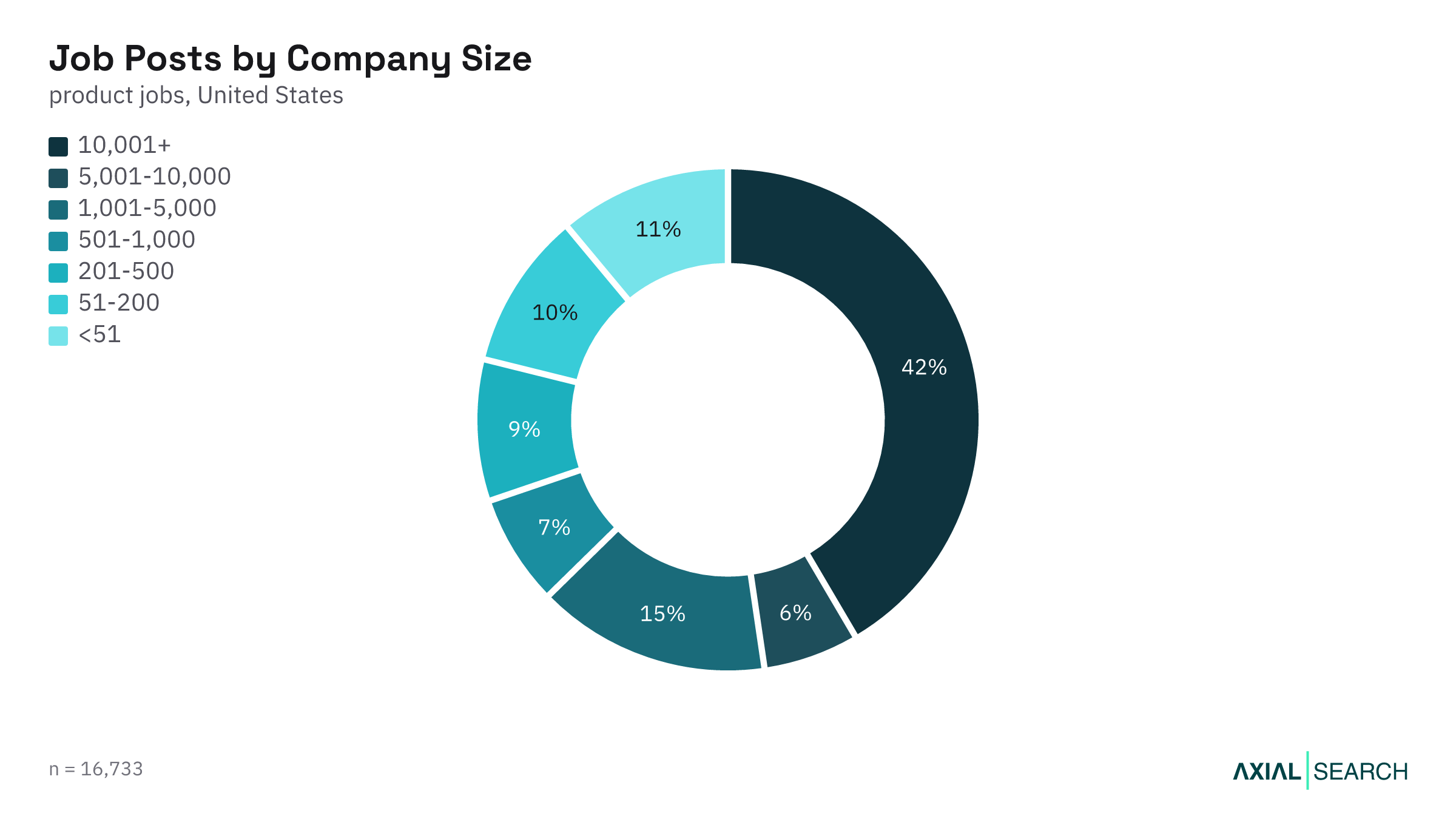
That split tells you AI product is both a big-platform hire and a growth-stage technical hire. The sector breakdown shows the same spread:
| Sector | Share of postings |
|---|---|
| Technology | 33% |
| Financial Services | 14% |
| Professional Services | 11% |
| IT Services | 9% |
| Telecom & Media | 6% |
| Manufacturing | 5% |
| Healthcare | 3% |
| Retail and Hospitality | 3% |
Technology posts the most by a wide margin, but Financial Services, Professional Services and IT Services all show meaningful volume. AI product hiring has spread well beyond tech-native companies into sectors that are building software and AI capabilities in-house.
What level of AI product hire do you actually need?
47% of AI product postings target a Manager-level hire, not a junior generalist and not, in most cases, a Director. The three cuts below describe the shape of the market so you can benchmark the req you're about to open.
Seniority levels in AI product hiring
Nearly half of all AI product postings are Manager-level and another quarter are Director-level.
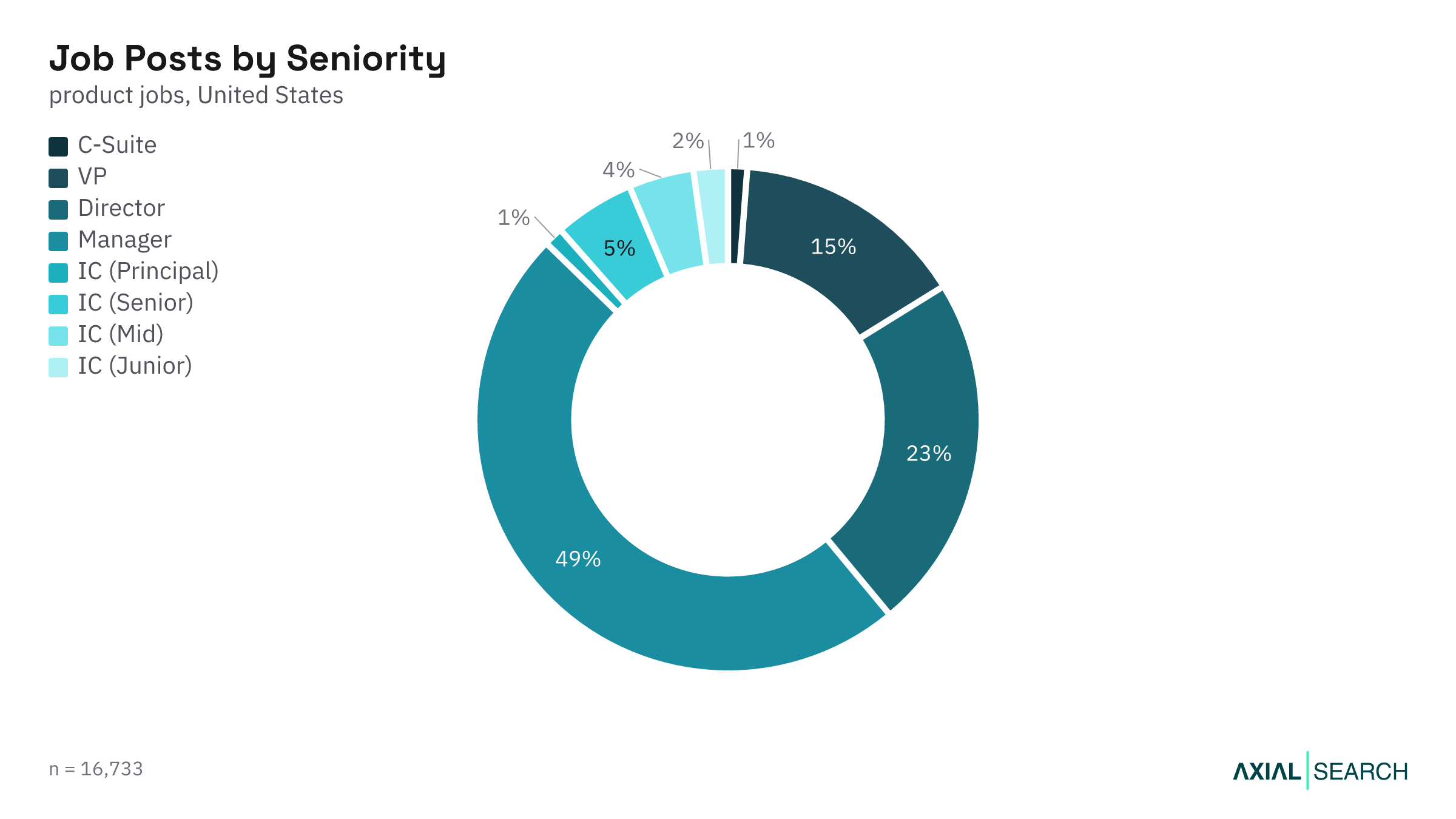
VP and C-Suite roles show up often enough to form a visible layer, but junior and mid-level individual contributor roles are rare. If you're early in your career, the direct route into AI product is narrow; most people arrive after proving they can lead something adjacent first. We break down what each seniority band pays in AI product salaries.
Full-time versus contract AI product roles
This is a permanent-hire market: 94% of AI product postings are full-time.
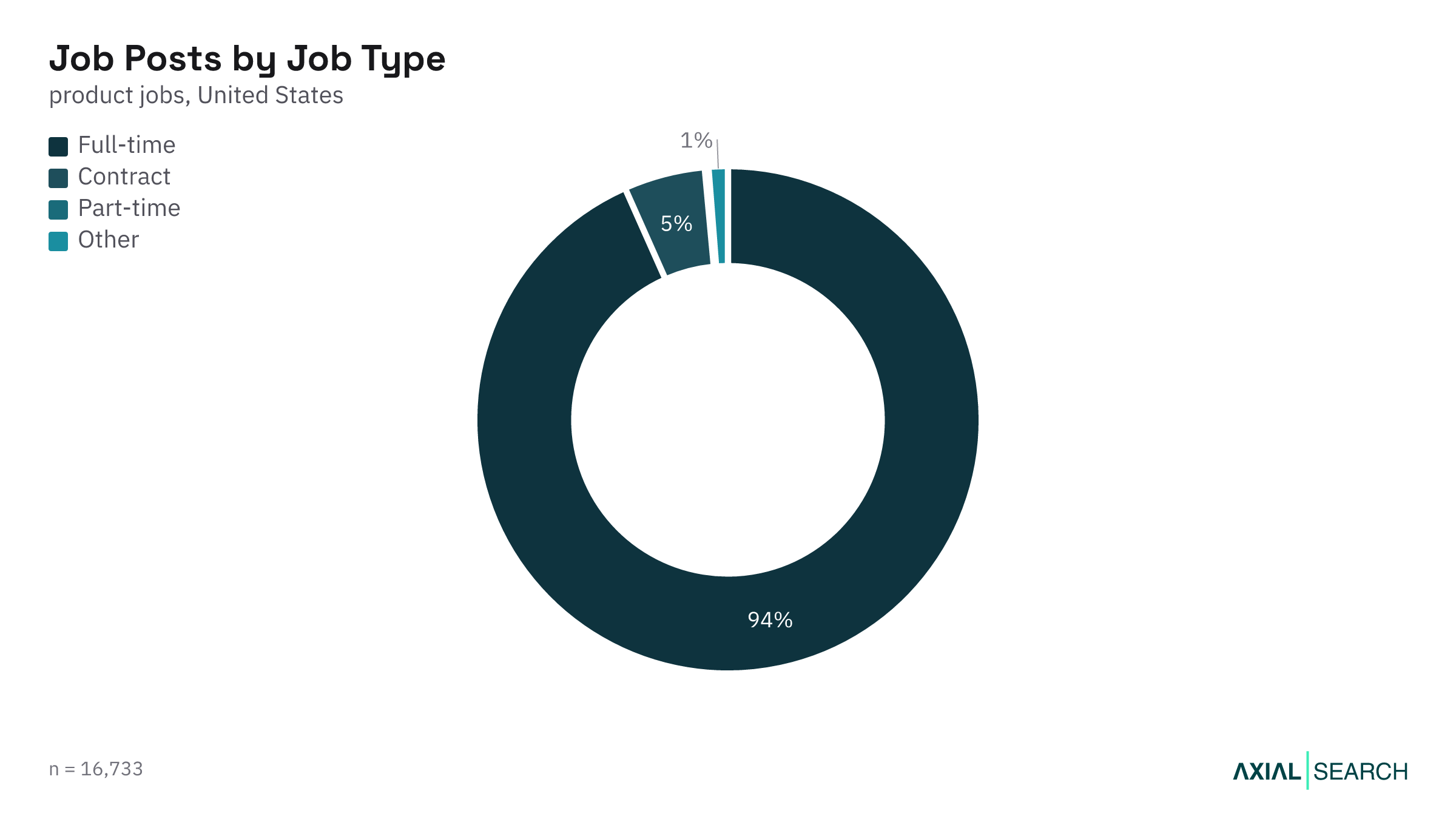
Companies are building product as a standing capability, not staffing it with contractors or consultants. The handful of contract and part-time roles that exist are outliers, not the norm.
Remote, hybrid and onsite AI product roles
Among postings that specify a work model, 48% are hybrid and 32% are fully remote.
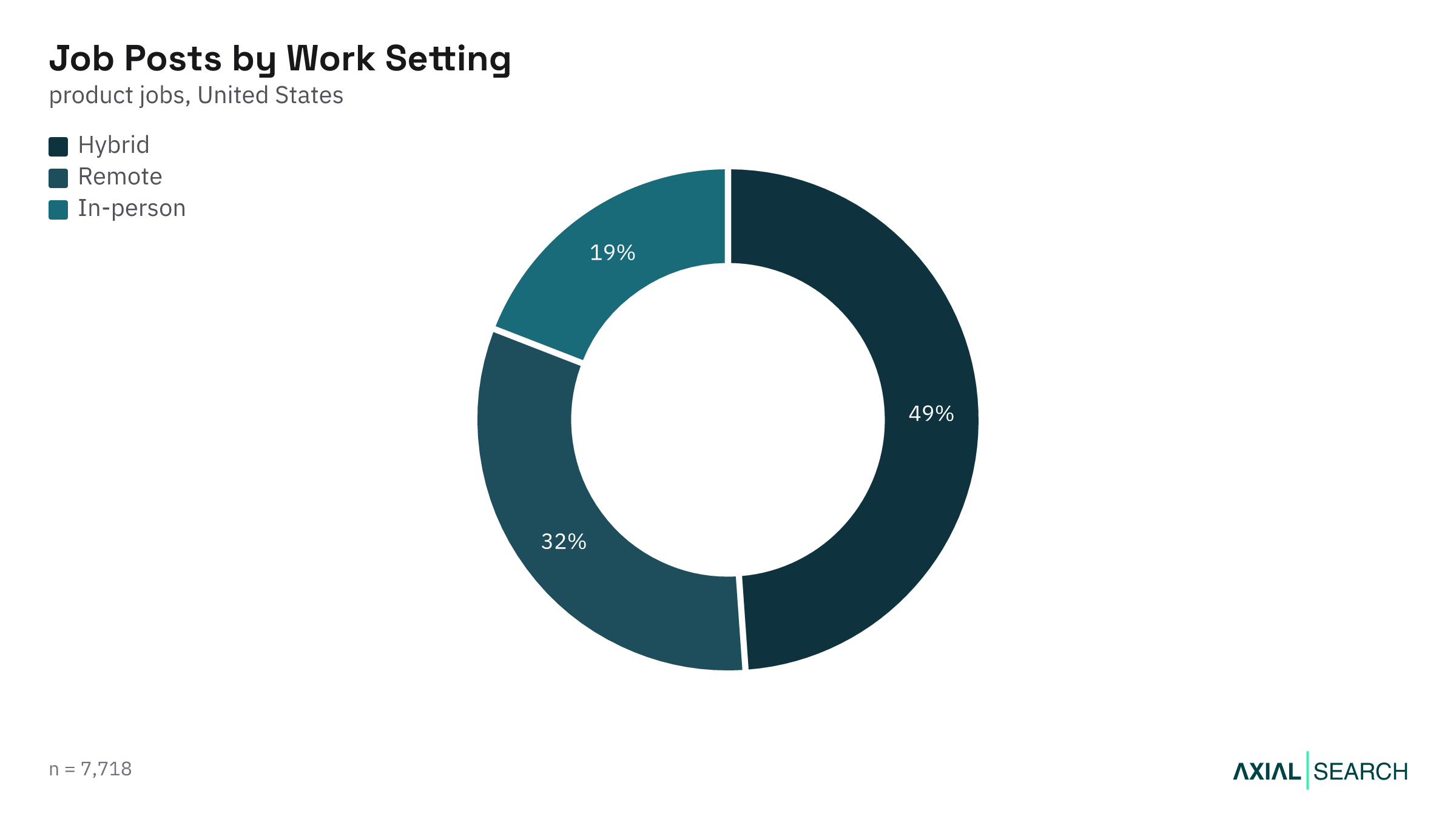
Only one in five is strictly on-site. If you're requiring people in the office five days a week, you've narrowed your addressable candidate pool considerably.
Where is AI product management talent concentrated?
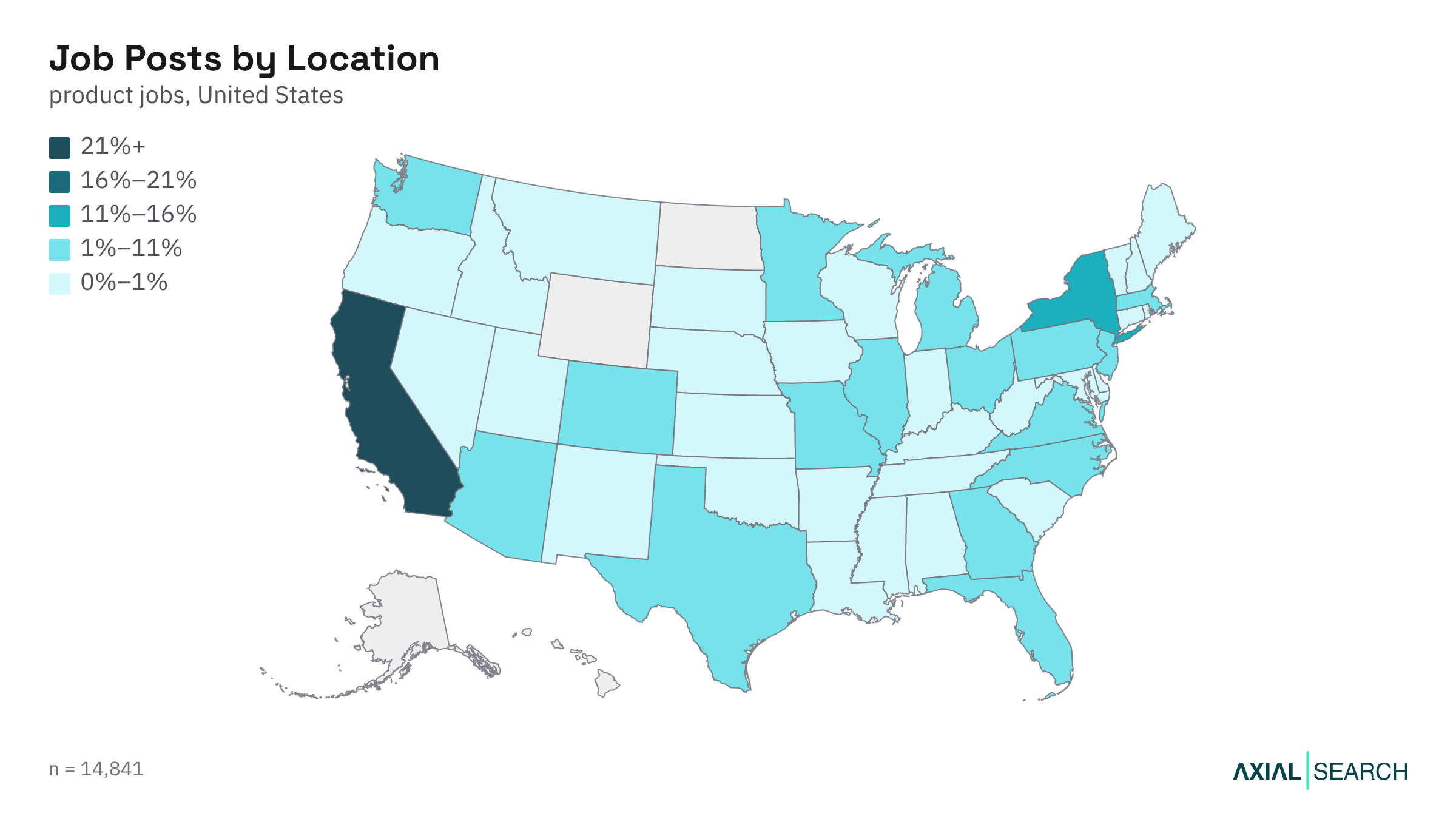
AI product talent concentrates in California (25% of postings) and New York (16%) — together 41% of the market, a big share but not a stranglehold.
| State | Share of postings |
|---|---|
| California | 25% |
| New York | 16% |
| Texas | 9% |
| Washington | 7% |
| Massachusetts | 4% |
| Illinois | 4% |
| North Carolina | 3% |
| Florida | 3% |
Texas, Washington and Massachusetts form a clear second tier. The presence of Washington (Seattle) and Texas (Austin) shows AI product hiring isn't just a Bay Area and New York story — it's national, with multiple tech hubs competing for talent.
The top cities for AI product jobs
San Francisco is the single biggest AI product market at 9.9% of postings, but the list below it is more distributed than you might expect.
| City | Share of postings |
|---|---|
| San Francisco, CA | 10.1% |
| Seattle, WA | 5.5% |
| Chicago, IL | 3.7% |
| Austin, TX | 3.6% |
| Boston, MA | 3.2% |
| San Jose, CA | 2.7% |
| Atlanta, GA | 2.5% |
| Mountain View, CA | 2.2% |
Seattle, Austin and Chicago all show meaningful volume, and Boston and San Jose round out the top six. If you're hiring in the Midwest or the South, you're not fishing in a dry pond.
How do you assess AI product management candidates?
Assess AI product candidates on the calls they made, not the features they shipped — use case selection tops what employers screen for, alongside real fluency with Agile delivery (28% of postings) and foundation models (19%).
Ask them to walk through one AI bet they championed end to end, including which problems they killed before they started. That single question filters more effectively than a portfolio review, because AI product is a judgment discipline with a delivery muscle, not the reverse.
Judgment questions to screen AI product candidates on
Ask the candidate to describe an AI use case they chose not to pursue and why — the reasoning behind what they said no to reveals more than a list of what they shipped. Follow with how they framed the business case for the ones they did pursue, and how they measured whether the bet paid off.
Push past the roadmap. Ask how they secured and kept executive sponsorship when an AI initiative hit a rough quarter — sponsorship is unusually important in this function, and a candidate who's never had to defend a bet under pressure hasn't been tested yet.
Delivery questions for senior AI product candidates
For Director and VP candidates, ask them to design the operating model for an AI product org: how they'd sequence bets, staff them and report progress to the executive team. Director pay lands close to the Principal IC track, so hold that bar to genuine organizational judgment, not just roadmap management.
Ask how they'd know six months in that a bet wasn't going to pay off, and what they'd do about it. That question separates candidates who've killed their own initiatives from candidates who've only ever defended them.
Red flags to watch for when interviewing AI product candidates
Watch for candidates who can describe a feature roadmap fluently but go vague the moment you ask why a specific use case was worth prioritizing over the alternatives — that gap is common and it's exactly what this market pays a premium to avoid.
Also watch for a background that's all delivery cadence and no use-case judgment — the leadership profile across AI product roles puts use case selection and AI literacy at the top of what employers screen for, and a candidate who's only run process hasn't demonstrated either yet.
Final Thoughts
For employers. You're competing for the same experienced AI product leaders everyone else wants, and the seniority mix explains why these hires are hard to close. 41% of postings come from enterprise-scale companies, but small and mid-size firms also participate in the market — this is a function that scales across company size, not just at the top. If you're requiring strict on-site presence, you've cut your addressable candidate pool significantly; hybrid and remote postings account for 80% of roles where work setting is specified. The candidates you want are evaluating multiple offers in parallel, so speed and clarity on scope matter more than another round of stakeholder alignment.
Methodology & sources
Data sources. Job data is collected from publicly available postings on online job boards and updated weekly, covering US roles posted since January 2026. Explore and filter it on our live AI job market dashboard.
Company size, seniority, job type and work setting are each group's share of postings. Work-setting shares are computed over the postings that state a work model — the rest are silent, not counted as a category.
Top states and cities are ranked by share of postings; remote-only postings are excluded from the cities list.
Salary figures cited in this article are drawn from the subset of postings that state a salary range; percentiles and medians are calculated within each seniority band and reported in full in AI product salaries. Bonus and equity figures reflect the share of postings that mention those forms of compensation.
The interview questions are built from what postings in this dataset ask for, plus Axial Search's own placement experience — they are guidance, not a guarantee of what any single employer should require.

AI Product Management Jobs in 2026: What 12,400 Postings Reveal
The complete picture of the AI product job market in 2026: hiring demand, what these roles pay, where the jobs are, who's hiring and what it takes to get in.

AI Product Management Salaries: 12,400 Postings, Benchmarked
What AI product roles pay in 2026: median salary, pay by seniority, top-paying sectors and locations, and how often bonus and equity are mentioned in US job postings.

The Skills That Land AI Product Management Roles in 2026
How to become a product professional in 2026: the leadership capabilities employers screen for, the experience and degrees required, the certifications that matter, and the skills most in demand across US postings.
Turn AI ambition into lasting business value
Whether you're hiring your first AI leader or scaling enterprise transformation capability, we help you define, assess and recruit the people who make it stick.