
What Intelligent Automation Roles Pay in 2026
What intelligent automation roles pay in 2026: median salary, pay by seniority, top-paying sectors and locations, and how often bonus and equity are mentioned in US job postings.
 Updated: August 20, 2026
- The ceiling matters more than the band. The intelligent automation market prices Director talent above VP at the top of the posted range, reversing the usual hierarchy.
- IC and management tracks converge at the top. Principal ICs out-earn Managers at the median, so staying technical doesn't cap your upside the way it does in most functions.
- Professional Services leads on pay. Intelligent automation in consulting pays $215,000 median salary, ahead of Life Sciences and Technology — the opposite of the pattern in most AI disciplines where tech pays best.
- Equity is rare until C-suite. Only 7% of intelligent automation postings mention equity overall, climbing to 41% at the executive tier but staying below 12% for every IC and mid-management level.
- Geography matters less than seniority. California leads at $204,000, but the gap between the top state and the fifth (New York at $185,000) is just $19,000 — tight compared to other AI functions.
- Bonus mention rates track rank, not function. 71% of C-suite intelligent automation postings advertise a bonus; just 16% of junior IC roles do, consistent with the broader AI market's pattern of rewarding executive accountability over execution.
How much do intelligent automation specialists make?
The median intelligent automation salary is competitive, and the Principal IC track pays close to Director money — Principal ICs out-earn Managers at the median, so staying technical doesn't cap your ceiling the way it does in most functions.
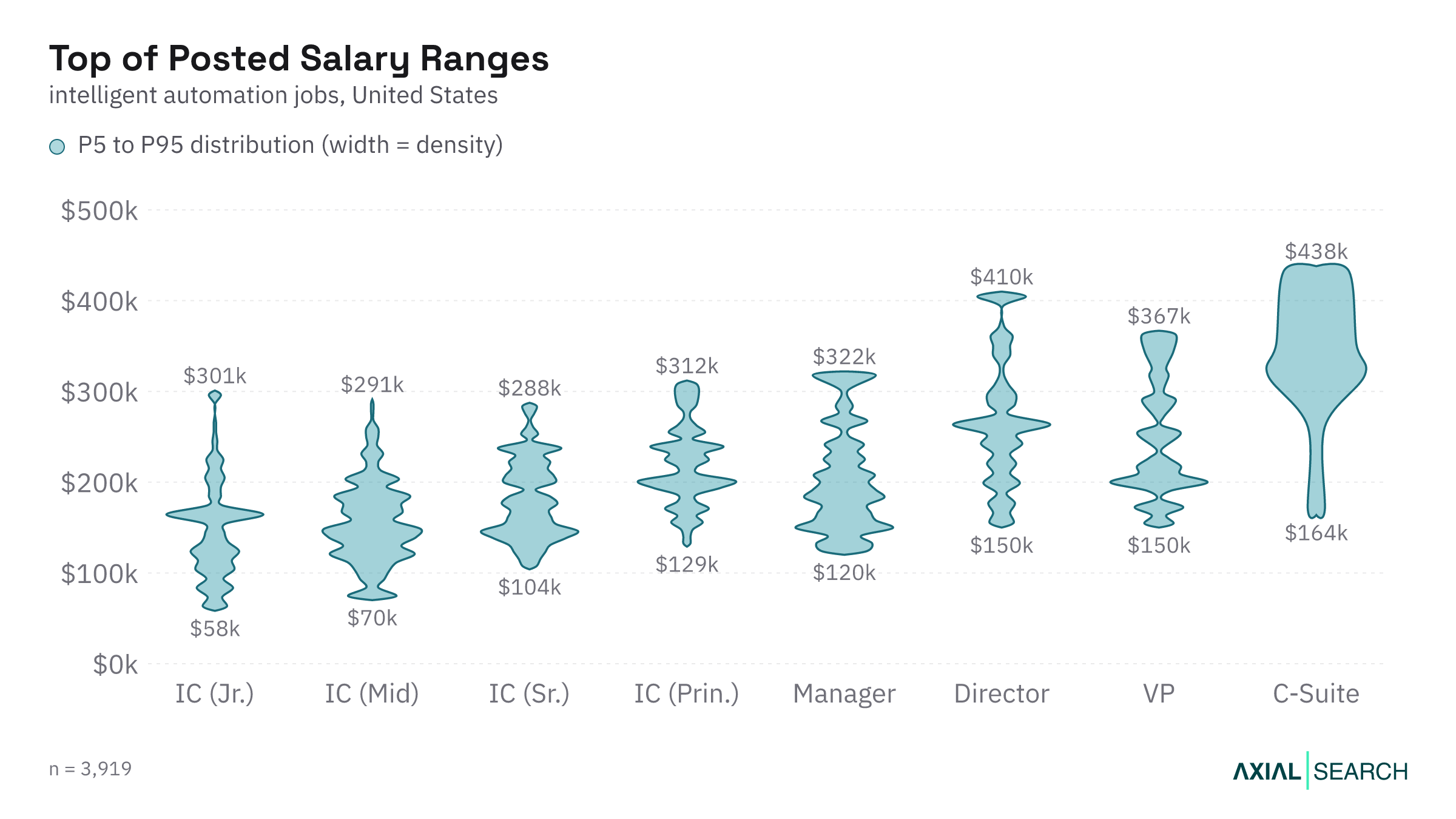
Top of the posted range by seniority — the median and typical maximum of what's posted, 5th to 95th percentile. This is the ceiling candidates can credibly negotiate toward, not the typical offer.
| Seniority | 5th percentile | 25th percentile | Median | 75th percentile | 95th percentile |
|---|---|---|---|---|---|
| IC (Junior) | $58,000 | $103,000 | $140,000 | $170,000 | $301,000 |
| IC (Mid) | $70,000 | $124,000 | $150,000 | $186,000 | $291,000 |
| IC (Senior) | $104,000 | $142,000 | $174,000 | $219,000 | $288,000 |
| IC (Principal) | $129,000 | $185,000 | $208,000 | $241,000 | $312,000 |
| Manager | $120,000 | $152,000 | $185,000 | $225,000 | $322,000 |
| Director | $150,000 | $210,000 | $260,000 | $297,000 | $410,000 |
| VP | $150,000 | $197,000 | $219,000 | $290,000 | $367,000 |
| C-Suite | $164,000 | $317,000 | $334,000 | $355,000 | $438,000 |
Where two percentiles show the same figure, employers are clustering on a round number at that end of the band. The distribution is fairly tight below Principal level, so the step from Senior IC to Principal or Manager to Director is where compensation jumps noticeably. At the executive tiers the medians converge — title moves your pay less than negotiation once you're past Director.
Where most intelligent automation salaries cluster
The market is densest at the Mid and Senior IC bands, where hiring volume is highest, so the middle of this distribution is where most candidates land.
For candidates, that means the promotion to Principal or Director is the inflection point worth optimizing for. For employers, it means retention risk is highest in the band just below those levels, where the next step up delivers the biggest lift.
Companies are pricing Directors above VPs in this function, likely because the role requires both technical depth and operational ownership. For candidates, that means the Director title carries more negotiating power than you'd assume from its place in the org chart; for hirers, it means trying to fill a Director mandate with a VP-titled role won't save you money — closing that kind of gap is exactly what AI recruitment built for this market is for.
What is the full salary range for intelligent automation specialists?
The full posted intelligent automation salary range runs from $58,000 at the 5th percentile for Junior ICs up to $438,000 at the 95th percentile for C-suite roles — see the table above for the full breakdown by seniority.
How much room is there to negotiate at the top of the intelligent automation range?
More than the median suggests — the gap between the median and the 95th percentile is unusually wide for Director postings, among the widest of any band in the table above.
That spread is the real story: the market has priced Director-level automation talent as a scarce asset, so the posted maximum is a starting point in negotiation, not a hard ceiling.
Which industries pay intelligent automation specialists the most?
Intelligent automation pays the most where process complexity and compliance risk are highest — Professional Services tops the table at $215,000 median salary, ahead of Life Sciences and Technology.
| Sector | Median salary | Postings |
|---|---|---|
| Professional Services | $215,000 | 509 |
| Technology | $208,000 | 658 |
| Life Sciences | $207,000 | 206 |
| Capital Markets & PE | $190,000 | 92 |
| Financial Services | $185,000 | 257 |
Financial Services and Capital Markets sit lower in the rankings, a departure from other AI functions where finance typically pays at or near the top.
How much does sector really matter for intelligent automation pay?
Less than you'd think — the gap between the top sector (Professional Services) and the bottom of this list (Financial Services) is relatively modest.
Sector matters, but seniority and the specific scope of the role move your pay far more. For candidates deciding between a Director role in Financial Services and a Manager role in Professional Services, the title will likely matter more than the sector.
Does company size affect intelligent automation pay?
Yes — enterprise-scale firms post a median salary around $210,000, nearly $35,000 ahead of mid-market firms, with startups sitting in between.
- Enterprise-scale (5,000+): highest around $210,000 median salary, with equity mentioned in some of those that disclose pay.
- Startup / small (<500): equity mentioned in a small portion of those that disclose pay.
- Mid-market (500–5,000): equity mentioned in a portion of those that disclose pay.
How pay differs by company size for intelligent automation roles
Enterprise-scale firms (5,000+ employees) post the highest median salary at $210,000.
Startups and small firms sit in between, which means the mid-market — not the smallest employers — is actually where base pay is weakest.
Does company size affect intelligent automation equity offers?
Yes, and the pattern inverts the usual assumption — equity appears more often at large firms than at small ones (10%).
That runs counter to the pattern in most tech functions. Intelligent automation at enterprise scale often carries retention risk — the best people leave for better-funded projects — so equity is used as a lock-in, not a substitute for cash.
Where do intelligent automation specialists earn the most?
Pay is geographically compressed for intelligent automation — the top states cluster within about $19,000 of each other, so where you work moves your salary less than how senior you are.
| State | Median salary | Share of postings |
|---|---|---|
| California | $204,000 | 12.9% |
| Washington | $200,000 | 2.7% |
| Massachusetts | $200,000 | 3.5% |
| Virginia | $187,000 | 3.6% |
| New York | $185,000 | 7.0% |
California is the standout, pairing the highest volume (13.2% of all postings) with top-tier pay.
How tight is the geographic spread in intelligent automation pay?
Tighter than most AI functions — the gap between the top state (California, $204,000) and the fifth (New York, $185,000) is relatively small.
That compression means geography is a secondary lever in a negotiation. Seniority and sector both move the number more than which state the role is posted in.
The top-paying cities for intelligent automation
Zoom into the metro level and the picture sharpens, though the range across the top tier stays narrow. The Silicon Valley core and the Pacific Northwest tech corridor lead the way — markets where the highest-value automation mandates concentrate.
The California markets and Seattle pay the most, but the gap between those metros and the next tier is narrower than in most AI functions. For where these roles are actually posted in volume, see our intelligent automation hiring guide.
How often are intelligent automation bonus and equity offered?
A bonus is mentioned in intelligent automation postings and equity in just 7% — both are floors, not ceilings, since many roles that don't advertise either still offer one.
Dollar figures are almost never posted, so a mention rate is the best signal available, and both climb sharply with seniority.
How often a bonus is offered
A bonus is mentioned in intelligent automation postings overall — less common than in strategy or executive roles, but common enough to ask about.
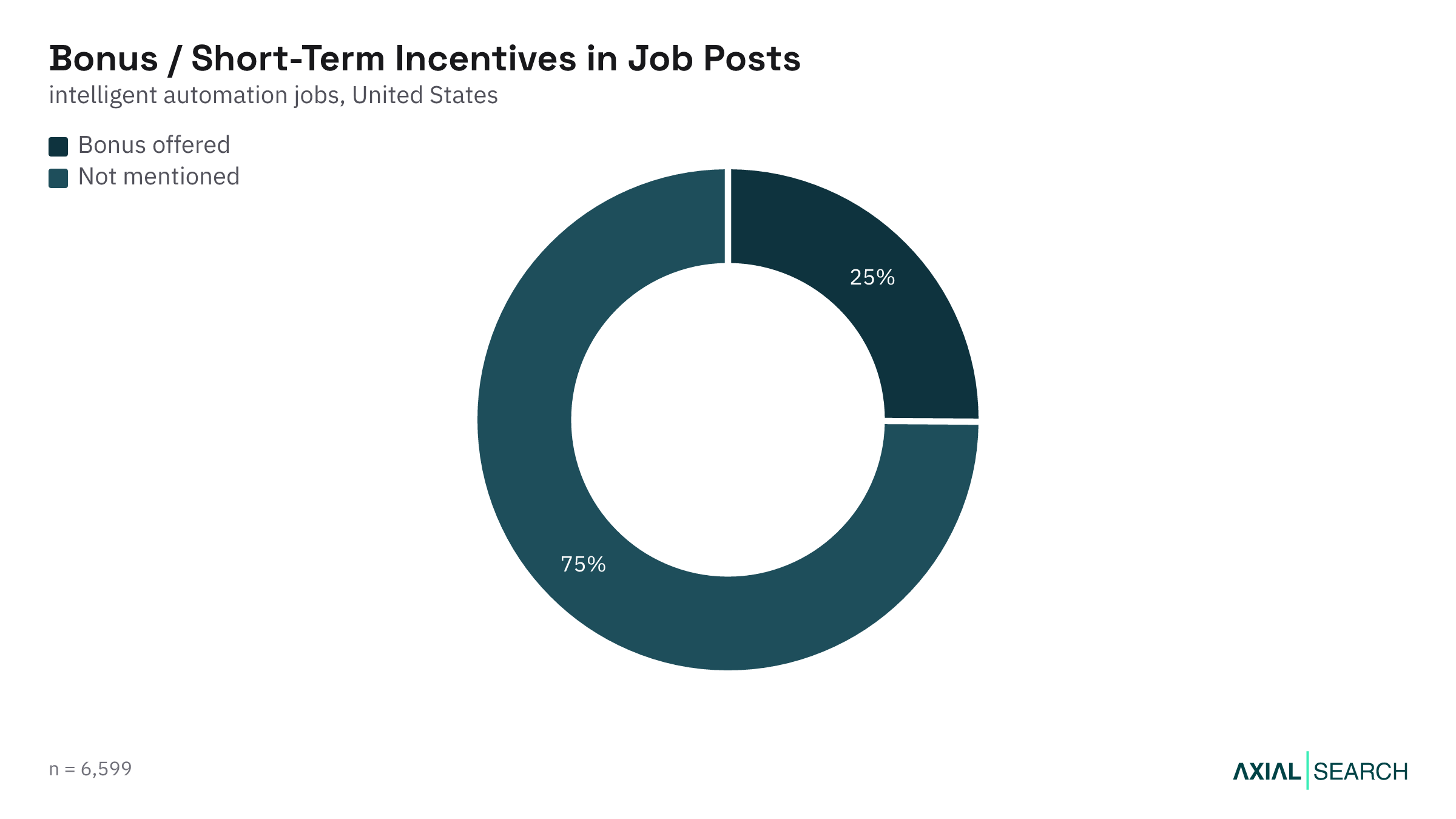
The mention rate climbs with seniority, with C-suite postings more likely to mention a bonus compared to junior IC level. The inflection point is Principal IC and Manager, where mention rates jump to the mid-30s. For candidates at those levels, if a bonus isn't in the initial offer, it's worth negotiating explicitly.
How often equity is offered
Equity is mentioned in just 7% of intelligent automation postings overall, the lowest rate of any level below the executive tier.
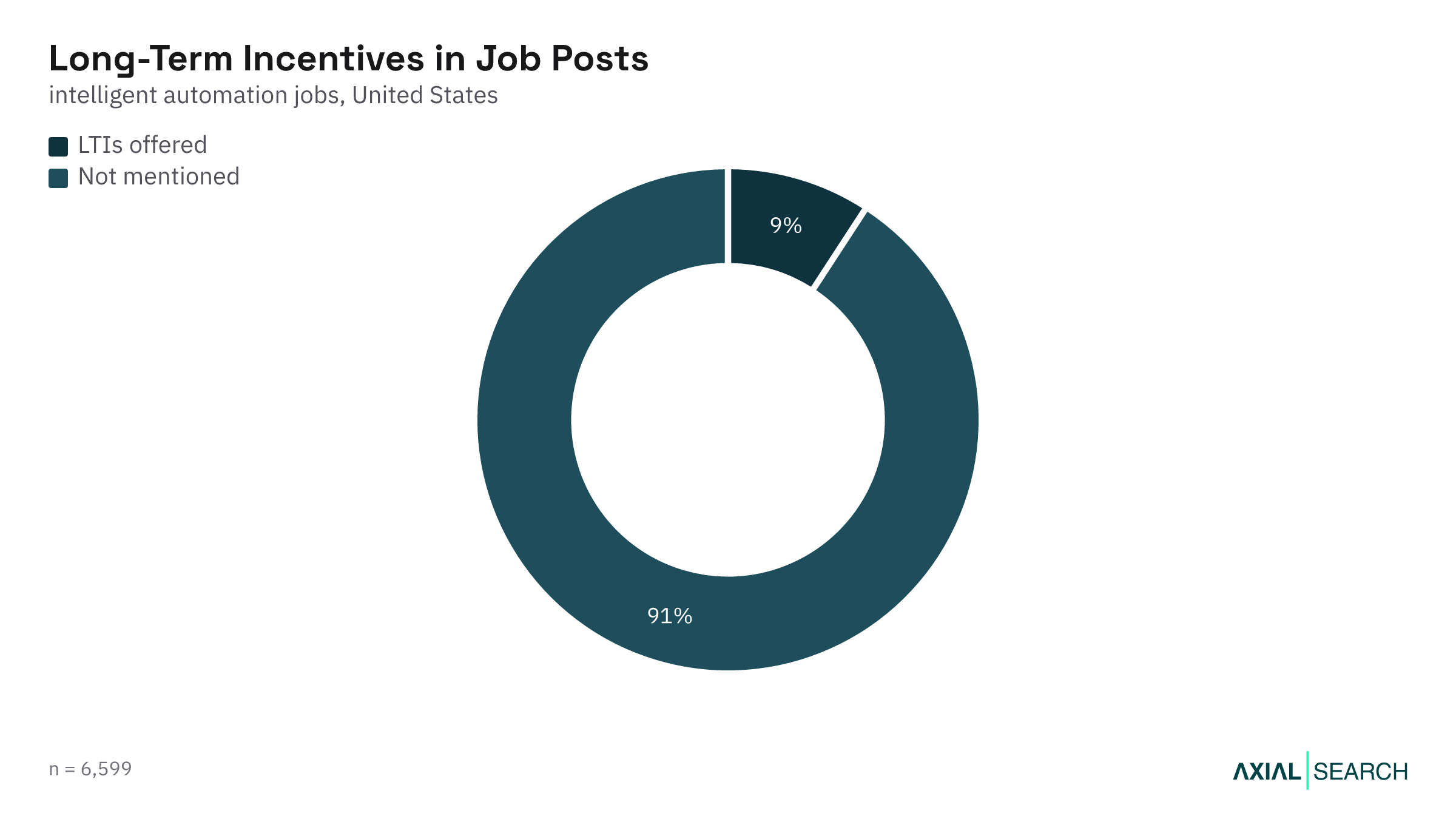
It peaks at C-suite level and is lowest at the junior and mid IC levels. Unlike in strategy or data science roles, where Principal ICs often see higher equity mention rates than Directors or VPs, intelligent automation keeps equity rare until you reach the executive tier.
| Level | Bonus mentioned | Equity mentioned |
|---|---|---|
| IC (Junior) | 16% | 6% |
| IC (Mid) | 17% | 6% |
| IC (Senior) | 24% | 13% |
| IC (Principal) | 35% | 18% |
| Manager | 34% | 12% |
| Director | 42% | 9% |
| VP | 42% | 10% |
| C-Suite | 76% | 52% |
What the bonus-versus-equity split says about intelligent automation retention
Equity here is an executive-retention tool, not a technical one — unlike AI engineering, where equity concentrates at Principal IC level as a lever to keep senior technical staff from walking.
For candidates, the low equity mention rate below C-suite means you should negotiate it directly rather than expect it to appear unprompted. For hirers, it means you're competing on base and bonus at every level except the top, which limits your retention tools for senior IC and mid-management staff.
Final Thoughts
For candidates. The intelligent automation market rewards seniority more than sector or geography — the step from Manager to Director moves your pay further than switching from New York to California. The Director title carries unusual leverage in negotiation because companies are pricing it above VP level, so if you're operating at that scope, fight for the title. Equity is rare unless you're C-suite, which means most of your upside lives in base and bonus; negotiate both hard, and don't assume equity will appear without asking. If you're choosing between staying technical and moving into management, the Principal IC track pays close to Director money, so staying technical is a viable long-term path. If you focus more on defining long-term AI priorities than building the automation itself, AI strategy salaries reflect that advisory role.
For employers. The market has priced Director-level intelligent automation talent as scarce, so trying to hire one at VP pay won't work — you'll need to match the top of the Director band to compete. Retention risk is highest in the band just below Director and Principal IC, where the next promotion delivers the biggest compensation jump; if you're losing people at Manager or Senior IC level, that's why. Equity mention rates are low across the board, which means you're competing on cash, and the candidates who care about long-term upside are already filtering you out if your offer is silent on equity.
Methodology & sources
- Data sources. Job data is collected from publicly available postings on online job boards and updated weekly, covering US roles posted since January 2026. Explore and filter it on our live AI job market dashboard.
- All salary figures are derived from the minimum and maximum salary bands employers post, annualized and reported as percentiles, not averages.
- Every salary figure on this page is the top of the posted range — the ceiling employers advertise, not the typical offer. The seniority table reports it at the 5th, 25th, 50th (median), 75th and 95th percentiles. Median salary in the sector, company-size and location tables is the median of that ceiling within each group.
- Bonus and equity figures are mention rates: the share of postings that state a bonus or equity. A posting silent on either is counted as "not mentioned"; it does not mean none is offered.

Inside the Intelligent Automation Job Market: 5,400 Postings Analyzed
Intelligent automation’s job market in 2026, mapped from 5,428 US postings: what these roles pay, how hot demand is, where hiring is concentrated, and what it takes to break in.

What to Know When Hiring Intelligent Automation Specialists
What it takes to hire intelligent automation specialists in 2026: pay benchmarks, how competitive the market is and interview questions that actually screen for the role, from 5,428 US postings.

How to Become an Intelligent Automation Specialist in 2026
How to become an intelligent automation specialist in 2026: the qualifications, certifications and career path 5,428 US job postings actually ask for.
Turn AI ambition into lasting business value
Whether you're hiring your first AI leader or scaling enterprise transformation capability, we help you define, assess and recruit the people who make it stick.