
What to Know When Hiring Intelligent Automation Specialists
What it takes to hire intelligent automation specialists in 2026: pay benchmarks, how competitive the market is and interview questions that actually screen for the role, from 5,428 US postings.
 Updated: September 9, 2026
- Demand has eased from its spring peak: intelligent automation hiring is cooling, though employers are still hiring continuously rather than in bursts.
- Enterprise scale leads, but breadth matters: one in three intelligent automation postings comes from 10,000+ employee companies, yet mid-size firms post 41% combined and even sub-51 startups account for 11%.
- IT Services owns a quarter of the market: intelligent automation roles concentrate in IT Services (24%), Technology (14%) and Professional Services (11%) — consulting and systems integrators drive the top of the funnel.
- Real entry path, not leadership-only: 36% of intelligent automation postings target mid-level ICs and another 18% are junior — more than half the market sits below Senior IC, rare in AI hiring.
- Hybrid and remote are viable: among the 45% of intelligent automation postings that specify work setting, 40% are hybrid and 36% fully remote — only a quarter require full-time on-site presence.
- National distribution, not coastal clustering: California and Texas together hold 26% of intelligent automation demand, but North Carolina, Georgia and Illinois all rank top-six — the work follows operations footprints, not just tech hubs.
What will you need to pay to hire intelligent automation specialists?
Budget for an intelligent automation hire from the Junior IC level up to Director, with the Principal IC track commanding comparable compensation to Director money.
That's the posted band, not the final offer. Bonus (mentioned in intelligent automation postings) and equity sit on top, and both climb sharply at the executive tier rather than rising steadily with seniority. For the full breakdown by seniority, sector and location, see intelligent automation salaries.
How intelligent automation pay changes with seniority
Pay rises steadily through Mid and Senior IC, then the Principal IC track closes in on Director money — a much tighter gap than most functions show at that level.
If you're building a req around a Manager title expecting to underpay a senior technical candidate, the data says otherwise — a Principal IC candidate can credibly ask for money close to a Director's, and often gets it, which is exactly the kind of pay-band mismatch AI recruitment that already knows this market helps you avoid before you lose the candidate.
Where bonus and equity fit into an intelligent automation offer
Intelligent automation postings mention bonuses more often than equity, and neither is spread evenly across levels — both climb sharply at the executive tier and barely register below it.
If you're competing for a Senior IC or Manager candidate, equity is doing very little work in that conversation — cash is what closes intelligent automation offers at every level except C-suite.
How competitive is the market for intelligent automation specialists?
Easing, but not thin — more than half the intelligent automation market sits at Mid IC or above.
The consistency of the flow means competition for strong talent doesn't pause for a season, so hiring plans that assume a quiet stretch will be caught flat-footed.
Why the intelligent automation entry-level pipeline is deeper than most AI functions
Intelligent automation postings sit at Mid IC or below — a wider entry path than most AI hiring offers, where senior and leadership roles usually dominate the req list.
That means you can realistically grow talent from within rather than compete only for senior hires — a build-your-own-bench plan is faster here than in functions where the entry-level pipeline is thin.
Who are you competing with for intelligent automation talent?
You're competing against a genuinely broad field — a third of intelligent automation postings come from enterprise-scale companies (10,000+ employees), but mid-size firms post 41% combined and sub-51 startups account for 11%.
Free to republish with credit and a link back to this article (terms). Cite as: Axial Search, "What to Know When Hiring Intelligent Automation Specialists," May 2026.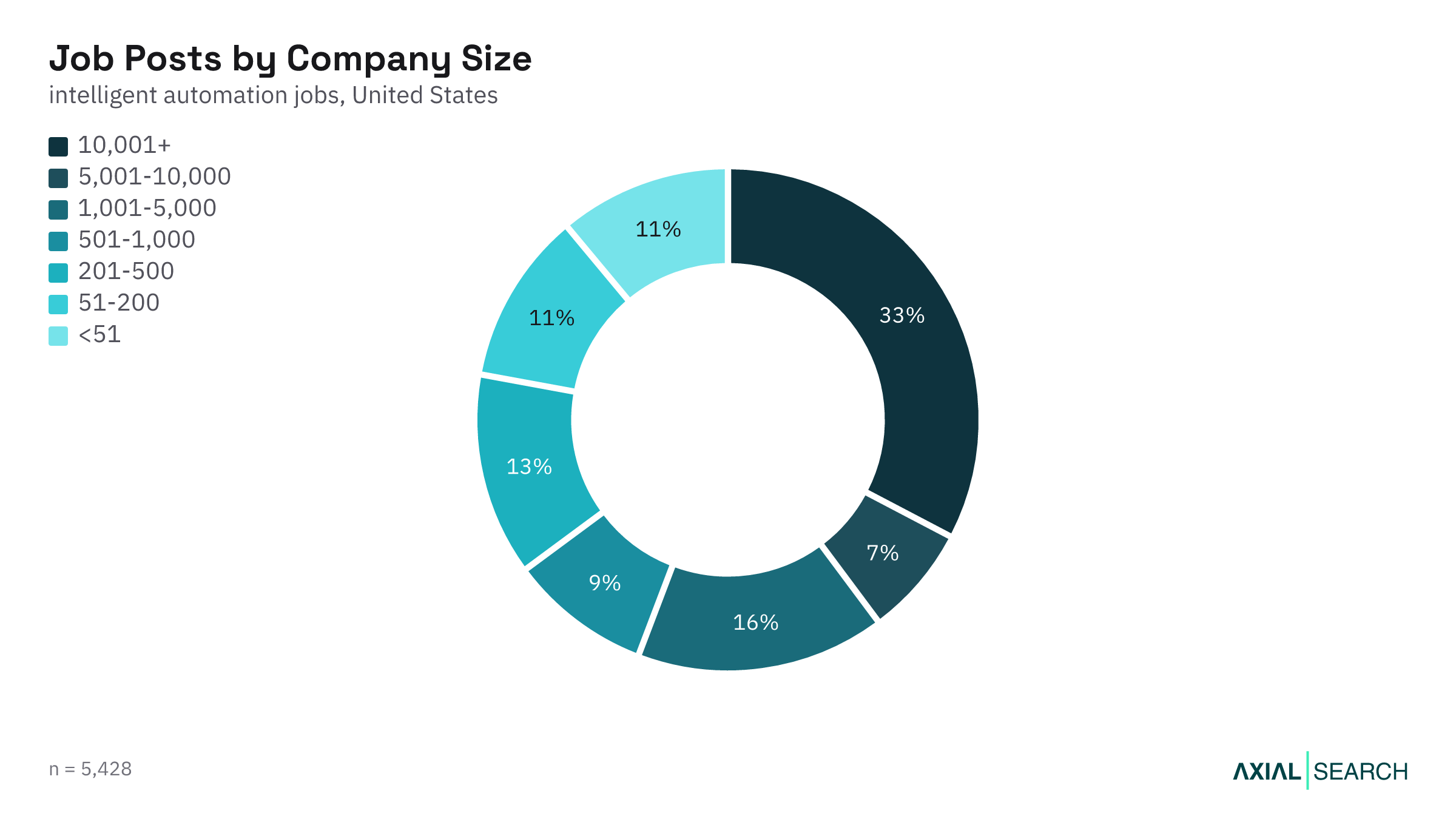
That split tells you intelligent automation is both a big-company operations play and a startup technical hire. The sector breakdown shows the same spread:
| Sector | Share of postings |
|---|---|
| IT Services | 24% |
| Technology | 14% |
| Professional Services | 11% |
| Manufacturing | 8% |
| Financial Services | 7% |
| Healthcare | 4% |
| Life Sciences | 4% |
| Retail and Hospitality | 4% |
IT Services dominates — consulting and systems integrators hire automation engineers to deploy client solutions — but Technology, Manufacturing and Financial Services all post actively. The presence of Healthcare and Life Sciences signals that regulated industries are starting to automate too, not just the easy workflows.
What level of intelligent automation hire do you actually need?
Most intelligent automation hires are full-time mid or senior ICs, not managers — 36% of postings target mid-level alone.
The three cuts below — seniority, contract type and work setting — describe what a typical opening looks like, so you can benchmark the req you're about to open.
Seniority levels in intelligent automation hiring
36% of intelligent automation postings are mid-level ICs, and a significant portion are junior — more than half the market sits at Mid IC or below, a real entry path this function offers more than most AI hiring.
Free to republish with credit and a link back to this article (terms). Cite as: Axial Search, "What to Know When Hiring Intelligent Automation Specialists," May 2026.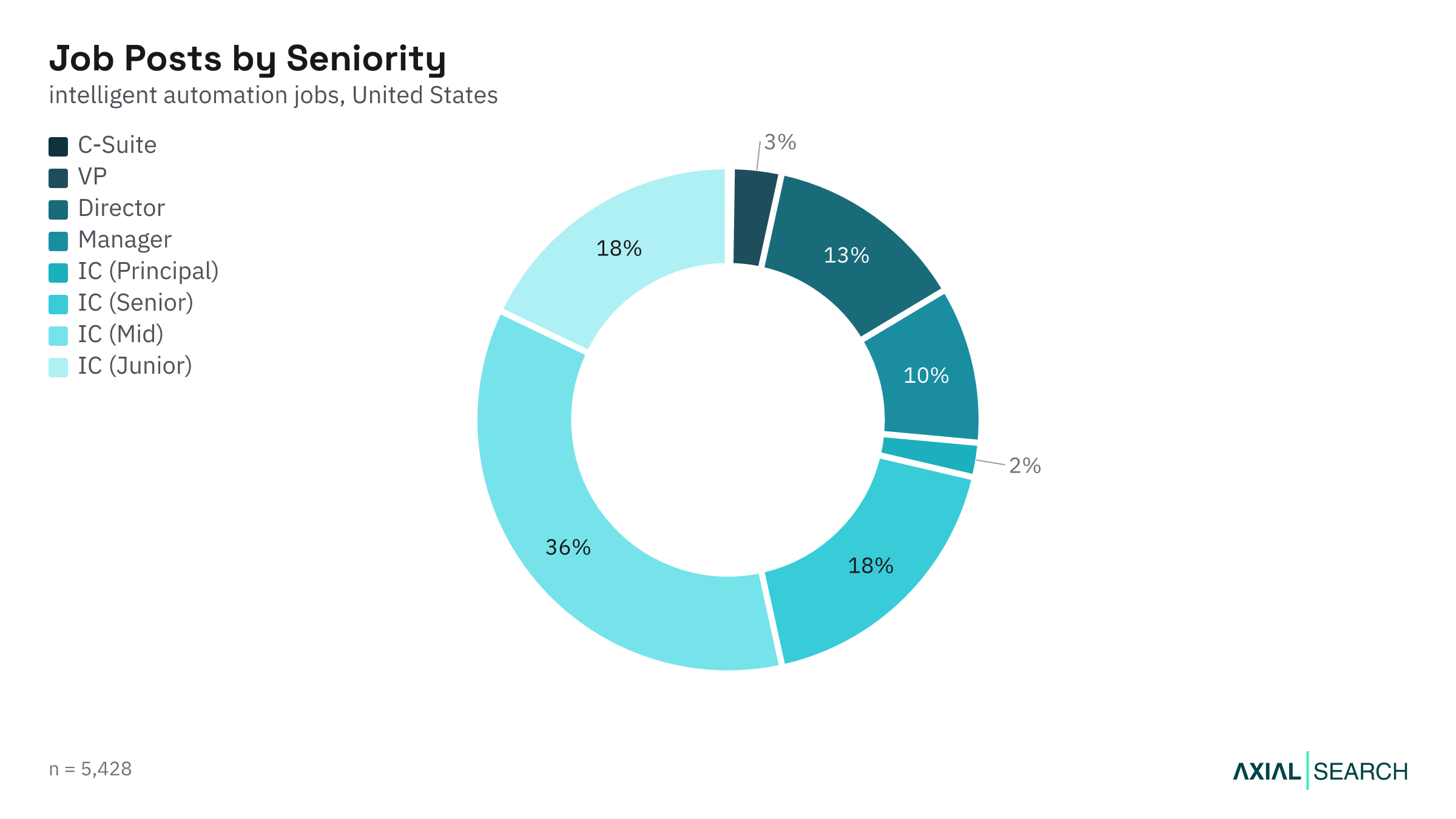
Managers and Directors together account for a significant portion, with VP and C-suite slots being rare. If you're building a bench of future leaders, this is a function where you can grow one from mid-level rather than only compete for senior hires. We break down what each seniority band pays in intelligent automation salaries.
Full-time versus contract intelligent automation roles
Four in five intelligent automation postings are full-time roles, but the 17% contract share is higher than most AI functions.
Free to republish with credit and a link back to this article (terms). Cite as: Axial Search, "What to Know When Hiring Intelligent Automation Specialists," May 2026.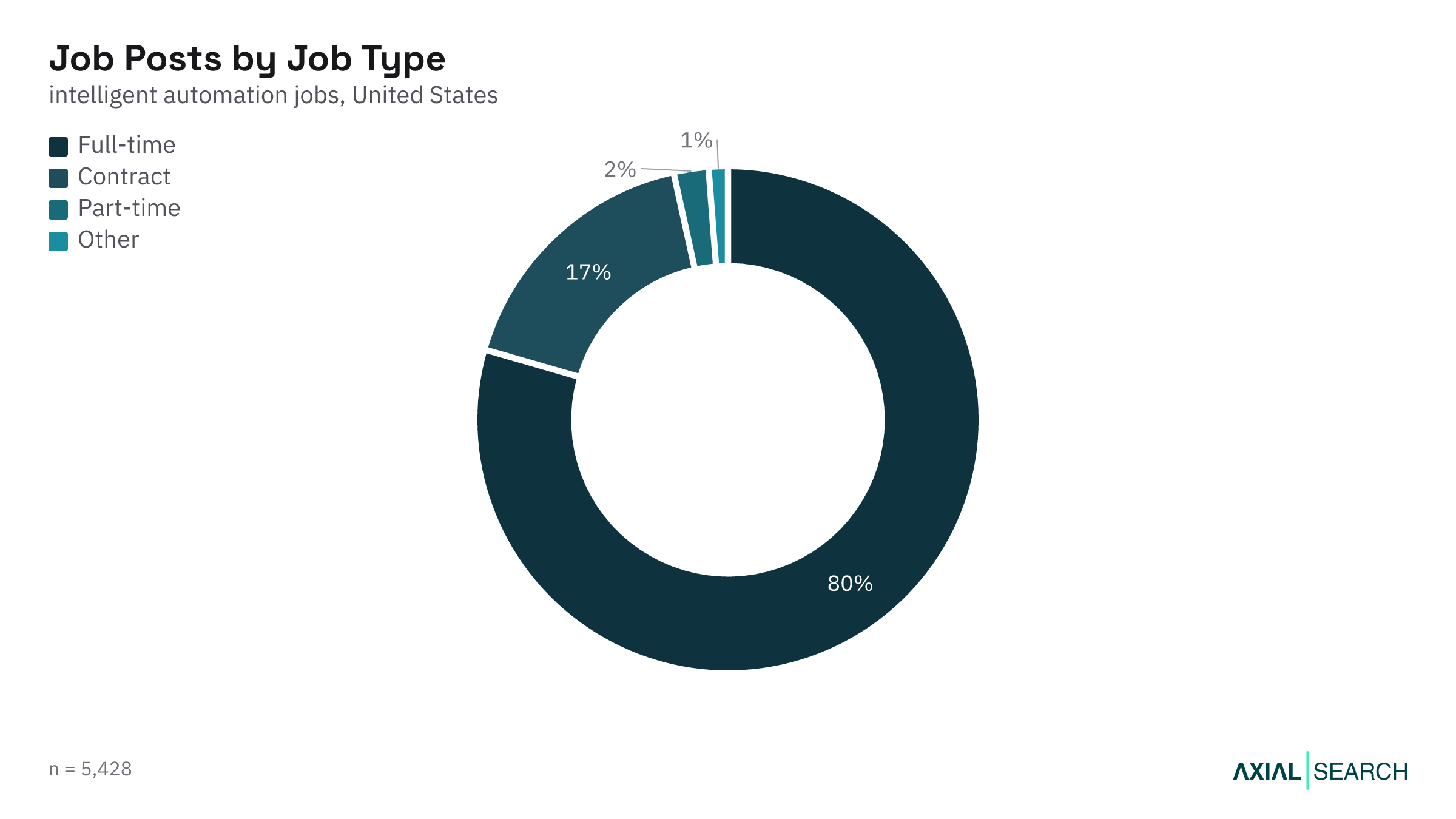
That tracks with the consulting and project-deployment pattern in IT Services — companies hire automation talent on a contract basis to get a specific workflow running, then roll off. If you need a workflow deployed without a permanent headcount commitment, project staffing is a viable model here in a way it isn't for most AI roles.
Remote, hybrid and onsite intelligent automation roles
Hybrid and remote are nearly tied among intelligent automation postings that specify a work setting, with only a minority requiring full-time on-site presence.
Free to republish with credit and a link back to this article (terms). Cite as: Axial Search, "What to Know When Hiring Intelligent Automation Specialists," May 2026.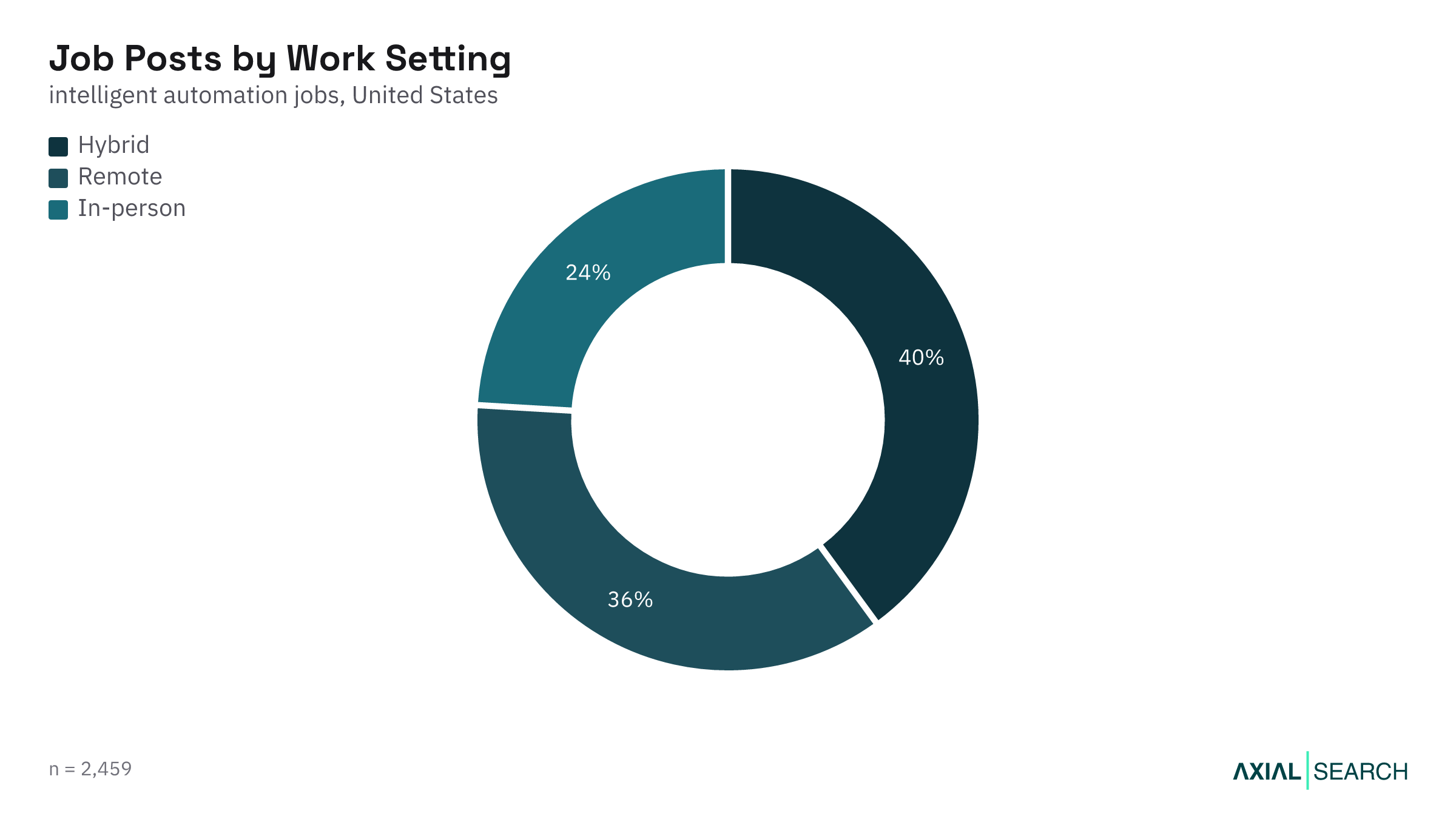
The work involves systems integration and production deployment, which often benefits from some physical proximity to operations teams, but it's less tied to an office than many technical roles. Widening the search to hybrid and remote candidates meaningfully expands your pool.
Where is intelligent automation talent concentrated?
Intelligent automation talent concentrates in California and Texas (13% of postings each) and New York (7%) — more nationally distributed than most AI functions, with North Carolina, Georgia and Illinois all in the top eight.
Free to republish with credit and a link back to this article (terms). Cite as: Axial Search, "What to Know When Hiring Intelligent Automation Specialists," May 2026.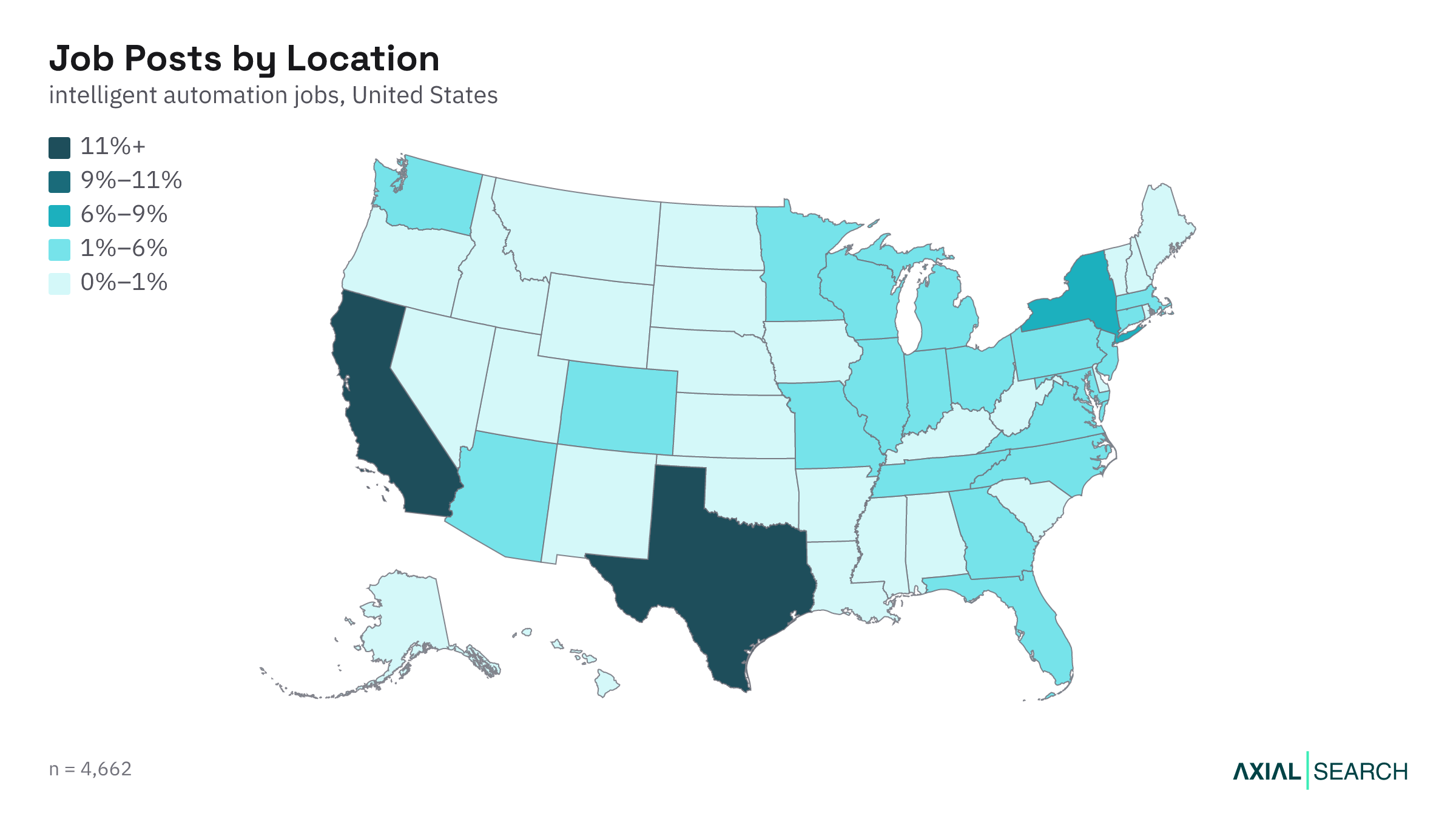
| State | Share of postings |
|---|---|
| Texas | 13% |
| California | 13% |
| New York | 7% |
| North Carolina | 5% |
| Illinois | 4% |
| Georgia | 4% |
| Pennsylvania | 4% |
| Virginia | 4% |
Intelligent automation jobs are less coastally concentrated than other AI specialties — the California and Texas weight is smaller here than in AI strategy hiring or machine learning, since automation work follows operations and manufacturing footprints, not just tech hubs.
The top cities for intelligent automation jobs
At the city level, Austin leads at 4.2%, but the distribution is national rather than coastal.
| City | Share of postings |
|---|---|
| Austin, TX | 4.0% |
| Charlotte, NC | 3.3% |
| Chicago, IL | 3.3% |
| San Francisco, CA | 3.2% |
| Dallas, TX | 2.9% |
| Atlanta, GA | 2.9% |
| Houston, TX | 2.7% |
| Boston, MA | 2.1% |
Austin's top position reflects both its tech employer base and its lower cost structure for operations work. Charlotte, Atlanta and Dallas all rank ahead of traditional tech centers like New York or Boston — automation hiring follows where companies run big back-office and manufacturing operations, not just where they build software.
How do you assess intelligent automation candidates?
Assess intelligent automation candidates on judgment and delivery together — Python and foundation models are the skills the market actually screens for, so start there.
Ask them to walk through one process they chose to automate and the system they built to run it, including what broke and how they found out. That single question filters more effectively than a stack of algorithm puzzles, because intelligent automation is a delivery discipline, not a pure research one.
Technical questions to screen intelligent automation candidates on
Ask the candidate to walk through a real automation they built: which process they chose, why, how they deployed it, and how they knew it was working in production.
Follow with specifics on their stack — Python, UiPath or another RPA platform, whether they've wired a foundation model into a workflow — since Python (34%), foundation models (26%) and cloud platforms (25%) are what the market actually screens for. Push past the happy path: ask what broke after launch and what they changed.
Questions for senior and Principal intelligent automation candidates
For Senior and Principal IC candidates, ask them to design an automation program end to end: which processes they'd prioritize, how they'd sequence the rollout, and how they'd measure ROI.
The Principal IC band pays within a similar range of Director money, so hold that bar to genuine judgment about which automations are worth building, not just coding skill.
Red flags to watch for when interviewing intelligent automation candidates
Watch for candidates who can describe an automation platform fluently but go vague the moment you ask which process they chose to automate and why.
That gap is common, and it's exactly the gap this market pays a premium to avoid — the leadership-profile data puts use-case selection and hands-on execution at the top of what employers screen for, and a candidate who's only implemented what they were told to build hasn't demonstrated the first half of that.
Final Thoughts
For employers. The intelligent automation talent pool hasn't caught up to demand, so you're competing for the same hands every quarter. The entry path is clearer here than in other AI functions, so if you're willing to hire mid-level ICs and train them up rather than wait for senior talent, you'll move faster. The 17% contract share shows that project staffing works in this market — a model worth considering if you need to get a specific workflow deployed without a permanent headcount commitment. And the geographic spread means you're not just fishing in the Bay Area talent pool; Charlotte, Austin and Atlanta all have real depth.
Methodology & sources
- Data sources. Job data is collected from publicly available postings on online job boards and updated weekly, covering US roles posted since January 2026. Explore and filter it on our live AI job market dashboard.
- Hiring demand is the count of matching postings per week.
- Company size, seniority, job type and work setting are each group's share of postings. Work-setting shares are computed over postings that state a work model — the rest are silent, not counted as a category.
- Top states and cities are ranked by share of postings; remote-only postings are excluded from the cities list.
- Salary figures cited in this article are drawn from the subset of postings that state a salary range; percentiles and medians are calculated within each seniority band and reported in full in intelligent automation salaries. Bonus and equity figures reflect the share of postings that mention those forms of compensation.
- The interview questions are built from what postings in this dataset ask for, plus Axial Search's own placement experience — they are guidance, not a guarantee of what any single employer should require.

Inside the Intelligent Automation Job Market: 5,400 Postings Analyzed
Intelligent automation’s job market in 2026, mapped from 5,428 US postings: what these roles pay, how hot demand is, where hiring is concentrated, and what it takes to break in.

What Intelligent Automation Roles Pay in 2026
What intelligent automation roles pay in 2026: median salary, pay by seniority, top-paying sectors and locations, and how often bonus and equity are mentioned in US job postings.

How to Become an Intelligent Automation Specialist in 2026
How to become an intelligent automation specialist in 2026: the qualifications, certifications and career path 5,428 US job postings actually ask for.
Turn AI ambition into lasting business value
Whether you're hiring your first AI leader or scaling enterprise transformation capability, we help you define, assess and recruit the people who make it stick.