
The Skills That Land Intelligent Automation Roles in 2026
How to become a intelligent automation professional in 2026: the leadership capabilities employers screen for, the experience and degrees required, the certifications that matter, and the skills most in demand across US postings.
Updated: July 13, 2026

Intelligent automation sits at the intersection of AI strategy and hands-on implementation — the rare leadership track where employers expect you to both choose the right use cases and build them. This is what they screen for: the capabilities, qualifications, credentials and skills that appear in 5,428 US job postings analyzed this quarter and how to position yourself against them.
- Use-case selection and hands-on execution drive equal demand in intelligent automation — employers want leaders who can identify the right processes to automate and deliver working systems themselves.
- Degrees matter less than in pure strategy roles — 65% of intelligent automation postings require one, versus 72% in AI strategy, and a bachelor's clears the bar; the median asks for five years of experience.
- UiPath certifications dominate the credential landscape — the Automation Developer Professional appears in one in forty postings, and five of the top eight certifications are UiPath-specific.
- Platform fluency beats model depth — UiPath shows up in 23% of postings, Azure in 17%, AWS in 14%; technical breadth across Python, foundation models and cloud infrastructure is expected, not narrow specialization.
- This function rewards delivery over narrative — intelligent automation leaders ship production systems; the profile skews execution-heavy compared to pure AI strategy, with hands-on technical work a baseline expectation at every level.
The intelligent automation leadership profile employers screen for
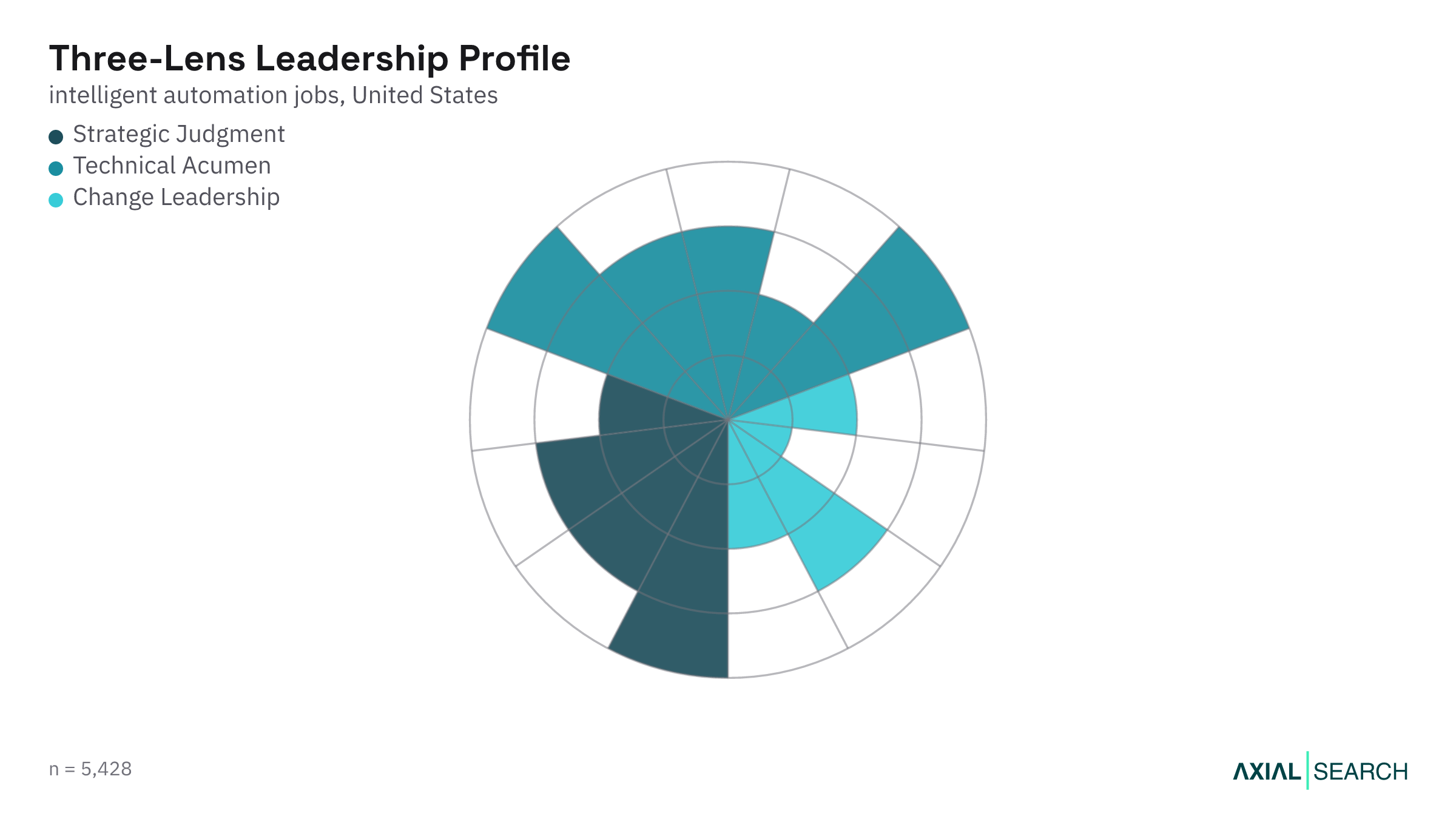
Intelligent automation is one of the few AI leadership tracks where employers expect strategic judgment and hands-on delivery at the same level. Our Three-Lens Leader framework scores every role across strategic judgment, technical acumen and change leadership, and for intelligent automation the top of the profile is a near-tie.
Use Case Selection and Hands-On Execution lead almost level — knowing which processes are worth automating, and being able to build the automation yourself.
AI Literacy and Architectural Fluency back them, since the work increasingly means wiring models into existing systems. Operating Model Design rounds out the top five, the tell that automation is as much about redrawing how work flows as about the technology.
When you position yourself, pair a process you chose to automate with the working system you delivered. This is exactly the profile AI recruitment is built to identify.
What qualifications intelligent automation roles require
The baseline is mid-level experience plus a technical degree. The bar is lower than pure strategy roles and higher than pure engineering ones — the job exists in the middle.
How much experience intelligent automation roles expect
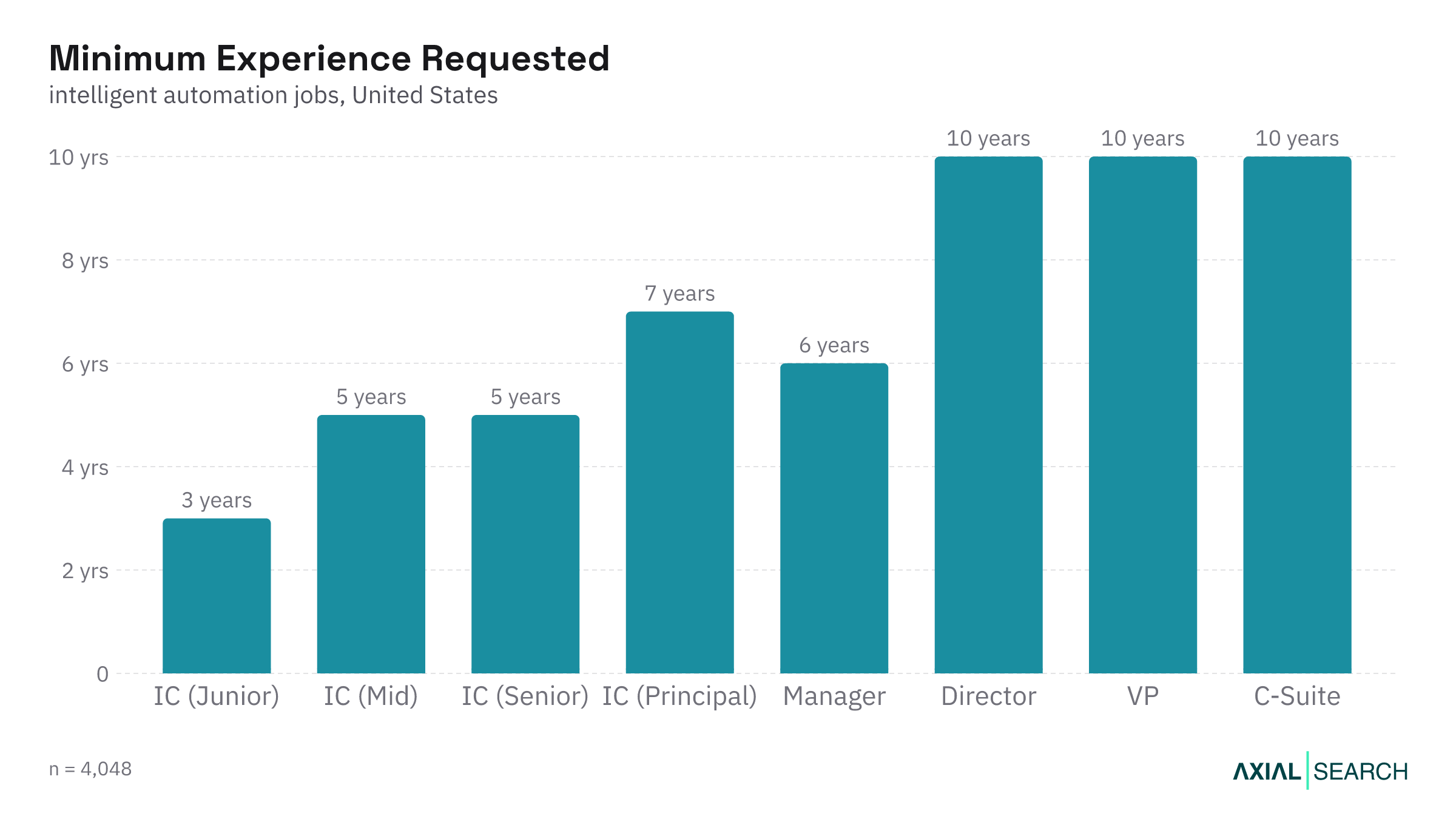
Most roles ask for around five years of experience, rising to a decade at Director level and above. The overall median of five years means this is a mid-career entry point but not a late one — you can land here earlier than in pure AI strategy.
Junior IC roles ask for three years, enough to have shipped a few automations and learned the patterns. The experience curve climbs steadily but not steeply: six years at Manager, seven at Principal IC, ten at Director and above.
Degrees and fields intelligent automation employers want
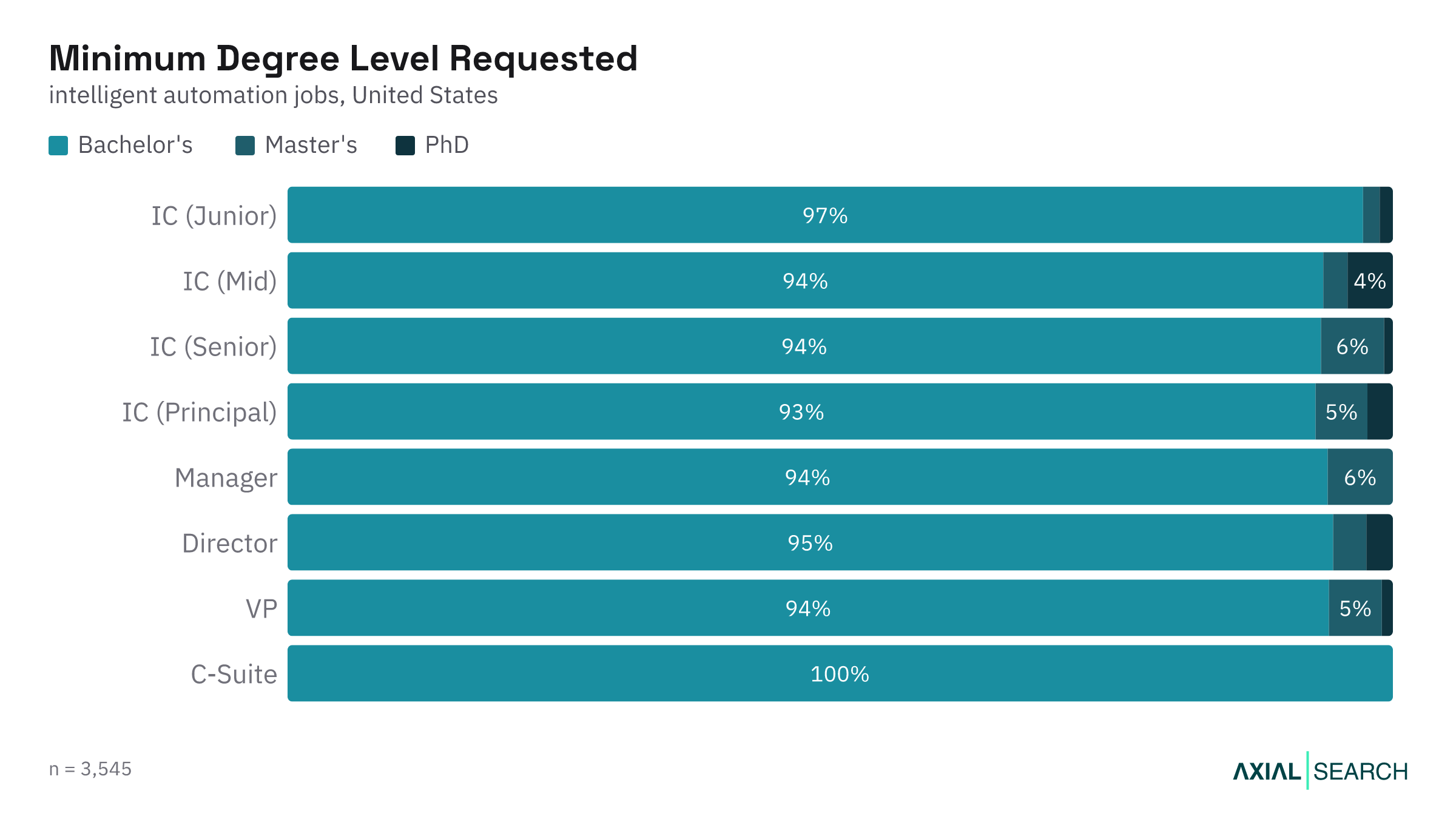
Just under two-thirds of postings require a degree, lower than the 72% in AI strategy but still a strong baseline. A bachelor's clears the bar for nearly all roles — advanced degrees barely register even at the C-suite.
The field you studied matters more than the level and it's overwhelmingly technical:
| Degree field | Share of postings |
|---|---|
| Computer Science | 40.9% |
| Engineering | 29.9% |
| Business | 19.3% |
| Information Systems | 10.2% |
| Information Technology | 8.0% |
| Data Science | 7.3% |
The fields split roughly four-to-one between technical and business backgrounds. Computer Science, Engineering, Information Systems, Information Technology and Data Science together account for about 96% of degree-requiring postings.
Business makes up the remainder. This is a technical role first — the business fluency comes second.
Certifications for intelligent automation roles
Certifications matter here more than in any other AI leadership function and the landscape is dominated by a single vendor.
Five of the top eight credentials are UiPath-specific:
| Certification | Share of postings |
|---|---|
| Project Management Professional (PMP) | 3.0% |
| UiPath Automation Developer Professional | 2.3% |
| Certified ScrumMaster (CSM) | 1.4% |
| UiPath Certified Advanced RPA Developer | 1.2% |
| Certified Scrum Product Owner (CSPO) | 1.1% |
| Certified Public Accountant (CPA) | 1.0% |
| UiPath Certified Professional | 0.8% |
| UiPath Automation Solution Architect Professional | 0.6% |
The signal is clear: if you're building a career in this function, UiPath fluency is close to table stakes. The Automation Developer Professional credential appears in nearly one in forty postings, a mention rate an order of magnitude higher than most AI certifications.
The project-management credentials (PMP, CSM, CSPO) reflect that a lot of intelligent automation work is, in practice, running complex delivery programs. If you already hold one, mention it.
If you don't, prioritize the UiPath track over generic PM certifications.
The skills that matter for intelligent automation roles
Technical breadth beats specialization in this function. Employers want someone who can code, configure platforms, understand foundation models and monitor production systems — not a deep specialist in any one.
The capabilities intelligent automation leaders need
| Capability | Share of postings |
|---|---|
| Python | 34.0% |
| Foundation Models | 24.9% |
| Observability & Monitoring | 23.6% |
| Cloud Platforms | 23.5% |
| Agile | 22.0% |
| SQL | 18.8% |
Three themes run through this list.
Programming literacy (Python 34%, SQL 19%) is expected — you can't lead intelligent automation without being able to read and write code. Foundation model fluency (25%) signals that modern automation increasingly means orchestrating LLMs, not just rule engines.
Observability and monitoring (24%) reflects that automations live in production and someone has to keep them running.
Software and tools intelligent automation roles use
| Software / tool | Share of postings |
|---|---|
| UiPath | 23.0% |
| Microsoft Azure | 17.0% |
| AWS | 14.1% |
| Microsoft Power Automate | 13.4% |
| Anthropic | 9.1% |
| Microsoft Excel | 8.6% |
The vendor concentration is striking. UiPath appears in nearly one in four postings, three times the rate of any single AI platform in other functions.
The cloud platforms (Azure 17%, AWS 14%) matter because automations run on cloud infrastructure. Power Automate (13%) reflects the Microsoft ecosystem's gravitational pull in enterprise automation.
Anthropic's appearance (9%) is a sign that Claude is increasingly the LLM of choice for intelligent automation workflows, not just for knowledge work.
These are the tools postings mention — a platform not listed isn't disqualifying. Treat the list as the vocabulary to be fluent in, not a checklist to complete.
How to position yourself for an intelligent automation role
Pull the threads together and a clear playbook emerges.
Lead with both judgment and delivery. The single strongest thing you can show is a track record of identifying the right automation opportunities and shipping them — that's what the leadership profile rewards and it's what separates an intelligent automation leader from a pure strategist or a pure engineer.
Back it with the conventional credentials. Evidence the roughly five years and the technical degree and don't be shy about hands-on technical work.
A lot of intelligent automation leadership is delivery in disguise.
Get the UiPath credentials. This is the one AI function where vendor-specific certifications genuinely move the needle. The Automation Developer Professional credential opens more doors than any generic AI certification.
Demonstrate technical breadth over depth. Be able to talk fluently about Python, foundation models, cloud platforms and production monitoring without pretending to be a specialist in any one.
Breadth, credibly held, is the goal.
If you're on the other side of the table, building an intelligent automation team rather than joining one, this is exactly the profile AI recruitment is built to find.
Final Thoughts
For candidates. Intelligent automation rewards people who can both spot the right use case and build it — that's the rare combination employers screen for. Lead with shipped automations you chose, not just implemented. Get the UiPath Automation Developer Professional credential; it shows up in one in forty postings and opens more doors than any generic AI cert. Demonstrate technical breadth: Python, foundation models, cloud platforms, production monitoring. The profile is delivery-heavy; be ready to talk about how you kept systems running, not just how you designed them. If you focus more on setting organizational direction than implementing specific automation workflows, AI strategy skills become the priority.
For employers. The intelligent automation market is unusual: the talent pool skews more technical than AI strategy but less specialized than pure engineering, and vendor concentration is higher than in any other AI function. If you're hiring for judgment and delivery in equal measure, look for candidates who've chosen automations that shipped and stayed live — that's the profile the data rewards. UiPath fluency is close to table stakes; five of the top eight certifications are UiPath-specific. Don't screen for narrow depth; screen for credible breadth across platforms, models and delivery practices.
Methodology & sources
- Data sources. Job data is collected from publicly available postings on online job boards and updated weekly, covering US roles posted since January 2026. Explore and filter it on our live AI job market dashboard.
- Requirements are extracted from job descriptions using a combination of programmatic rules and AI analysis. Minimum experience is the median minimum years requested by seniority; minimum degree is the lowest degree a posting requires.
- Top degree fields, certifications and skills are the items mentioned most often across postings.
- These are mention rates — the share of postings that state each item. A skill, degree or certification not appearing means it wasn't stated in the posting, not that it isn't valued.
Need help finding intelligent automation leadership? Axial Search specializes in placing the technical leaders who can both pick the right automations and ship them.

Intelligent Automation Jobs in 2026: What 5,400 Postings Show
The complete picture of the intelligent automation job market in 2026: hiring demand, what these roles pay, where the jobs are, who's hiring and what it takes to get in.

Intelligent Automation Hiring in 2026: Demand, Employers and Cities
Where intelligent automation jobs are in 2026: hiring demand and trend, top states and cities, who's hiring by sector and company size, and the mix of seniority, contract type and remote work across US postings.

Intelligent Automation Pay in 2026: Salaries, Bonuses and Equity
What intelligent automation roles pay in 2026: median salary, pay by seniority, top-paying sectors and locations, and how often bonus and equity are mentioned in US job postings.
Turn AI ambition into lasting business value
Whether you're hiring your first AI leader or scaling enterprise transformation capability, we help you define, assess and recruit the people who make it stick.