
How to Hire AI Governance Leaders in 2026
Where AI governance jobs are in 2026: hiring demand and trend, top states and cities, who's hiring by sector and company size, and the mix of seniority, contract type and remote work across US postings.
 June 17, 2026
- AI governance hiring runs steady: Hiring follows regulatory timelines rather than model-release news cycles rather than spiking with model releases.
- Enterprise dominates demand: 56% of AI governance postings come from companies with 10,000+ employees, led by Professional Services at 36%.
- The seniority mix is flatter than other AI functions: Manager roles represent 28% of AI governance postings and Senior ICs another 23%, meaning entry and mid-career paths exist alongside leadership openings.
- Full-time and hybrid is the norm for AI governance: 90% of AI governance roles are full-time, and among postings that specify work setting, 54% are hybrid and 31% fully remote.
- Geographic spread favors regulated hubs: California and New York together hold 27% of AI governance postings, but Charlotte, Chicago and Dallas each post 3–4%, reflecting where banks and enterprises run risk functions.
What will you need to pay to hire AI governance leaders?
Budget a median of $169,000 for an AI governance hire — the Principal IC track pays close to Director money, so staying technical doesn't cap what you'll need to offer a strong candidate, though the executive tier doesn't climb further: VP and C-suite bands actually trail Director and Manager.
That's the posted band, not the final offer. For the full breakdown by seniority, sector and location, see AI governance salaries.
How AI governance pay scales with seniority
Pay climbs steadily through the ladder, but the shape matters more than the climb: the Principal IC track converges with Director money, so a req built around a Manager title may be underpricing a senior technical candidate.
If you're structuring a level to save money by avoiding a Director title, the data says the reverse — a Principal IC candidate can credibly ask for Director money, and often gets it.
Where bonus and equity fit into an AI governance offer
Bonus is common in AI governance offers, mentioned in roughly half of postings; equity is rarer and concentrates at C-suite and Principal-IC level rather than spreading evenly by seniority.
If you're competing for a Principal-IC candidate, an equity component is doing more work in that conversation than it will for a Manager hire — exactly the kind of leveling call AI executive search is built to get right.
How competitive is the market for AI governance leaders?
Moderately competitive — Senior IC and Manager roles together make up more than half of AI governance postings, and the total pool is thin for a function every regulated enterprise now needs.
AI governance hiring tracks regulatory timelines rather than model-release news cycles.
Why the AI governance bench is thin at both ends
Junior IC roles make up just 8% of AI governance postings and the deep-expert Principal IC track only 5%, so neither the entry pipeline nor the senior-most technical bench is deep.
That means a realistic build-your-own-bench plan takes years, not quarters — for an immediate need, hiring is faster than developing.
Who are you competing with for AI governance talent?
You're competing against enterprise-scale companies most often — 56% of AI governance postings come from organizations with 10,000+ employees — and heavily against Professional Services firms, which post more roles than any other sector.
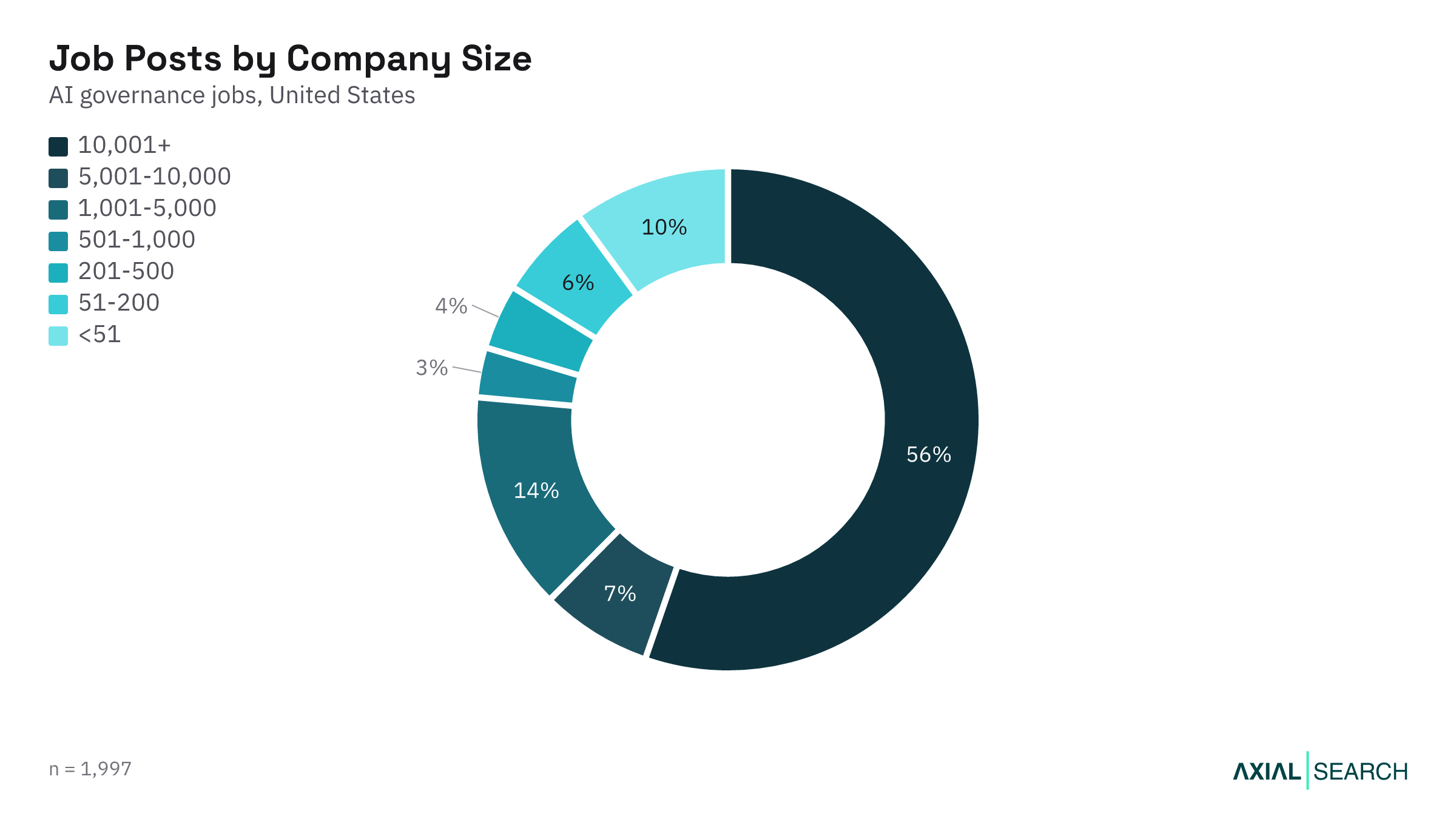
More than half of all AI governance postings come from companies with more than 10,000 employees. These are organizations large enough to face real regulatory exposure and reputational risk if they get AI wrong, and they're staffing accordingly. The next tier, companies with 1,001 to 5,000 employees, accounts for another 14%, and firms with 5,001 to 10,000 employees post 7%. Together, enterprises above 1,000 headcount represent 77% of the market.
| Sector | Share of postings |
|---|---|
| Professional Services | 36% |
| Technology | 13% |
| Financial Services | 13% |
| IT Services | 7% |
| Healthcare | 6% |
| Capital Markets & PE | 4% |
| Manufacturing | 4% |
| Retail and Hospitality | 3% |
Professional Services dominates at 36%, likely because the big consultancies are embedding governance frameworks into every AI engagement they sell and need people internally who can design and deliver them. Technology firms post 13% and IT Services another 7%. Healthcare's presence at 6% is notable — these are high-stakes domains where governance failures have direct consequences, and the fact that Healthcare ranks fourth tells you this work has moved beyond pure tech companies into regulated industries that didn't historically carry AI risk functions. The distribution is less concentrated than AI strategy hiring and more evenly spread across sectors that share regulatory exposure.
What level of AI governance hire do you actually need?
Mostly a full-time, mid-to-senior hire — 90% of AI governance postings are full-time roles, and the seniority mix is flatter than other AI functions. The three cuts below describe what a typical opening looks like.
Seniority levels in AI governance hiring
Manager-level roles account for 28% of AI governance postings, Senior ICs another 24% and Mid-level ICs 17% — together, Senior and Mid IC roles make up a meaningful share of the market, which is rare in AI hiring, where most specialized functions skew heavily toward Director and VP.
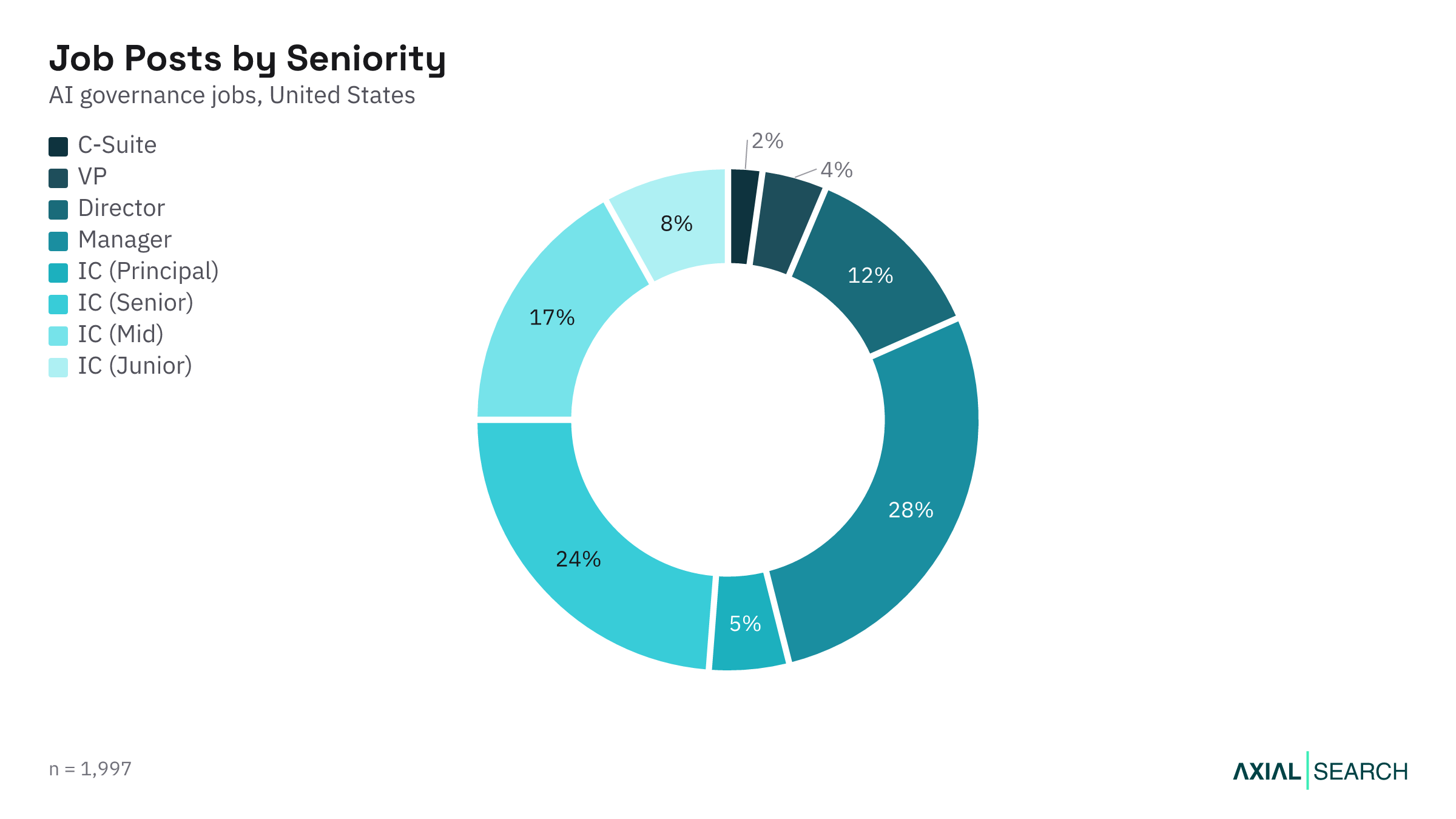
Here, only 12% of postings are Director-level, 4% are VP and 2% are C-suite. That means AI governance has real entry and mid-career paths, not just senior leadership openings — if you're building a team rather than hiring a single figurehead, there's a pipeline to build from. Junior IC roles represent 8% of AI governance postings, and Principal IC — the deep-expert track for people who stay individual contributors — accounts for 5%.
Full-time versus contract AI governance roles
Nine out of ten AI governance postings — 90% — are full-time roles, so companies are building AI governance as a permanent function, not staffing it with contractors or consultants.
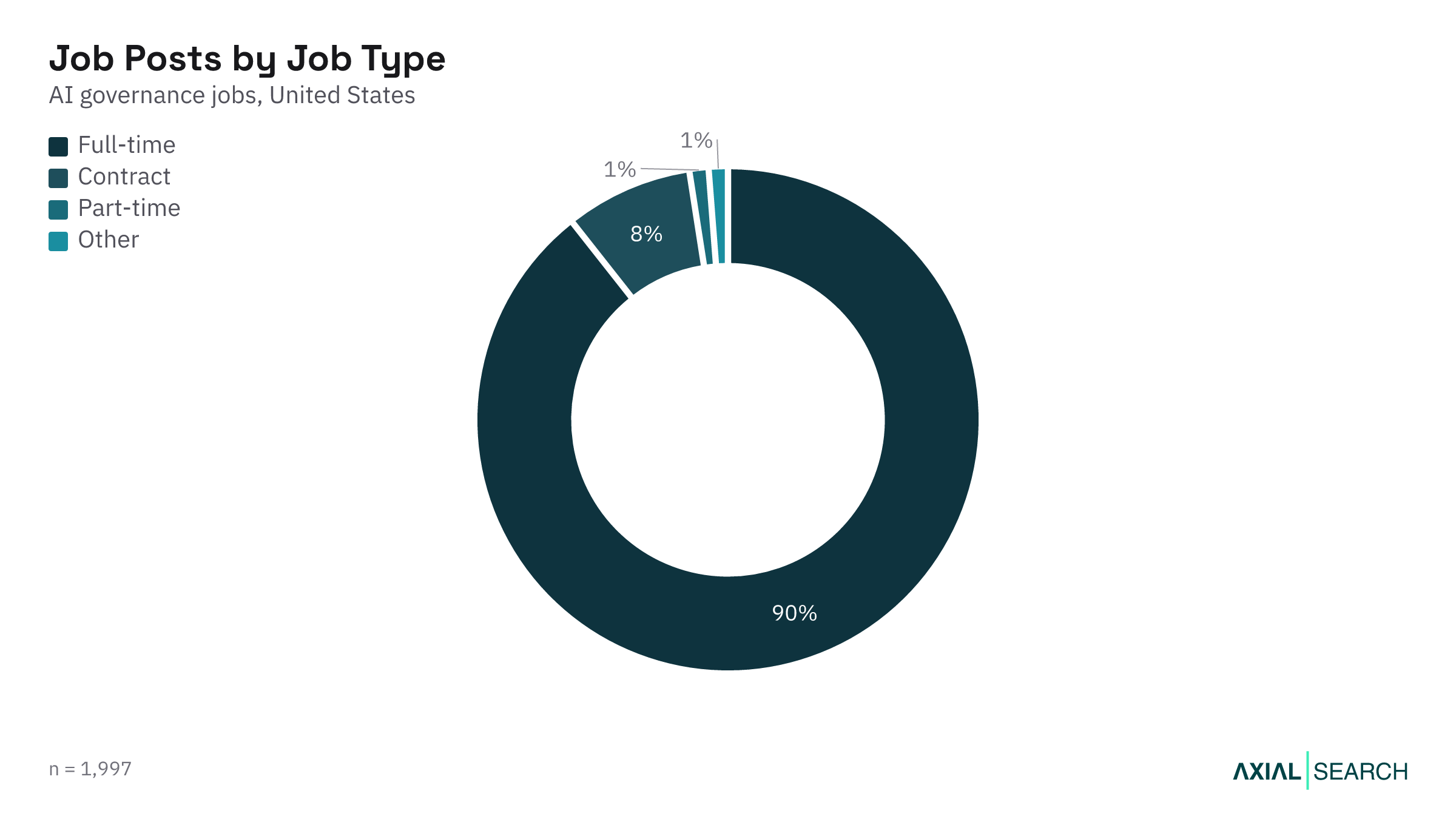
Contract roles make up 8% of the market, part-time another 1%, and a small "Other" category the remaining 1%. Employers want these people embedded in the organization, not rented.
Remote, hybrid and onsite AI governance roles
Most AI governance postings — 53% — are hybrid, 31% are fully remote and 16% are in-person, so hiring through AI executive search doesn't require restricting the search to a single metro.
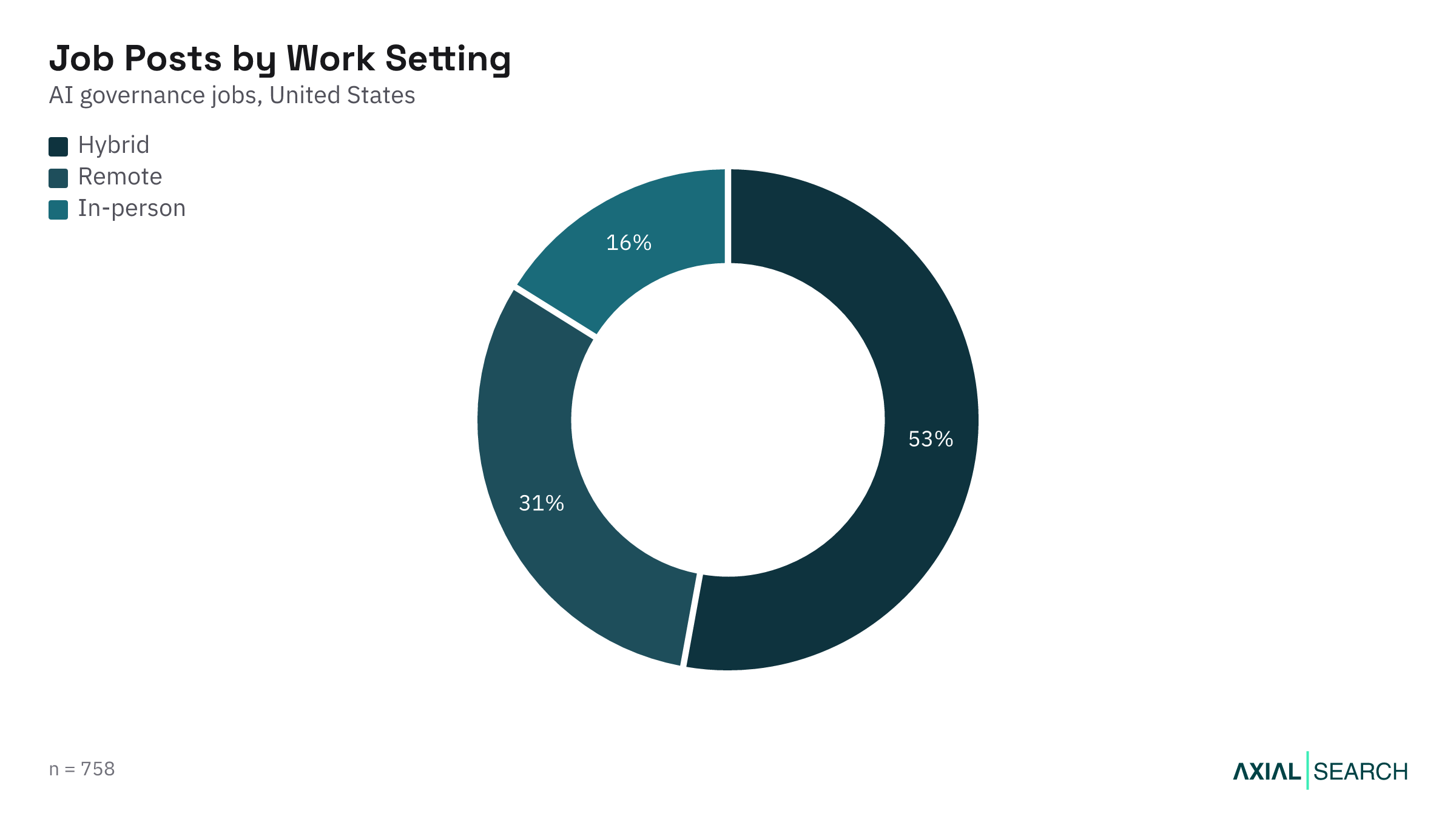
That still means hybrid is the norm, so expect most shortlists to favor candidates within commuting distance of a major office even when the posting allows remote work.
Where is AI governance talent concentrated?
AI governance talent concentrates in California (14% of postings) and New York (12.7%), together just over a quarter of the market, with real depth beyond the coasts in regulated hubs like North Carolina.
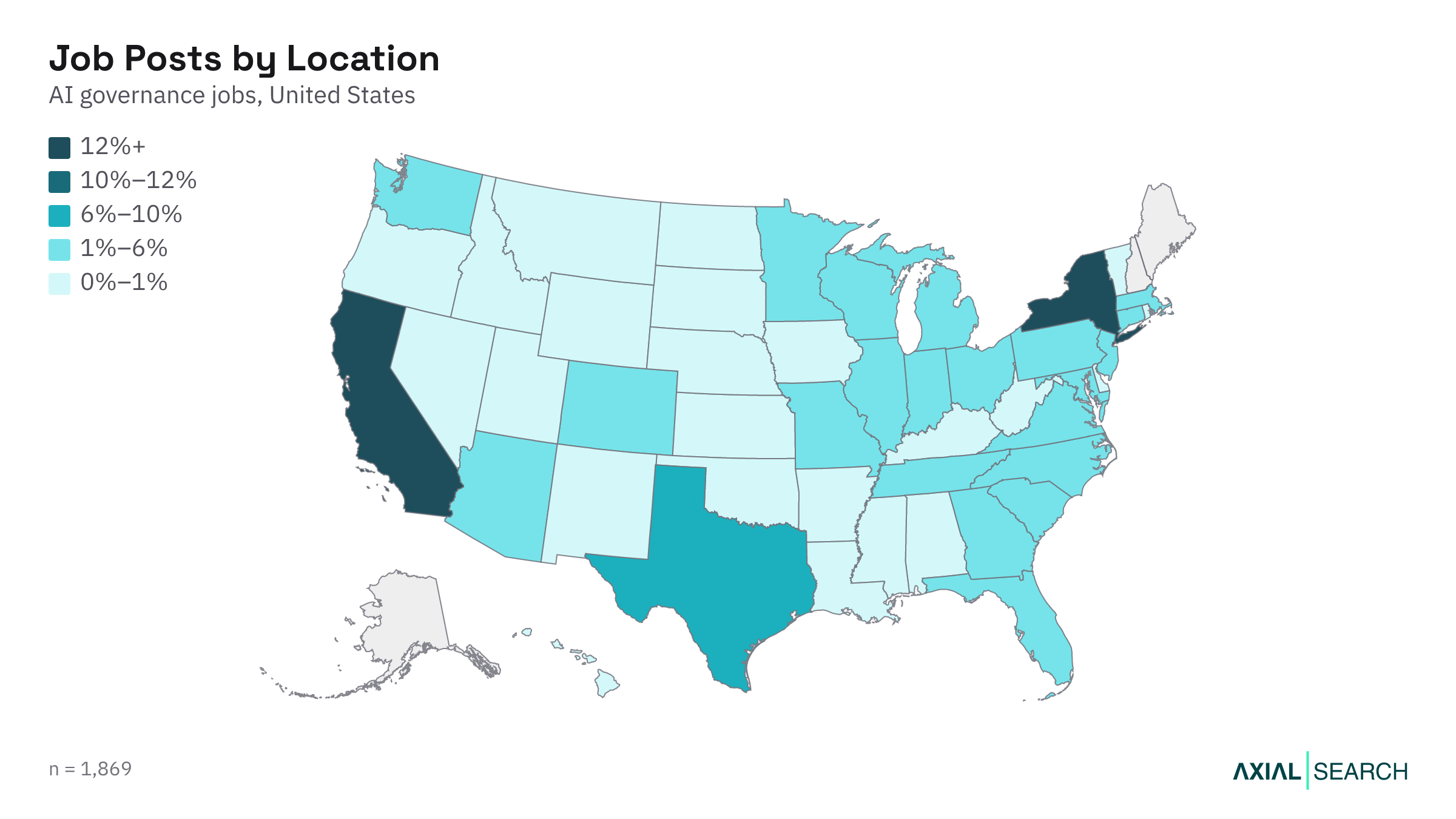
Texas follows with 8.1%, North Carolina at 4.5%, New Jersey 4.2% and Florida 4.0%. Illinois, Washington, Virginia and Georgia each sit between 3% and 4%, and Massachusetts contributes 2.7%.
The distribution is more national than you'd see in pure tech hiring. These roles live where large regulated companies have headquarters, not just where startups are. North Carolina's presence at 4.5% stands out: that's driven by Charlotte's banking sector, which has built out governance and risk functions at scale.
The top cities for AI governance jobs
At the city level the picture is more dispersed than the state view suggests. San Francisco leads at 5.4% of AI governance postings, but Chicago, Charlotte and Dallas all rank highly, and no single city dominates the way New York does for AI strategy.
| City | Share of postings |
|---|---|
| San Francisco, CA | 5.4% |
| Chicago, IL | 3.7% |
| Charlotte, NC | 3.1% |
| Dallas, TX | 3.1% |
| Atlanta, GA | 2.9% |
| Seattle, WA | 2.6% |
| Boston, MA | 2.2% |
| Austin, TX | 1.9% |
For employers hiring through AI executive search, that means the talent pool for AI governance is more nationally distributed than other AI functions, though the work still pays best in the tier-one metros.
How do you assess AI governance candidates?
Assess AI governance candidates on judgment, not just policy knowledge — governance discipline and AI literacy top what employers screen for, and observability tooling shows up in 41.2% of AI governance postings, so start with a real risk they caught, not a framework they can recite.
Ask them to walk through one deployment where they flagged an exposure before it shipped: what they saw, how they escalated it, and what changed as a result. That single question filters more effectively than a stack of framework trivia, because AI governance is a judgment discipline, not a checklist one.
Technical questions to screen AI governance candidates on
Ask the candidate to describe a system they helped govern — what the risk surface looked like, which controls they put in place, and how they verified those controls actually held once the system was live. Follow with specifics on their technical grounding: whether they can read a model card, what observability tooling they've used, and how they'd apply a framework like NIST to an AI-specific workload.
Push past the policy layer. Ask what they'd do if engineering pushed back on a control they proposed — a candidate who can only cite the policy, not negotiate the tradeoff, isn't ready for a cross-functional governance role.
Scenario questions for senior AI governance candidates
For Principal-IC and Director candidates, ask them to design a governance program for a new AI capability end to end: risk assessment, review gates, escalation path and ongoing monitoring. The Principal IC band pays close to Director money, so hold that bar to a genuinely programmatic level, not just a checklist one.
Ask how they'd handle a model that's technically compliant on paper but behaving in a way that feels wrong in production. That question separates candidates who've operated real governance programs from candidates who've only drafted policy.
Red flags to watch for when interviewing AI governance candidates
Watch for candidates who can recite frameworks fluently but go vague the moment you ask how they'd actually stop a launch or push back on an engineering team. That gap is common, and it's the exact gap this market pays a premium to avoid.
Also watch for a background that's all policy and no technical grounding — the leadership profile across the AI governance job market puts governance discipline and AI literacy at the top of what employers screen for, and a candidate who can't read what the system is actually doing hasn't demonstrated the second half of that profile yet.
Final Thoughts
For employers. You're competing for a thin pool of people who can pair policy judgment with real technical grounding. Speed matters, and the seniority mix — over half Senior IC or Manager — means most candidates have options. Interview around real risk decisions, not framework recall, and be ready to move quickly on candidates who can demonstrate both governance discipline and AI literacy. The Principal IC track competes with Director-level pay, so if you're hiring senior technical talent, expect them to negotiate as hard as your management candidates do.
Methodology & sources
- Data sources. Job data is collected from publicly available postings on online job boards and updated weekly, covering US roles posted since January 2026. Explore and filter it on our live AI job market dashboard.
- Hiring demand is the count of matching postings per week.
- Company size, seniority, job type and work setting are each group's share of postings. Work-setting shares are computed over the 38% of postings that state a work model; the rest are silent, not counted as a category.
- Top states and cities are ranked by share of postings; remote-only postings are excluded from the cities list.
- Salary figures cited in this article are drawn from the subset of postings that state a salary range; percentiles and medians are calculated within each seniority band and reported in full in AI governance salaries.
- Interview questions are built from what postings in this dataset ask for, plus Axial Search's own placement experience — they are guidance, not a guarantee of what any single employer should require.

AI Governance Pay in 2026: Salaries, Bonuses and Equity
What AI governance roles pay in 2026: median salary, pay by seniority, top-paying sectors and locations, and how often bonus and equity are mentioned in US job postings.

Breaking Into AI Governance: Skills, Degrees and Certifications
How to become an AI governance professional in 2026: the leadership capabilities employers screen for, the experience and degrees required, the certifications that matter, and the skills most in demand across US…

The State of the AI Governance Job Market in 2026
The complete picture of the AI governance job market in 2026: hiring demand, what these roles pay, where the jobs are, who's hiring and what it takes to get in.
Turn AI ambition into lasting business value
Whether you're hiring your first AI leader or scaling enterprise transformation capability, we help you define, assess and recruit the people who make it stick.