
The Skills That Land Digital Transformation Roles in 2026
How to become a digital transformation leader in 2026: the qualifications, degrees, certifications and skills that 1,781 US job postings actually screen for, the leadership profile employers hire against, and how to position yourself for the role in a competitive market.
 Updated: August 28, 2026
- Judgment leads technical execution: Digital transformation employers prize use case selection and executive sponsorship above hands-on delivery — 34% of roles sit in Professional Services firms where these capabilities decide outcomes.
- Entry bar is mid-career plus breadth: 84% of digital transformation postings require a degree, and the typical ask is five years of experience across strategy, delivery or an adjacent technical function.
- Bridge roles need bridge degrees: Business (45%) and Computer Science (43%) degrees appear at near-equal rates in digital transformation — fluency in both languages is the competitive edge.
- PMP carries real weight: The credential appears in 16% of all digital transformation postings — more than twice the rate of the next-most-common credential, CPA at 6%.
- ERP and Agile lead the skill list: ERP platforms show up in 34% of digital transformation postings and Agile in 34% — enterprise-systems fluency, not any single tool, is what gets screened for.
How do you become a digital transformation leader?
Becoming a digital transformation leader takes roughly five years of experience across strategy, delivery or an adjacent technical function, plus a track record of use cases you picked and got funded. A degree helps — 84% of postings ask for one — but it doesn't replace decision-making experience.
Pull the threads together and a clear playbook emerges.
What to lead with when applying for digital transformation roles
The single strongest thing you can show is a track record of picking the right transformation initiatives, building the business case and winning executive backing — that's what the leadership profile rewards, and it's what separates a strategist from a project manager.
What credentials back up a digital transformation application
Evidence the roughly five years and the degree, and don't be shy about program-leadership experience. If you hold PMP, mention it — it carries real weight here, showing up in 16% of postings.
How to demonstrate enterprise-systems fluency for a digital transformation role
Be able to talk credibly about ERP platforms, cloud architectures and how modern delivery works, without pretending to be an engineer or a pure technologist. Breadth, credibly held, is the goal. That bridge profile is exactly what AI executive search is built to identify.
What makes digital transformation a bridge role
The strongest candidates can hold a conversation with the CTO about technical debt and with the CFO about ROI, and neither conversation sounds like a bluff. If that's you, say so — explicitly, in the interview and on the resume.
What leadership profile do employers screen for in digital transformation roles?
Four capabilities lead what digital transformation employers screen for out of the 13 we track: use case selection, securing sponsorship, operating model design and value framing — judgment and stakeholder work, not technical build.
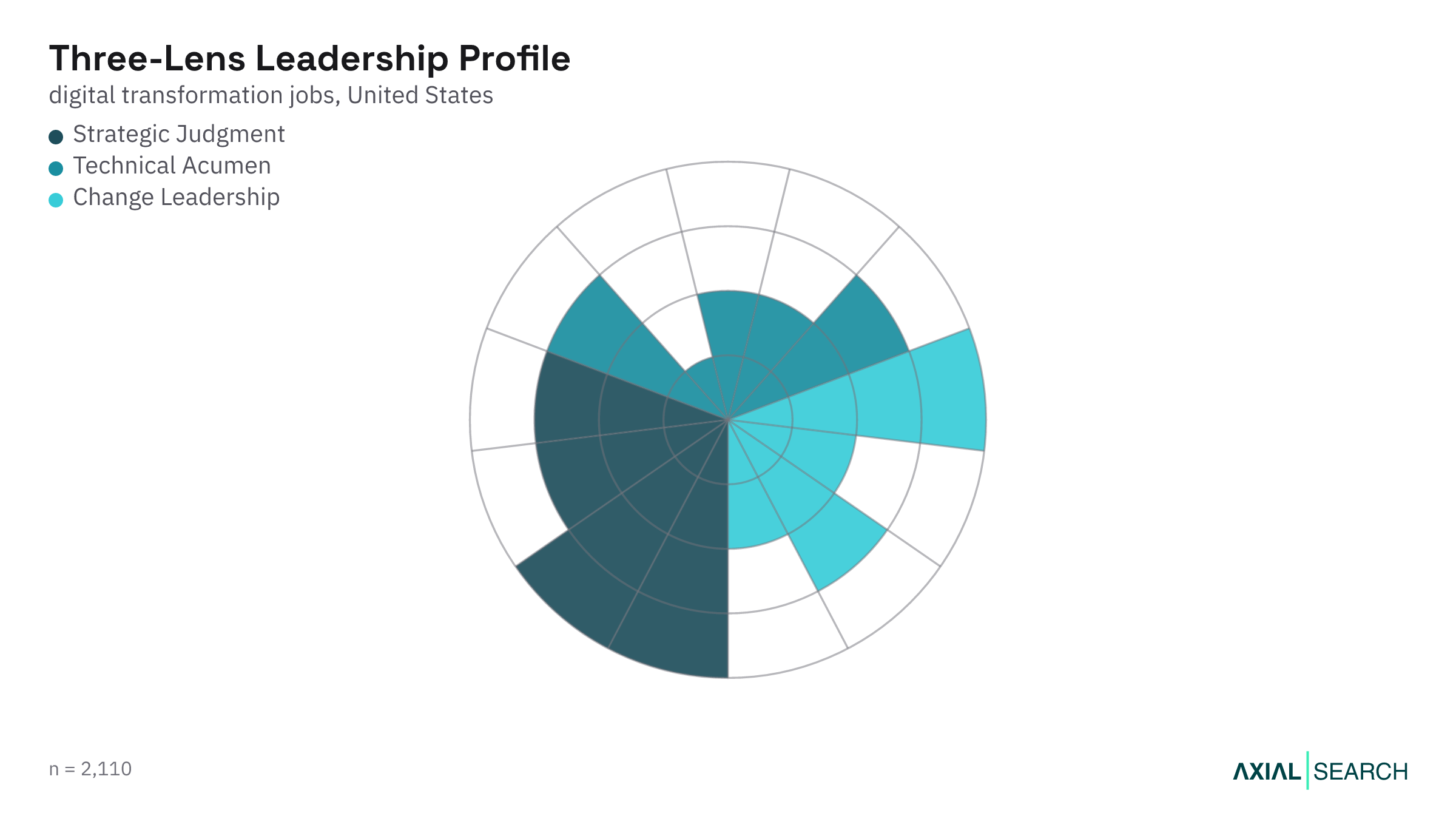
Our Three-Lens Leader framework scores every role across strategic judgment, technical acumen and change leadership, and for digital transformation four of the top capabilities are about judgment and bringing people along. Use case selection leads: choosing the changes worth making. It's backed by securing sponsorship, which ranks higher here than in almost any other function we track, because transformation without sustained executive commitment stalls. Operating model design and value framing round out the top tier — the work of redrawing how the organization operates and proving the case for it. Hands-on execution and resource management sit in the middle of the pack, a reminder that credibility still requires having built something, even if it isn't the top screen.
When you position yourself, lead with transformations you sponsored and saw through, and the operating changes that made them stick. This is exactly the profile that gets rewarded at the top of the ladder.
Which capabilities matter least for digital transformation roles
Architectural fluency ranks lowest of the thirteen capabilities we track, with driving adoption and shaping the narrative also trailing the pack.
Employers want people who can decide what to build and secure the budget for it — not people who can architect the solution themselves or manage the day-to-day rollout. That's a sharp contrast with more technical AI functions, where architectural fluency often tops the list.
What qualifications do digital transformation leaders need?
The baseline is mid-career experience plus a degree. 84% of digital transformation postings require one, and the typical ask is five years — the bar is high but conventional, and the real differentiation lives in the leadership profile above and the skills below.
How much experience digital transformation roles expect
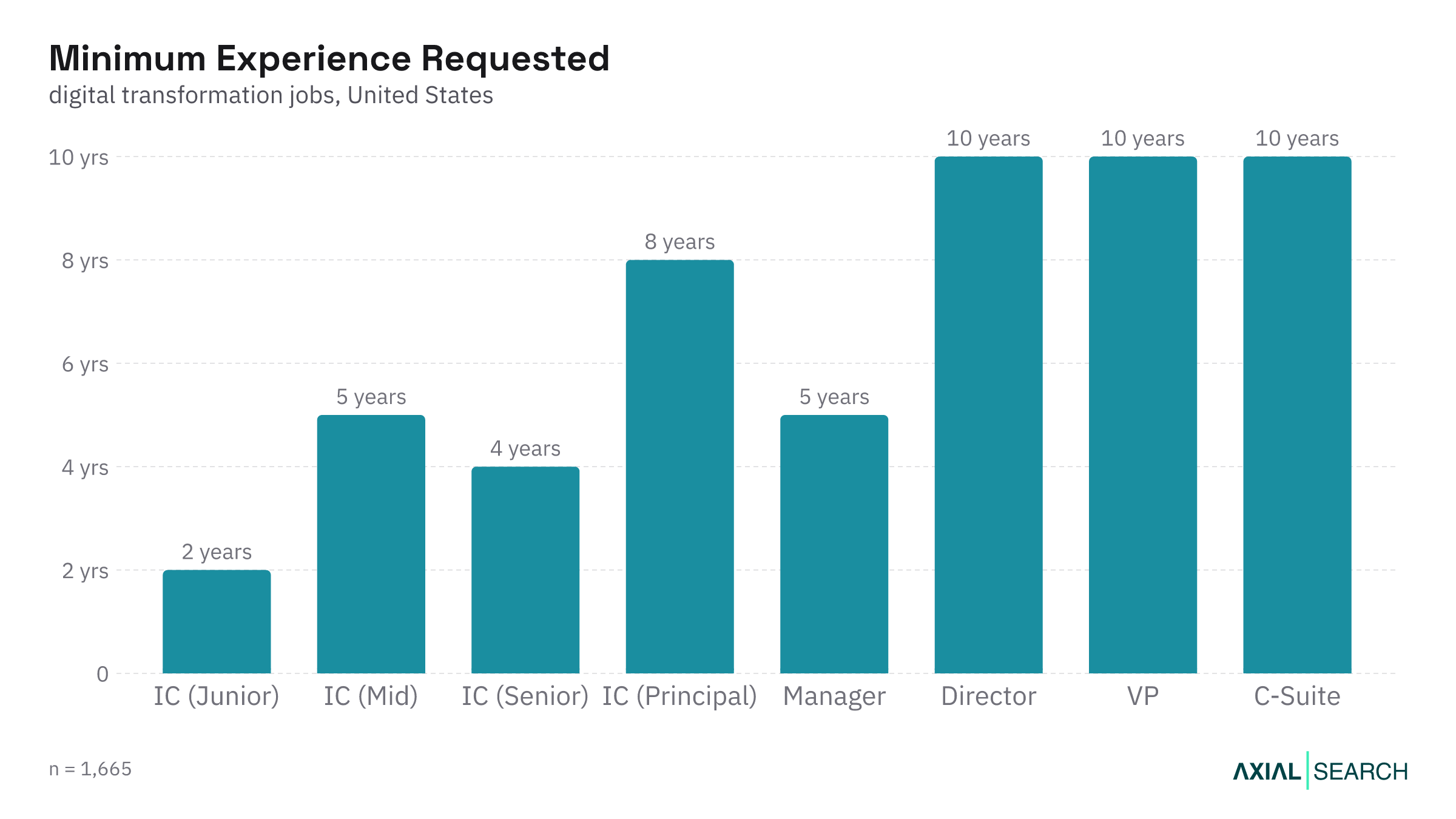
Most digital transformation roles ask for around five years of experience, rising to a decade at Director level and above.
Nearly half the market sits at Manager level or higher, so the realistic entry point is mid-career — you arrive having led strategy, delivery or a technical function somewhere adjacent first. The broader talent pool reflects how long digital transformation has been a recognized function; there are simply more people with the years on the board than in newer, more narrowly-scoped AI strategy careers.
Degrees and fields digital transformation employers want
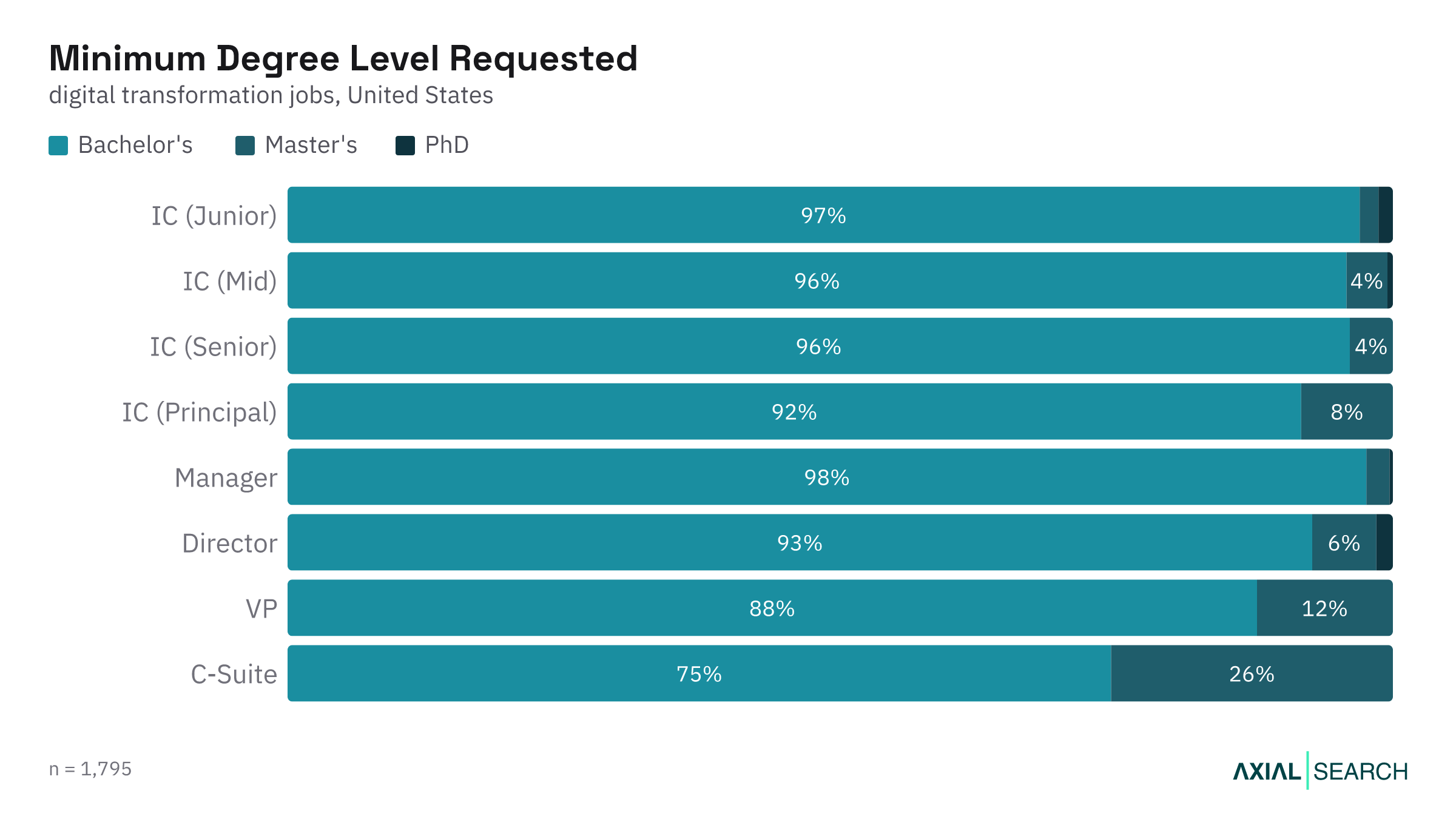
Just over four-fifths of digital transformation postings require a degree, and while a bachelor's clears the bar for most roles, advanced degrees become more common at the top — just over a quarter of C-suite postings ask for a master's.
The field you studied matters, and the split is nearly even:
| Degree field | Share of postings |
|---|---|
| Computer Science | 43.2% |
| Business | 40.5% |
| Engineering | 34.8% |
| Information Systems | 15.3% |
| Business Administration | 10.9% |
| Information Technology | 10.4% |
| Finance | 9.4% |
| Accounting | 8.1% |
Business and Computer Science appear at near-equal rates, with Engineering close behind. The overlap is the function in miniature: digital transformation lives on the bridge between the technology and the business, and both routes in are credible. Information Systems and IT degrees show up too, reflecting the enterprise-systems heritage of the discipline.
Which certifications matter for digital transformation leaders?
PMP is the dominant credential by a wide margin, appearing in 16% of digital transformation postings — more than twice the rate of the next-most-common credential, CPA at 6%.
| Certification | Share of postings |
|---|---|
| Project Management Professional (PMP) | 15.8% |
| Certified Public Accountant (CPA) | 7.3% |
| Program Management Professional (PgMP) | 3.1% |
| Certified ScrumMaster (CSM) | 2.1% |
| Certified Information Systems Security Professional (CISSP) | 1.8% |
| Certified Scrum Product Owner (CSPO) | 1.8% |
| ITIL Certification | 1.7% |
| Professional Scrum Product Owner (PSPO) | 1.6% |
The signal is clear: digital transformation is, in practice, complex program leadership, and employers value the formal training behind it. Everything below PMP is a long tail.
If you hold PMP, mention it. If you don't, weigh the investment against your current positioning — it won't unlock the market on its own, but it carries more real weight here than in most other AI-adjacent functions.
Which security and privacy certifications appear in digital transformation postings
CPA's appearance reflects the number of roles that sit in finance-led transformations, while the security and privacy credentials — CISSP, CISA, CISM and CIPP — cluster at 1–2% each, a reminder that transformation work often touches regulated systems and sensitive data.
None of them individually move the needle much, but together they signal that a security or compliance background is a real, if secondary, path into the function.
Which skills matter for digital transformation roles?
Breadth beats depth in this function — ERP platforms (34%) and Agile (34%) are the two most-mentioned skills in digital transformation postings.
The capabilities digital transformation leaders need
| Capability | Share of postings |
|---|---|
| Agile | 34.0% |
| ERP Platforms | 33.8% |
| Cloud Platforms | 23.0% |
| SQL | 16.9% |
| Observability & Monitoring | 16.9% |
| Software Development Life Cycle (SDLC) | 16.0% |
ERP platforms and Agile lead, a reminder that digital transformation is still an enterprise-systems discipline first. Cloud fluency appears in postings, SQL in another portion — both are table stakes for credible conversations about how modern systems run. Observability and monitoring show up as a key concern, reflecting that transformation leaders need to know how to instrument the systems they deploy, not just ship them.
The takeaway for candidates is to demonstrate delivery literacy and enterprise-systems fluency, not just technical depth in any one platform. For hiring managers, this is the skill profile that separates someone who can lead a transformation from someone who can only configure a system.
Software and tools digital transformation roles use
| Software / tool | Share of postings |
|---|---|
| SAP | 23.2% |
| Microsoft Azure | 19.3% |
| Oracle | 13.2% |
| Automation Anywhere | 11.1% |
| Amazon Web Services (AWS) | 10.8% |
| Atlassian Jira | 7.8% |
SAP leads the list by a wide margin, appearing in 26.1% of postings. Azure and Oracle follow, then Automation Anywhere — a sign that RPA still sits inside the digital transformation remit at many organizations. AWS shows up at 11.1%, and Microsoft Copilot at 8.4%, evidence that AI assistants are now part of the expected toolkit.
Remember that these are the tools postings mention — a platform not listed isn't disqualifying. Treat the list as the vocabulary to be fluent in, not a checklist to complete. The real skill is knowing how these systems fit together and where the integration points break.
What does a digital transformation career path look like?
A digital transformation career path runs from an IC or delivery role through 5 years of experience to Manager, then 10 years or more to Director and above — with a Principal IC track that pays close to Director money for leaders who'd rather keep building than start managing budgets and headcount.
That means the choice at the top isn't purely financial: it comes down to whether you want to keep owning delivery directly or start owning the portfolio of change across an organization, since the data shows both paths pay well once you're senior.
Final Thoughts
For candidates. The digital transformation market rewards breadth over depth — employers are hiring someone who can bridge the technical and the commercial, not a specialist in either. Lead with the transformations you've sponsored and the operating changes that made them stick. Show you can pick the right initiatives, win executive backing, and see them through without needing to build the systems yourself. If you hold PMP and have five years across strategy, delivery or an adjacent function, you clear the baseline; the competitive edge is demonstrating judgment under ambiguity and fluency across ERP platforms, cloud architectures and delivery methodologies. If you focus more on deploying intelligence systems than redesigning operations, AI strategy careers is the closer fit.
For employers. The profile you're screening for — judgment, sponsorship, operating model design — lives at the intersection of strategy and delivery, and it's harder to source than pure technical talent because fewer people have built that bridge credibly. The credentials are table stakes (the degree, the five years, often PMP), but the real filter is whether a candidate can hold a credible conversation with both the CTO and the CFO and make an organization move.
Methodology & sources
- Data sources. Job data is collected from publicly available postings on online job boards and updated weekly, covering US roles posted since January 2026. Explore and filter it on our live AI job market dashboard.
- Requirements are extracted from job descriptions using a combination of programmatic rules and AI analysis. Minimum experience is the median minimum years requested by seniority; minimum degree is the lowest degree a posting requires.
- Top degree fields, certifications and skills are the items mentioned most often across postings.
- These are mention rates — the share of postings that state each item. A skill, degree or certification not appearing means it wasn't stated in the posting, not that it isn't valued.

Digital Transformation Salaries: 1,800 Postings, Benchmarked
What digital transformation leaders earn in the US in 2026: the median salary, how pay scales across eight seniority levels, the highest-paying sectors and states, and how often bonus and equity show up, benchmarked…

Digital Transformation Jobs in 2026: What 1,800 Postings Reveal
Digital transformation's 2026 job market, mapped from 1,781 US postings: what these leadership roles pay, how hot hiring demand runs, whether the work is remote, and what digital transformation leaders actually do —…

How to Think About Digital Transformation Hiring in 2026
What it takes to hire digital transformation leaders in 2026: pay benchmarks, how competitive the market is, where talent concentrates, and how to assess candidates, all drawn from 1,781 US job postings analyzed this…
Turn AI ambition into lasting business value
Whether you're hiring your first AI leader or scaling enterprise transformation capability, we help you define, assess and recruit the people who make it stick.