
How to Think About Digital Transformation Hiring in 2026
What it takes to hire digital transformation leaders in 2026: pay benchmarks, how competitive the market is, where talent concentrates, and how to assess candidates, all drawn from 1,781 US job postings analyzed this quarter.
 June 24, 2026
- A senior-weighted market: digital transformation hiring concentrates well above entry level — the work is less seasonal than most enterprise hiring.
- Enterprise-dominated hiring: 65% of digital transformation postings come from organizations with 10,000+ employees, and Professional Services alone accounts for 36% of all roles.
- Manager-heavy, not Director-gated: Digital transformation roles are modal at Manager (34% of postings), with a full ladder from junior IC (14%) through C-suite (4%) — a wider seniority spread than most leadership tracks.
- Hybrid is the default: Among digital transformation postings that specify work setting, 69% are hybrid and only 17% are fully remote — this work expects you in the office part-time.
- Nationally distributed, not coastal-only: Texas (11%) and California (10%) lead digital transformation hiring by state, but the top ten cities together hold just 27% of postings — the work happens everywhere.
What will you need to pay to hire digital transformation leaders?
Budget a median of $164,000 for a digital transformation hire — the market compresses sharply above Manager, so Director, VP and C-suite budgets don't need to differ by much once you're past that level.
That's the posted band, not the final offer. Bonus (mentioned in 28% of digital transformation postings) sits on top far more often than equity (4%) — this is a base-and-bonus market, not an upside play. For the full breakdown by seniority, sector and location, see digital transformation salaries.
How digital transformation pay changes with seniority
Pay rises through IC and into Manager, then compresses: Director, VP and C-suite medians sit closer together than the title jumps would suggest, and the Principal IC track pays close to Director money.
If you're building a req around a Director title expecting a big step up from Manager pay, the data says the gap is smaller than you'd plan for — budget accordingly and don't over-index on title alone.
Where bonus and equity fit into a digital transformation offer
28% of digital transformation postings mention a bonus and just 4% mention equity, and neither is spread evenly — bonus peaks at Manager (44%) and equity peaks at Director (9%).
If you're competing for a Director-level candidate, an equity component does more work in that conversation than it will anywhere else in the ladder; for a Manager hire, a defined bonus structure matters more. Structuring that offer correctly is exactly where AI executive search earns its keep.
How competitive is the market for digital transformation leaders?
Competitive and senior-weighted — a third of the market sits at Manager level where candidates have options.
Hiring arrives in occasional surges, likely reflecting synchronized cycles at large consulting firms and enterprise clients, but it is the baseline between them that you hire against. That sustained baseline means you're fishing the same pool every Monday — not racing to beat a surge, but competing steadily for a finite number of qualified leaders.
Why competition concentrates at Manager level in digital transformation hiring
34% of digital transformation postings sit at Manager, but the technical-expert Principal IC track — the deep bench most teams eventually want to promote from — is just 1% of postings.
That means you can't grow your own Manager bench quickly from inside; the volume you're competing for is Manager-level hires made from outside the company, not internal promotions from a large IC pool.
Who are you competing with for digital transformation talent?
Two-thirds of digital transformation postings (65%) come from companies with more than 10,000 employees — organizations large enough to be running multi-year transformation programs and staffing them with dedicated roles.
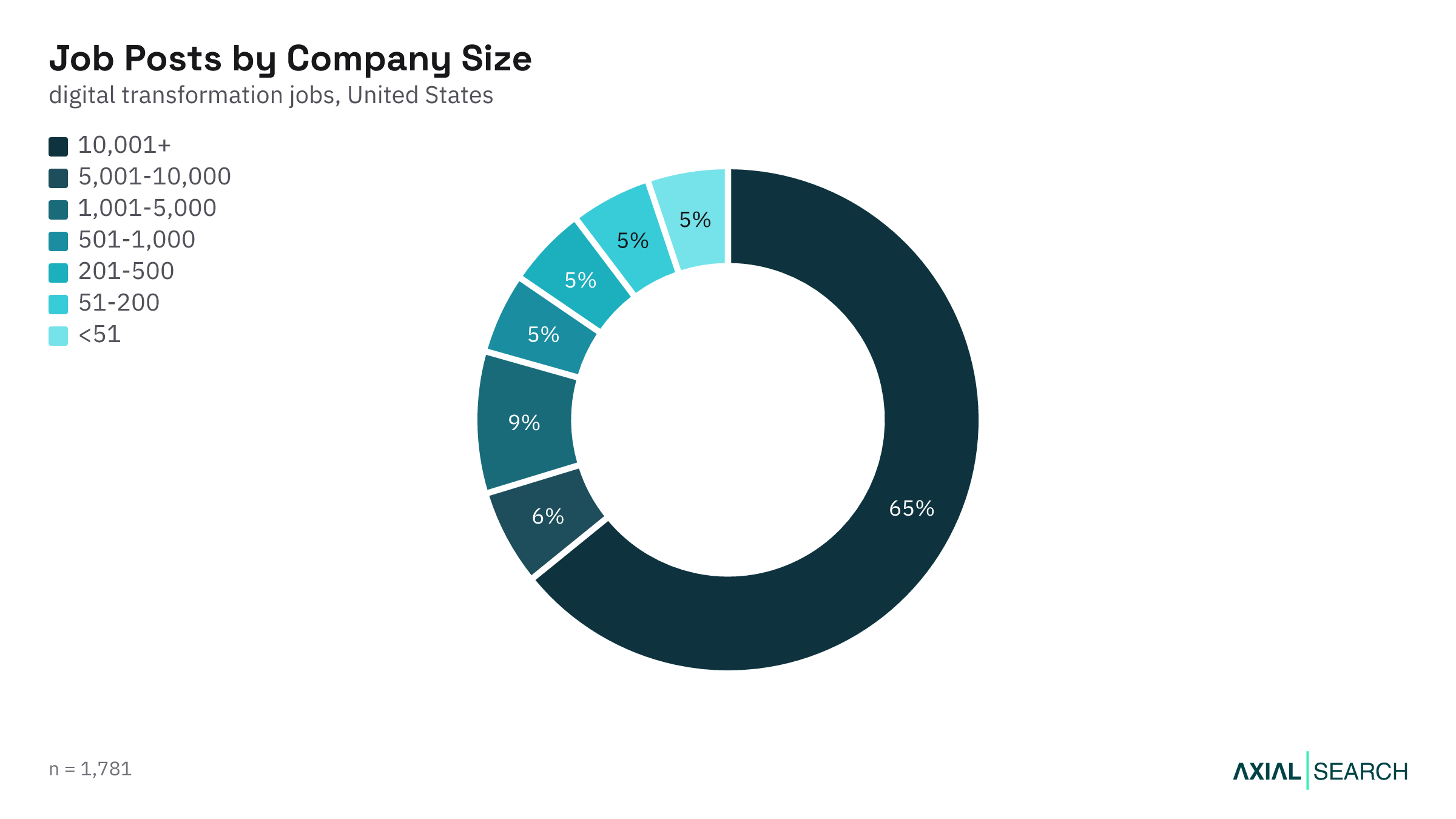
The next tier down, 1,001 to 5,000 employees, accounts for 9%, and the 5,001-to-10,000 band another 6%. Startups under 51 employees post just 5% of roles — this is not a function small teams are building out yet. The sector mix reflects that enterprise weight:
| Sector | Share of postings |
|---|---|
| Professional Services | 36% |
| Financial Services | 18% |
| IT Services | 9% |
| Manufacturing | 7% |
| Technology | 3% |
| Healthcare | 3% |
| Life Sciences | 3% |
| Retail and Hospitality | 2% |
Professional Services dominates — consulting firms and service providers hire transformation talent to deploy at client sites, which explains why more than a third of all postings trace back to that sector. Financial Services and Manufacturing both rank high, showing this work has spread well beyond tech-native companies and into industries with legacy infrastructure to overhaul.
What level of digital transformation hire do you actually need?
34% of digital transformation postings are Manager-level, and the roles lean toward full-time, hybrid work rather than fully remote — the three cuts below describe what a typical opening looks like.
Seniority levels in digital transformation hiring
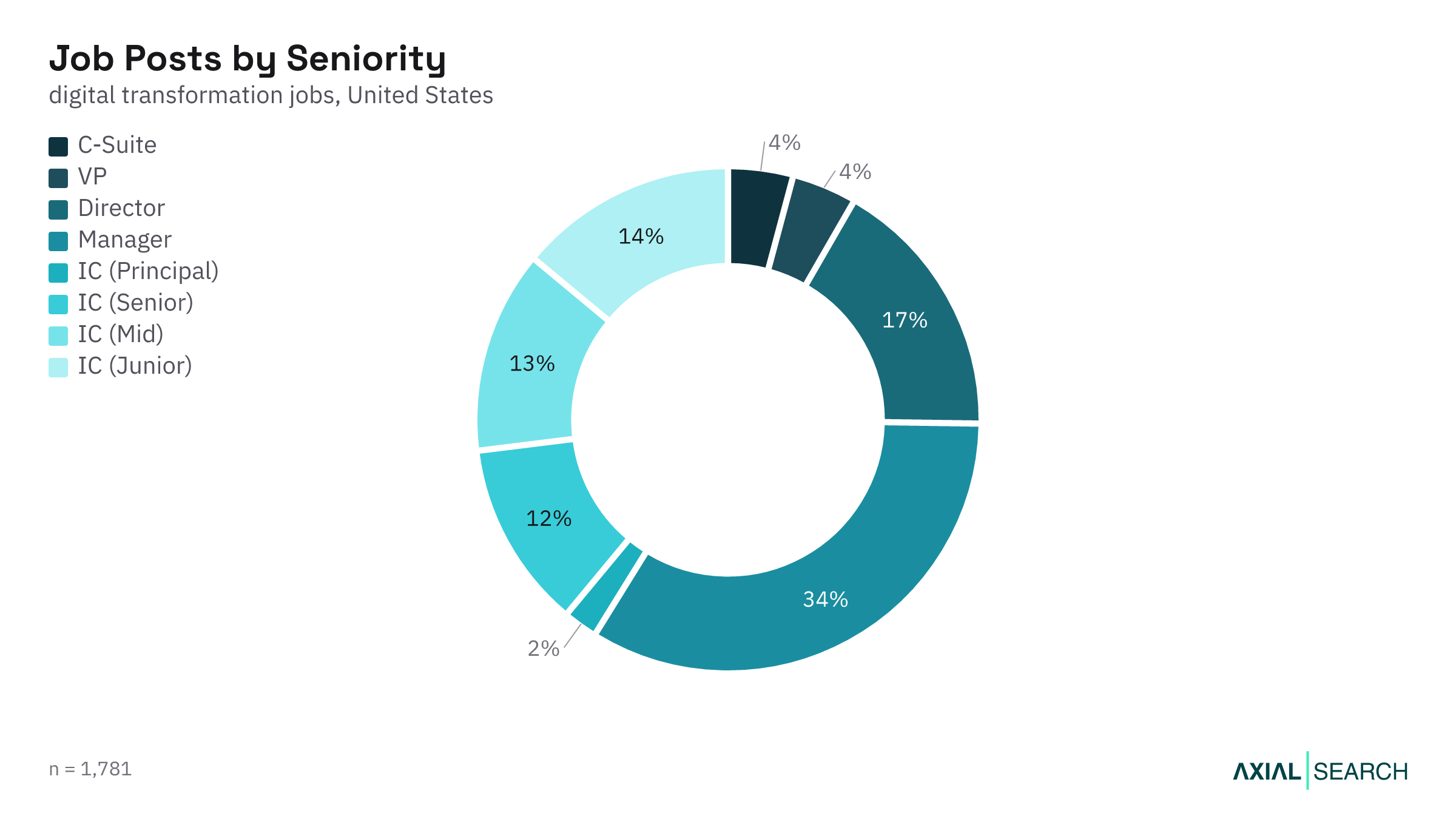
Digital transformation postings skew Manager-level — 34% of all roles sit at that band, with Director adding another 17%.
The distribution then spreads across the IC ladder: 14% are junior ICs, 13% mid-level and 12% senior, while VP and C-suite each make up 4%. Principal IC, the technical-expert track that stays out of management, is just 1%. That's a wider spread than most senior leadership functions, where Director-level dominates — for employers, it means you're hiring teams rather than single senior leaders, and the market supplies enough volume at each band to staff a full program without cherry-picking only Directors.
Full-time versus contract digital transformation roles
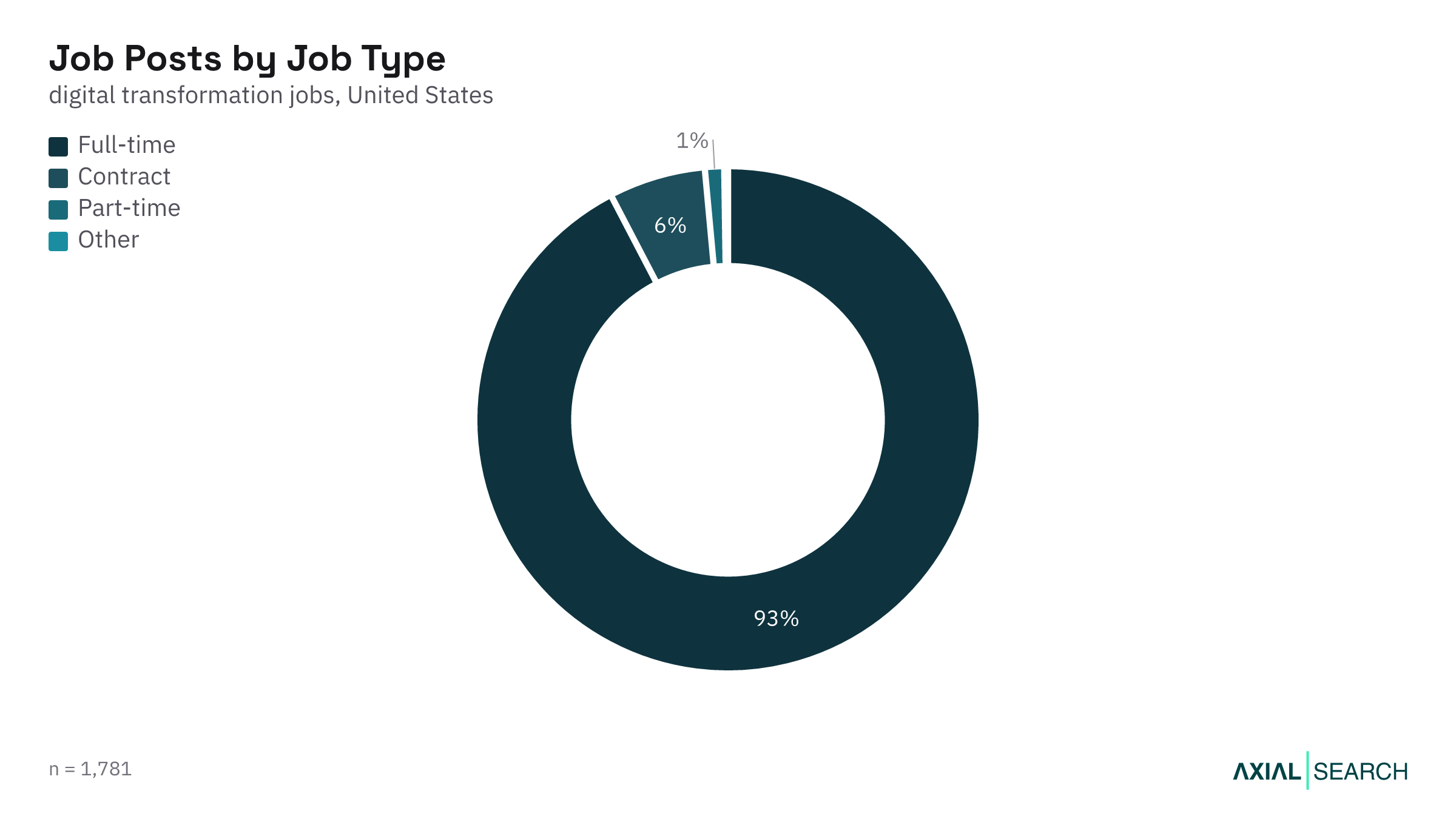
This is a permanent-hire market: 93% of digital transformation postings are full-time, with contract work making up 6% and part-time or other arrangements the remaining 1%.
Companies are building digital transformation as a standing capability, not staffing it with contractors on short engagements — plan your req as a permanent hire from the start.
Remote, hybrid and onsite digital transformation roles
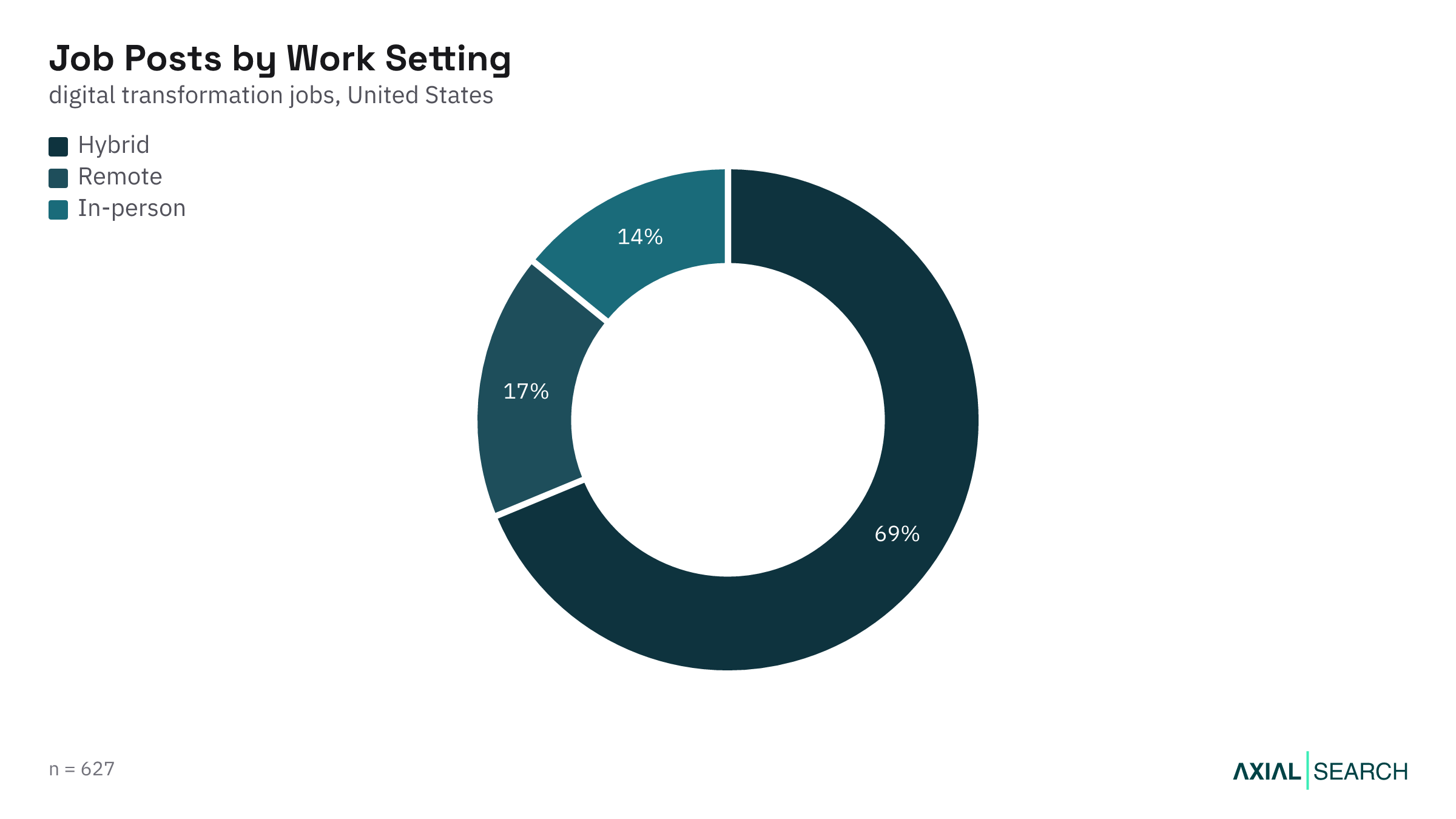
Most digital transformation postings don't state a work model at all, but among the 35% that do, hybrid is the default at 69%, with only 17% fully remote and 14% strictly on-site.
If you're willing to hire hybrid rather than insist on fully on-site, you widen your candidate pool substantially — the market has already normalized part-time-in-office arrangements for this function.
Where is digital transformation talent concentrated?
Digital transformation talent concentrates in Texas (11% of postings), California (10%) and New York (9%) — the top eight states hold just over half the market.
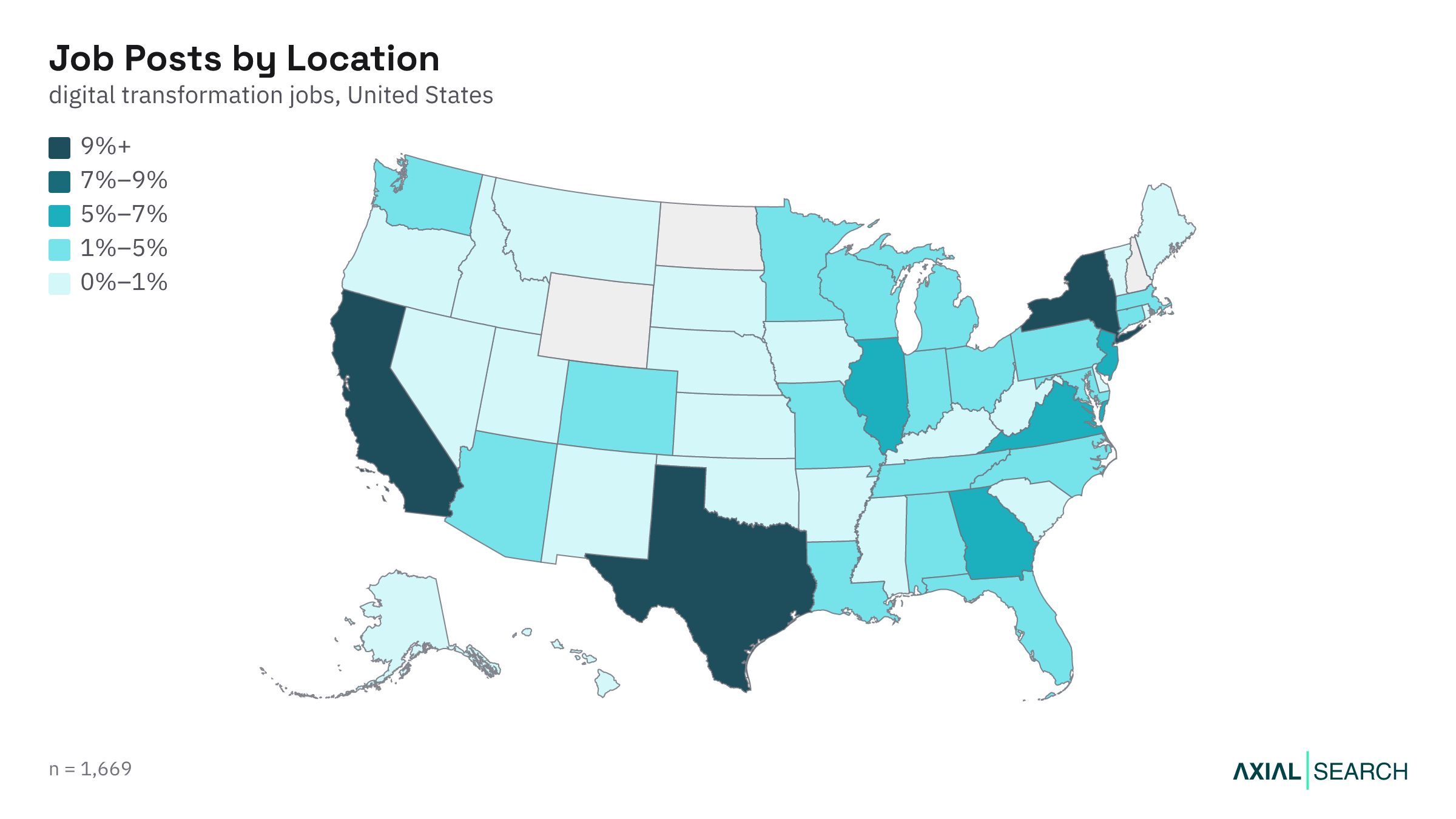
| State | Share of postings |
|---|---|
| Texas | 11% |
| California | 10% |
| New York | 9% |
| Illinois | 5% |
| New Jersey | 5% |
| Georgia | 5% |
| Virginia | 5% |
| Florida | 4% |
The top ten states together account for just over half of postings, leaving the remainder spread across the other forty — hiring happens everywhere, not just in a handful of metros. Because the talent is regionally spread, local presence and regional expertise matter more here than in coastal-concentrated functions.
The top cities for digital transformation jobs
At the city level, Chicago leads with 5.2% of postings, a reflection of its concentration of enterprise headquarters and the consulting firms that serve them. Atlanta follows at 4.1%, Houston at 3.2%, Dallas at 2.9%, Charlotte at 2.2% and San Francisco at 2.1%.
| City | Share of postings |
|---|---|
| Chicago, IL | 5.2% |
| Atlanta, GA | 4.1% |
| Houston, TX | 3.2% |
| Dallas, TX | 2.9% |
| Charlotte, NC | 2.2% |
| San Francisco, CA | 2.1% |
| McLean, VA | 1.6% |
| Boston, MA | 1.6% |
No single city dominates the way coastal hubs do for other functions — the top cities together hold a modest share of postings, so the majority of your competition is scattered across dozens of metros. If you're hiring outside the top markets, candidates who already know your regional market carry a real edge over a relocation hire.
How do you assess digital transformation candidates?
Assess digital transformation candidates on judgment and sponsorship, not technical depth — use case selection and securing sponsorship are the two most-screened capabilities in the 1,781 postings analyzed here, well ahead of hands-on execution.
Ask them to walk through one transformation they picked, funded and saw through, including what they had to give up to get it approved. That single question filters more effectively than a stack of ERP-configuration trivia, because digital transformation is a judgment discipline first.
Questions to screen digital transformation candidates on
Ask the candidate to walk through a real transformation initiative: how they identified it, how they built the business case, and how they secured executive sponsorship to fund it. Follow with specifics on delivery — which ERP platform, how they ran Agile at scale, how they measured adoption after go-live — since ERP platforms (36%) and Agile (33%) are what the market actually screens for.
Push past the pitch. Ask what they had to cut or compromise to get sponsorship, and how they kept the sponsor engaged once the program hit its first real setback.
Questions for senior digital transformation candidates
For Director and above, ask them to design a transformation roadmap end to end: how they'd sequence initiatives, whom they'd need as sponsor, and how they'd measure success beyond go-live. The Principal IC track pays close to Director money, so hold technical candidates for that level to a genuinely architectural bar, not just a delivery one.
Ask how they'd handle a sponsor who loses interest six months into a multi-year program — a scenario every senior digital transformation leader eventually faces. That question separates candidates who've secured sponsorship from candidates who've only maintained it.
Red flags to watch for when interviewing digital transformation candidates
Watch for candidates who can describe a system rollout fluently but go vague the moment you ask who sponsored it and how they kept that sponsor engaged. That gap is common, and it's exactly the gap this market pays a premium to avoid.
Also watch for a resume that's all project management and no measurable outcome — the leadership profile data across digital transformation postings puts use case selection and sponsorship at the top of what employers screen for, and a candidate who's only run the delivery plan hasn't demonstrated it yet.
Final Thoughts
For employers. You're competing for a thin pool of leaders who can pick the right fights and get them funded, not just run a project plan. The seniority mix — a third Manager, another sixth Director — means most candidates you'll see have options. Interview around real transformation decisions, not years of experience or ERP certifications, and be ready to move quickly on candidates who demonstrate use case selection and sponsorship. The Principal IC track competes with Director-level pay, so if you're hiring a senior technical leader, expect them to negotiate as hard as your management candidates do.
Methodology & sources
- Data sources. Job data is collected from publicly available postings on online job boards and updated weekly, covering US roles posted since January 2026. Explore and filter it on our live AI job market dashboard.
- Hiring demand is the count of matching postings per week.
- Company size, seniority, job type and work setting are each group's share of postings. Work-setting shares are computed over the 35% of postings that state a work model — the rest are silent, not counted as a category.
- Top states and cities are ranked by share of postings; remote-only postings are excluded from the cities list.
- Salary figures cited in this article are drawn from the subset of postings that state a salary range; percentiles and medians are calculated within each seniority band and reported in full in digital transformation salaries. Bonus and equity figures reflect the share of postings that mention those forms of compensation.
- Interview questions and assessment guidance are built from what postings in this dataset ask for, plus Axial Search's own placement experience — they are guidance, not a guarantee of what any single employer should require.

Digital Transformation Salaries: 1,800 Postings, Benchmarked
What digital transformation leaders earn in the US in 2026: the median salary, how pay scales across eight seniority levels, the highest-paying sectors and states, and how often bonus and equity show up, benchmarked…

The Skills That Land Digital Transformation Roles in 2026
How to become a digital transformation leader in 2026: the qualifications, degrees, certifications and skills that 1,781 US job postings actually screen for, the leadership profile employers hire against, and how to…

Digital Transformation Jobs in 2026: What 1,800 Postings Reveal
Digital transformation's 2026 job market, mapped from 1,781 US postings: what these leadership roles pay, how hot hiring demand runs, whether the work is remote, and what digital transformation leaders actually do —…
Turn AI ambition into lasting business value
Whether you're hiring your first AI leader or scaling enterprise transformation capability, we help you define, assess and recruit the people who make it stick.